
What is the Samaritan Pentateuch?

Written by Marko Marina, Ph.D.
Author | Historian
Author | Historian | BE Contributor
Verified! See our guidelines
Verified! See our editorial guidelines
Date written: September 28th, 2026
Disclaimer: The views and opinions expressed in this article belong to the author and do not necessarily match my own. - Dr. Bart D. Ehrman
Have you ever heard about Samaritan Pentateuch (often abbreviated as SP)? Most people probably haven’t. In fact, I would guess that most people who have heard of the Samaritans know them almost exclusively from Jesus’ famous parable of the Good Samaritan.
Over the centuries, that story has become such a cultural phenomenon in the Western world that the expression “Good Samaritan” is now commonly used for anyone who selflessly helps a stranger in need.
Yet behind that familiar phrase stands an actual ancient community with a remarkably rich religious, literary, and social history, one that developed alongside, and often in tension with, other communities that traced their heritage back to ancient Israel.
One of the most fascinating witnesses to that history is a text known as the Samaritan Pentateuch.
Although far less familiar to the general public than the Hebrew Bible or the Greek Septuagint, it occupies an important place in the study of the biblical text and its transmission in antiquity. Its very existence raises a series of intriguing questions.
Who exactly were the Samaritans? How did their sacred traditions relate to those of their Jewish neighbors? And what can their version of the Torah tell us about the forms in which the first five books of the Bible circulated in the ancient world?
To answer these questions, we first need to meet the community that preserved this remarkable textual tradition.
Before we delve into the world of the Samaritan Pentateuch, here’s something for anyone interested in how the Bible came to be. Joel Baden's course, "Bible by Committee - How the Pentateuch was Really Written" is an excellent chance to learn about how the Bible was built!
Who Were the Samaritans?
In his book The Samaritans: A Profile, Reinhard Pummer notes:
(Affiliate Disclaimer: We may earn commissions on products you purchase through this page at no additional cost to you. Thank you for supporting our site!)
Many students of the Bible take it for granted that the Old Testament in various books speaks about or refers to the Samaritans, either directly or indirectly. One passage that most often is thought to be a direct reference to Samaritans and to explain their origin is 2 Kings 17:24-41. It is, however, not the only Old Testament passage that is thought to deal with the origin and nature of the Samaritans or to polemicize against them. In particular, Ezra-Nehemiah is adduced by some scholars as evidence for the split and ongoing enmity between the two communities – Jews and Samaritans.


Contemporary scholarship, however, draws a much more complicated picture of the emergence and development of the Samaritan community.
Part of the difficulty is terminological. In ancient sources, an inhabitant of the geographical region of Samaria was not necessarily a “Samaritan” in the later religious sense.
Scholars therefore often distinguish between Samarians (people associated with the region of Samaria) and Samaritans, meaning the Israelite community whose worship eventually became centered on Mount Gerizim rather than Jerusalem.
This distinction matters because many supposed biblical references to the Samaritans may actually concern northerners or inhabitants of Samaria more generally. Indeed, Pummer notes that a number of scholars now conclude that the Hebrew Bible contains no unambiguous reference to the fully developed Samaritan community.
The older reconstruction of Samaritan origins was based largely on 2 Kings 17. According to the biblical account, the Assyrians conquered the northern kingdom in the eighth century B.C.E., deported part of its population, and settled people from other parts of the empire in Samaria.
Later Jewish tradition, especially as developed by Josephus, identified these settlers with the ancestors of the Samaritans and portrayed them as foreigners whose worship of Israel’s God was of doubtful legitimacy.
Yet archaeology and more recent historical research suggest substantial continuity in the population of Samaria. The region wasn’t emptied of Israelites; communities that continued to worship YHWH, the God of Israel, remained there, and by the Persian period, Samaria was prosperous, densely settled, and culturally similar in important respects to Judah.
For this reason, scholars are also increasingly cautious about speaking of a single “Samaritan schism.”
Older accounts often imagined one decisive moment when Jews and Samaritans separated into hostile communities, sometimes locating this rupture in the Persian period and associating it with the events described in Ezra-Nehemiah.
The evidence, however, points instead toward a gradual process of differentiation. Judeans and northern Yahwists shared Israelite traditions, worshiped the same God, and continued to interact, even as disagreements over religious authority and sacred geography became increasingly important.
Ingrid Hjelm, in her book The Samaritans and Early Judaism, notes:
Given the various traditions, it seems now reasonable to conclude that Samaritans and Jews never did form a single state, and that the only historical effort to establish such a state destroyed its basis. The Samaritans, no less than Judaeans, were willing to give up their own traditions as well as their claims to religious and cultural centres. Paralleling proto-MT [Masoretic Text] revisions, which sought to minimize the importance of the Gerizim and Shechem traditions, Samaritans had to argue for the primacy of these traditions...From this, it follows that the language of expulsion and dissidence must be silenced. This is a rationalistic afterthought aiming to predate authority for an established Judaism to a time before the formation of the Hasmonaean state, and to demonstrate that this Judaism, emanating from Jerusalem, was indeed the true Judaism, whose rejecters were schismatic 'from the cradle'.
Whatever one thinks about the relation between Samaritans and Jews in antiquity, the fact is that the central to Samaritan identity was Mount Gerizim near Shechem, which they regarded as the divinely chosen place of worship.
By the Hellenistic and Roman periods, the Gerizim-centered community had developed a clearly recognizable identity, but even then relations with Jews cannot be reduced to uninterrupted hostility.
Thus, the Samaritans are best understood as a community that emerged from the broader religious and ethnic world of ancient Israel and gradually developed its own distinctive traditions.
Now that we have briefly covered the history of the Samaritan people, we can take a closer look at one of the most important surviving witnesses to their religious tradition: the Samaritan Pentateuch.
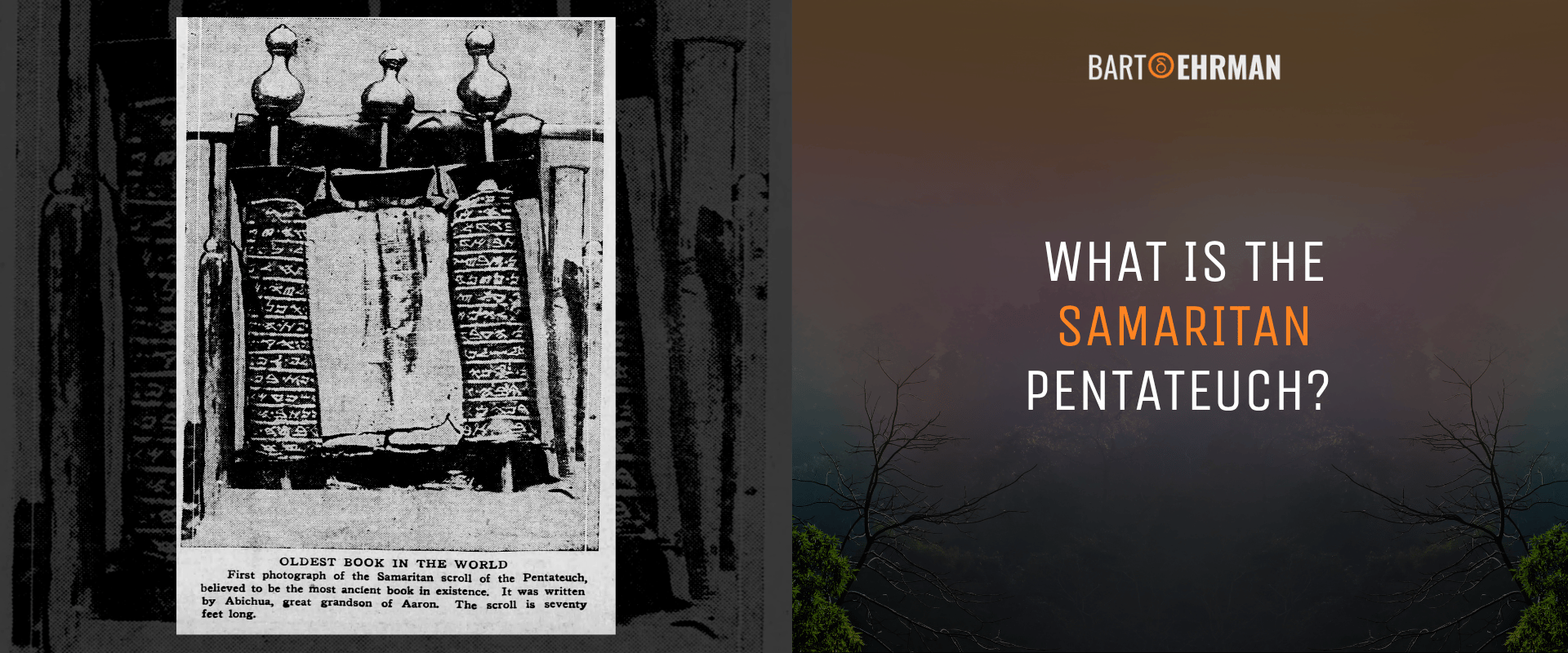
What Is the Samaritan Pentateuch?
In their book The Samaritan Pentateuch: An Introduction, Robert T. Anderson and Terry Giles note:
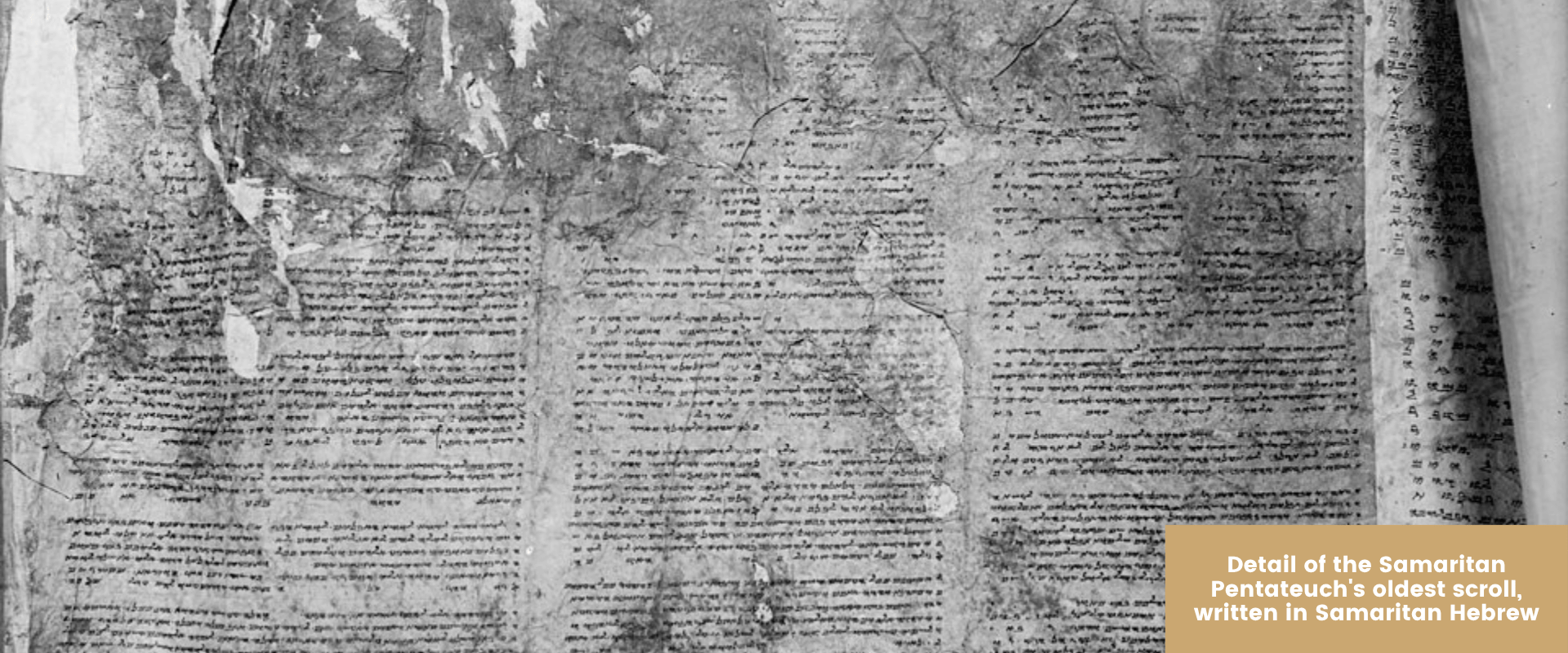
The Samaritan Pentateuch (SP) is the sacred text of the Samaritan community...Throughout its long history, the Samaritan community has always recognized as sacred only the first five books of the Hebrew Bible, the Pentateuch, but in a version quite distinct from the other two better known ancient versions of the Hebrew Bible: the Masoretic Text (MT) and the Septuagint (LXX). The SP shows its distinctiveness most noticeably through a number of scattered readings supporting the Samaritan insistence that worship be conducted on Mount Gerizim, recognized as God’s chosen site instead of Mount Zion in Jerusalem...Like the Samaritan community itself, the SP has experienced all the vagaries of a troubled history. At times respected and fought over by those who sought to own its influence, at times dismissed and forced to wander in exile from its homeland, and at times all but ignored, the SP has persevered as the Samaritans themselves have.
So, in contrast to previous generations of scholars, the Samaritan Pentateuch today is considered a very important witness to the rich and complex literary history of ancient Judaism.
That reassessment owes much to the discovery of the Dead Sea Scrolls.
Earlier scholarship frequently treated the Masoretic Text, the standard Hebrew form of the Jewish Bible preserved by the medieval Masoretes, as the normative form of the text and interpreted the Samaritan Pentateuch largely as a secondary alteration of it.
For more on its history and significance, see our article on the Masoretic Text.
The discovery of the Dead Sea Scrolls, however, complicated this older picture considerably.
Different forms of scriptural books circulated side by side in the Second Temple period, including texts related to the later Masoretic tradition, texts resembling the Hebrew source behind the Septuagint, and manuscripts now commonly described as “pre-Samaritan.”
The latter share important features with the Samaritan Pentateuch but lack its specifically Samaritan theological readings.
This has led scholars to conclude that the form of the Pentateuch eventually adopted by the Samaritans wasn’t created from scratch by them. Instead, it belonged to one of several forms of the Torah circulating more broadly in ancient Judaism.
One characteristic of this pre-Samaritan tradition was a tendency toward harmonization. Scribes sometimes inserted material from one Pentateuchal passage into another to clarify the narrative, reconcile parallel accounts, or make an earlier story correspond more closely with its later retelling. Yet such practices were not uniquely Samaritan.
They belonged to the wider scribal culture of the period. Particularly interesting is what scholars have called the “Moses factor” or “Moses layer.”
Numerous expansions, especially those drawing material from Deuteronomy into Exodus and Numbers, reinforce Moses’ reliability as the mediator of divine revelation.
If Moses recounts an event in Deuteronomy, the earlier narrative is sometimes expanded so that the event appears there as well. The result is a textual tradition in which Moses increasingly becomes the unparalleled source of religious truth and the standard against which subsequent prophecy is measured.
The transition from this older pre-Samaritan tradition to the Samaritan Pentateuch proper appears to have involved a comparatively thin layer of specifically Samaritan editing.
The most conspicuous example is the distinctive Samaritan form of the Decalogue, which includes a command identifying Mount Gerizim as the proper place of worship.
Significantly, this command isn’t composed of wholly new material but is constructed from passages already found elsewhere in the Torah.
Another important change concerns Deuteronomy’s repeated reference to the place God “will choose”: in the Samaritan Pentateuch, God instead “has chosen” the place, supporting the claim that the legitimate sanctuary had already been identified in the Mosaic period.
Once these explicitly Samaritan readings are removed, the underlying text closely resembles the older pre-Samaritan textual tradition known from Qumran.
The Samaritan Pentateuch, therefore, is best understood as the product of a much longer process of textual transmission, interpretation, and communal appropriation.
Its foundations belong to the pluriform scriptural world of the Second Temple period, while its final form reflects the distinctive religious identity of the community that preserved it.
With this historical development in mind, we can now turn to the text itself and examine the principal features that distinguish the Samaritan Pentateuch from the Masoretic Text, the Septuagint, and other ancient witnesses to the Torah.
The Samaritan Pentateuch: Key Textual Features
Referring to the textual features of the Samaritan Pentateuch, Emanuel Tov, in his book Textual Criticism of the Hebrew Bible, notes:
The main ideological change... concerns the central place of worship. In every verse in the Hebrew Bible in which Jerusalem is alluded to as the central place of worship, the Samaritans have inserted in its stead, sometimes by way of allusion, their own center, Mount Gerizim... This change is particularly evident in both versions of the Decalogue in the addition of a tenth commandment referring to the sanctity of Mount Gerizim. The commandment is made up entirely of verses occurring elsewhere in the Torah: Deut 11:29a, Deut 27:2b-3a, Deut 27:4a, Deut 27:5-7, Deut 11:30.
But ideological changes aren’t the only differences one encounters when comparing the Samaritan Pentateuch with the Masoretic Text or the Septuagint. In fact, focusing exclusively on Gerizim would give a misleading impression of the text as a whole.
Most of the differences between the SP and MT have nothing specifically Samaritan about them. They involve spelling, morphology, vocabulary, grammatical regularization, different readings of individual words, and various forms of scribal and exegetical intervention.
Many of those can already be detected in manuscripts from the Judean Desert that predate or stand outside specifically Samaritan textual activity.
Perhaps the most conspicuous of these broader characteristics is the SP’s expansionist and harmonizing tendency.
Parallel passages are sometimes brought into closer agreement, particularly where Deuteronomy retells events narrated earlier in Exodus and Numbers.
Thus, material from Deuteronomy 1 concerning the appointment of judges is incorporated into Exodus 18, while other passages from Deuteronomy are inserted into Numbers.
Elsewhere, a missing “source” for a later quotation is supplied: the promise of a prophet like Moses from Deuteronomy 18 is inserted into the Sinai narrative in Exodus 20, while the contents of Jacob’s dream in Genesis 31 are supplied earlier in Genesis 30.
The Samaritan Pentateuch can also expand the fulfillment of divine commands. Where the MT may simply state that Moses and Aaron did what God commanded, the SP sometimes repeats the command in full as part of the narrative of its execution.
Importantly, these practices are also found in pre-Samaritan Dead Sea Scrolls such as 4QpaleoExodᵐ. They therefore cannot simply be attributed to Samaritan theology.
At the same time, the word “harmonization” needs to be used cautiously.
Hjelm has pointed out that these changes are neither systematic nor always successful in removing inconsistencies.
Some expansions actually leave competing versions of the same event standing beside one another, while in other cases it is difficult to prove which textual form is earlier. This is an important reminder that we shouldn’t automatically imagine a Samaritan scribe sitting down with the MT and deliberately “correcting” it.
The textual situation was considerably more complicated. The Dead Sea Scrolls demonstrate that expansionist forms of the Pentateuch already circulated independently of the Samaritan community, and individual pre-Samaritan manuscripts themselves differ in the number and character of their harmonizations.
Moreover, some SP readings may actually preserve an older or preferable form. Genesis 2:2, for example, says in the SP that God completed creation on the sixth day, thereby agreeing with the Septuagint against the MT’s “seventh day.”
The Septuagint is particularly important here because its agreements with the SP occasionally show that a Samaritan reading wasn’t necessarily created by Samaritans.
Since the LXX is a Greek translation, such agreements can sometimes point back to a Hebrew Vorlage (the Hebrew text from which the Greek translation was made) different from the form preserved in the MT.
One striking example is Exodus 12:40. The MT describes Israel’s 430 years as the period spent in Egypt, whereas the SP includes the patriarchal residence in Canaan within that chronological total; the Septuagint substantially agrees with the Samaritan form.
The same caution applies even to apparently ideological readings. The famous SP reading “Mount Gerizim” rather than MT’s “Mount Ebal” in Deuteronomy 27:4 has support in the Old Latin tradition, leading Tov to suggest that it may represent an ancient nonsectarian reading rather than a Samaritan invention.
Hjelm similarly warns that even the well-known difference between God “will choose” and “has chosen” the place of worship is less straightforward than it is sometimes presented, since the Samaritan textual and literary traditions themselves do not use the two forms with absolute consistency.
None of this means that the SP lacks genuinely Samaritan features. Its clearest ideological tendency remains the elevation of Mount Gerizim as the divinely chosen sanctuary, particularly through its distinctive version of the Decalogue and related readings concerning the place God has chosen.
But the larger textual picture is far more interesting than a simple contrast between a “Jewish Bible” and a “Samaritan Bible.”
The MT, SP, Septuagint, and Dead Sea Scrolls preserve overlapping evidence from an ancient period in which the Pentateuch circulated in several closely related yet genuinely different forms.
The Samaritan Pentateuch is therefore valuable not merely because it tells us what Samaritans believed, but because it allows us to glimpse a stage in the history of the Torah before one textual form became dominant within later Jewish tradition.
Conclusion
In his book What is Scripture? A Comparative Approach, Wilfred C. Smith writes:
The Scripture is a bilateral term. By that we mean that it inherently implies, in fact names, a relationship. It denotes something in a particular relation to something else... No plant is ‘objectively’ a weed: the term designates any plant that grows uncultivated in a situation where it is unwanted by human beings... No one is a king except in relation to a certain society and form of government... Fundamental, we suggest, to a new understanding of Scripture is the recognition that no text is a Scripture in itself and as such. People – a given community – make a text into Scripture, or keep it Scripture: by treating it in a certain way.
The Samaritan Pentateuch offers a particularly illuminating example of Smith’s insight.
It’s not simply an alternative or “deviant” version of a supposedly fixed biblical text, but the Torah as preserved, transmitted, interpreted, and ultimately invested with sacred authority by a particular community.
As we have seen, many of its textual features emerged from the same pluriform world of Second Temple Judaism that also produced the textual traditions reflected in the Masoretic Text, the Septuagint, and the Dead Sea Scrolls, while a comparatively limited number of later readings (above all those emphasizing Mount Gerizim) express specifically Samaritan convictions.
The Samaritan Pentateuch therefore matters because it reminds us that the history of the Bible is inseparable from the history of the communities that copied, interpreted, preserved, and regarded particular forms of its texts as Scripture.