
The Abomination of Desolation in the Bible: Meaning and Verses

Written by Marko Marina, Ph.D.
Author | Historian
Author | Historian | BE Contributor
Verified! See our guidelines
Verified! See our editorial guidelines
Date written: September 28th, 2026
Disclaimer: The views and opinions expressed in this article belong to the author and do not necessarily match my own. - Dr. Bart D. Ehrman
The “abomination of desolation” is one of those biblical phrases that reminds us just how dark some of the stories found in the Bible can be.
Today, especially from a Christian perspective, the Bible is often summarized through the life and teachings of Jesus, with particular emphasis on his commandments of love, mercy, and forgiveness.
But the biblical writings contain much more than that. They are also filled with stories of war, persecution, political violence, religious conflict, and communities trying to understand moments when their world seemed to be falling apart.
Few expressions capture that darker and more unsettling side of the Bible quite as vividly as the “abomination of desolation.”
Even today, the phrase continues to carry an ominous weight. It regularly appears in Christian discussions about prophecy, the end times, the Antichrist, and the future of Jerusalem, where it can sound like a mysterious warning about events still to unfold.
Yet, like many memorable biblical expressions, the “abomination of desolation” has a history. Its meaning developed as later authors and communities reused older biblical language to make sense of new crises.
So what did this strange phrase originally mean, and why did it become important enough for the authors of the New Testament to invoke it centuries later?
To answer those questions, we first need to look at how the “abomination of desolation” is understood today before tracing the expression back through the Gospel of Mark to its much earlier setting in the Book of Daniel.
If you are interested in how ancient Jews and Christians imagined the end of the age (and why those expectations mattered so much for the birth of Christianity) check out Dr. Jason Staples’ course, Visions of the End: How Early Jews and Christians Imagined the End of the Age.
Across 28 lectures, Dr. Staples explores the many ways early Jewish and Christian texts envisioned cosmic renewal, messiahs, resurrection, the restoration of Israel, and the fate of the nations. Rather than treating “apocalypse” as a simple story of destruction, the course shows how these traditions imagined the end of one corrupt age and the beginning of a renewed creation, and how those ancient hopes continue to influence the way we think about the future today.
The “Abomination of Desolation” in Modern Evangelical Christianity
In his book American Apocalypse: A History of Modern Evangelicalism, Matthew A. Sutton writes:
(Affiliate Disclaimer: We may earn commissions on products you purchase through this page at no additional cost to you. Thank you for supporting our site!)
Dispensationalists have never reached total consensus on some of the elements of their theology. They argue, for example, about the number of dispensations and their characteristics. They also debate when the dispensations will unfold in human history. The vast majority of Christians who eventually called themselves fundamentalists joined [John Nelson] Darby in settling on a ‘futurist’ interpretation, believing that prophecies of the last days outlined in Daniel, Ezekiel, Matthew, and Revelation would occur in the ‘seventieth week’ in rapid succession just before Christ’s return. . . . Influenced by dispensationalism, radical evangelicals agreed that at the end of the current age a series of extraordinary events would unfold. Most expected the ‘rapture’ to initiate Daniel’s seventieth week.


While Sutton is primarily focusing here on developments in the 19th and early 20th centuries, his insights help explain the historical and religious context behind modern uses of the phrase “abomination of desolation.”
The system he describes is usually known as dispensational premillennialism, associated especially with the nineteenth-century Anglo-Irish preacher John Nelson Darby and subsequently popularized in the United States.
One of its distinctive features was a futurist reading of biblical prophecy. Daniel’s famous “seventy weeks,” for instance, were understood as a prophetic chronology in which the final, seventieth “week” (a seven-year period) remained to be fulfilled shortly before the return of Jesus.
Within this framework, passages from Daniel, the Gospels, Paul’s letters, and Revelation could be fitted together as different pieces of a larger End-Times timetable.
This way of reading the Bible became increasingly influential in American Evangelical circles through prophecy conferences, books, magazines, and especially the enormously successful Scofield Reference Bible, first published in 1909.
Its explanatory notes introduced generations of readers to a dispensational and premillennial interpretation of biblical prophecy.
Paul S. Boyer, in his book When Time Shall Be No More: Prophecy Belief in Modern American Culture explains:
Scofield's continuing reputation rests on his Reference Bible (1909), which more than any other single work solidified the premillennial movement. Between 1909 and 1967, according to the publisher, Oxford University Press, sales certainly surpassed 5 million copies and may have exceeded 10 million. A 1967 revision sold an additional 2.5 million copies by 1990. For more than eighty years the Scofield Reference Bible has been a major conduit for disseminating premillennial dispensationalism throughout the world. One scholar [James Barr] has called it "perhaps the most important single document in all fundamentalist literature.
Israel also acquired a particularly important place within this prophetic scheme. Darby and later American premillennialists expected the Jewish people to return to Palestine, while figures such as William E. Blackstone regarded developments involving Jews and the land of Israel as signs indicating where humanity stood on the prophetic clock.
In this interpretive tradition, therefore, the “abomination of desolation” became much more than an obscure expression from an ancient Jewish text. It could be understood as a still-future event involving the Antichrist, Jerusalem, a restored Temple, and the period of unprecedented suffering usually called the Great Tribulation.
That interpretation remains very much alive in the 21st century.
The influential American Evangelical pastor and prophecy teacher David Jeremiah, for example, identifies the “abomination of desolation” with an image associated with the Beast that will be erected in Jerusalem.
For Jeremiah, its appearance will signal that the Great Tribulation is about to begin. It’s a reading that brings together Matthew 24, Revelation 13, the Antichrist, and a future crisis centered on Jerusalem.
Nor is this language confined to older prophecy literature. In July 2026, Trinity Broadcasting Network aired an episode of “Israel: The Prophetic Connection” devoted specifically to “the abomination of desolation.”
In this episode, an evangelical minister John Tweedie discussed the possibility of a future Jewish Temple on the Temple Mount within an explicitly end-times framework.
Needless to say, such examples shouldn’t be taken to represent all Evangelicals (Christian interpretations of these texts differ substantially across the denominations) but they demonstrate the continuing influence of the futurist tradition Sutton traces historically.
So, the “abomination of desolation” remains a powerful biblical phrase within some conservative Evangelical movements, where it can function as a signpost for events believed still to lie ahead.
But this modern theological usage raises a more fundamental historical question: Where did the phrase originally come from, and what did it mean in its earliest literary context? Did it signify a specific event that causes desolation? To answer these questions, we have to turn back more than 2,000 years to the Book of Daniel.
The Abomination of Desolation in the Book of Daniel: Meaning and Context
In his book Introduction to the Hebrew Bible, John J. Collins writes:
The setting of Daniel 7-12 also differs from that of chapters 1-6. The tales are set in the Diaspora and generally reflect an acceptance of Gentile rule. The visions, in contrast, are focused on events in Jerusalem and reflect a time of persecution. While no names are mentioned and the allusions are veiled, they point quite clearly to the persecution instigated by the Syrian king Antiochus IV Epiphanes in 168-164 B.C.E., which provoked the Maccabean revolt and which is described in 1 and 2 Maccabees. At that time, Syrian forces occupied the Jerusalem temple and installed a pagan altar on top of the sacrificial altar there. The pagan altar becomes known as ‘the desolating abomination’ or ‘abomination of desolation’ both in Dan 11:31 and in 1 Macc 1:54.
Collins thus reminds us of the historical setting of Daniel 7-12 as material closely connected with events taking place in the second century B.C.E.
Before we can understand what the “abomination of desolation” means in Daniel, therefore, we have to keep in view the circumstances in which these visions took shape: the persecution of Jews under Antiochus IV, the disruption of traditional Jewish worship, and, above all, the desecration of the Jerusalem Temple.
Closely related forms of the expression occur several times in Daniel, most importantly in Daniel 9:27, 11:31, and 12:11.
Daniel 9 places it within the famous prophecy of the “seventy weeks.” The chapter begins with Daniel reflecting on Jeremiah’s prediction that Jerusalem would remain desolate for seventy years.
Did You Know?
Cyril of Jerusalem and a Future 'Abomination'
The “abomination of desolation” became quite an important phrase in early Christian eschatology. Cyril of Jerusalem, writing in the 4th century, believed that its ultimate fulfillment was still in the future. In his Catechetical Lectures, he states explicitly that “the abomination of desolation is yet to come” and connects it with the appearance of the Antichrist, whom he identifies with Paul’s mysterious “man of sin” in 2 Thessalonians.
For Cyril, then, Daniel’s ominous phrase was, among other things, a warning about the dramatic events Christians should expect before the end of the age. This shows just how early Christians were already doing something remarkably similar to many later interpreters: rereading an ancient biblical prophecy as a key to events they believed were still waiting to unfold.
The angel Gabriel then reinterprets those seventy years as seventy “weeks” of years which is a symbolic period of 490 years culminating in a final seven-year period of crisis.
As Raymond Hammer explains in his Commentary, this final “week” begins with the removal and murder of the high priest Onias III in 171 B.C.E.; halfway through it comes the desecration of the Temple, when Antiochus brings sacrifice and offering to an end.
In other words, Daniel 9 doesn’t simply provide an abstract timetable for some indefinitely distant apocalypse. Its chronology is being used to interpret a crisis that the author regarded as reaching its climax in his own age.
Daniel 11 makes the historical referent considerably clearer. In 11:31, forces associated with Antiochus defile the sanctuary, abolish the regular sacrifice, and establish what the Anchor Bible commentary translates as an “appalling abomination.”
Louis E. Hartman and Alexander A. Di Lella connect this with the anti-Jewish measures described in 1 Maccabees and identify the offending cultic installation as an altar and/or image associated with Baal Shamem, the “Lord of Heaven,” identified in Greek religious terminology with Zeus Olympios.
They date its installation to early December 167 B.C.E. Daniel 12:11 once again links the same “abomination” with the abolition of the regular sacrifice, confirming that these passages belong to the same cluster of traditions about the profanation of the sanctuary.
The precise physical form of the object remains debated (an altar, an image, or some combination of the two), but its function in Daniel is much less obscure: it represents an intolerable pagan intrusion into Israel’s holiest sacred space.
Hartman and Di Lella further note:
Although the Seleucids before Antiochus IV venerated Zeus Olympios (his image was inscribed on some of their coins), the historic god of the dynasty was Apollo who was pictured on coins seated upon the Cyprian omphalos. This being the case, it could be said that Zeus Olympios was a god whom Antiochus’ ancestors did not know, in the sense that they did not recognize him to be their chief god; Apollo had that distinction. If this interpretation is correct – most other commentators translate and understand 11:38 quite differently – the inspired author intended a double indictment of Antiochus, first for abominably desecrating the Temple with the altar and/or image of Zeus Olympios, and secondly (here our author is being sarcastic) for setting up the worship of Zeus, the god who was not even acknowledged as principal deity of the Seleucids.
Their observation helps clarify the force of Daniel’s rhetoric. The “abomination” represents first and foremost a cultic profanation: foreign worship has been introduced into the Temple, the regular sacrificial system has been interrupted, and Antiochus’ policies are portrayed as an assault upon the covenant and the sovereignty of Israel’s God.
Seen in this historical setting, then, the “abomination of desolation” originally belonged to Daniel’s attempt to make theological sense of the Antiochene persecution.
The author looks at a concrete political and religious catastrophe and interprets it apocalyptically: Antiochus may appear triumphant, the Temple may be polluted, and faithful Jews may suffer, but this crisis has a divinely appointed limit and will ultimately be overturned by God.
Hartman and Di Lella accordingly describe these visions as a form of Jewish resistance literature intended to reassure those suffering under Antiochus that history remained under divine control.
Yet the phrase didn’t remain confined to that 2nd century B.C.E. setting. Centuries later, early Christians would take Daniel’s evocative language of desecration and apply it to another looming catastrophe centered on Jerusalem and its Temple.
To see how that happened, we now need to turn to the Gospel of Mark.
Don't Miss Bart Ehrman's New Webinar:
"Will You Be Left Behind? A History of The Rapture"
50-minute lecture by critically acclaimed Biblical Scholar & 6 NYT best-selling author, Dr. Bart Ehrman, to be turned into an online course
“Let the Reader Understand”: The Abomination of Desolation in Mark
In his book Introducing the New Testament, Mark A. Powell notes:
The Gospel of Mark probably was the first Gospel written. Most scholars think that it was produced sometime between 65 and 73, around the time of the Jewish war with Rome, and just after the Roman persecutions that took the lives of Peter, Paul, and many other Christians. Perhaps the deaths of those believers prompted the author to put into writing what had formerly been the subject of Christian preaching... Mark tells his story of Jesus with an urgency that surpasses what is found in the other Gospels. Everything seems to happen very quickly: the Greek word for ‘immediately’ (euthys) is used forty-two times in this Gospel, eleven times in the first chapter alone. And the breathless anticipation with which Mark writes has theological implications. The first words of Jesus in this Gospel are ‘The time is fulfilled!’ (1:15), and the story that follows is told in a manner to confirm that claim: the world is rapidly changing and will never be the same again. The events that Mark says have unfolded were of cosmic, ultimate significance, and the events that he says are about to unfold will be more momentous still.
This sense of urgency becomes especially visible toward the end of the Gospel, nowhere more clearly than in Mark 13, where Jesus speaks about war, persecution, the fate of Jerusalem, and the coming culmination of history.
It is in this setting that Mark introduces the “abomination of desolation.”
In Mark 13:14, Jesus tells his hearers that when they see the “abomination of desolation” standing where it should not be, those in Judea should flee to the mountains.
The expression is unmistakably drawn from Daniel, especially Daniel 11:31 and 12:11, with Daniel 9:27 also a background influence.
As Joel Marcus explains in his Commentary on Mark, Daniel originally used this language for the desecration of the Jerusalem Temple under Antiochus IV Epiphanes. Mark, however, reuses that older scriptural language to interpret a new crisis in the 1st century C.E.
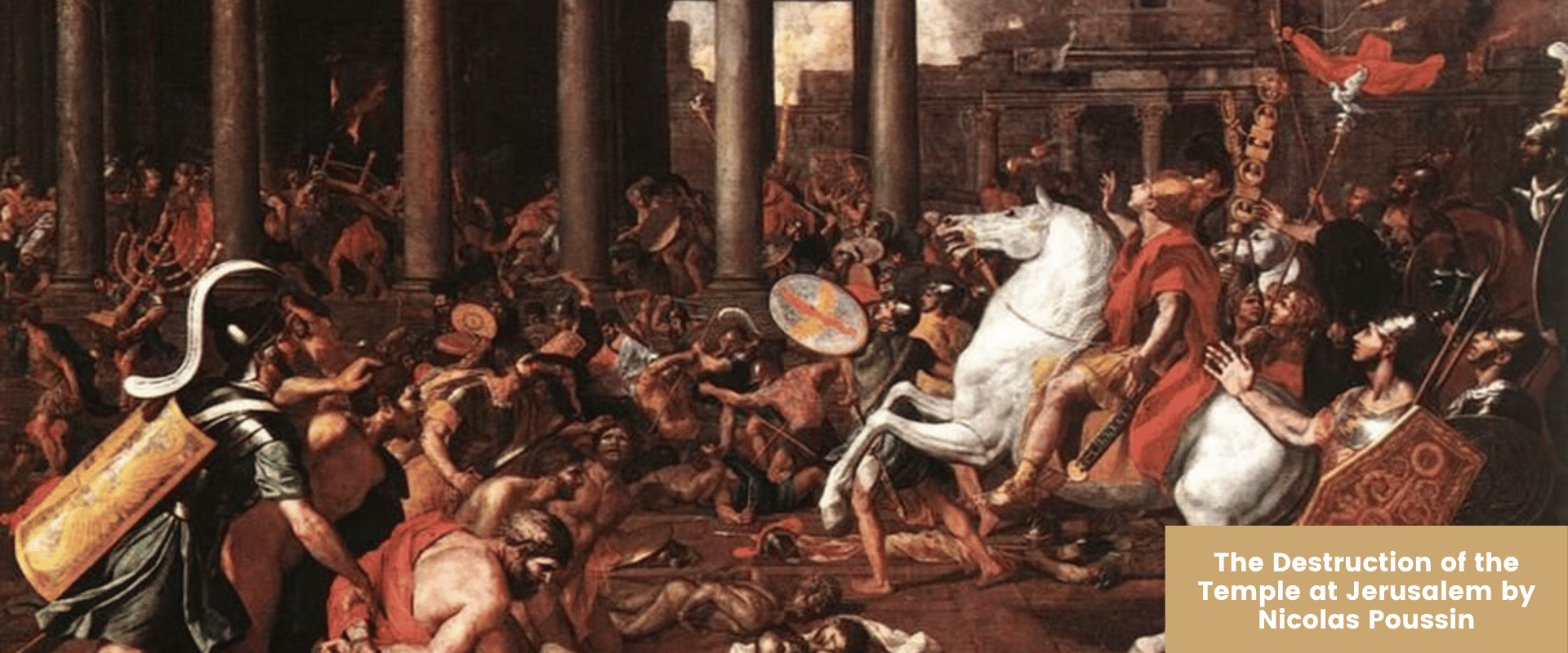
The precise event Mark has in mind remains debated, and this is where the passage requires some caution. Some interpreters have associated the “abomination” with the Roman destruction of the Temple under Titus in 70 C.E.
Marcus, however, notes two difficulties with that identification. First, the Greek participle translated “standing” is masculine even though the noun “abomination” is neuter, which may suggest that Mark is thinking of a person rather than simply an event.
Second, Mark immediately tells people in Judea to flee. If the Temple had already been destroyed and Jerusalem effectively lost, that warning would seem strangely late.
Marcus therefore favors an earlier episode during the Jewish War: the occupation of the Temple by Jewish revolutionaries in 67–68 C.E., together with their seizure of the high priesthood.
Josephus himself describes their conduct in the sanctuary as a desecration, and Marcus suggests that Mark may have viewed a revolutionary leader (or perhaps the unqualified high priest installed by the Zealots) as the concrete embodiment of Daniel’s “abomination.”
That interpretation becomes even more interesting when we consider Mark’s brief aside, “let the reader understand.”
Marcus regards this as probably Mark’s own editorial intervention, a direct signal to his audience that the ancient prophecy needs to be decoded in light of their present circumstances.
In other words, Mark isn’t simply quoting Daniel for decoration. He is inviting his readers to recognize a pattern: just as Antiochus’ desecration of the Temple had marked an earlier period of persecution and crisis, so events unfolding around Jerusalem in Mark’s own generation could be interpreted through the same scriptural lens.
Marcus even suggests that Mark may be reversing a Zealot reading of Daniel. Whereas the revolutionaries could have regarded pagan influence as the true “abomination,” Mark may instead have turned the accusation against the revolutionaries themselves, presenting their violent occupation of the sacred precinct as the desecration Daniel had anticipated.
The broader context of Mark 13 confirms that this isn’t merely a prediction about the Temple but part of a larger apocalyptic interpretation of suffering.
Immediately after the warning about the “abomination,” Jesus speaks of an unprecedented period of tribulation, again echoing Daniel, especially Daniel 12:1.
Marcus argues that Mark adapts this language to address a community living through its own period of fear and upheaval, while simultaneously insisting that the crisis remains under divine control.
The result is a striking example of how biblical prophecy develops through reuse: Daniel had employed the “abomination of desolation” to interpret the persecution under Antiochus IV, and Mark now applied the same image to the turmoil surrounding Jerusalem in the 1st century.
That process of reinterpretation wouldn’t end with Mark; later Christians would continue to read the phrase against still newer historical and eschatological horizons.
Conclusion
The history of the “abomination of desolation” therefore illustrates something fundamental about the way biblical interpretation develops over time.
In Daniel, the phrase emerged from the concrete trauma of Antiochus IV’s persecution and the desecration of the Jerusalem Temple, expressing the conviction that even this apparent triumph of oppression remained subject to God’s ultimate control.
Centuries later, Mark reused the same Danielic language to interpret another period of crisis surrounding Jerusalem during the Jewish War, inviting his readers to recognize their own circumstances through an older scriptural pattern.
Modern Evangelical interpretations continue that long history of reinterpretation by projecting the phrase into a still-future end-times scenario involving the Antichrist, Jerusalem, and the Great Tribulation.
The meaning of the “abomination of desolation,” then, has never been entirely static: to understand it historically, we have to distinguish carefully between what Daniel meant in the second century B.C.E., how Mark adapted that language in the 1st century C.E., and how later Christians have continued to apply it to their own expectations about the future.
Don't Miss Bart Ehrman's New Webinar:
"Will You Be Left Behind? A History of The Rapture"
50-minute lecture by critically acclaimed Biblical Scholar & 6 NYT best-selling author, Dr. Bart Ehrman, to be turned into an online course