
What is Creationism? Meaning, Examples, and History

Written by Marko Marina, Ph.D.
Author | Historian
Author | Historian | BE Contributor
Verified! See our guidelines
Verified! See our editorial guidelines
Date written: September 28th, 2026
Disclaimer: The views and opinions expressed in this article belong to the author and do not necessarily match my own. - Dr. Bart D. Ehrman
Growing up in a predominantly Catholic country, I came across the ideas usually grouped under the broad label of Creationism relatively late in life.
When I first encountered them, they struck me as a rather unfamiliar way of thinking about the Bible and the creation of the world. I can still vividly remember the first time I spoke with someone who, by modern standards, would clearly qualify as a proponent of Creationism.
He was a young student from a Protestant background who sincerely and confidently embraced its central assumptions.
A friend and I tried, with the enthusiasm that often accompanies such conversations when one is younger, to persuade him to see things differently. Yet every argument we offered seemed to run into the same wall of certainty. Eventually, after realizing that none of us was likely to change the other's mind, we simply stopped trying.
Years later, I find myself approaching questions such as biblical infallibility and Creationism from a very different perspective.
Rather than asking which side of the debate is correct from a theological standpoint, I now approach the subject as a historian, interested in how religious ideas emerge, develop, change, and acquire authority within particular communities.
In that sense, I look at Creationism much as I would any other significant current within the history of Christianity: not as something to defend or attack, but as a phenomenon that deserves to be understood on its own terms and placed within its proper historical and intellectual context.
That shift in perspective is particularly useful because Creationism is both familiar and surprisingly difficult to define.
The word itself is frequently used in public discussions, often with the assumption that everyone already knows precisely what it means. Yet, as is so often the case with religious labels, the reality becomes more complicated once we begin looking closely at the people, ideas, and historical circumstances associated with it.
So what exactly do we mean when we speak of Creationism? How did the ideas associated with that term develop, and why have they become so important in certain Christian contexts?
And perhaps most intriguingly for historians of early Christianity, how closely do modern debates about creation resemble the ways ancient Jews and Christians actually approached the opening chapters of Genesis? Those are the questions we will explore in what follows.
But before getting into the world of Creationism, I think it is worth going even further back and asking a more basic question: how did the story of Adam and Eve acquire the meanings we so often take for granted today?
In Shawna Dolansky’s 10-lecture course, Digging Up Eden, you will trace the interpretation of Genesis backward through centuries of Christian thought, peeling away later layers such as original sin, the identification of the serpent with Satan, and the medieval story of Lilith. Along the way, figures such as Paul, Tertullian, Augustine, Aquinas, Luther, and Calvin reveal how each generation reshaped Eden in response to its own theological and cultural concerns.
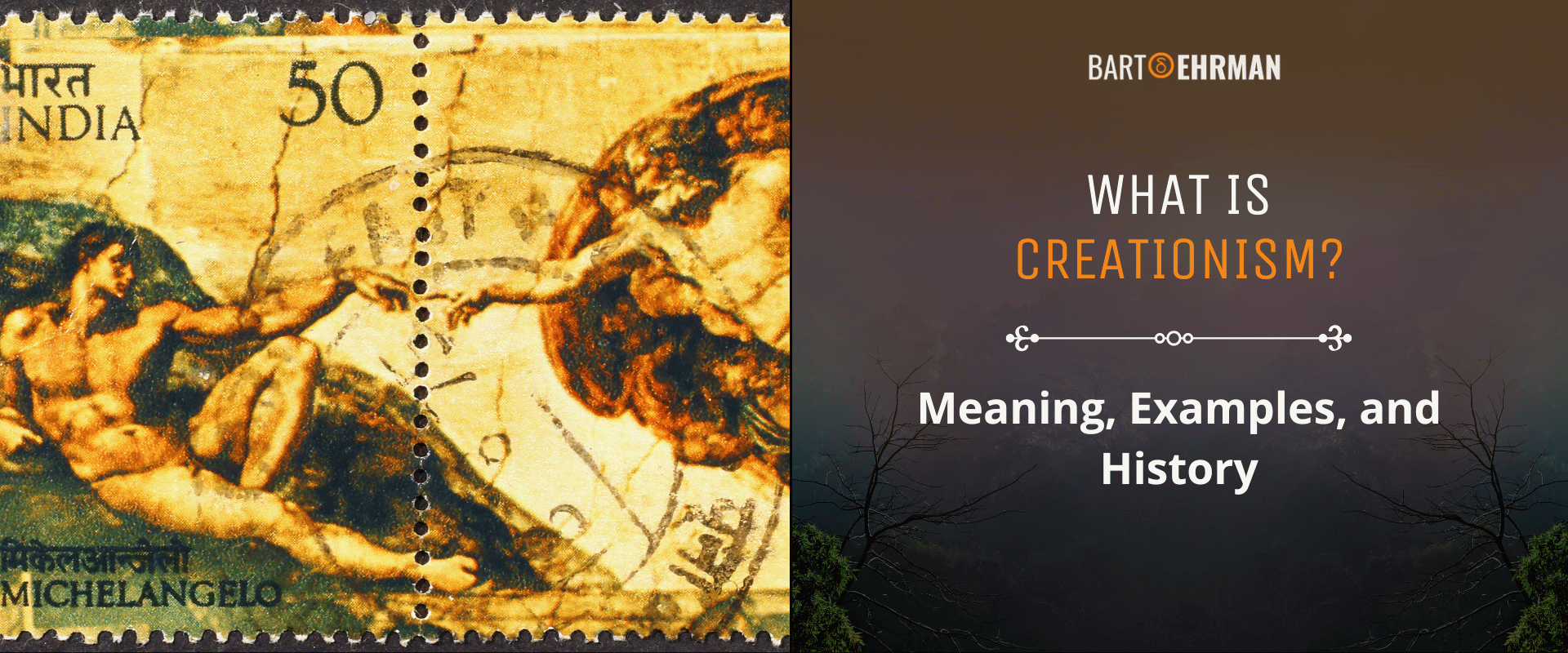
What Is Creationism? Meaning and Major Forms
Section 4(a) of the Arkansas Balanced Treatment for Creation-Science and Evolution-Science Act of 1981, commonly known as Act 590, offered an unusually explicit legal definition of what it called “creation-science”:
Creation-science includes the scientific evidences and related inferences that indicate: (1) Sudden creation of the universe, energy, and life from nothing; (2) The insufficiency of mutation and natural selection in bringing about development of all living kinds from a single organism; (3) Changes only within fixed limits of originally created kinds of plants and animals; (4) Separate ancestry for man and apes; (5) Explanation of the earth's geology by catastrophism, including the occurrence of a worldwide flood; and (6) A relatively recent inception of the earth and living kinds.


The Arkansas statute shouldn’t be taken as an exhaustive definition of every position that has been described as Creationism.
It does, however, capture particularly well the form generally known as creation science, in which the early chapters of Genesis are treated not simply as theological statements about God and creation but as providing a reliable framework for reconstructing the physical history of the universe, Earth, and living organisms.
Within this approach, biblical interpretation and claims about natural history become closely intertwined. As historian of science Ronald L. Numbers explains in The Creationists: The Evolution of Scientific Creationism:
(Affiliate Disclaimer: We may earn commissions on products you purchase through this page at no additional cost to you. Thank you for supporting our site!)
The creation scientists, by contrast, compress the history of life on earth into less than ten thousand years. To accomplish this, they attribute most of the fossil record to the brief period of the flood and its aftermath. They believe that the majority of plants and animals buried sequentially in the stratified rocks once lived together in the antediluvian world; thus these relics do not represent successive populations of flora and fauna spanning millions of years, as evolutionists and most other creationists would assert.
This compression of geological and biological history into a biblical chronology is characteristic of one important form of modern Creationism, but it’s not shared by all creationists.
For that reason, it’s useful to distinguish between two broad families within Creationism: Young-Earth Creationism and Old-Earth Creationism.
Young-Earth Creationism generally maintains that the universe, Earth, and the major forms of life were created only several thousand years ago, commonly within a range of roughly 6,000 to 10,000 years.
Its proponents usually interpret the 6 days of Genesis 1 as ordinary days and regard Noah’s Flood as a real, worldwide catastrophe capable of explaining a substantial portion of the geological and fossil record.
Numbers himself has emphasized that Young-Earth creationists understand much of the geological record through the lens of Noah’s Flood and place the history of life within only several thousand years.
Old-Earth Creationism, by contrast, accepts the great antiquity of the universe and Earth established by modern astronomy and geology while continuing to attribute at least some decisive stages in the origin or development of life to direct divine creative action.
The category itself encompasses several different models, including “day-age” interpretations, in which the days of Genesis are understood as long periods of time, and progressive creationism, according to which God introduced new forms of life at different points across an extended geological history.
These distinctions already show why Creationism cannot be reduced to a single doctrine or a single way of reading Genesis.
But if we had to find a particularly useful definition that would cover all the major streams of this thought, we could use Michael Ruse’s explanation:
Creationism means the taking of the Bible, particularly the early chapters of Genesis, as literally true guides to the history of the universe and to the history of life, including us humans, down here on earth.
Defining principal forms of Creationism is certainly an essential first step, but definitions alone tell us little about why these positions arose or how some of them became influential.
To understand that, we need to turn from the content of Creationism to its historical development and to the circumstances in which modern creationist movements took shape.
A Brief History of Modern Creationism: Darwin, Fundamentalism, and the Evolution Controversy
In their book Enquête sur les créationnismes: Réseaux, stratégies et objectifs politiques (Investigation of Creationisms: Networks, Strategies and Political Objectives), Cyrille Baudouin and Olivier Brosseau note:
“The mention of the word ‘creationism’ immediately evokes the doctrine of the creation of the world in six days as recounted in Genesis. Yet, before the end of the 19th century, there was no question of creationism. The word appeared at the end of the 19th century to designate anti-evolutionist movements born within evangelical churches in the southern United States. These oppositions developed alongside the increasingly widespread acceptance, within the scientific community, of the theory of the evolution of species proposed in 1859 by the naturalist Charles Darwin (1809-1882) in On the Origin of Species, and its diffusion throughout society. In its primary sense, creationists are those who affirm that the account of Creation, as it appears, for example, in Genesis, must be accepted literally: creationism is then described as literalist. Its proponents regard the theory of evolution as a challenge to their beliefs and their conception of the world. Their principal objective is the prohibition of the teaching of the theory of evolution.” (my translation)
Darwin was certainly a crucial starting point, but we should be careful not to conclude that modern Young-Earth Creationism emerged fully developed immediately after On the Origin of Species appeared in 1859.
As Numbers has demonstrated, 19th-century Christian responses to evolution were considerably more diverse than such a picture would suggest.
Within only a few decades, organic evolution had gained widespread acceptance among professional naturalists in North America, while evolutionary ideas were also making substantial inroads among liberal Christians and even among educated evangelicals.
More importantly, many of the Christians who continued to oppose Darwin nevertheless accepted conclusions reached by contemporary geology.
Numbers also emphasizes that comparatively few 19th-century creationist writers defended both a recent creation in six literal days and an explanation of the fossil record based upon Noah’s Flood.
Victorian creationists frequently accommodated the antiquity of the Earth to such an extent that some of them appear closer to later theistic evolutionists than to twentieth-century proponents of creation science.
The boundaries between “creationist” and “evolutionist,” therefore, remained remarkably fluid.
The Presbyterian geographer Arnold Guyot interpreted the days of Genesis as long epochs in cosmic history and allowed natural laws to account for much of the development of the created world, while still maintaining direct divine creation at certain decisive points.
The Canadian geologist John William Dawson similarly accepted an ancient Earth, interpreted the days of creation as extended periods, and even allowed that creation and a limited degree of evolutionary development weren’t necessarily incompatible.
Even among conservative Protestant theologians, opposition to Darwin did not automatically entail belief in a young Earth. Charles Hodge of Princeton Theological Seminary, for example, attacked Darwinism because he believed that it excluded divine purpose from nature, yet he accepted the great antiquity of the Earth and approved interpretations of the Genesis days as geological epochs.
By the final decades of the 19th century, however, the debate was increasingly shifting from questions about the scientific adequacy of evolution toward questions about its compatibility with Scripture and central Christian doctrines, particularly the biblical account of human origins.
It was within this broader climate that opposition to evolution became increasingly visible in conservative American Protestantism during the early twentieth century, culminating symbolically in the famous Scopes “Monkey Trial” of 1925.
Earlier that year, Tennessee had enacted the Butler Act, which prohibited teachers in state-supported schools from teaching that human beings had descended from lower forms of life.
John T. Scopes, a high-school teacher in Dayton, Tennessee, agreed to serve as the defendant in a test case challenging the law.
The resulting trial became a national spectacle, with former presidential candidate William Jennings Bryan assisting the prosecution and celebrated attorney Clarence Darrow leading the defense.
Scopes was convicted and fined $100, although the Tennessee Supreme Court later overturned the conviction on a technicality.
The importance of the trial went far beyond Scopes himself. It turned disagreements over evolution, biblical authority, education, and the place of religion in American public life into a national cultural controversy and became one of the enduring symbols of the confrontation between Protestant fundamentalism and modern evolutionary science.
Yet even the Scopes controversy shouldn’t be mistaken for evidence that present-day Young-Earth Creationism had already become the standard conservative Christian position.
Numbers' survey shows that the combination now associated with modern creation science, a roughly six-thousand-year-old Earth, six ordinary creation days, rejection of the progressive fossil record, and the attribution of much of geology to a worldwide flood, remained comparatively unusual among 19th-century published creationists.
These ideas existed, and figures such as Eleazar and David Lord defended versions of them, but Numbers stresses how marginal such views remained among scientifically and theologically prominent creationist writers of the period.
As the 20th century progressed, however, these previously scattered ideas began to coalesce into a more recognizable movement.
Several developments contributed to this transformation: the growing influence of Protestant biblical literalism and biblical inerrancy, the spread of public education and evolutionary teaching, and the emergence of fundamentalism as an organized response to theological and cultural modernity.
Particularly important was the work of Seventh-day Adventist writer George McCready Price, who defended a recent Creation and a worldwide flood and helped give renewed prominence to flood geology in conservative Protestant circles.
After the Scopes Trial, organized anti-evolutionism temporarily lost momentum, even as evolutionary material became less prominent in many American school textbooks.
The controversy revived dramatically in the late 1950s, when the launch of Sputnik prompted major reforms in American science education, and evolution returned more fully to biology classrooms.
But the decisive turning point came in 1961, with the publication of John C. Whitcomb and Henry M. Morris’ The Genesis Flood: The Biblical Record and Its Scientific Implications.
Drawing in part on earlier Adventist flood geology, Whitcomb and Morris argued that the six days of Creation were ordinary twenty-four-hour days, that the major forms of life had been created directly, and that a worldwide flood could account for much of the geological and fossil record.
Their book helped consolidate the basic framework of what would increasingly be known as creation science and gave modern Young-Earth Creationism a much more systematic and influential form.
So, modern Creationism wasn’t born at a single moment after Darwin. It developed through a longer process in which debates over evolution, biblical authority, human origins, geology, and education gradually produced the more clearly defined creationist movements familiar today.
To understand what those movements now look like, we should turn next to the Christian traditions in which modern Creationism, particularly its Young-Earth form, has found its strongest support and to some of the major figures who have helped shape and popularize it.

Where is Creationism Most Popular?
Christianity today encompasses a vast number of churches, denominations, and theological traditions, and their attitudes toward Young-Earth Creationism vary considerably.
Rather than attempting to survey every branch of Christianity, the following table highlights several of the most influential Christian traditions and some particularly relevant conservative Protestant communities.
The categories necessarily simplify a more complicated reality: an official denominational position doesn’t tell us what every individual member believes, and some traditions permit considerable internal disagreement.
Christian tradition / denomination | General stance toward Young-Earth Creationism (YEC) |
|---|---|
Roman Catholic Church | Does not require or generally endorse YEC. |
Eastern Orthodox Church | No universal Young-Earth position. |
Anglican/Episcopal traditions | Generally not Young-Earth Creationist. |
Mainline Protestant churches (e.g., Methodist) | Generally accepting of an old Earth and often of evolution. |
Conservative Reformed/Presbyterian churches | YEC has substantial support, but conservative Reformed theology does not automatically entail it. |
Lutheran Church - Missouri Synod (LCMS) | Strongly sympathetic to a Young-Earth framework. |
Wisconsin Evangelical Lutheran Synod | Explicitly supportive of the six-day creation. |
Seventh-day Adventist Church | Explicitly Young-Earth Creationist. |
Southern Baptist Convention | Creationism is highly influential, but YEC is not imposed as an official position. |
Assemblies of God (USA) | Strongly creationist and opposed to common ancestry, though not formally committed to a specific age of the Earth. |
Did Ancient Jews and Christians Read Genesis Literally?
In his book Evolution and Creation, Ernan McMullin writes:
There was no Jewish doctrine of creation, no theoretical development of the hints given in the Genesis story. The Hebrews were not speculatively inclined, and, besides, the story of creation was only background for the more important truths of the Pentateuch. It was only when Christianity began to make its way in the Mediterranean world that the Old Testament it inherited came under serious philosophical scrutiny for the first time.
This doesn’t mean, however, that ancient Jewish thinkers showed no interest in the creation story or made no attempt to determine its deeper significance.
Before turning to some representative examples, an important qualification is necessary. Our sources do not allow ancient Jewish and Christian interpreters to be divided neatly into two opposing camps of “literalists” and “allegorists.”
That sharp distinction reflects modern hermeneutical debates more readily than the intellectual world of antiquity, where the same author could treat one element of Genesis historically while simultaneously drawing theological, moral, numerological, or allegorical meanings from it.
The diversity is already apparent within ancient Judaism.
Josephus, writing toward the end of the 1st century C.E., presents Genesis 1 in a comparatively straightforward manner. In his Antiquities of the Jews, he paraphrases the creation week as a sequence of events and treats it as part of the history with which his account of the Jewish people begins.
Yet a very different approach appears in the work of Philo of Alexandria, an older contemporary of the earliest Christians.
Deeply engaged with Hellenistic philosophy, Philo didn’t approach Genesis primarily as a source of chronological information about the physical development of the world. Instead, he searched beneath the narrative surface for metaphysical and ontological truths.
He argued that creation itself was instantaneous and that the six-day sequence represented the rational ordering of created reality rather than six successive periods during which God gradually completed his work.
As Andrew Brown emphasizes in his excellent study The Days of Creation, Philo became one of the most important precedents for later Christian nonliteral interpretations of Genesis, particularly within the Alexandrian tradition.
Early Christian interpretation inherited precisely this variety. Some writers continued to understand the Creation days as a genuine chronological sequence, while at the same time finding additional theological meanings within them.
Others were considerably less interested in the physical chronology of creation. Clement of Alexandria, for example, regarded the sevenfold structure of Genesis as symbolically important and understood Creation itself as instantaneous.
Origen went further. He pointed to the obvious difficulty of speaking about the first, second, and third “days,” complete with evenings and mornings, before the creation of the sun and moon.
For Origen, such features of the narrative indicated that the reader should move beyond a merely surface-level understanding toward a figurative and spiritual interpretation. Yet this is precisely where modern categories can mislead us.
Origen's rejection of a straightforward six-day chronology didn’t make him an ancient advocate of an old Earth in the modern scientific sense. He still believed that the world was less than ten thousand years old.
Nonliteral interpretation of the Genesis days, therefore, didn’t automatically imply anything resembling modern evolutionary theory or contemporary Old-Earth Creationism.
Nor should we imagine that the early Christian tradition moved uniformly toward allegory.
Basil of Caesarea, in his famous Hexaemeron, adopted a considerably more straightforward interpretation of the creation sequence.
Brown understands Basil as accepting an initial instantaneous creation of the basic elements, followed by their organization during six ordinary creation days.
His brother Gregory of Nyssa, however, illustrates once again how difficult it is to force ancient interpretation into a simple literal-versus-allegorical binary.
Gregory didn’t simply reject Basil's account, but he placed greater emphasis on the ontological structure underlying the narrative: the principles of created things could be understood as having been established simultaneously and then unfolding according to an order embedded within Creation.
The same Genesis text could therefore sustain historical, philosophical, theological, and symbolic readings at the same time without ancient interpreters necessarily regarding these approaches as mutually exclusive.
The most influential Western example is Augustine of Hippo. Far from understanding the six days as six ordinary solar days, Augustine argued that God created all things together and that the temporal sequence of Genesis represented an ordering of Creation rather than six successive periods of divine activity.
McMullin notes that Augustine explicitly rejected the idea that these should be understood as ordinary solar days and instead developed his doctrine of rationes seminales, or “seed-principles,” according to which the potentialities of later creatures were present within the original Creation and could unfold over time.
Needless to say, Augustine wasn’t proposing biological evolution, and he didn’t teach that one species gradually transformed into another. His concern was theological and exegetical rather than scientific.
Nevertheless, his enormous influence on medieval Christianity is enough to show why claims that Christians traditionally possessed a single, uniformly literal interpretation of Genesis are historically difficult to sustain.
As Brown states, while citing Frank Robbins’ book The Hexaemeral Literature: A Study of the Greek and Latin Commentaries on Genesis:
Augustine was 'the chief authority of the medieval Latin writers on creation,' and his treatment of the sequence of creation days was the most influential one to emerge from the patristic era... Augustine was a prime influence on Eriugena, Anselm, Bonaventure and Thomas Aquinas regarding exegesis of the creation week as in theology generally. He remains the chief ancient authority cited, although not always with agreement, in the Genesis commentaries of Luther and Calvin.
Ancient Jews and Christians therefore believed that God was the Creator, but how the opening chapters of Genesis should be interpreted was already a matter of substantial diversity long before Darwin, modern geology, or contemporary Creationism entered the discussion.

Conclusion
Who knows where that young friend who once defended Creationism so confidently is today? I haven’t seen him in years, though I somehow doubt that he abandoned Young-Earth Creationism and quietly embraced evolutionary theory.
Yet looking back, the more interesting question is no longer whether one side could have persuaded the other, but how such convictions emerged and why they came to carry such weight.
As we have seen, modern Creationism isn’t simply an unbroken continuation of an ancient Christian reading of Genesis. It developed historically, especially in response to modern evolutionary theory, debates over biblical authority, education, and the changing place of Christianity within modern society.
At the same time, neither Judaism nor early Christianity possessed a single uniform interpretation of the Genesis creation narratives: Josephus, Philo, Origen, Basil, Gregory of Nyssa, Augustine, and others approached the text in strikingly different ways, often combining historical, theological, philosophical, and allegorical readings.
The history of Creationism therefore reminds us of a broader lesson that historians encounter repeatedly: religious ideas may present themselves as timeless, but the forms they assume, the questions they answer, and the boundaries they defend are always shaped by particular historical circumstances.
Understanding Creationism historically doesn’t require either defending or dismissing it. It requires recognizing both its modern distinctiveness and the much older, far more diverse history of thinking about what it means to say that God created the world.