
Joseph and the Coat of Many Colors: Bible Story Summary and Key Themes

Written by Joshua Schachterle, Ph.D
Author | Professor | Scholar
Author | Professor | BE Contributor
Verified! See our editorial guidelines
Verified! See our guidelines
Date written: January 10th, 2026
Disclaimer: The views and opinions expressed in this article belong to the author and do not necessarily match my own. - Dr. Bart D. Ehrman
The story of Joseph and the coat of many colors in Genesis 37 has long occupied a central place in Jewish and Christian interpretation, functioning simultaneously as family drama, theological reflection, and cultural memory.
In this article, I’ll consider the Joseph narrative with attention to both its literary features and its interpretive history. Approaching the story of Joseph through literary analysis, translation studies, and historical criticism, I’ll show why this ancient narrative continues to resonate. The enduring power of the Joseph story lies not in the precise material or color of a robe, but in the ways the narrative addresses themes of suffering, identity, and redemption—themes that have invited interpretation and reinterpretation across centuries of Jewish and Christian thought.
By the way, if you’re interested in learning more about biblical stories and traditions, check out Bart Ehrman’s course on the Hebrew Bible featuring scholar Dr. Joel Baden.

Joseph and the Coat of Many Colors Summary
The story of Joseph in Genesis begins with his father Jacob, who is also called Israel. Jacob — along with Esau — is one of the sons of Isaac, who was the son of Abraham. In other words, Jacob is of the lineage of the Jewish patriarchs. He eventually has 12 sons and one daughter by four women: Leah, Rachel, Bilhah, and Zilpah.
In order of their birth, Jacob’s first 11 sons are named Reuben, Simeon, Levi, Judah, Dan, Naphtali, Gad, Asher, Issachar, Zebulun, and Joseph. There is also a daughter named Dinah and a 12th son named Benjamin, who will be born later. Jacob’s twelve sons will, in turn, be known as the founders of the Twelve Tribes of Israel, each tribe named after one son. The tribe of Joseph, however, is split between what the Hebrew Bible calls two “half tribes” named Ephraim and Manasseh, after Joseph’s sons.
At the beginning of Joseph’s amazing story in Genesis 37:2-4 (NRSV), he is still the youngest son of Jacob and just a teenager.
Joseph, being seventeen years old, was shepherding the flock with his brothers; he was a helper to the sons of Bilhah and Zilpah, his father’s wives, and Joseph brought a bad report of them to their father. Now Israel loved Joseph more than any other of his children because he was the son of his old age, and he made him an ornamented robe. But when his brothers saw that their father loved him more than all his brothers, they hated him and could not speak peaceably to him.


While it is only subtly referred to in this passage, Joseph is, at this point, the only son of Jacob’s favorite wife Rachel. This situation inevitably creates conflict between Joseph and his half-brothers. Jacob/Israel clearly exacerbates the problem by openly favoring Joseph, as shown by the special garment he gives him (more on that later).
Later, in Genesis 37:5-11, Joseph has two prophetic dreams that perhaps he shouldn’t have shared with his brothers or his father:
Once Joseph had a dream, and when he told it to his brothers, they hated him even more. He said to them, “Listen to this dream that I dreamed. There we were, binding sheaves in the field. Suddenly my sheaf rose and stood upright; then your sheaves gathered around it and bowed down to my sheaf.” His brothers said to him, “Are you indeed to reign over us? Are you indeed to have dominion over us?” So they hated him even more because of his dreams and his words.
He had another dream and told it to his brothers, saying, “Look, I have had another dream: the sun, the moon, and eleven stars were bowing down to me.” But when he told it to his father and to his brothers, his father rebuked him and said to him, “What kind of dream is this that you have had? Shall we indeed come, I and your mother and your brothers, and bow to the ground before you?” So his brothers were jealous of him, but his father kept the matter in mind.
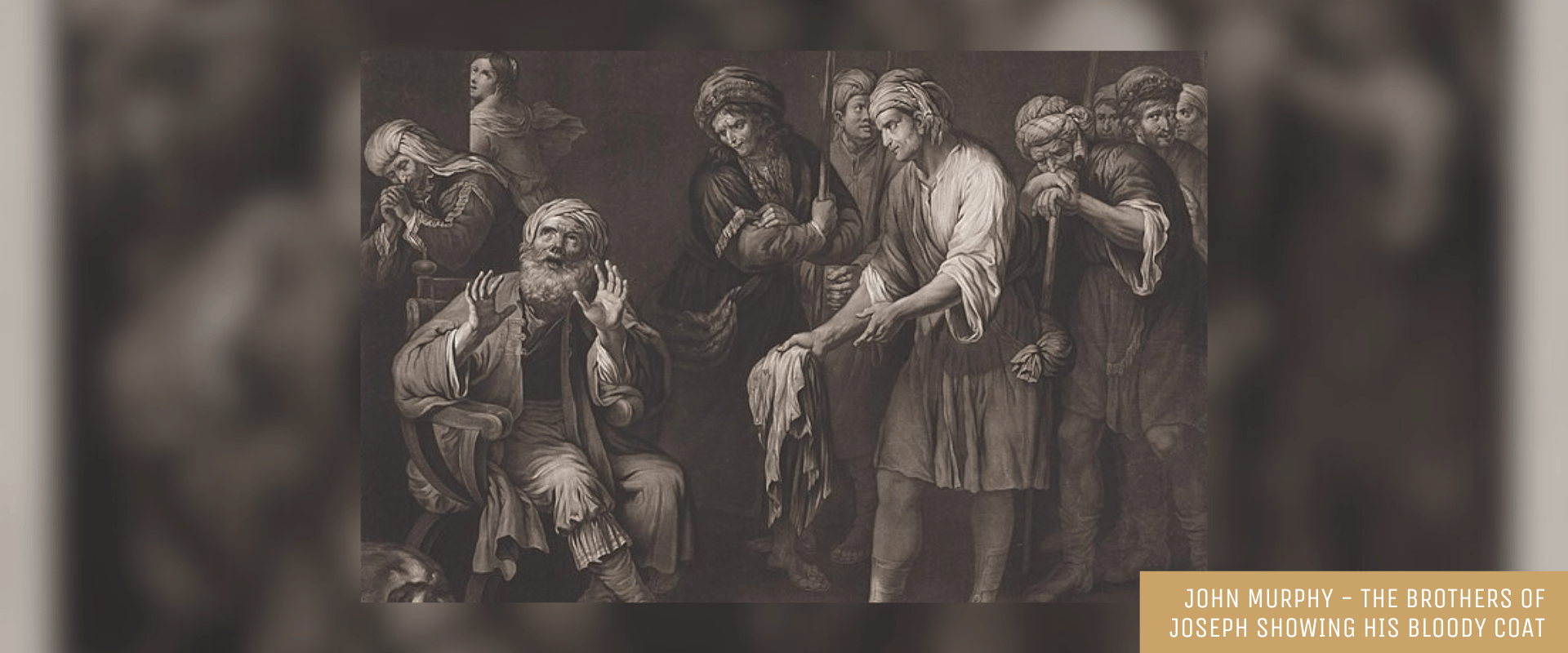
The implication of both these dreams — that Joseph was far superior to his brothers and even to his parents — causes his brothers to jealously assault him, stripping him of the fancy robe given to him by his father, and selling him into slavery. In other words, it’s not really the robe itself that makes Joseph’s brothers hate him. It’s the favoritism shown to him by Jacob that the robe symbolizes — although Joseph’s own confidence in his superiority, as illustrated in the dreams, doesn’t help either. Nevertheless, Joseph’s brothers show the robe to Jacob after having it covered in animal blood, as evidence that Joseph has been killed. Speaking of that robe, let’s get back to the passage in Genesis 37:2-4.
I’m sure by now you’re wondering about the way the robe is described by the NRSV translation. Isn’t it supposed to be a “coat of many colors?” Why does the NRSV call it an “ornamented robe” instead? To answer that question, we need to look into the original Hebrew words of the story and issues of translation.
Joseph and the Coat of Many Colors Translation
We all know that the Hebrew Bible was written almost entirely in the Hebrew language (with a few passages written in Aramaic as well). The NRSV, while calling Joseph’s garment an “ornamented robe,” provides a footnote that the “meaning of the Hebrew is uncertain.” However, in the HarperCollins Study Bible, Ronald Hendel notes that the same Hebrew phrase is used in 2 Samuel 13:18 to describe a royal robe that princesses wear.
(Affiliate Disclaimer: We may earn commissions on products you purchase through this page at no additional cost to you. Thank you for supporting our site!)
The Hebrew words used to describe Joseph’s robe/coat are ketonet passim. The first word, ketonet, has variously been translated as either tunic, robe, or coat. However, it’s the second word, passim, that proves to be a problem for translators who continue to debate its meaning in the Joseph story.
In The JPS Torah Commentary: Genesis, Nahum Sarna wrote that medieval scholar Rabbi David Kimhi thought that passim meant “striped.” Sarna also comments that “in Aramaic and rabbinic Hebrew pas means the palm of the hand and the sole of the foot.” This led 1st-century Jewish historian Josephus to write in the Antiquities of the Jews that the garment was "a long-sleeved tunic reaching to the ankle."
Sarna goes on to note all the different ways the word passim has been translated by different Jewish scholars over the years:
The word passim can be translated as… embroidered (Ibn Ezra; Bachya; Ramban on Exodus 28:2), striped (Ibn Janach; Radak, Sherashim), or with pictures (Targum Yonathan). It can also denote a long garment, coming down to the palms of the hands (Rashbam; Ibn Ezra; Baaley Tosafoth; Bereshith Rabbah 84), and the feet (Lekach Tov). Alternatively, the word denotes the material out of which the coat was made, which was fine wool (Rashi) or silk (Ibn Janach).
What we have here is a failure to communicate!
Since none of these translations or interpretations say that passim means “colorful,” where did we get the standard translation of Joseph’s garment as a “coat of many colors?” It turns out that this is actually a translation based on the Greek Old Testament, known as the Septuagint.
The translation of the Hebrew Scriptures from their original Hebrew/Aramaic into Greek, obscured some meanings. Of course, this is always the danger of translating: translation is also interpretation. The Septuagint translates ketonet passim into the Greek words, chitóna poikílon. The first word simply means garment or tunic, just like the Hebrew word ketonet. However, the second word, poikílon, can mean ornamented, many-colored, spotted, or dappled, according to the Liddell and Scott's Greek-English Lexicon.
This Greek version led to a Latin translation in which the coat was called a tunicam polymitam, literally a “multicolored tunic,” and eventually to various English translations calling Joseph’s garment some variation of a “coat of many colors.” For instance, take a look at these English translations of Genesis 37:3:
English Standard Version (ESV) – Now Israel loved Joseph more than any other of his sons, because he was the son of his old age. And he made him a robe of many colors.
New American Standard Bible (NASB) – Now Israel loved Joseph more than all his sons, because he was the son of his old age; and he made him a varicolored tunic.
King James Version (KJV) – Now Israel loved Joseph more than all his children, because he was the son of his old age: and he made him a coat of many colors.
Holman Christian Standard Bible (HCSB) – Now Israel loved Joseph more than his other sons because Joseph was a son born to him in his old age, and he made a robe of many colors for him.
While not all English translations of the Bible describe the garment as multicolored, this translation has become the traditional way to think of Joseph’s garment. For example, you may be aware of the musical Joseph and the Amazing Technicolor Dreamcoat, written by Andrew Lloyd Webber in 1965 and featuring songs like “Joseph’s Dreams” and “Joseph’s Coat.” While the colorfulness of the garment might, for most of us, symbolize the extravagance of Jacob’s love for Joseph, any of the above translations of the Hebrew word passim make that point equally well. It was a special piece of clothing.
NOW AVAILABLE!
Finding Moses: What Scholars Know About The Exodus & The Jewish Law
Riveting and controversial, the "FINDING MOSES" lecture series takes you on a deep dive into the stories of Moses, the exodus, and a whole lot more...
The Joseph and the Coat of Many Colors Bible Story: Historicity and Meaning
The entire story of the Jewish Patriarchs — Abraham, Isaac, and Jacob — and their descendants was written as an origin story for Israel. As such, most scholars believe that the events of the stories probably never happened. For example, in The Origins of Democracy in Tribes, City-States and Nation-States, Ronald Glassman writes that there probably never was a set number of Jewish tribes, calling the idea part of the Israelite origin myth, akin to other near eastern founding myths. In addition, translator Paul Davidson writes that
The stories of Jacob and his children, then, are not accounts of historical Bronze Age people. Rather, they tell us how much later Jews and Israelites understood themselves, their origins, and their relationship to the land, within the context of folktales that had evolved over time.
If this is true of the stories of the patriarchs, it is equally true of the story of Joseph. Joseph’s story eventually leads him to a position of leadership in Egypt. This results in his father and brothers coming to live in Egypt, eventually leading to the Israelites’ slavery and the exodus. However, outside of the Bible we have no evidence of Israelites becoming slaves in Egypt or of a massive exodus of Israelites out of Egypt. In short, many scholars believe these stories are literary constructions rather than straightforward historical accounts. If so, what does the story of Joseph and the coat of many colors mean?
The story has been interpreted in several ways. To medieval Jewish scholar Obadiah ben Jacob Sforno, for instance, Joseph’s arrogance in telling his family about his dreams of superiority showed his immaturity and the necessity of being cautious with one’s words. He praised Joseph, on the other hand, for maintaining his Jewish identity even when separated from his family.
Another medieval Jewish Bible commentator, Rabbi Solomon ben Isaac — otherwise known as Rashi — excused Joseph’s immaturity as well as his failure to reach out to his family once he was in a leadership position in Egypt, since Joseph had accepted God’s will for his life.
Some early Christian writers, on the other hand, saw Joseph as pointing to the later events of the life of Christ. For example, John Chrysostom, a 4th century bishop of Antioch and Constantinople, wrote that when Joseph willingly went to his brothers when his father asked him to check on them (Gen 37:13-14), even though they hated him and would likely hurt him, Jesus likewise went to Jerusalem even though he knew he would be betrayed and killed.
Meanwhile, modern scholar Robert Alter writes that the story of Joseph and his brothers has a lesson for fathers who tend to overindulge one of their children:
The heretofore shrewd Jacob on his part is just as blind—and will remain so two decades later—as his old father Isaac was before him. He witlessly provokes the jealousy of the ten sons by his unloved wife Leah and by the concubines; then he allows himself to be duped about the actual fate of Joseph, at least in part because of his excessive love for the boy and because of his rather melodramatic propensity to play the role of sufferer.
In other words, Jacob’s spoiling of Joseph leads to Joseph’s misfortunes.
Conclusion
The Bible story of Joseph and the coat of many colors is a classic, told in Sunday schools and synagogues for millennia. But like many such stories, it’s a bit more complicated than it is often believed to be.
In the story, Joseph, the youngest son of the patriarch Jacob, is favored over his brothers to an extraordinary degree by his father. This results in Jacob giving Joseph a special garment of some kind: it may simply have been a finely-made robe, or one with many colors, but either way it symbolized his high status. Joseph’s brothers, having had enough of this, sell Joseph into slavery and tell Jacob that he was killed.
While standard English Bible translations have for centuries depicted Joseph’s garment as a multicolored robe or coat, it turns out that the original Hebrew is not so easy to decipher. While it might indicate colors, it could just as well mean a long garment, a royal garment, a striped garment, and many other possibilities. However, the significance of the robe in the story seems clear regardless of the translation: Jacob gives a special garment to Joseph, but doesn’t do the same for his brothers.
While most historians doubt the historicity of Joseph’s story, Jewish and Christian commentators have long taken moral lessons from it. These include ethical injunctions about being cautious with one’s words and not spoiling one child over the others, and prophetic ones where Joseph’s betrayal and mistreatment are a prefiguring of similar events in the life of Jesus. As such, the story of Joseph and the coat of many colors is a gift that has kept on giving for thousands of years.
NOW AVAILABLE!
Finding Moses: What Scholars Know About The Exodus & The Jewish Law
Riveting and controversial, the "FINDING MOSES" lecture series takes you on a deep dive into the stories of Moses, the exodus, and a whole lot more...