

Demons in the Bible: Where They Came From and What They Actually Are

Written by Marko Marina, Ph.D.
Author | Historian
Author | Historian | BE Contributor
Verified! See our guidelines
Verified! See our editorial guidelines
Date written: November 17th, 2026
Disclaimer: The views and opinions expressed in this article belong to the author and do not necessarily match my own. - Dr. Bart D. Ehrman
“Come on, we have to see it! It can’t be that scary!” Those were the words my friend used to convince me to watch “The Pope’s Exorcist,” a 2023 horror film starring Russell Crowe. As it turned out, the movie was far scarier than I had anticipated.
But once the initial terror had worn off, it left me thinking about something much more interesting: demons in the Bible and how our understanding of these mysterious supernatural beings has developed over the centuries.
After all, demons have become familiar figures in popular culture, appearing in everything from horror movies to novels and television shows. But how much of what we think we know about them actually comes from biblical sources, and how are demons described in the Bible?
As a historian of early Christianity, I find these questions particularly fascinating because the beliefs we often take for granted have their own histories. Ideas about supernatural beings did not emerge fully formed, nor did they remain unchanged throughout antiquity. So, what exactly are demons in the Bible?
Where did the concept originate? Are demons real in the Bible, and how did ancient Jewish and Christian writers understand these beings? Perhaps most intriguingly, what did they imagine demons actually looked like? To answer these questions, we need to leave Hollywood behind and explore the ancient texts themselves.
If, at the end of this article, you find it not detailed enough, don't worry! And if you are really eager to explore the fascinating world of demons, ghosts, and other supernatural beings in greater depth, Dr. Travis Proctor's 26-lecture course, Demons and Ghosts in the Bible, is the perfect next step.
Drawing on biblical texts and their broader historical contexts, Dr. Proctor takes you on an engaging journey through ancient beliefs about the supernatural and their development over time.
Whether you're simply curious about the subject or already familiar with biblical scholarship, this eye-opening course offers a compelling opportunity to discover how ancient people understood the unseen forces they believed shaped their world.
What Are Demons in the Bible? Etymology and Definition
In a scholarly essay, French historian Daniel Marguerat writes:
(Affiliate Disclaimer: We may earn commissions on products you purchase through this page at no additional cost to you. Thank you for supporting our site!)
“Renan is right to seek proof of this in the act of exorcism, which presupposes a belief in demons affecting an individual's health; the best physician is therefore the healer, who mediates God's power against unclean spirits. The author acknowledges that Jesus possessed a particular gift for exorcism, though not without offering his own explanatory hypothesis: ‘A gentle word is often sufficient in such cases to drive out the demon.’ But he is mistaken. Observation of exorcism rituals, even today, demonstrates the importance of gestures that touch the body and speak to the body. The first exorcism reported in the Gospel of Mark is accompanied by a forceful and stern command from Jesus (Mark 1:25). Exorcism is intrinsically a life-and-death struggle against the power of Evil.” (my translation)


Unlike Ernest Renan, the 19th-century French scholar whose interpretation he challenges, Marguerat emphasizes the confrontational nature of Jesus' exorcisms.
Indeed, the earliest Gospel portrays Jesus as a powerful exorcist who confronts unclean spirits through divine authority. But what exactly were these mysterious beings, and how did they become such prominent figures in Christian thought?
To begin answering these questions, we should first consider the word “demon” itself.
Surprisingly, it didn’t originally carry the exclusively negative meaning familiar to most Christians today. The English word derives, through Latin, from the ancient Greek daimōn (δαίμων), with the related term daimonion (δαιμόνιον) also appearing frequently in ancient literature.
In Greek religious thought, these terms could designate various divine or supernatural powers, sometimes understood as intermediaries between gods and human beings.
As Bart Ehrman explains in The Triumph of Christianity, the daimones were
low-level divine beings who were more active in humans’ daily lives than the greater gods and who could be either nefarious or beneficent, depending on circumstances and their character or mood.
In other words, a daimōn wasn’t necessarily an evil spirit. Such beings could exert either beneficial or harmful influence, depending on the particular religious or philosophical context.
But what demons are mentioned in the Bible?
Interestingly, the answer depends partly on which biblical texts we examine. In the Hebrew Bible, we encounter mysterious beings such as the shedim (Deuteronomy 32:17), associated with the worship of foreign gods, and the se'irim (Leviticus 17:7), often translated as “goat-demons.”
The Book of Tobit introduces Asmodeus, a malevolent supernatural being who repeatedly kills the husbands of a woman named Sarah (Tobit 3:8; 6:14–15).
In the New Testament, demons are particularly prominent in the Gospels, where Jesus encounters and expels unclean spirits. Perhaps the most memorable example is “Legion,” the collective name given by the numerous spirits possessing a man in Mark 5:1–20.
The original meaning of the word “daimōn” underwent significant transformations in Jewish and Christian traditions, where demons increasingly came to be associated with malevolent supernatural forces.
Already by the 2nd century C.E., Christian intellectuals such as Justin Martyr portrayed demons as fundamentally hostile to God and humanity.
In his First Apology, Justin argued that the gods worshipped by Greeks and Romans were actually wicked demons who had deceived human beings into offering them divine honors. Such interpretations helped establish the overwhelmingly negative understanding of demons that would become characteristic of Christian theology.
Today, mainstream Christian denominations generally understand demons as evil spiritual beings opposed to God, commonly identified with angels who rebelled against him.
Within this theological framework, demons are associated with Satan and understood as agents of temptation, deception, and spiritual corruption. The Catholic Church, for example, explicitly teaches that the Devil and other demons were originally created good but became evil through their own choices.
Yet this familiar Christian understanding raises an important historical question. If demons are now regarded as inherently evil supernatural beings, how did that conception emerge in the first place?
More specifically, where do demons come from? And can we even find a biblically accurate demon in the Hebrew Bible?
To appreciate how these beliefs developed, we must look beyond later Christian theology and examine the much older religious traditions preserved in the biblical writings themselves.
Where Do Demons Come From?
In his book The Origin of Evil Spirits, Archie T. Wright explains:
By the turn of the Common Era there was in place a worldview within Judaism in which the activity of autonomous or semi-autonomous evil spirits was regarded as a reality. This view is exemplified, for example, in the ministry of Jesus as described in the Synoptic Gospels of the New Testament. By contrast, there is little evidence in Jewish literature during the earlier biblical period for such evil spirits. The understanding of demonic affliction found in the Jewish Scriptures (both Hebrew and Greek traditions) does not contain any references to autonomous or semi-autonomous evil spirits that are able to afflict humanity at will. When they are mentioned in the Hebrew Bible, evil spirits are seen as beings sent by God to accomplish God's plan in the lives of individuals and the nation of Israel.
This distinction is crucial for understanding the history of demons in the Bible. For instance, in 1 Samuel 16:14, an evil spirit torments King Saul, but it comes from God rather than acting independently.
How, then, did the elaborate demonology familiar from the New Testament and later Christian writers emerge?
To answer this question, we must go back to one of the most mysterious passages in the Hebrew Bible: Genesis 6:1–4.
According to this brief narrative, certain beings called the “sons of God” (bene elohim in Hebrew) took human women as wives and had children with them.
The passage also mentions the Nephilim, mysterious figures associated with the mighty heroes of ancient times. But who were these sons of God? Were they heavenly beings, powerful human rulers, or something else entirely? And what did their actions have to do with the existence of evil?
Genesis itself provides remarkably few answers. As Wright emphasizes, the passage doesn’t explicitly describe the sons of God as rebellious angels, nor does it identify their offspring as demons. Its ambiguity, however, provided fertile ground for subsequent Jewish interpretations.
One particularly influential interpretation emerged in the Book of the Watchers (1 Enoch 1–36), a Jewish work generally dated somewhere in the 3rd century B.C.E.
Building upon Genesis 6, its authors identified the sons of God as heavenly beings known as Watchers who descended to earth and had sexual relations with human women (1 Enoch 6–7).
Their offspring were gigantic, violent creatures whose destructive behavior devastated the earth. Another strand of the narrative describes how rebellious angels transmitted forbidden knowledge to humanity, contributing further to its corruption.
But the most important development for our purposes appears in 1 Enoch 15:8–12.
Here, the author explains that although the giants were physically destroyed, their spirits continued to exist, afflicting and oppressing human beings.
In this tradition, evil spirits originated not directly from the fallen angels themselves, but from the spirits of their dead offspring. This was a remarkable development: the mysterious events of Genesis 6 had become an explanation for the continued existence of malevolent supernatural beings.
The story did not end there. Another influential Jewish composition, the Book of Jubilees, written during the 2nd century B.C.E., developed this tradition further.
In Jubilees 10:1–14, we learn that evil spirits continued tormenting humanity even after the Flood.
When Noah's descendants complained about their suffering, Noah prayed for divine intervention. God ordered the spirits to be restrained, but Mastema, their leader, requested that some remain under his authority.
God granted his request, allowing one-tenth of the spirits to continue their activities while the remaining nine-tenths were bound.
Noah also received knowledge of remedies to protect his descendants from their harmful influence. This account helped explain not only where evil spirits came from, but also why they continued to trouble humanity despite God's judgment upon the ancient world.
By the 1st century C.E., beliefs about malevolent spirits had become an important feature of some Jewish religious worldviews, particularly those reflected in apocalyptic literature, which frequently portrayed history as a struggle involving supernatural forces.
The New Testament emerged within this intellectual and religious environment. In the Synoptic Gospels, demons appear as evil spirits capable of possessing and afflicting human beings, while Jesus repeatedly confronts and expels them through divine authority (Mark 1:21–28; 5:1–20).
In her book The Origin of Satan, Elaine Pagels explains one particular reason for such a strong presence of demons within the Gospel traditions:
Many liberal-minded Christians have preferred to ignore the presence of angels and demons in the gospels. Yet Mark intends their presence to address the anguished question that the events of the previous decades had aroused: How could God allow such death and destruction? For Mark and his fellows, the issue of divine justice involves, above all, the issue of human violence. The gospel writers want to locate and identify the specific ways in which the forces of evil act through certain people to effect violent destruction, above all, in Matthew’s words,’the righteous blood shed on earth, from the blood of innocent Abel to the blood of Zechariah the son of Barachiah’ (23:35) – violence epitomized in the execution of Jesus, which Matthew sees as the culmination of all evils. The subject of cosmic war serves primarily to interpret human relationships – especially all-too-human conflict – in supernatural form. The figure of Satan becomes, among other things, a way of characterizing one’s actual enemies as the embodiment of transcendent forces. For many readers of the gospels ever since the first century, the thematic opposition between God’s spirit and Satan has vindicated Jesus’ followers and demonized their enemies.
Additionally, other early Christian writings also demonstrate familiarity with Enochic traditions, most notably the Letter of Jude (verses 6, 14–15).
We should not assume, however, that every Jewish or Christian author accepted the same explanation for the origins of evil spirits.
What we can say is that centuries of Jewish interpretation, particularly traditions surrounding Genesis 6 and the Watchers, helped shape the world in which New Testament accounts of demons became intelligible.
The history of demons in the Bible, therefore, is inseparable from the broader development of Jewish religious thought during the Second Temple period.

Are Demons Fallen Angels?
Most Christians today would probably answer this question with a resounding yes. After all, demons are commonly understood in Christian theology as angels who rebelled against God, followed Satan, and were subsequently expelled from heaven.
But this familiar understanding raises an important historical question: Were demons already identified as fallen angels in the Bible, or did this association emerge much later?
As we have seen, the Hebrew Bible contains no systematic account of demons as rebellious angels serving Satan.
Indeed, as Henrike Frey-Anthes explains in her article, even the term “demon” can be misleading when applied to the diverse supernatural beings and harmful powers mentioned in these ancient texts.
The identification of demons in the Bible with fallen angels, therefore, should not be assumed to have existed from the beginning.
Interestingly, even the influential Book of the Watchers doesn’t identify demons straightforwardly with fallen angels. Here, the distinction between the rebellious Watchers and the evil spirits that emerged from their offspring is crucial.
The Watchers were heavenly beings who violated the divinely established boundaries between heaven and earth, while their giant offspring were eventually destroyed.
According to 1 Enoch 15:8–12, however, the spirits of these giants survived and continued to afflict humanity.
In other words, the fallen angels were the fathers of the evil spirits, not necessarily the evil spirits themselves.
This distinction becomes particularly important when we remember that the Enochic narrative was one of the major influences on Jewish beliefs about supernatural evil during the centuries preceding Christianity.
How, then, did demons come to be identified with fallen angels?
The answer lies in the continuing development of these traditions within early Christianity. Some New Testament writings, such as Jude 6 and 2 Peter 2:4, refer to angels who sinned and were subsequently punished, reflecting traditions associated with the Watchers.
Yet neither passage explicitly identifies these imprisoned angels with the demons expelled by Jesus in the Gospels.
The association becomes more pronounced in the writings of early Christian authors. In his Second Apology, for example, Justin Martyr describes angels who had sexual relations with women and produced offspring whom he identifies as demons.
Although Justin's account doesn’t simply equate the original angels with their offspring, it illustrates how these categories were increasingly brought together within Christian explanations of evil.
The familiar identification of demons as fallen angels thus reflects a process of theological development rather than a single, clearly articulated doctrine found throughout the Bible.
But demons aren't the only supernatural subject whose history might surprise you. What about hell?
Did Jesus really teach that sinners would suffer eternal torment? In his free, two-lecture course, What the Hell? Jesus's Teachings on the Afterlife, Dr. Bart D. Ehrman explores what Jesus actually said about the afterlife and how later Christian ideas about hell developed. If you've ever wondered where these beliefs came from, this free course is a fascinating place to start!
What Do Demons Look Like?
In Angels, Devils: The Supernatural and Its Visual Representation, historian Gerhard Jaritz notes:
Visual representations and their messages’ mediation to the beholders which they were meant for have to be seen as indispensably connected with a variety of contexts. On the one hand, images of the ‘supernatural’ had to be recognizable for their audience, that is, to become in some way (more) ‘natural’; but, on the other hand, they should also not lose the ‘supernatural’ character of the message. They were supposed to mean proximity as well as distance for their beholders, explicability and inexplicability at the same time.
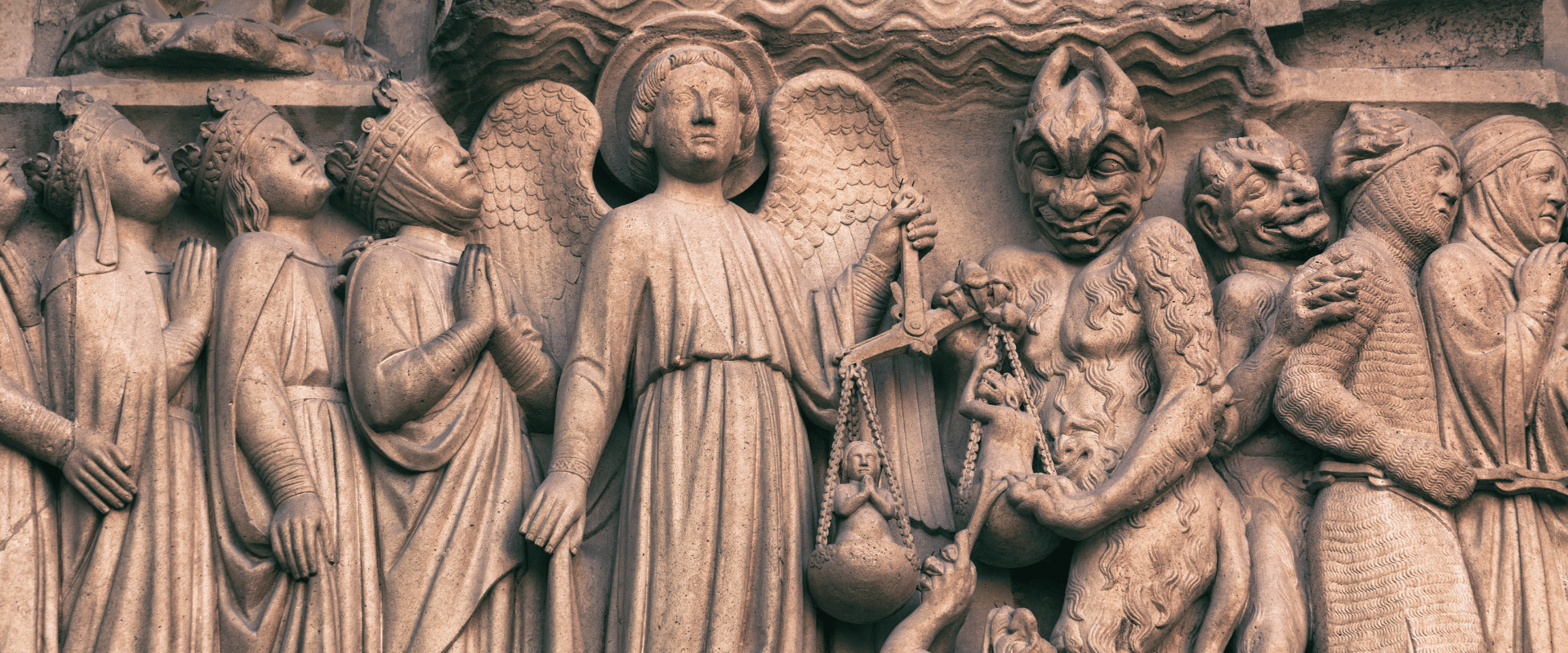
This tension helps explain why medieval European artists developed such vivid portrayals of supernatural beings, including demons and devils. With their horns, claws, wings, and grotesque faces, these creatures became instantly recognizable symbols of evil.
Yet the question remains: How much of this familiar imagery can actually be traced back to the Bible? Is it possible to reconstruct biblically accurate demons?
Interestingly, demons in the Bible are rarely described in terms of their physical appearance.
The Hebrew Bible contains references to mysterious beings sometimes interpreted as demons, including the se'irim, often translated as “goat-demons” (Leviticus 17:7; Isaiah 13:21), and Lilith. Known as one of the names of demons in the Bible, she appears among the unsettling inhabitants of Edom's ruins (Isaiah 34:14).
But these passages provide almost no detailed descriptions of what such beings supposedly looked like.
Moreover, the winged and hybrid figures found in ancient Near Eastern art weren’t necessarily evil; many served protective functions. We should therefore be cautious about projecting later Christian images of monstrous demons onto these ancient texts.
The New Testament is similarly reticent about demonic appearances, even though demons play a much more prominent role in its narratives.
In Mark 1:23–26, an unclean spirit speaks through a man in a synagogue, recognizes Jesus, and causes the man to convulse before departing. In Mark 5:1–20, the demons possessing a man identify themselves as “Legion” and eventually enter a herd of pigs.
Yet neither account describes the spirits' physical features. Instead, their presence becomes apparent through their actions and their effects upon the people they possess.
Even Matthew 12:43–45, which describes an unclean spirit wandering through waterless places, offers no physical description.
Biblical authors, it seems, were considerably more interested in what demons did than in what they looked like.
The elaborate monsters familiar from medieval art and modern horror films belong largely to the subsequent history of Christian imagination rather than to the explicit descriptions found in the biblical texts.
Conclusion
Perhaps I shouldn't have let my friend convince me to watch “The Pope's Exorcist” after all. Then again, that frightening experience gave me an opportunity to think more deeply about demons in the Bible and how remarkably different their ancient portrayals are from the terrifying creatures we encounter in modern horror films.
As we've seen, the familiar Christian understanding of demons didn’t emerge fully formed.
Rather, it developed over centuries, shaped by changing religious beliefs and the interpretations of ancient Jewish and Christian authors.
From the mysterious supernatural beings mentioned in the Hebrew Bible to the elaborate explanations found in the Book of the Watchers and the accounts of Jesus' exorcisms in the Gospels, the history of demons reveals how ancient people sought to make sense of evil, suffering, and the supernatural.
And perhaps that's what makes this subject so fascinating: even our most familiar images of evil have histories of their own.