

Who Was Joshua in the Bible? The Book, the Conquest, and Archaeology

Written by Joshua Schachterle, Ph.D
Author | Professor | Scholar
Author | Professor | BE Contributor
Verified! See our editorial guidelines
Verified! See our guidelines
Date written: November 18th, 2026
Disclaimer: The views and opinions expressed in this article belong to the author and do not necessarily match my own. - Dr. Bart D. Ehrman
Who was Joshua in the Bible? He is one of the most important figures in the Hebrew Bible, yet also one of its most complicated. His story includes some of the Bible’s most famous episodes, from the fall of Jericho to the division of Canaan among the twelve tribes of Israel. But the biblical Joshua raises questions that go far beyond the traditional story of a heroic conqueror.
Who was Joshua in the Bible, and what did he do? In this article, I’ll examine who Joshua was according to biblical texts, what his name means, and what he did. I’ll also look at his relation to Moses and how Jewish and Christian interpreters have wrestled with the book’s most difficult passages. Along the way, I’ll consider a larger question: what can Joshua’s story still tell us about the people who created and preserved it?
Who Is Joshua in the Bible?
When it comes to Joshua, bible verses feature him in several places. In the Pentateuch, he is initially an assistant to Moses. We first see his name in Exodus when a nation called the Amalekites launch a surprise attack on the Israelites at Rephidim shortly after they leave Egypt. Moses directs Joshua to fight them off.
So Joshua did as Moses told him and fought with Amalek, while Moses, Aaron, and Hur went up to the top of the hill… And Joshua defeated Amalek and his people with the sword (Exod. 17:10,13).


Joshua also accompanies Moses to Mount Sinai (Exod. 24:13, Exod. 32:17), dwells in the Tent of Meeting, the place where the Israelites would go to seek counsel from Yahweh (Exod. 33:11), and wishes to protect Moses from competing prophets (Num. 11:28).
Another instance of Joshua in the Bible occurs in Numbers, where he is one of the designated spies, one from each of the 12 tribes of Israel, chosen to do reconnaissance on the land of Canaan before the Israelites enter it. We are told in Numbers 13:8 that he is “from the tribe of Ephraim” and that his name is “Hoshea son of Nun.” However, in 13:16, Moses changes his name from Hoshea to Joshua. While there is no explicit reason given in the biblical text, it may have to do with the meaning of these names (more on that below).
After the death of Moses, Joshua becomes Moses’ successor, leading the Israelites into Canaan, conquering the inhabitants, and distributing the conquered lands to each Israelite tribe. Under Joshua’s leadership, the Israelites renew their covenant with Yahweh, promising to reject all other gods. According to the book that shares his name, Joshua later dies at a very old age:
After these things Joshua son of Nun, the servant of the Lord, died, being one hundred ten years old. They buried him in his own inheritance at Timnath-serah, which is in the hill country of Ephraim, north of Mount Gaash (Joshua 24:29–30).
What Does the Name Joshua Mean?
The English name Joshua derives from the Hebrew name Yehoshua, which can be divided into two parts. Yeho is a shortened form of the Tetragrammaton (YHWH), one of the principal Hebrew names for God in the Old Testament. The second part of the name, -shua, is a verbal root meaning "to rescue," "deliver," or "save." While explaining more about the Joshua meaning, Robert Cargill thus notes that it is a theophoric name, that is, a name containing the name of a deity, and literally means "Yahweh is help," or "Yahweh saves."
Cargill further notes that there have been several variations of the name including Yoshua and Yeshua, the name which was later transliterated into Greek as Jesus (Iēsous). It follows, then, that Joshua and Jesus are simply different forms of the same name (in Greek they are exactly the same). So why did Moses change Joshua’s name from Hoshea to Joshua?
Again, the verse in Numbers doesn’t tell us, but we can infer the reason from the meaning of both names. Hoshea, which is also the name of the prophet in the Hebrew Bible whom we call Hosea, means "salvation" or "he saves." However, Joshua is more specific: “Yahweh saves.” Moses, (or the authors of the book of Numbers) likely wanted to specify that Yahweh was the one who saved the Israelite people.
Who Was Joshua to Moses in the Bible?
When God tells Moses that his death is approaching, Joshua, “a man in whom is the spirit,” is chosen to be Moses’s successor (Num. 27:18–23, Deut. 3:28, Deut. 31). Although he is instructed to share power with the high priest Eleazar, it is Joshua who will lead the Israelites into Canaan to conquer the land.
Since Moses is considered the greatest of all prophets within Judaism, is Joshua a prophet as well? Although the Hebrew word for prophet, navi, is not used to explicitly describe Joshua, Zev Farber points out that there are many parallels between the paths of Moses and Joshua:
Joshua meets an angel of God outside Jericho and is told to remove his shoes, in a scene reminiscent of Moses’s first encounter with God at the burning bush (Josh 5:13-15). Moreover, while not the main focus of his story, God speaks to Joshua many times.
Moreover, Farber notes that like Moses,
Joshua wields the power of a prophet: He lays a curse upon anyone who builds Jericho (Josh 6:26), which comes to pass hundreds of years later (1Kgs 16:34), he dooms the Gibeonites to perpetual servitude in the temple (Josh 9:27), and he stops the sun (Josh 10:12-14). Joshua also functions as a religious leader, setting up memorial stones (Josh 4), circumcising the people (Josh 5:2-9), celebrating Passover (Josh 5:10) and Sukkot (Neh 8:17), building an altar (Josh 8:30-31), setting up refuge and Levitical cities (Josh 20-21), learning and teaching torah (Josh 1:7-8, Josh 8:32-35, Josh 24:25-26), and exhorting the people to remove their idols and be loyal to God (Josh 24:14-24).
So, in addition to taking over the leadership of the Israelites from Moses, Joshua clearly takes on Moses’ prophetic role.
Who Wrote the Book of Joshua and When?
Like many of the books in the Hebrew Bible, the Book of Joshua was written anonymously. Although the Babylonian Talmud, specifically Bava Batra 15a, argued that “Joshua wrote his own book and eight verses of the Torah,” in Israel Constructs its History: Deuteronomistic Historiography in Recent Research, Albert de Pury and Thomas Romer note that even Christians such as the famous Protestant reformer John Calvin believed the book must have been written long after the time of Joshua.
In fact, in the Eerdmans Commentary on the Bible, Lawson Younger notes that according to most scholars, the Book of Joshua was written as part of a much larger work which scholars call the Deuteronomistic History, since its narrative structure, language, and theology are deeply shaped by the theological perspective and writing style of the book of Deuteronomy. In other words, the Book of Joshua is not an independent biography, but rather the first installment of a grand, multi-book history spanning Joshua, Judges, Samuel, and Kings which was composed first at the court of King Josiah in the late 7th century BCE, and extensively revised in the 6th century BCE (we’ll see more on more on the significance of Josiah later).
In the HarperCollins Study Bible: Robert Boling notes that the Book of Joshua incorporates three types of material: conquest narratives (chs. 2–11), geographical lists (chs. 12–21), and theological discourses (ch. 1, chs. 23–24). Boling goes on to write that scholars believe
Individual narratives began as folktales about local victories but were later made into connected narratives signifying a unified Israelite victory.
(Affiliate Disclaimer: We may earn commissions on products you purchase through this page at no additional cost to you. Thank you for supporting our site!)
Book of Joshua: Summary and Structure
What is the Book of Joshua about? The following outline, taken from the HarperCollins Bible Dictionary and written by Paul Achtemeier and Roger Boraas, gives us a broad look at the structure of Joshua before we look at what happens in the text.
I. Transfer of leadership to Joshua (1:1–18)
A. God's commission to Joshua (1:1–9)
B. Joshua's instructions to the people (1:10–18)
II. Entrance into and conquest of Canaan (2:1–12:24)
A. Entry into Canaan
B. Victory over Canaan (6:1–12:24)
III. Division of the land among the tribes (13:1–22:34)
A. God's instructions to Joshua (13:1–7)
B. Tribal allotments (13:8–19:51)
IV. Conclusion (23:1–24:33)
A. Joshua's farewell address (23:1–16)
B. Covenant at Shechem (24:1–28)
C. Deaths of Joshua and Eleazar; burial of Joseph's bones (24:29–33)
We should note that while Joshua is appointed Moses’ successor in the Pentateuch, the book of Joshua is mainly concerned with Israel’s conquest and settlement of Canaan under Joshua’s leadership.
The narrative of Joshua describes three main phases of this process. First, in chapters 1–12, God commands Joshua to lead the Israelites across the Jordan River into the land of Canaan. Through divine intervention and military strategy, most famously the collapse of the walls of Jericho, the Israelites defeat numerous Canaanite cities/nations. Despite the divine sanction for this conquest, it involves many examples of killing that seem both gratuitous and highly unethical, something I’ll address below.
Second, in chapters 13–22, Joshua oversees the distribution of the conquered territories to the 12 tribes of Israel.
Now Joshua was old and advanced in years, and the Lord said to him, “You are old and advanced in years, and very much of the land still remains to be possessed… I will myself drive them out from before the Israelites; only allot the land to Israel for an inheritance, as I have commanded you. Now, therefore, divide this land for an inheritance to the nine tribes and the half-tribe of Manasseh” (Joshua 13:1, 6–7).
Finally, we have Joshua's farewell address in chapters 23–24, where the aged Joshua gathers the nation to deliver a speech, which culminates with this challenge:
"Now if you are unwilling to serve the Lord, choose this day whom you will serve, whether the gods your ancestors served in the region beyond the River or the gods of the Amorites in whose land you are living, but as for me and my household, we will serve the Lord [Yahweh]" (Joshua 24:15).
As we’ll see below, mainstream scholarship finds that the Book of Joshua is a theological and nationalist narrative compiled and revised centuries after the supposed conquest. In addition, archaeological evidence often contradicts its story, although there is some ongoing debate over some archeological sites.
NOW AVAILABLE!
Finding Moses: What Scholars Know About The Exodus & The Jewish Law
Riveting and controversial, the "FINDING MOSES" lecture series takes you on a deep dive into the stories of Moses, the exodus, and a whole lot more...
Did the Walls of Jericho Really Fall?
When the Israelites cross over into Canaan, the first city they encounter is Jericho, a powerful, securely locked city fortified with massive, thick double walls . How are they to enter this citadel, much less conquer it? Yahweh gives Joshua a plan in Joshua 6.
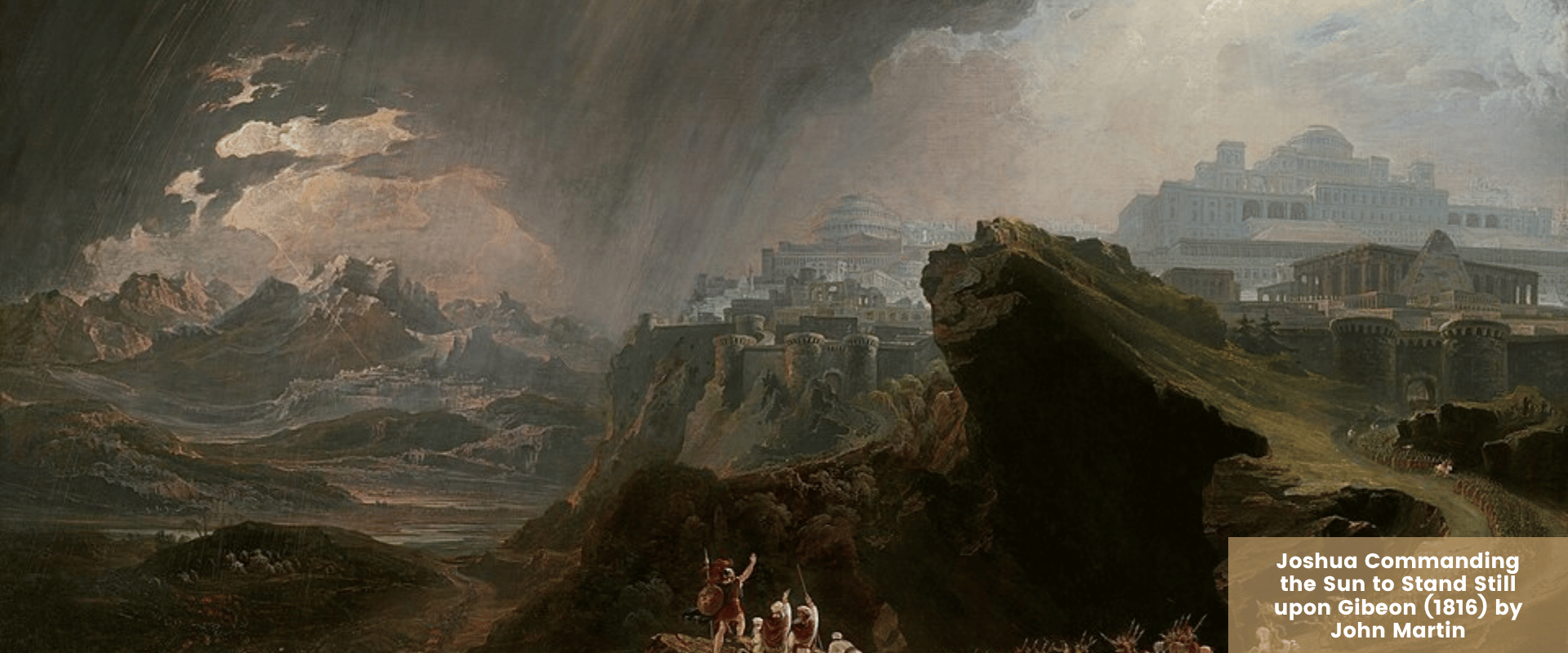
For the first six days, God tells Joshua to have the armed men and seven priests carrying ram-horn trumpets (shofars) march around the city once a day. The Ark of the Covenant is carried in the procession, and the people keep silent except for the blowing of the horns. Then, on the seventh day, the army marches around the city seven times instead of just once. Finally, after the seventh lap, the priests blow a long, loud blast on the trumpets, the Israelites give a mighty shout, and the massive walls collapse, allowing the army to charge straight into the city. But is there any empirical evidence that this truly happened?
In her book Biblical Peoples And Ethnicity: An Archaeological Study of Egyptians, Canaanites, Philistines, And Early Israel 1300-1100 B.C.E., Anne Killebrew notes that the consensus among scholars is that the Book of Joshua holds little historical value. Its origin lies in a time far removed from the times that it depicts. Moreover, the story of Jericho and the rest of the conquest represents the nationalist propaganda of the Kingdom of Judah and their claims to the territory of the Kingdom of Israel after 722 BCE.
Excavations at the site of biblical Jericho (now called Tell es-Sultan) show a significant destruction layer (known as City IV), whose destruction nevertheless does not align neatly with the biblical dates. William Dever writes that archaeologist Kathleen Kenyon dated the major destruction of the Middle Bronze Age city to about 1550 BCE, linking it to the expulsion of the Hyksos by the Egyptians. By the Late Bronze Age (15th–13th centuries BCE) when the biblical destruction of Jericho is supposed to have happened, the site was largely unfortified, sparsely occupied, or abandoned.
For this and other reasons, most modern historians and archaeologists view the story of the fall of Jericho as a later theological or national epic from the Kingdom of Judah rather than a historical event matching the Bronze Age archaeological layers. But if this is the case, how did the Israelites get into the land of Canaan?
How Israel Actually Emerged in Canaan
According to mainstream archaeological and historical consensus, ancient Israel did not emerge through a sudden, violent military conquest as described in the Book of Joshua or a mass exodus from Egypt. Instead, scholars view early Israel as an indigenous development that grew out of the native population of Canaan during the Late Bronze Age and the transition into Iron Age I (around 1200 BCE).
Key Archaeological and Scholarly Findings
Jonathan Laden writes that genetic and material culture studies show that the early Israelites were largely local Canaanites who gradually shifted their way of life rather than a foreign invading force. He also notes that as lowland Canaanite city-states collapsed or declined toward the end of the Late Bronze Age, groups of rural farmers, pastoralists, and displaced peoples moved into the central hill country of Canaan.
These new highland communities built unfortified or simple ring-shaped villages, lived in characteristic four-room houses, and notably lacked pig bones in their garbage deposits—an early sign of a distinct ethnic identity, according to William Dever.
The consensus of modern archeology, then, is that rather than arriving with a pre-existing national identity, these disparate regional groups gradually coalesced over time, worshiping the deity Yahweh and distinguishing themselves from surrounding Canaanite and Philistine cultures.
Herem and the Conquest Narratives
In the Book of Joshua, the Hebrew word herem keeps coming up in the context of all the bloody, merciless killing of the conquest of Canaan. As used in the Book of Joshua, the term means “something dedicated to God or under a ban,” and sometimes also refers to “things or persons to be utterly destroyed.” For instance, in the story of the conquest of Jericho, we see this right before the last trumpet blast bringing down the walls:
Joshua said to the people, “Shout! For the Lord has given you the city. 17 The city and all that is in it shall be herem [devoted to the Lord for destruction]… As for you, keep away from the things devoted to destruction [ha-herem], so as not to covet and take any of the devoted things and make the camp of Israel an object for destruction, bringing trouble upon it (Joshua 6:16–18).
Notice that since everything which is labeled herem is designated for destruction, anything herem that the Israelites take from the city—besides those things God commands them to take—will bring a curse upon them.
The Hebrew root of the word herem, is haram, meaning to separate or set something apart from regular, profane human use and consecrate it to a deity. Thus, depending on the context, herem can mean total destruction (such as putting a city and its inhabitants to the sword) or dedication of non-living spoils (like gold, silver, and bronze) directly into the treasury of Yahweh.
However, in most cases where herem is used in Joshua, it entails a kind of scorched-earth policy enacted upon the people and territory of Canaan. This brings up obvious ethical problems for readers, especially in verses such as 10:40:
So Joshua defeated the whole land, the hill country and the Negeb and the lowland and the slopes and all their kings; he left no one remaining but utterly destroyed all that breathed, as the Lord God of Israel had commanded.
This brings up a disturbing conclusion: the God of Israel apparently ordered his people to commit genocide, as Ra’anan Boustan asserts in Violence, Scripture, and Textual Practice in Early Judaism and Christianity? Scholar Pekka Pitkänen agrees with Boustan’s conclusion, but claims that "the biblical material should not be read as giving license for repeating it."
Meanwhile, John H. and J. Harvey Walton in The Lost World of the Israelite Conquest: Covenant, Retribution, and the Fate of the Canaanites, argue that the question of identifying the conquest as genocide is immaterial since, like many scholars, they believe the events themselves were mere hyperbole and not intended to be taken literally, based on comparisons to other Near Eastern literary cultures. Either way, anyone who takes the Bible seriously has to wrestle with the ethical issues the Book of Joshua brings up.
In attempting to justify the violence of passages like Joshua 6, Robert Boling, mentioned above, argued that herem is commanded to prevent "spiritual contagion," that is, eradicating Canaanite religious practices so Israel would not fall into idolatry. However, even if this is true, does staying faithful to Yahweh justify killing “all that breathed”? Or, if the events never happened, as modern archeology seems to indicate, does it justify even the rhetoric of killing an entire population? Throughout history, we have seen that dangerous rhetoric can have dangerous consequences.
Interestingly, the early Church Fathers often interpreted the Book of Joshua as an allegory, reading the historical and military events not as literal earthly warfare, but as spiritual blueprints for Jesus Christ and the Christian life. For instance, faced with the challenge of physical violence and the destruction of Canaanite cities, Origen of Alexandria (185–253 CE), in his Homilies on Joshua, rejected a purely literal moral endorsement of slaughter. Instead, he interpreted the enemy tribes as representing internal vices and demons (such as pride, greed, lust, and wrath), all of which Christians must conquer through spiritual warfare.
In addition, some Church Fathers, such as Justin Martyr (c. 110–165 CE), claimed that the fall of Jericho, brought down by faith, marching, and trumpets after seven days, was a foreshadowing of Christ’s victory over the powers of the world and sin, especially since the names “Joshua” and “Jesus” were exactly the same in Greek.
Was Joshua a Real Person?
Most modern historians and archaeologists consider Joshua to be a figure of myth rather than a real historical person for several reasons.
First, extensive archaeological research over the past century has found no scientific or historical evidence to support the biblical account of the Exodus or a unified, violent military conquest of Canaan by an incoming nation during the Late Bronze Age (as I noted above).
Therefore, the mainstream scholarly view is that the Book of Joshua is not a factual account of historical events. Given the lack of historical evidence for the events of Joshua, Carolyn Pressler in her commentary on Joshua, Judges, and Ruth suggests that the theological messages of Joshua, including the allegorical interpretations of the Church Fathers, should be given priority over any historical readings.
But there is one other way to conceive of the historicity of Joshua. Remember that I said that the Book of Joshua was likely written during the reign of King Josiah? In their book The Bible Unearthed, archeologists Israel Finkelstein and Neil Asher Silberman note that Josiah may be more significant in interpreting the book and character of Joshua than previously thought. They argue that
The towering figure of Joshua is used to evoke a metaphorical portrait of Josiah, the would-be savior of the people of Israel… God’s charge to Joshua at his assumption of leadership (Joshua 1:1-9) is framed in the phraseology of a royal installation. The loyalty pledge of the people for complete obedience to Joshua as the successor of Moses (Joshua 1:16-18) recalls the custom of public obeisance to a newly crowned king. And Joshua leads a ceremony of covenant renewal (Joshua 8:30-35), a role that became the prerogative of the kings of Judah.
It is king Josiah who lurks behind the mask of Joshua in declaring that the people of Israel must remain entirely apart from the native population of the land. The book of Joshua thus brilliantly highlights the deepest and most pressing of seventh-century concerns.
If their theory is correct, perhaps Joshua was written as a hero after whom Josiah could model his own image as he attempted to renew Judah’s connection with Yahweh.
Conclusion
So, who was Joshua in the Bible? According to the biblical tradition, Joshua was Moses’ successor, a military leader, religious authority, and the figure who led Israel into Canaan. His name—“Yahweh saves”—captures one of the central theological ideas of the story: Israel’s victories and survival are attributed not simply to human strength, but to the power and faithfulness of Yahweh. Joshua’s story culminates not only in conquest and settlement, but in his final appeal to Israel to remain faithful to their God: “as for me and my household, we will serve the Lord.”
Yet the historical Joshua is much harder to recover. The Book of Joshua was likely compiled and shaped centuries after the period it describes, as part of the larger Deuteronomistic History. Archaeological evidence does not support the picture of a unified Israelite army sweeping through Canaan and destroying its cities, and the emergence of early Israel appears to have been a much more gradual and complex process involving populations already living in Canaan. For this reason, Joshua is best understood not simply as a historical biography, but as a theological and ideological narrative that reflects the concerns of the communities that preserved and shaped it.
In the end, Joshua stands at the intersection of history, memory, theology, and national identity. Whether viewed as a historical leader, a legendary hero, a literary counterpart to Josiah, or a theological symbol later interpreted by Jewish and Christian readers, Joshua has had an enormous influence on how generations have understood Israel’s origins and relationship with God. His story also reminds us that biblical narratives can be historically difficult, theologically profound, and ethically challenging all at once. Understanding Joshua therefore requires not only asking what the Bible says happened, but also asking why later generations told the story in the way they did—and what they hoped their audience would learn from it.
Like the topic of this article? Then check out this online course, taught by Dr. Joel Baden, about the writing of the first five books of the Bible: The Bible by Committee.
NOW AVAILABLE!
Finding Moses: What Scholars Know About The Exodus & The Jewish Law
Riveting and controversial, the "FINDING MOSES" lecture series takes you on a deep dive into the stories of Moses, the exodus, and a whole lot more...