
Who is Lilith in the Bible?

Written by Marko Marina, Ph.D.
Author | Historian
Author | Historian | BE Contributor
Verified! See our guidelines
Verified! See our editorial guidelines
Date written: September 3rd, 2026
Disclaimer: The views and opinions expressed in this article belong to the author and do not necessarily match my own. - Dr. Bart D. Ehrman
Who is Lilith in the Bible? This is a surprisingly loaded question. It’s one of those questions that often reveal more about the assumptions of modern readers than about the biblical material itself.
As most readers know, the Bible has had an enormous impact on the history of Western civilization, largely because of the spread and influence of Christianity, but also because biblical stories have continued to live far beyond the pages of the Bible.
Why isn’t Lilith in the Christian Bible with as much frequency as some of the more well-known characters? Over many centuries, interpreters, artists, theologians, novelists, filmmakers, and popular culture have repeatedly returned to biblical figures and filled in the gaps left by the biblical texts themselves.
As a result, many people assume that certain famous stories, characters, and ideas are “biblical” even when they are only loosely connected to the Bible, or not found there at all.
Mary Magdalene is perhaps the most obvious example: countless later traditions about her are widely known, even though they go well beyond what the New Testament actually says. Lilith belongs in a similar category.
That is precisely what makes the question so interesting. Lilith is often imagined as if she were a major biblical figure, surrounded by dramatic stories about creation, rebellion, sexuality, demons, and the hidden history of Eden.
For many modern readers, Lilith is known as Adam’s first wife, a rebellious woman who refused to submit to him and fled Eden; for others, she is a night demon, a seducer, a threat to infants and mothers, or even a symbol of female independence.
These images are powerful, but they come mainly from later Jewish, Christian, and modern traditions rather than from the biblical text itself.
But when we turn to the Bible itself, the picture becomes much more complicated, and much more intriguing.
The real issue is not simply “Who was Lilith?” but also: how did a marginal and mysterious biblical reference become the basis for such a powerful afterlife in later Jewish, Christian, and modern imagination? In other words, what happened to Lilith?
To answer that question, we need to begin not with medieval legends or modern fantasy, but with the biblical text itself, and with the surprising fact that the Lilith most people think they know is largely a product of interpretation after the Bible.
There are, obviously, a lot of important figures within the Judeo-Christian tradition, but probably not many are as important as Moses and the story about him that we find in the Book of Exodus.
But what can historians actually know about Moses, the Exodus, and the origins of Jewish law? In Bart D. Ehrman’s 8-lecture course, Finding Moses: What Scholars Know About the Exodus and the Jewish Law, you’ll explore the fascinating gap between biblical tradition, historical evidence, archaeology, and modern scholarship. Join the course and discover what scholars can (and cannot) say about one of the most influential figures in religious history!
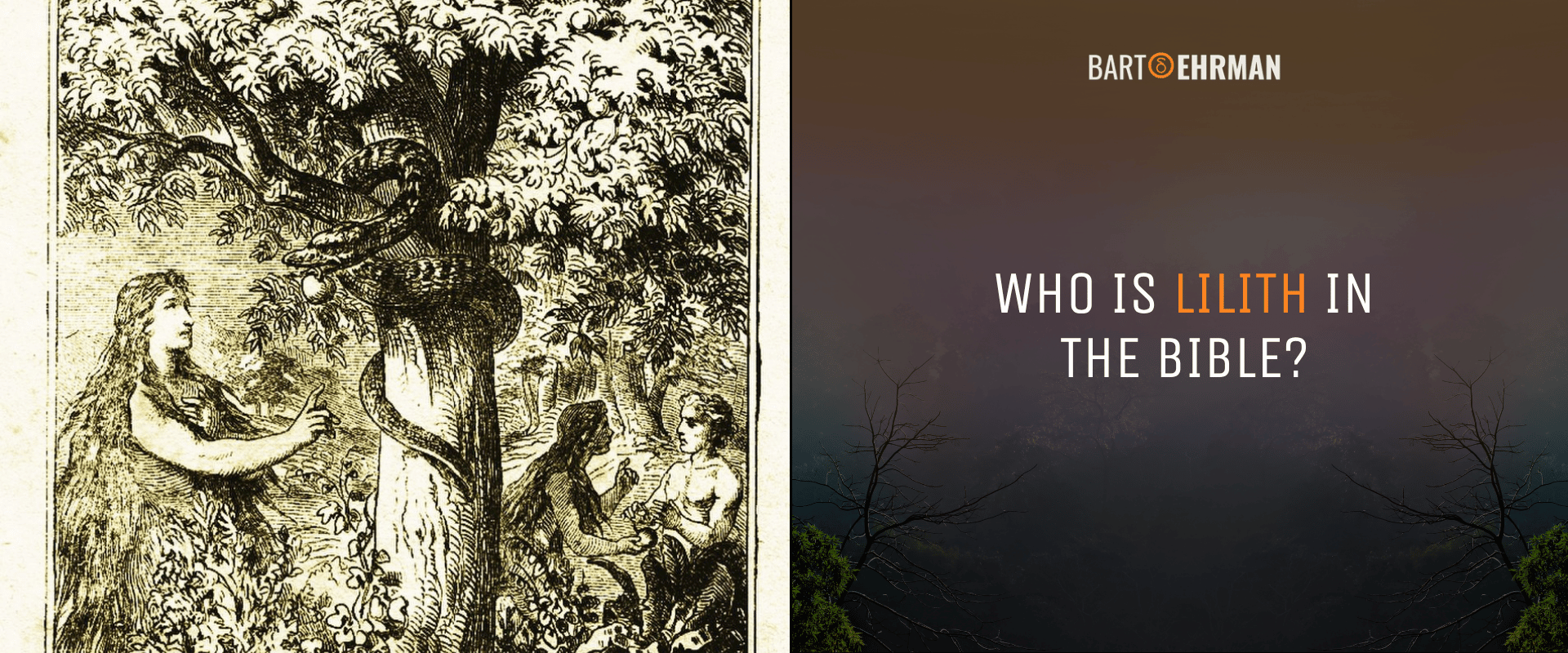
Where Is Lilith Mentioned? Biblical Evidence
In his book Lilith, the First Eve: Historical and Psychological Aspects of the Dark Feminine, Siegmund Hurwitz writes:
(Affiliate Disclaimer: We may earn commissions on products you purchase through this page at no additional cost to you. Thank you for supporting our site!)
Of all the motifs in Jewish mythology, none – other than that of the Messiah – remains so vivid to this day as the myth of Lilith. She occupies a central place among the demonic images of Judaism because she is by far the most distinctive figure among this religion’s numerous evil spirits...The figure of Lilith as we encounter her in Jewish literature is, however, by no means restricted exclusively to Jewish mythology. She occurs among both Semitic and non-Semitic peoples – among the Babylonians, Assyrians, Jews and Arabs on the one hand and among the Sumerians and Hittites on the other. But only in Jewish mythology has the Lilith myth existed for more than two and a half thousand years and has even managed to develop still further.


Hurwitz’s statement captures very well the enormous mythological afterlife of Lilith. She isn’t simply a name from an ancient text. She is a figure who came to occupy a powerful place in Jewish imagination, later folklore, literature, demonology, and modern culture.
It does come as something of a surprise, then, that such an important figure in later Jewish mythological tradition begins with only one explicit appearance in the Hebrew Bible, and even that appearance is far removed from the stories later readers came to associate with her.
The famous Lilith of later tradition, including Lilith as Adam’s first wife, isn’t found in Genesis. She doesn’t appear beside Adam in Eden. She doesn’t speak, act, rebel, or receive a narrative of her own.
In the Bible itself, the Hebrew term usually rendered “Lilith” appears only in Isaiah 34:14, in a dark poetic oracle about the destruction of Edom. The word is Hebrew, lîlît, and it’s sometimes connected with the Semitic root associated with night.
That connection helps explain why some translations preserve the name “Lilith,” while others render it more generically as “night creature,” “night monster,” “screech owl,” or something similar.
However, this translation is far from certain. As Michèle Bitton explains in an article:
“Although Lilith appears in the Hebrew Bible, her name has often been incorrectly linked to the Hebrew word laylah, ‘night.’ Today, however, scholars generally regard the Hebrew term lilit as a borrowing from Assyrian [more precisely, from Akkadian/Assyro-Babylonian demonological terminology]. It derives ultimately from the Sumerian lil, “wind,” a root also found in the name of the Lils, the Akkadian demons mentioned above. The name Lilith may also be compared with other Assyrian words formed from the same root, such as lūti, ‘lasciviousness,’ or lulu, ‘disorder’ or ‘libertinism.’” (my translation)
So, as you can see, already at the level of translation, we are dealing with a rare and difficult word.
But for better understanding, the immediate context is crucial. Isaiah 34 isn’t a story about human origins, gender, marriage, or Eden. It’s a prophetic judgment oracle.
Edom, imagined as one of Zion’s enemies, is condemned to total devastation. The land is pictured as burning, ruined, empty of human life, and taken over by wild and ominous creatures.
In Joseph Blenkinsopp’s translation of Isaiah 34:14, the verse reads: “wildcats will gather with hyenas, / the satyr will call to his mate, / there too will Lilith alight / and there find a spot for herself.”
This is the only biblical setting in which Lilith appears: not a garden, but a wasteland; not a domestic drama, but a landscape of curse and desolation.
Marvin A. Sweeney makes the same point in his Commentary on Isaiah:
Verses 14-15 break the pattern of paired converted perfect verbs by employing a converted perfect and an imperfect in v. 14a followed by three emphatic statements introduced by references to "there" that describe how Ihe desert beasts will meet or inhabit the coastlands. This is basically stated in v. 14a with a reference to satyrs; v. 14b ( 'ak-šām, "indeed there") refers to the "night hag" (lîlît), v. 15a (šāmmâ, "there") describes the owl, and v. 15b ('ak-šām, "indeed there") describes the kite with her mate. The image of such creatures inhabiting the areas of Edom formerly inhabited by people completes the picture of destruction.
Furthermore, Blenkinsopp, in his Commentary on Isaiah, explains that chapters 34 and 35 function together as a kind of diptych: Edom’s annihilation is contrasted with Zion’s restoration. Edom becomes an uninhabited wasteland, while the wilderness associated with Zion will eventually flourish.
In that context, Lilith belongs to what Blenkinsopp describes as the “back to nature” theme: once a land’s social and political order is destroyed, urban life ends and the territory becomes the home of wild creatures.
This is why the list in Isaiah 34 includes jackals, ostriches, ravens, owls, wildcats, hyenas, and other difficult-to-identify beings.
Blenkinsopp also cautions that the meanings of many of these creatures are uncertain; among the twelve species listed, only “raven” and “jackal” are beyond doubt. That uncertainty matters. The verse may evoke demonic beings, and the neighboring term śāʿîr can mean either a goat or a goat-demon, but the text itself doesn’t pause to explain exactly who or what Lilith is.
According to Blenkinsopp, Lilith may have originated as a minor Assyrian demon, lilitu, and he also acknowledges the rich later Jewish folklore in which she becomes a dangerous female figure associated with sexuality, childbirth, and nocturnal danger.
But that later tradition shouldn’t be read back too quickly into Isaiah. Even the textual evidence is complicated: the Qumran Isaiah scroll and the Targum (an ancient Aramaic translation and interpretation of the Hebrew Bible) have a plural form, which could support a more mundane meaning, such as “nightjar,” a secretive bird.
Nevertheless, Blenkinsopp prefers the Masoretic reading and interprets Lilith as a fitting inhabitant of this eerie realm of death. The safest conclusion is therefore modest but important: in the Bible, Lilith is a mysterious figure or creature of the ruined wilderness, mentioned only once, in a poetic vision of judgment.
How this obscure biblical name became one of the most vivid figures in later Judeo-Christian tradition and mythology is the story to which we now turn.
Lilith in Later Judeo-Christian Tradition: From Night Creature to Adam’s First Wife
In his book The Hebrew Goddess, Raphael Patai writes:
The earliest mention of a she-demon whose name is similar to that of Lilith is found in the Sumerian king list which dates from ca. 2400 B.C.E. It states that the father of the great hero Gilgamesh was a Lillu-demon. The Lillu was one of four demons belonging to a vampire or incubi-succubae class. The other three were Lilitu (Lilith), a she-demon; Ardat Lili (or Lilith’s handmaid), who visited men by night and bore them ghostly children; and Irdu Lili, who must have been her male counterpart and would visit women and beget children by them.
This ancient Near Eastern background is important because it reminds us that Lilith didn’t emerge in a cultural vacuum.
Long before later Jewish literature gave her a more detailed personality and biography, there were already Mesopotamian traditions about dangerous nocturnal beings associated with sexuality, dreams, demons, and the vulnerable boundaries of human life.
But the sheer level of mythical development that will arise around Lilith in later Jewish tradition surpasses all of the ancient accounts of female demons or goddesses that bore the same or a similar name.
In the Bible, as we have seen, Lilith appears only briefly and obscurely. In later Jewish texts, however, she gradually becomes a much more vivid and terrifying figure.
As Patai explains, by the Talmudic period, Lilith had become a fully developed evil she-demon, even though the surviving Talmudic and midrashic references are still relatively brief.
Some passages associate her with wings; others with long hair; and later rabbinic interpretation could imagine the Lilin as beings with human form, but with wings. Here we are already far beyond Isaiah’s ruined wilderness. Lilith has become a recognizable demonological figure.
It’s also in later Jewish tradition that Lilith becomes connected with Adam. This is the famous tradition most modern readers probably know: Lilith as Adam’s first wife.
In this story, Adam and Lilith cannot live together peacefully because Lilith refuses to accept a subordinate position. She insists that she and Adam are equal, since both were created from dust.
When Adam attempts to overpower her, she utters the divine name, rises into the air, and flees to the Red Sea, a place imagined as full of demons.
God then sends three angels (Senoy, Sansenoy, and Semangelof) to bring her back, but Lilith refuses. Needless to say, nothing of this kind exists in the Genesis account. Rather, it’s a later mythic attempt to give Lilith a narrative identity and to explain her hostility toward infants, mothers, and men.
That last point is crucial, because in these traditions Lilith isn’t only a rebellious woman from a lost Edenic past. She is also a present danger.
The myth explains why amulets bearing the names of the three angels were used to protect newborn children: according to the story, Lilith swore that whenever she saw the angels’ names or images on an amulet, she would not harm the child.
This wasn’t merely literary speculation. Aramaic incantation bowls from late antique Babylonia, several of them Jewish, preserve magical texts directed against Lilith or “Liliths.”
Patai stresses that these bowls show not only what the learned elite said about Lilith, but also what she meant in popular religious practice. In these materials, Lilith threatens households, thresholds, childbirth, newborns, sexuality, and fertility; she attacks children, causes barrenness or miscarriage, and must sometimes be expelled by means of a symbolic writ of divorce.
In medieval Kabbalistic literature, Lilith’s mythology expands dramatically. As Patai notes:
While the major characteristics of Lilith, as we have just seen, were well developed by the close of the Talmudic period, it remained for Kabbalistic mysticism to establish a relationship, and quite a close one at that, between her and the deity.
Hurwitz adds by noting:
The principal work of the Kabbalah, the Zohar which was written at the beginning of the 14th century by the Spanish Kabbalist Moises de Leon, contains numerous passages in which Lilith is mentioned, either directly or indirectly. In these, the author borrows various motifs that appeared in earlier and partly non-Kabbalistic works such as the Alphabet of ben Sira. In the Zohar, too, Lilith appears as the first wife of Adam, who left him after a bitter quarrel.
So, she is no longer merely a night demon, a threat to children, or a seducer of men. Lilith becomes part of a vast cosmic drama involving evil, sexuality, divine judgment, and the demonic realm.
When we move beyond the question of “Who is Lilith in the Bible?” to broaden the scope of mentions related to her, they become quite varied. Some traditions describe her as created before Adam; others imagine her formed from impure earth; still others connect her with Samael, the demonic counterpart to divine holiness.
This is also where a common modern question sometimes enters the discussion: Is Lilith Lucifer’s wife?
Strictly speaking, that isn’t a biblical idea. The Bible never presents Lilith as the wife of Lucifer, Satan, or any demonic ruler.
But later Jewish and esoteric traditions do sometimes associate her with Samael, and this association helps explain why modern readers can easily merge Lilith with broader ideas about Satan, Lucifer, and the demonic realm.
Christian tradition, by contrast, never developed Lilith with anything like the same richness or centrality. She doesn’t become an important figure in the New Testament, in mainstream Christian theology, or in major doctrinal reflection.
Where she does appear in Christian imagination, it’s usually through indirect channels: inherited Jewish legend, demonology, folklore, art, literature, or later esoteric interpretation.
Still, modern popular culture (shaped in different ways by Jewish tradition, Christian imagination, and especially Catholic visual and symbolic worlds) has found Lilith endlessly useful.
She can appear as demon, seductress, rebel, feminist icon, fantasy ancestor, or symbol of spiritual bondage. That modern afterlife is the next stage of the story.
NOW AVAILABLE!
Finding Moses: What Scholars Know About The Exodus & The Jewish Law
Riveting and controversial, the "FINDING MOSES" lecture series takes you on a deep dive into the stories of Moses, the exodus, and a whole lot more...
Who Is Lilith in Popular Culture? Two Illustrative Examples
In her article written for Bible Review Journal, Janet Howe Gaines wrote:
Lilith’s peregrinations continue today. This winged night creature is, in effect, the only ‘surviving’ she-demon from the Babylonian empire, for she is reborn each time her character is reinterpreted. The retellings of the myth of Lilith reflect each generation’s views of the feminine role. As we grow and change with the millennia, Lilith survives because she is the archetype for the changing role of woman.
Gaines’ article was published more than 20 years ago, but her words seem more relevant than ever.
To borrow, cautiously, from Carl G. Jung’s language, Lilith has repeatedly emerged from the collective unconscious as a powerful manifestation of the repressed feminine shadow: dangerous, seductive, wounded, rebellious, demonized, and yet strangely compelling.
This is especially visible in popular culture, where Lilith continues to be invoked and reimagined for very different literary, ideological, and theological purposes. Two examples will illustrate the point.
The first comes from C. S. Lewis’ The Lion, the Witch and the Wardrobe, the most famous volume of The Chronicles of Narnia. Lewis’ world is deeply shaped by Christian imagination, but it’s not a simple allegory in which every figure corresponds neatly to a biblical character.
Rather, Narnia draws freely on biblical motifs, medieval cosmology, classical mythology, fairy tale, and older folklore.
Lilith appears not as part of the genealogy of the White Witch, Jadis. Mr. Beaver explains that the Witch isn’t truly human: she descends partly from giants and partly from Lilith, whom he identifies as Adam’s first wife.
In other words, Lewis uses the later Jewish myth of Lilith (not Isaiah 34) to mark the White Witch as an anti-Eve figure, a being associated with unnatural power, deception, coldness, and rebellion against the created order.
This is a revealing modern use of Lilith. Lewis doesn’t stop to explain the long history of the tradition, and most readers probably pass over the reference without recognizing its full background.
Yet the allusion does important literary work. By connecting the White Witch to Lilith, Lewis gives his villain an ancestry that is older, darker, and more dangerous than ordinary human wickedness.
The White Witch belongs to a mythic world of distorted femininity, false sovereignty, and spiritual sterility.
Her winter kingdom (frozen, childless, and joyless) becomes almost the opposite of the fruitful creation that Aslan restores. Lilith, in this context, functions as a symbolic ancestor of corrupted power.
Our next example comes from a TV show that captured the attention of millions, including a substantial number of my students, who quite often have some kind of question about it, usually about the level of historical accuracy of the show.
“The Chosen,” created by Dallas Jenkins, is a dramatized retelling of the life of Jesus and the disciples.
One of its most memorable opening storylines concerns Mary Magdalene. In the first episode of Season 1, Mary isn’t initially presented simply as “Mary.” She is living under the name “Lilith,” tormented by demonic possession, trauma, and self-destruction.
Nicodemus attempts to exorcise her and fails. Jesus later encounters her, calls her by her true name, and restores her identity.
Luke 8:2 and Mark 16:9 (a longer ending that wasn’t a part of the original Mark) associate Mary Magdalene with deliverance from “seven demons,” but the Gospels never call her Lilith, nor do they connect her with the later Jewish mythology of Adam’s first wife.
The show’s use of “Lilith” is therefore not a historical detail about Mary Magdalene. It’s a dramatic symbol.
In “The Chosen,” “Lilith” names Mary’s bondage, alienation, and loss of self; “Mary” names her restoration. The movement from Lilith to Mary allows the show to dramatize salvation as the recovery of true identity.
This is precisely why Lilith remains so culturally useful: she can be demon, rebel, wound, temptation, false self, or symbol of liberation, depending on the needs of the storyteller.
So, as you can see, modern culture has inherited not only the biblical word but the entire afterlife of interpretation that grew around it, and it continues to give Lilith new lives.
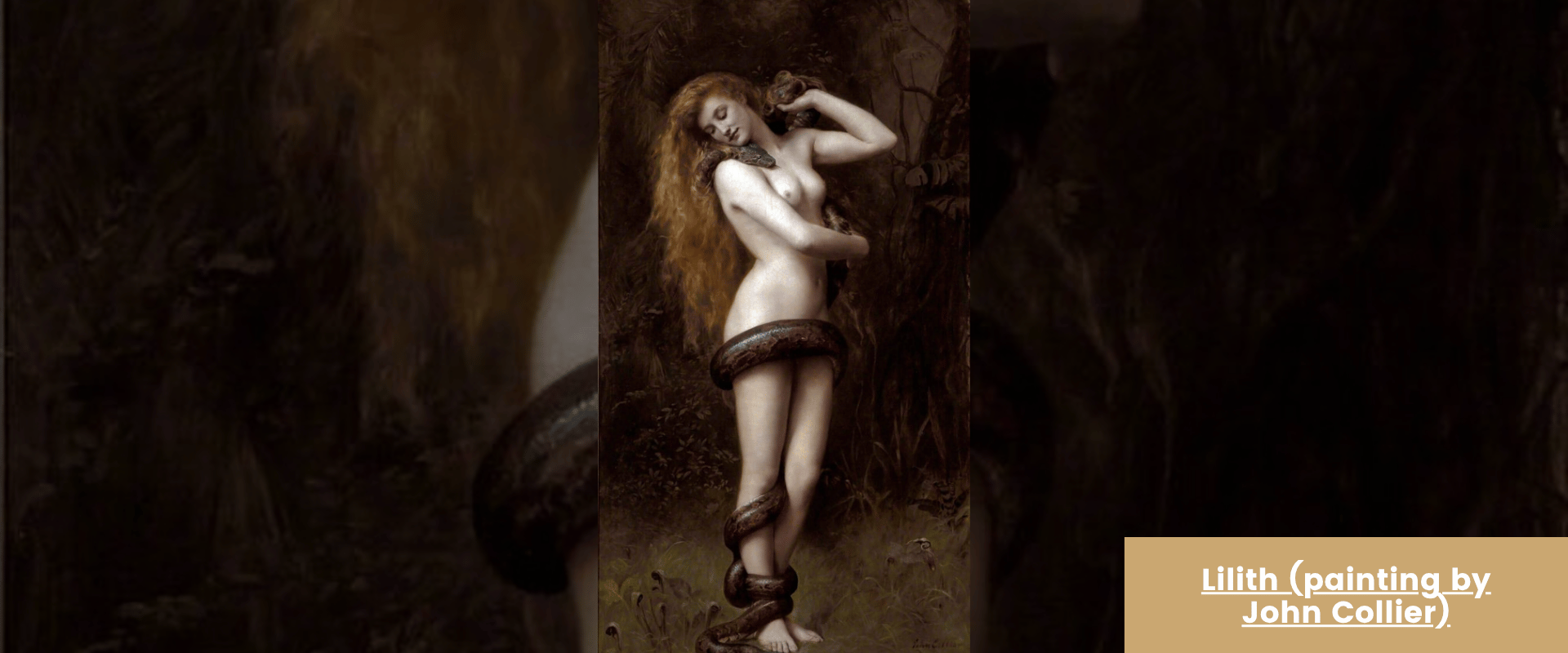
Conclusion
Who is Lilith in the Bible? As we saw in this article, the most historically responsible answer is also the most surprising one: in the Bible itself, Lilith is barely there.
She appears only once, in Isaiah 34:14, not as Adam’s first wife, not as a rebel in Eden, and not as a fully developed demonic figure, but as a mysterious inhabitant of a devastated wilderness. The famous Lilith of later imagination is therefore a biblical name with a vast post-biblical afterlife.
That is why the question “what did Lilith do?” must be answered carefully. In the Bible, she does almost nothing; she simply “alights” in a ruined landscape of judgment.
But in later Jewish tradition, medieval demonology, Kabbalistic speculation, Christian literary imagination, and modern popular culture, she does a great deal.
She rebels, flees, threatens, seduces, haunts, protects symbolic boundaries, represents demonic danger, and later becomes a figure through whom writers and artists explore gender, power, trauma, liberation, and identity.
Lilith’s story, then, is less a story about what the Bible says than about what later interpreters did with one obscure biblical word. And that, in the end, may be precisely why she remains so fascinating.
NOW AVAILABLE!
Finding Moses: What Scholars Know About The Exodus & The Jewish Law
Riveting and controversial, the "FINDING MOSES" lecture series takes you on a deep dive into the stories of Moses, the exodus, and a whole lot more...