
Is the Epistle of Barnabas in the Bible? Text, Date, and Summary

Written by Joshua Schachterle, Ph.D
Author | Professor | Scholar
Author | Professor | BE Contributor
Verified! See our editorial guidelines
Verified! See our guidelines
Date written: June 9th, 2026
Disclaimer: The views and opinions expressed in this article belong to the author and do not necessarily match my own. - Dr. Bart D. Ehrman
The Epistle of Barnabas occupies an interesting place in the history of the Bible. Revered by some early Christians, copied alongside books of the New Testament in important biblical manuscripts, and quoted by influential church fathers as Scripture, the letter nevertheless failed to secure a permanent place in the Christian canon. Why was it rejected?
In this article, I’ll explain what the Epistle of Barnabas is, when and why it was written, why some Christians once considered it Scripture, and why it was ultimately left out of the Bible. We’ll also examine the book’s major themes, including its radical reinterpretation of the Jewish Law and its role in the separation between Christianity and Judaism.
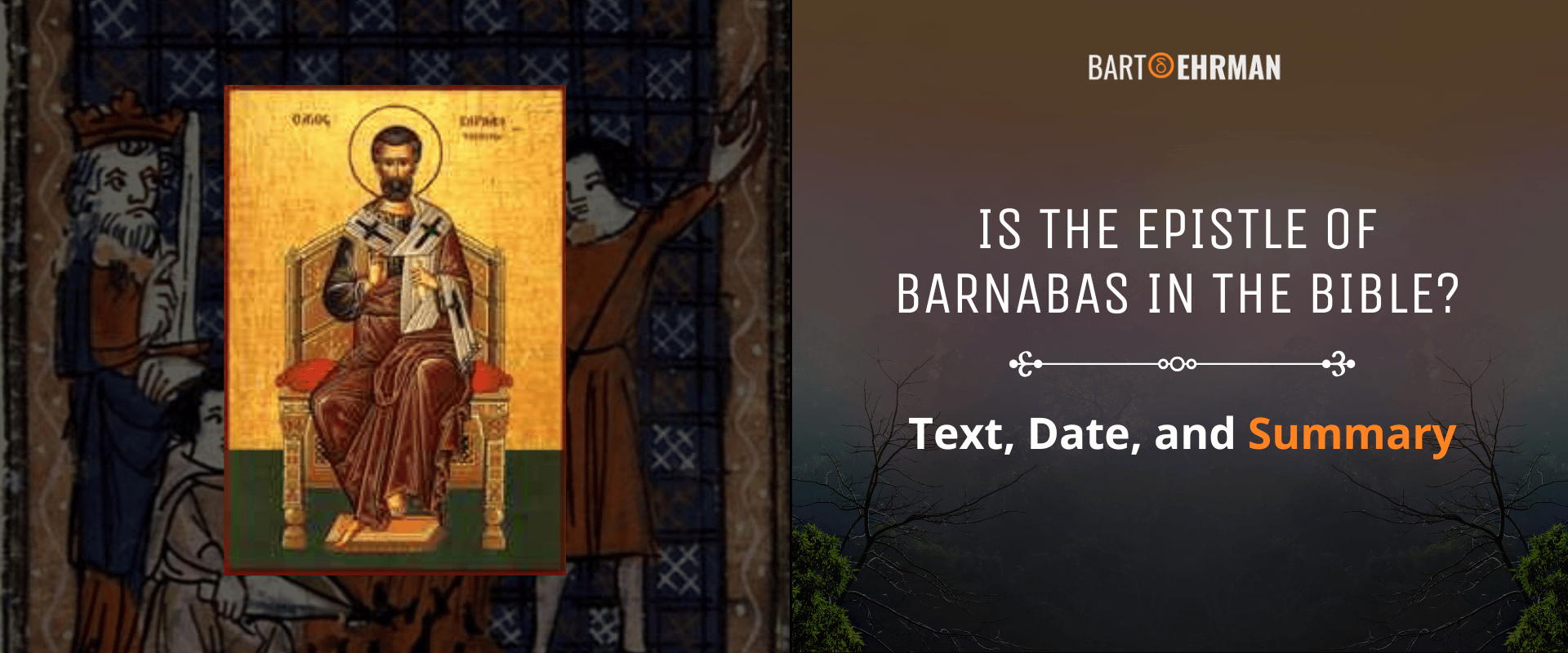
What Is the Epistle of Barnabas?
The Epistle of Barnabas is an early Christian letter, although it often reads more like a didactic essay (don’t confuse it with the Gospel of Barnabas, which was actually written during the Middle Ages). Like the Epistle of James and the Epistle to the Hebrews, it was written not to an individual recipient but to a group of Christians.
The book was immensely popular in early Christianity. What’s more, the fact that it was included in the 4th-century Codex Sinaiticus, one of the oldest examples we have of a complete Bible manuscript, shows that many believed the Epistle of Barnabas to be worthy of scriptural status. In Sinaiticus, the letter is near the end of the codex, after Revelation and before another book that would later be rejected, the Shepherd of Hermas.
However, it’s also a troubling book for modern readers because, as Bart Ehrman writes, “it presents one of the strongest attacks against Jews and Judaism from the early second century.” Indeed, it argues that the Jews’ covenant with God had been invalidated millennia before Christ (more on that later).
Like the Gospels of the New Testament, the letter was originally written anonymously. So, how did it get its title? Ehrman writes that
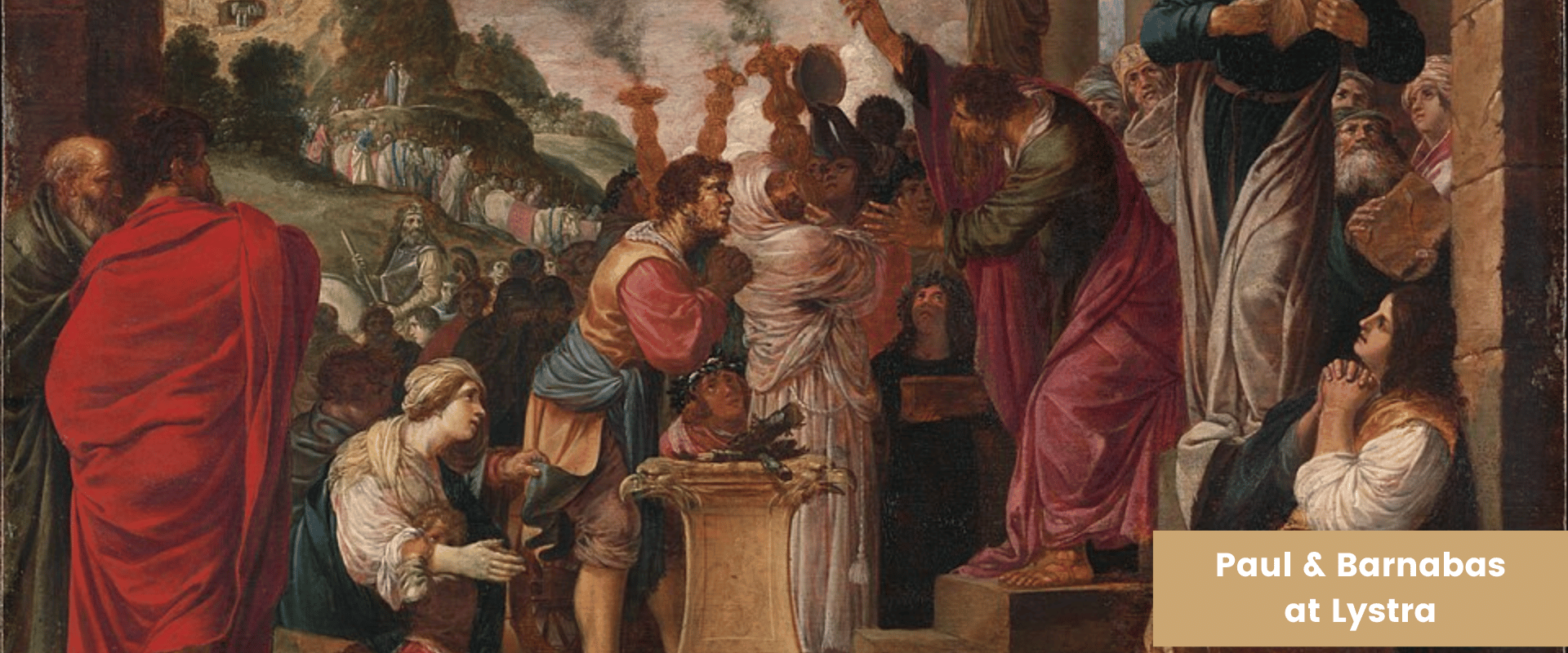
The second- and third-century Christians who first referred to the book claimed that it had been written by Paul’s companion Barnabas (hence its name; see Acts 11–15), but they may have been simply guessing. Indeed, these later authors may have ascribed the book to a companion of the apostle to elevate its importance.


The book’s composition can be reliably dated to somewhere between 70 and 135 CE. Why? First of all, the letter refers to the destruction of the Temple in Jerusalem, which happened in 70 CE. Referring to a passage from the Hebrew Bible, the author says
Moreover [God] says again, "See, those who have destroyed this temple will themselves build it" (Isa 49:17). This is happening. For because of their war, it was destroyed by their enemies. And now the servants of the enemies will themselves rebuild it (Barn. 16.4).
To most scholars, this section of the text indicates that the Epistle had to be written after 70 CE. However, in assuming that “the enemies”—that is, Rome— will rebuild the Temple, the author also inadvertently dates the letter sometime before 135 CE, by which time the Roman emperor Hadrian had built a temple to the god Jupiter on the site of the Jerusalem temple. By this time, in other words, there was no chance that the Romans would rebuild the temple they had destroyed.
Date and Occasion
Because there is no scholarly consensus on the precise date of the letter’s composition, opinions vary. Since there is only one apparent reference to the writings of the New Testament Gospels (in Barn 4.14: “Many are called but few are chosen” from Matt 22:14), some scholars , such as Helmut Koester date the book to between 70 and 80 CE, before Matthew was written:
(Affiliate Disclaimer: We may earn commissions on products you purchase through this page at no additional cost to you. Thank you for supporting our site!)
It cannot be shown that he [the author] knew and used the Gospels of the New Testament. On the contrary, what Barnabas presents here is from 'the school of the evangelists'. This demonstrates how the early Christian communities paid special attention to the exploration of Scripture in order to understand and tell the suffering of Jesus. Barnabas still represents the initial stages of the process that is continued in the Gospel of Peter, later in Matthew, and is completed in Justin Martyr.
However, another scholar, J. E. Jacquier, argues that since the phrase cited from Matthew is preceded by the words “as it is written” in the epistle, that the Gospel of Matthew is considered by the author to be Scripture. If so, this would indicate that the epistle was written at a later date than Koester believed, since scriptural status was not granted to the Gospels until well into the 2nd century.
In terms of location, it is generally assumed that the Epistle of Barnabas was written in Alexandria, Egypt. Clement of Alexandria is the first Christian author to mention the book, and clearly believes that the Epistle belongs in the New Testament. His student Origen of Alexandria believed likewise, as would 4th-century Christians including Didymus the Blind and Jerome. However, not everyone believed the Epistle of Barnabas to be Scripture.
Fourth-century church historian Eusebius, in listing his own canon, placed the Epistle among those books he considered not authentic—that is, not really written by the Barnabas found in the book of Acts. And yet it was included in the 6th-century Codex Claromontanus. Its inclusion shows that, even at that late date, it still had scriptural status for some. Harry Gamble writes that the Epistle and some other books that would later be excluded from the canon were actually used more by early churches than books such as Hebrews and 2 Peter, which would eventually be included. So why was the Epistle of Barnabas later rejected?
I’ve already noted that Eusebius, a highly influential 4th-century bishop and church historian, rejected the book as “spurious.” He based this on his doubt that it was truly written by Paul’s apostolic companion Barnabas (a claim the original letter never made, by the way). In addition, Athanasius, the 4th-century bishop of Alexandria, rejected the book in his highly influential canon list. While Clement and Origen (both from Alexandria) accepted the book, Clayton Jefford writes “There are no additional references to the text outside of the Alexandrian area during the second and third centuries.” In short, use of the book outside of Alexandria may not have been widespread enough to justify its ultimate inclusion.
What prompted the writing of this anti-Judaism polemic? In the Introduction to his translation of the Epistle of Barnabas, Bart Ehrman argues that there may have been a general trend among some early Christian groups which the author of the Epistle found threatening, saying that in
the ongoing relations between Jews and Christians, as some members of the Christian community were being tempted to see that Judaism is a valid religion and that Jews really were people of the covenant... It may be that Christians who were adopting such views in this author's community, whether in Alexandria or elsewhere, began questioning the validity of their own faith and were being tempted to convert to Judaism (it is clear that they were themselves Gentile: 3.6; 16.7).
This provides us with a good segue to an overview of the content of the Epistle of Barnabas.

Epistle of Barnabas Summary
In general, the point of the Epistle of Barnabas is that the Old Testament was actually written for Christians, not Jews. As such, the Old Testament writings point ultimately to Christ, while the Jewish Law should have been interpreted spiritually, not literally as Jews have. In other words, Jews have always misread the Scriptures. In addition, according to the author, the covenant between God and the Jews was broken, not at the advent of Christ, but in the time of Moses.
Writing to his Gentile Christian audience, the author tells them
watch yourselves now and do not become like some people by piling up your sins, saying that the covenant is both theirs [the Jews’] and ours. For it is ours. But they permanently lost it, in this way, when Moses had just received it (Barn. 4.6–7).
How and when did the Jews lose their covenant with God, according to the author?
But when they turned back to idols they lost it. For the Lord says this: "Moses, Moses, go down quickly, because your people, whom you led from the land of Egypt, has broken the law." Moses understood and cast the two tablets from his hands. And their covenant was smashed—that the covenant of his beloved, Jesus, might be sealed in our hearts, in the hope brought by faith in him (Barn. 4.8).
In other words, the Jews have not had a covenant with God since Moses received the Ten Commandments, the smashing of the tablets symbolically divesting them of the covenant. To prove that the divine covenant is exclusively for Christians, then, the author does interpretive gymnastics, using allegory to interpret the Jewish Law in a Christian way. Allegorical exegesis was common among many in the city of Alexandria, by the way, where the Jewish philosopher Philo, as well as Christians such as Origen made frequent use of the same method.
The author’s claim that Jews do not practice religion correctly is based on the idea, found in Barnabas 9.5, that they had been deceived by an “evil angel” into thinking the Jewish Laws about sacrifices and rules of eating should be taken literally. The author then attempts to make clear how those laws should be interpreted.
For example, in chapter 2, the author says that, despite all the detailed instructions in the Hebrew Bible on how burnt offerings were to be made (Leviticus 1:3–17, for instance), God didn’t actually want those literal actions performed:
For through all the prophets he has shown us that he has no need of sacrifices, whole burnt offerings, or regular offerings… And so he nullified these things that the new law of our Lord Jesus Christ, which is without the yoke of compulsion, should provide an offering not made by humans.
Instead, he quotes from Psalm 51:17 that “a sacrifice to God is a broken spirit,” indicating that God wants humility and that burnt offerings are thus unnecessary.
Similarly, in chapter 3 the author says that when God spoke of fasting, he meant giving up injustice, not abstaining from food. Circumcision, discussed in chapter 9, was apparently not meant to be taken literally either, but rather meant that God had “circumcised our hearing” so that Christians would believe.
The halakhic dietary rules from Leviticus 11 are discussed in chapter 10 and get some interesting interpretive treatments. When the Israelites were forbidden from eating pigs, for example, the author says that what was actually meant was that they shouldn’t act like pigs, who ignore their master (that is, God) when they are full, but cry out when they are hungry. When they are told not to eat scavenger birds, it really means to avoid people who don’t work for their food but live off of others’ labor. Perhaps the strangest interpretation of dietary laws, though, comes from Barnabas 10.6:
But also "do not eat the hare." For what reason? "You must not," he says, "be one who corrupts children or be like such people." For the rabbit adds an orifice every year; it has as many holes as years it has lived.
To many of us, these interpretations seem bizarre. Even more bizarre, though, is the fact that despite the author’s obvious hostility toward Jews, he is nevertheless using a common Jewish interpretive method known as midrash.
According to Wilda Gafney, midrashic readings "discern value in texts, words, and letters, as potential revelatory spaces" and “reimagine dominant narratival readings while crafting new ones to stand alongside… former readings.” You can see this method at work in the above interpretations of dietary laws, but they are perhaps more commonly found in rabbinic writings.
For instance, Israel Drazin notes that the original Hebrew version of Exodus 8:2 “mentions that a frog (singular) came and covered Egypt. The Babylonian Talmud, Sanhedrin 67b, states that Rabbi Akiva felt that a single frog miraculously covered all of Egypt.” Just for context, Dr. Drazin notes that often in ancient Hebrew, a singular form like “frog” was used to imply a whole species. However, a giant frog covering Egypt is a bit more similar to the Epistle’s interpretations of Scripture.
In addition, the author of Barnabas uses an ancient numerological system known as gematria as an interpretive device. This system granted numerical values to letters and then gave these values religious significance. One example of this appears in Barnabas chapter 9 as the author is discussing the story of Abraham in the book of Genesis. As Philip Carrington writes, "In reading the story of Abraham circumcising his household, [the author’s] eye fell on the figure 318 which appeared in the scroll as ΤΙΗ. Now ΙΗ was a familiar contraction of the sacred name of Jesus, and is so written in the Alexandrian papyri of the period; and the letter Τ looked like the cross." Thus the author was able to interpret Abraham’s story as prefiguring Christ.
The Epistle combines these two methods in chapter 15 to interpret the “real” duration of the six days of creation:
Pay attention, children, to what it means that "he finished in six days." This means that in six thousand years the Lord will complete all things. For with him a day represents a thousand years. He himself testifies that I am right, when he says, "See, a day of the Lord will be like a thousand years." And so, children, all things will be completed in six days—that is to say, in six thousand years.
In other words, the world will last only 6,000 years, although the author doesn’t tell his readers how much longer that will be for people of his time.
Finally, in chapter 18, the author takes a bit of a right turn, starting a whole new section based on what is known as the Two Ways discourse. This description, as well as lists of good and bad behaviors which fall under the two categories, then continues to the end of the text:
There are two paths of teaching and authority, the path of light and the path of darkness. And the difference between the two paths is great. For over the one are appointed light-bearing angels of God, but over the other angels of Satan. And the one is Lord from eternity past to eternity to come; but the other is the ruler over the present age of lawlessness (Barn. 18.1).
When the early Christian text known as the Didache was rediscovered in manuscript form in 1873, scholars naturally assumed that its section on the Two Ways, which is almost identical, was copied from the Epistle of Barnabas. However, in his translation of the Epistle of Barnabas, Bart Ehrman notes that scholars now generally believe that both documents were drawing on an earlier Jewish document that is now lost.
Conclusion
Christian textual history is littered with ancient books that, while popular with Christians, were eventually left out of the biblical canon. Some of these include the Didache, The Gospel of Thomas, and The Shepherd of Hermas. Also among these books is the Epistle of Barnabas.
Rumored to have been written by Paul’s missionary companion Barnabas, the book was actually written anonymously between 70 and 135 CE, as demonstrated by references to the possibility of Rome rebuilding the Jerusalem temple they’d destroyed. The main purpose of the book was to tell Christians that they were the real people of God and that Jews were not.
To do this, the author took pains to interpret Old Testament passages, including the Jewish Law, using the highly allegorical Jewish method of midrash, insisting that this was how readers were meant to understand those writings. In fact, the author is highly critical of Jews for literally following those laws pertaining to religious practice.
The Epistle of Barnabas is evidence of a time in which some Christian communities were divided between those who saw Christianity as an outgrowth of Judaism, or even the truest form of Judaism, and those who saw it as a completely new beginning. If nothing else, the Epistle demonstrates that in the early centuries of Christianity, Judaism and Christianity were not entirely separated.