
Gnostic Gospels: Meaning, List, and Summaries

Written by Joshua Schachterle, Ph.D
Author | Professor | Scholar
Author | Professor | BE Contributor
Verified! See our editorial guidelines
Verified! See our guidelines
Date written: June 8th, 2026
Disclaimer: The views and opinions expressed in this article belong to the author and do not necessarily match my own. - Dr. Bart D. Ehrman
The Gnostic Gospels are among the most fascinating and controversial writings to emerge from early Christianity. Hidden for centuries and rediscovered only in the modern era, these texts reveal a radically different understanding of Jesus, salvation, and the nature of reality itself.
In this article, I’ll explain what the term “Gnostic Gospels” actually means, examine some of the key gnosticism beliefs, trace the discovery of Gnostic texts, and provide summaries of some of the most important Gnostic Gospels ever found.
Gnosticism – Meaning and Origins of the Term
The word “gnostic” comes from the Greek word gnosis which simply means knowledge. The related word gnostikos is an adjective meaning “good at knowing” or “able to discern.” Thus, Gnostics were people who believed they had a special knowledge of some kind. It’s important to acknowledge, though, that none of the groups we call Gnostics used that name for themselves. They called themselves Christians and simply believed that their version of Christianity was the correct one.
Meanwhile, the word gospel (Greek: euangelion) was simply a word meaning “good news.” It wasn’t originally a literary genre. The reason it came to be thought of as one was that the four canonical Gospels, with their stories of the life and teachings of Jesus, were framed by their authors as good tidings for human beings who were enslaved by sin. In fact, Mark, our oldest written biblical Gospel, begins by identifying itself as “The beginning of the good news (euangeliou) of Jesus Christ.” The other two Synoptic Gospels, Matthew and Luke, use the word in a similar manner:
Matthew 4:23:
“And Jesus went about all Galilee, teaching in their synagogues, preaching the gospel of the kingdom…”
Luke 7:22:
“Jesus answered and said to them, “Go and tell John the things you have seen and heard: that the blind see, the lame walk, the lepers are cleansed, the deaf hear, the dead are raised, the poor have the gospel preached to them.”


Paul also uses the word gospel frequently in his letters:
Galatians 1:11: “For I want you to know, brothers and sisters, that the gospel that was proclaimed by me is not of human origin…”
1 Corinthians 1:17: “For Christ did not send me to baptize, but to preach the gospel…”
Combined, then, the term Gnostic Gospels, means written gospels excluded from the biblical canon which were written by groups identified (by other Christian groups) as Gnostics.
The difficulty for historians of Christianity is that the term Gnostic is actually too vague to cover all the groups to which it is applied. In fact, some scholars have argued that because of its imprecision, the term should be thrown out completely. Having acknowledged that, in this article, I’ll use the term as a convenient shorthand, looking specifically at some of the shared features of these groups. This requires us, though, to understand Gnostic thought in general so we can interpret some of their gospels.
Gnosticism’s Beliefs
Gnostics believed that the universe began with the highest divine figure, which many called the Monad (meaning “One”). This Monad, which, unlike the God of Judaism and Christianity, did not have a personal will or act like a person, emanated a lower class of divine beings, known as the Aeons.
Then, from among the Aeons, there appeared a divine being called the Demiurge, which created the physical world. In some Gnostic traditions, the Demiurge combatted the Monad, and was thus deemed evil. Therefore, the material world, created by an evil god, was itself evil, or at least ignorant.
Meanwhile, included among the Monad’s emanations, some sort of divine elements tumbled from above into the material realm created by the evil Demiurge, becoming concealed in human beings. These divine elements could only recover from this fall by acquiring mystical knowledge or gnosis, and thus remembering their origin.
Some Gnostic groups believed the Demiurge to be the God of the Hebrew Bible, a jealous god (Exodus 34:14) trapping souls in the physical bodies it had created. Through mystical knowledge, Gnostics were trying to liberate their souls from the evil material world in order to return to their origin, the Monad.
(Affiliate Disclaimer: We may earn commissions on products you purchase through this page at no additional cost to you. Thank you for supporting our site!)
History and Discovery of the Gnostic Gospels
For a very long time, historians had only the testimony of early Christian heresy hunters, such as Irenaeus of Lyons and Hippolytus of Rome, as descriptions of the beliefs and practices of Gnostic groups. These could not be entirely accepted at face value since they were explicitly trying to discredit the Gnostics. This left historians with a dearth of knowledge about how members of these groups conceived of themselves.
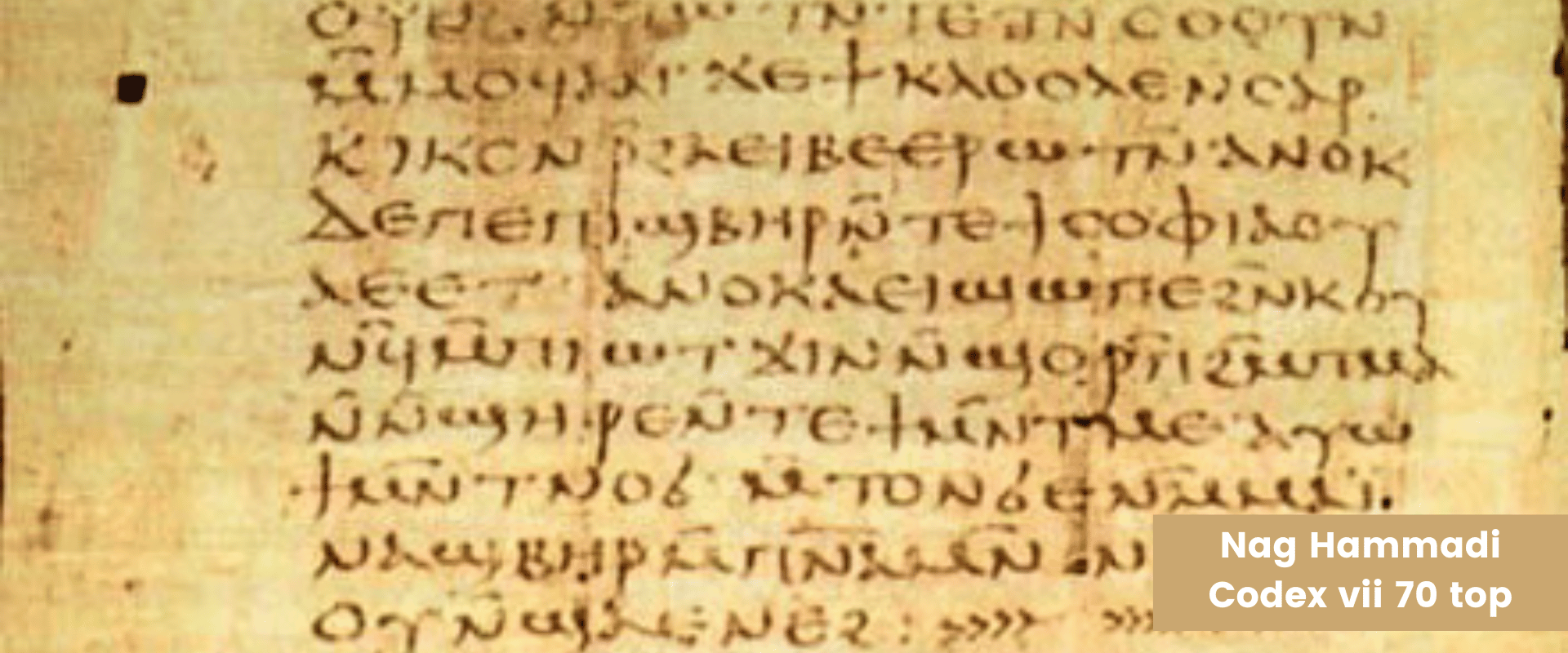
However, in 1945, a group of Gnostic texts were found near the Egyptian town of Nag Hammadi (which is why the collection is known as the Nag Hammadi library). Finally, historians could read about Gnosticism in texts written by Gnostics rather than by their enemies. The results were illuminating, to say the least.
The Nag Hammadi library was not merely a Gnostic gospel library. It contained 13 leather-bound books which had included over 50 distinct texts. Among these were five apocryphal gospels. Unlike the canonical Gospels, however, none of the Nag Hammadi gospels tells the life story of Jesus. Instead, they are representations of Jesus’ teachings according to Gnostic ideas. These texts were composed in the 2nd or 3rd centuries, although the copies found at Nag Hammadi had been made in the 4th century and were found buried in a large jar. In her book The Gnostic Gospels, Elaine Pagels (who popularized the term “Gnostic Gospels”) notes that by the 4th century, these books had been deemed heretical and thus banned by Christian authorities:
But in Upper Egypt, someone, possibly a monk from a nearby monastery of St. Pachomius, took the banned books and hid them from destruction in the jar where they remained buried for almost 1,600 years.
The fact that someone hid these books rather than simply burning them indicates that whoever buried them believed they had spiritual value, despite the prohibitions of 4th-century Christian authorities.
For those interested in reading the Nag Hammadi library for themselves, I recommend The Nag Hammadi Scriptures: A Study of Gnostic Scriptures and Early Christian Thought, which is almost a kind of Gnostic Bible. Each book includes an introductory essay and annotations to help explain difficult passages and, of course, it includes the Gnostic Gospels and the other, more visionary writings.
Having explained the background of the Nag Hammadi library, I’ll now describe its five gospels, as well as one other found elsewhere, in a bit more detail. By the way, another Gnostic Gospel, The Gospel of Judas, was found in the 1970s in a different Egyptian location. For more info on it, read Marko Marina’s article here.

List and Brief Summaries of Gnostic Gospels
As I noted above, these gospels were written long after Jesus’s death and even long after the writing of Matthew, Mark, Luke, and John. For this reason, they are generally considered as part of a secondary layer of Christian tradition and thus much less valuable as history than the original Gospels (although the canonical Gospels are certainly not perfect historical sources either).
That said, there is one exception among the Gnostic Gospels: the Gospel of Thomas. While likely written in the 2nd century, it contains a lot of material that overlaps with the canonical Gospels. For that reason, some scholars argue that it probably contains authentic, independent sayings of Jesus. For instance, Annette Merz and Gerd Theissen claim that the book’s format, a collection of sayings without a narrative, was probably how the earliest traditions about Jesus were handed down. On the other hand, Mark Goodacre argues that the author of the Gospel of Thomas merely took sayings of Jesus from the Synoptic Gospels and reinterpreted them in line with the teachings of his (possibly Gnostic) community. The debate goes on.
Since we are discussing it, let’s look into the Gospel of Thomas a bit further.
Gospel of Thomas
The prologue of this gospel says “These are the hidden sayings that the living Jesus spoke and Didymus Judas Thomas wrote down.” Note that these sayings are said to be hidden, in other words, they are not intended for everyone. This alone differentiates them from the canonical Gospels, which make no such claims.
While some of the sayings in Thomas parallel those from the Synoptics, some of these are slightly different. The Parable of the Sower, for instance, is found in Matthew, Mark, Luke, and Thomas. However, in Thomas, there is no later explanation of the parable as there is in the Synoptics. The same is true for the Parable of the Mustard Seed. It also quotes Jesus as saying “Blessed are the poor, for theirs is the Kingdom of Heaven,” a saying found almost identically in Luke.
Nevertheless, many of the sayings in Thomas are cryptic at best. Here are a couple of examples:
Jesus said, "The man old in days will not hesitate to ask a small child seven days old about the place of life, and he will live. For many who are first will become last, and they will become one and the same" (saying 4).
Jesus said, "Blessed is the lion which becomes man when consumed by man; and cursed is the man whom the lion consumes, and the lion becomes man" (saying 7).
As Elaine Pagels points out, these seem more like Zen koans, paradoxical riddles used to provoke enlightenment, than straightforward teachings. In short, the Gospel of Thomas oscillates between familiar sayings with Synoptic parallels and these more esoteric sayings.
Gospel of Philip
Although this gospel was found bound in the same ancient book as the well-known Gospel of Thomas, it’s not nearly as famous. The sole manuscript of the Gospel of Philip was found in the Nag Hammadi library. While it can broadly be called Gnostic, Bart Ehrman notes that it belonged specifically to a group known as the Valentinians, named after their founder Valentinus, and that it was written in the 3rd century. Oddly, though, the book’s author does not claim to be the Apostle Philip, although he is the only one of the 12 disciples named in the book.
Unlike the canonical Gospels but like the Gospel of Thomas, the Gospel of Philip has no central narrative. In summary, it’s an assemblage of aphorisms, parables, discussions, and exegeses of the book of Genesis. Wesley Isenberg notes that while the Gospel of Philip contains 17 sayings attributed to Jesus, nine of them are very similar to sayings in the canonical Gospels. Consider this example:
"Whoever doesn't eat my flesh and drink my blood doesn't have life in them." (Gospel of Philip, Resurrection, 57).
So Jesus said to them, “Very truly, I tell you, unless you eat the flesh of the Son of Man and drink his blood, you have no life in you” (John 6:53).
There are also a lot of gaps in the text, which makes it difficult to translate (translators have filled in the blanks the best they can). Nevertheless, there are many enigmatic phrases which are difficult to interpret:
The Lord said, "Blessed is the one who exists before existing, because they who exist did exist, and will exist."
Those who say that the Lord died first and then rose up are in error – for He rose up first and then died.
Those who say they will die first and then rise are in error. If they do not first receive the resurrection while they live, when they die they will receive nothing.
Jesus came to crucify the world.
In addition, the text focuses a lot on Mary Magdalene and her closeness to Jesus.
Gospel of Truth
Like all the other Nag Hammadi gospels, the Gospel of Truth—written in the 2nd century CE—is not the story of Jesus’ life on earth. In fact, Jesus never makes an appearance as a speaker in this gospel. Instead, an anonymous narrator has written a discourse on the meaning of Jesus’ coming to earth. In rather classic Gnostic form, the Gospel of Truth is a theological treatise on salvation through saving knowledge (gnosis). One of its main themes, therefore, is about how humanity’s spiritual ignorance brought the inferior material world into being.
The treatise goes on to explain that this is the reason for Jesus’ mission. Like the Gospel of John, the Gospel of Truth describes Jesus as the divine Logos or Word of God. However, in this case the Word was sent to heal humanity’s spiritual blindness by teaching them their true origins. It also teaches that Jesus’ crucifixion was meant to teach humanity about sloughing off this mortal coil and thus becoming the immortal, non-physical beings they were meant to be. There is, therefore, no language of sacrifice around the crucifixion in the Gospel of Truth.
By ridding themselves of the profane material world, then, humanity can return to their origin, called the Pleroma or “fullness” in the Gospel of Truth. This is apparently another designation for the Monad or original unity, which many Gnostic groups considered the origin of the material universe.
Gospel of the Egyptians
Also known as the Holy Book of the Great Invisible Spirit, this 2nd-century gospel emerged from the Gnostic group known as the Sethians, who were named after Seth, the 3rd son of Adam and Eve (Gen 4:25). It begins with a cosmology in which the supreme deity, called the “Great Invisible Spirit,” emanated lesser deities known as the Father, the Mother (or Sophia, “Wisdom”), and the Son (Jesus), as well as other divine beings.
Meanwhile, although Jesus himself does not appear or speak in the text as a character, the anonymous author explains that Seth started an “incorruptible race,” and that he was a previous incarnation of Jesus. Jesus himself is said to have come down from the heavens into the realm of a hostile group of divine rulers known as the Archons in order to free people, through knowledge, from material creation.
So, how are humans freed from the material realm? The text orders them to undergo a type of baptism ritual known as the "five seals," through which they will know their divine origin, overcome the Archons, and become immortal as their souls ascend to the Great Invisible Spirit.
Gospel of Mary
Written in the late 2nd or early 3rd centuries CE and discovered in the Berlin Codex— a 5th-century manuscript written in Coptic— this gospel is usually believed to be about Mary Magdalene, since she was known to have been an important follower of Jesus, although it never says so explicitly. Some have argued that it was about Mary—the mother of Jesus—or another Mary.
Its story centers around Mary comforting the disciples after Jesus’ death by relating a secret vision she received from the risen Jesus. However, this leads to a power struggle since some of the disciples don’t believe that Jesus would give a woman secret knowledge not imparted to them.
While the text is fragmentary, missing several pages and with gaps in the extant pages, it seems to be divided into two main sections. The first section, due to missing pages, starts in the middle of a scene, which leaves the setting and situation difficult to know for certain. However, in an edited volume, Karen King argues that this first scene is likely a post-Easter appearance of Jesus to his disciples.
In this section, Jesus teaches the disciples that the soul must go beyond the physical world to find salvation through divine knowledge. He tells them to spread this word to the world, but the disciples are afraid to do so.
In the second section, Mary reassures the other disciples, which prompts Peter to ask her about Jesus’ secret teachings. She tells them that in her vision, Jesus showed her how the soul rises past hostile cosmic powers to find infinite repose. Some of the disciples, Peter and Andrew especially, resent her and reject what she says.
Apocryphon of James
This text was likely written in the 2nd century. The “James” featured here is said to be the brother of Jesus, known to have been an early leader of the church in Jerusalem (Acts 15:13–21). In fact, the text purports to be a letter written by James to an unknown recipient (the name is obscured by damage to the text). In this letter, “James” claims to have written a secret book in Hebrew, the words of which were revealed to him by the risen Jesus 550 days after his resurrection.
The author then says that Jesus had appeared to the 12 disciples and had demanded that James and Peter “be filled.” Not understanding what Jesus means by this, Peter asked him about it. Jesus then took James and Peter aside to "fill" them with gnosis, helping them to realize their true, divine nature.
Because of their spiritual nature, Jesus says believers must not fear suffering and death since it will free them from the lower, material realm. He then tells them of the importance of self-knowledge in order to understand their true nature.
Conclusion
Gnosticism was an early form of Christianity with a vast cosmology involving battling divine beings and secret, saving knowledge. All the groups placed under the moniker “Gnostic” were ultimately wiped out as the position we now know as Nicene or Orthodox Christianity became the standard of most churches worldwide.
Meanwhile, a group of Gnostic texts known now as the Nag Hammadi library were found in Egypt in 1945. These precious sources gave historians firsthand knowledge of some of the beliefs and practices of these groups. Among these 50 diverse texts were six gospels.
While we think of Gospels as biographies and teachings of Jesus of Nazareth, the Gnostic Gospels hardly address Jesus’ life at all. Instead, they either reproduce his supposed teachings or talk about his real cosmic purpose in coming down from heaven: to bring human beings the knowledge or gnosis they needed to free themselves from the inferior physical world. As such, these texts provide powerful examples of differing views of Jesus, his mission, and the significance of the Christian community, views that before were only known through the writings of hostile heresy hunters.