
Who was Clement of Rome? Summary and Commentary of 1 Clement

Written by Joshua Schachterle, Ph.D
Author | Professor | Scholar
Author | Professor | BE Contributor
Verified! See our editorial guidelines
Verified! See our guidelines
Date written: June 9th, 2026
Disclaimer: The views and opinions expressed in this article belong to the author and do not necessarily match my own. - Dr. Bart D. Ehrman
The letter known as 1 Clement is at the intersection between the world of the apostles and the emerging structure of the early Christian church. Written near the end of the first century CE, it is one of the earliest surviving Christian writings outside the New Testament and offers a fascinating glimpse into how believers understood authority, unity, worship, and tradition in the decades after the deaths of Peter and Paul.
In this article, I’ll investigate the identity of Clement of Rome, the letter’s presumed author, the historical context and dating of 1 Clement, why such a respected work was ultimately left out of the New Testament, and the major themes that run through the letter itself. Along the way, we will see how this ancient epistle preserves the concerns of a church struggling to maintain unity in a turbulent age—and how its ideas would echo throughout Christian history for centuries to come.
What is 1 Clement?
The 1st Epistle of Clement is an early Christian letter with an introduction that tells us where it comes from and who its intended recipients are:
The church of God which sojourns at Rome, to the church of God sojourning at Corinth, to them that are called and sanctified by the will of God, through our Lord Jesus Christ: Grace unto you, and peace, from Almighty God through Jesus Christ, be multiplied.


In fact, the letter was written as a response to dramatic events that had happened in the Corinthian church. Several clergy members— the author uses the Greek word presbyteros, which can mean “elder,” “priest,” or “bishop” in early church texts—had been forcibly deposed by the congregation. The author opposes this action and explains why those unseated leaders should be reinstated.
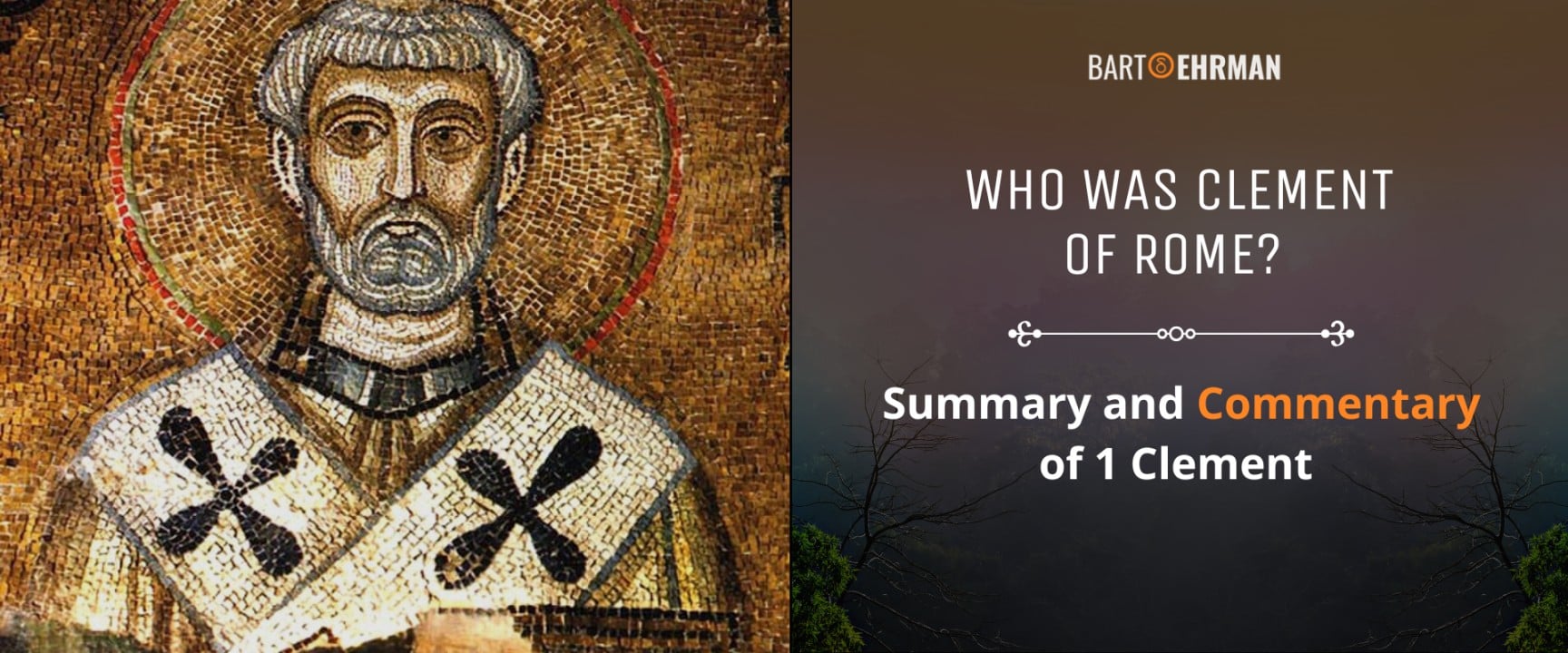
Although the letter was written anonymously, not only missing a title but without any other internal identifying evidence, it has long been attributed to Clement of Rome, who is said in other ancient writings to have been an early bishop of Rome. However, this identification turns out to be more complicated than it might appear.
Who Was Clement of Rome?
In Philippians 4:2–3, Paul refers to several of his fellow Christians by name:
I urge Euodia and I urge Syntyche to be of the same mind in the Lord. Yes, and I ask you also, my loyal companion, help these women, for they have struggled beside me in the work of the gospel, together with Clement and the rest of my coworkers, whose names are in the book of life.
It's possible that this brief reference inspired the later identification of Clement with the author of the epistle, although the name Clement (Latin: Clemens) was a common name in 1st and 2nd-century Rome, according to Elmer Merrill. However, later Christian authors added fuel to the fire. Bart Ehrman notes that we get conflicting reports about the place of Clement in the church of Rome depending on which author or text we read. In Against Heresies, for instance, Irenaeus of Lyons, writing in the 2nd century, says that Peter and Paul appointed someone named Linus as bishop of Rome before they were executed.
Eusebius, however, whose 4th-century Church History is a foundational document for the early centuries of the church, says “the first to be called bishop after the martyrdoms of Peter and Paul was Linus.” In other words, Eusebius believes Linus’ appointment happened after Peter and Paul’s deaths, meaning that he must have been appointed by someone else.
Eusebius goes on to say that after Linus, there came “Clement again, who became the third Bishop of Rome….” So if you’re keeping score, Eusebius seems to count Peter as the first bishop of Rome, Linus as the second, and Clement as the third. But wait! There’s more! In his book The Prescription Against Heretics, Tertullian, a 2nd-century North African Christian, writes instead that Clement was the first bishop of Rome and was appointed directly by Peter. Figuring out who (if anyone) to believe is quite the historical pickle.
Ehrman points out that in Paul’s letters—written mostly in the 50s CE and including the one written to the church of Rome—there is no mention of a designated leader of Christian communities. That is, in the 50s CE, Christian communities did not feel the need for a bishop or other titled leader. Sixty years later, when the martyr Ignatius, bishop of Antioch, writes his farewell exhortations to Christian communities in several cities, he assumes there are bishops over each of them except Rome, where he writes to the entire community instead.
Moreover, the author of 1 Clement assumes not that a bishop is head of the church of Corinth to which he is writing, but that they are governed by a kind of panel of presbyters, all of whom have been deposed by the congregation. Therefore, if, indeed, this letter was written by Clement of Rome, it seems unlikely he was sole bishop of Rome at the time, although he could certainly have been a member of their board of presbyters.
(Affiliate Disclaimer: We may earn commissions on products you purchase through this page at no additional cost to you. Thank you for supporting our site!)
When Was 1 Clement Written?
As with most ancient documents, scholarly opinions on the date of composition of 1 Clement vary. Scholars such as Thomas Herron believe the letter was written prior to 70 CE since it does not mention the destruction of the Temple, a hugely significant event, which happened then. However, most scholars date the letter to the mid-90s of the 1st century CE for several reasons. For instance, in chapter 47 of the letter, the author writes
It is a shameful report, beloved, extremely shameful, and unworthy of your training in Christ, that on account of one or two persons the steadfast and ancient church of the Corinthians is being disloyal to the presbyters.
If the author is writing in 70 CE or earlier, he could hardly call the church Paul founded in the 50s ancient. If he’s writing 25 years after that, however, “ancient” makes a bit more sense. He also says in chapter 63 that those delivering the letter from Rome are “faithful and prudent men, who have lived among us without blame from youth to old age.” This indicates that the men may have been present at the earliest foundation of the church in the 50s, but are now probably over 40, indicating that the church has been around for multiple decades.
By the way, if the date of 95–97 CE is correct, that puts it in the same time range as the composition of the Book of Revelation, although in a very different environment from the relatively isolated island of Patmos.
Why Was 1 Clement Excluded From the Canon?
In addressing popular Christian books that were nevertheless excluded from the canon, Harry Gamble writes that with some very well-known early books, the passage of time eroded their use among Christians:
What needs to be emphasized in respect of many of these documents, especially 1 Clement, Barnabas, the Shepherd, and the Didache, is that the esteem and use attaching to them was appreciably earlier, more continuous, and more widespread than to many of the writings that were finally accepted in the canon, including Hebrews, 2 Peter, James, and 2 and 3 John. Some of them, indeed, continue to appear in canon lists and manuscripts of the fourth century. If the scope of the canon had been determined in the second century, it seems likely that they would have found a place in it.
In other words, while there is nothing theologically objectionable in 1 Clement for early Christians, its widespread use in churches seems to have merely diminished with time until it no longer seemed important enough to include in the canon by the 4th century. In addition, the fact that the author was not, or did not claim to be, one of the original apostles may have given it less weight than other New Testament books.
This doesn’t mean, by the way, that Christians rejected the book altogether. It was included in the 5th-century Bible known as Codex Alexandrinus as part of the New Testament, and a medieval Arab scholar named Ibn Khaldun even mentions it as part of the New Testament in the 14th century.

The Content of 1 Clement
This letter is long, folks (65 chapters!). To go through and summarize every part of it would be far beyond the scope of this humble article. However, I’ll start with a very brief summary of the letter’s scope and purpose and then focus specifically on a few key chapters.
1 Clement is an epistle written by an anonymous representative from the church of Rome to the church of Corinth in order to vigorously protest its recent overthrow of local church leaders. The author insists that those who removed the leaders of the church must, as a matter of Christian humility and obedience, stand down and give authority back to those presbyters.
Since this is the purpose of the letter, the author uses scriptural examples and other forms of rhetoric to demonstrate why returning power to the original presbyters is the best course of action. Let’s start with chapter 5, which gives an interesting indication of how the author of the letter and his Roman community remembered and passed down key events in the early church.
In chapter 5, the author, claiming that those who deposed the leaders were motivated by the sin of envy, warns about the dire consequences of envy by giving two important apostolic examples:
Through jealousy and envy the greatest and most righteous pillars of the Church were persecuted and contended unto death. Let us set before our eyes the good apostles: Peter, who because of unrighteous jealousy suffered not one or two but many trials, and having thus given his testimony went to the glorious place which was his due. Through jealousy and strife Paul showed the way to the prize of endurance; seven times he was in bonds, he was exiled, he was stoned, he was a herald both in the East and in the West, he gained the noble fame of his faith, he taught righteousness to all the world, and when he had reached the limits of the West he gave his testimony before the rulers, and thus passed from the world and was taken up into the Holy Place, the greatest example of endurance.
Since Paul and Peter have long been assumed to be leaders of the Roman church, these are key examples for the author to use to persuade the Corinthian rebels of their wrongdoing. Peter, in particular, seems not to have been killed only by Roman authorities but also through the envy (of other Christians? We’ll never know.). The rhetorical purpose of the commentary here is clear: the author is placing the usurpers in Corinth in the same category of those who killed Peter and Paul rather than the category of the righteous apostolic martyrs.
Later on, in chapters 31 and 32, the author writes about the Old Testament patriarchs, focusing specifically on Jacob “who departed from his country in meekness because of his brother, and went to Laban and served him, and to him was given the scepter of the twelve tribes of Israel.” In other words, it was because of Jacob’s humility in serving his future father-in-law, Laban, that he eventually became the father of the twelve tribes. Those who serve will be worthy of leadership.
In chapter 42, the author writes of apostolic succession, the notion that all church authority was passed down by the original apostles, and how it goes directly back to Christ. He thus says that
the Apostles received the Gospel for us from the Lord Jesus Christ, Jesus the Christ was sent from God. The Christ therefore is from God and the Apostles from the Christ. In both ways, then, they were in accordance with the appointed order of God's will.
While it doesn’t appear that each church at this point was governed by a single bishop, each had a set of presbyters who could trace their appointments directly back to one of the apostles, and thereafter to Christ. The implication of this commentary is clear: those leaders deposed were enacting God’s will through apostolic succession. You, the rebels, are going against the will of God in Christ.
Chapter 44 explains this further, saying that a system was set up by the apostles so that if any of the original appointees died, others could be appointed in their place. This being the case, the rebel faction had no right to depose the original leaders.
Chapter 46 sounds very much like one of Paul’s letters, decrying strife among the members of the Christian community:
Why are there strife and passion and divisions and schisms and war among you? Or have we not one God, and one Christ, and one Spirit of grace poured out upon us? And is there not one calling in Christ? Why do we divide and tear asunder the members of Christ, and raise up strife against our own body, and reach such a pitch of madness as to forget that we are members one of another?
Using Paul’s metaphor of a body, all the members of which must work together, the author softens his tone near the end of the letter, calling for those who took over the church to humble themselves and repent. We don’t know what response, if any, came from the Corinthian church rebels.
Finally, in chapters 59–61, we have an interesting example of an early Christian prayer, known as the prayer of 1 Clement. In fact, it’s one of the oldest examples of liturgical prayer outside of the New Testament. The prayer is long, but several important themes emerge that remain as themes of liturgical prayer in many Christian traditions today.
#1 – Divine Help and Salvation: The prayer asks God to "be our help and defender," to “save the distressed, lift the fallen, and heal the sick.”
#2 – God’s Sovereignty: It praises God as Creator, Judge, and ruler of all, who "alone can give us these gifts."
#3 – Intercession for Leaders: Interestingly, it prays for wisdom and harmony for "our rulers and governors on earth". Keep in mind that Christians were still not entirely safe from persecution in Rome at this time.
#4 – Peace and Unity: It asks for harmony among people, echoing and emphasizing the theme of unity in the rest of the Epistle.
What is noteworthy here is that the author prays for the Roman governors while still emphasizing that they are ultimately subject to the rule of God. This prayer, or parts of it, is used regularly in Catholic and Anglican liturgies, although less often in the Orthodox tradition.
Conclusion
The letter known as 1 Clement is an early Christian document, most likely written near the end of the 1st century CE. Although written anonymously, it has long been attributed to Clement of Rome, a shadowy figure mentioned briefly in one of Paul’s letters and subsequently in histories written from the 2nd to the 4th centuries as an early bishop of Rome.
Unlike some apocryphal literature, there is nothing in 1 Clement that would offend those who ultimately would formulate orthodox Christianity. However, its use faded with time to the point that it was eventually excluded from the biblical canon. Unlike some other books, however, it was never denigrated as heretical, and people continued to read it long after its exclusion.
The letter, written from the Roman church to the church in Corinth, pleads with a new group of upstart leaders, who had deposed the appointed leaders in a veritable coup, to humble themselves and give power back. The author’s argument for this course of action focuses on holy examples of humility and service, including the Israelite patriarchs and the apostles Peter and Paul, showing how those who don’t humble themselves are ultimately putting themselves in opposition to God’s will. This is true, the author argues, because all church leadership was passed down from Christ to the apostles, and henceforth to the leaders of individual churches.
The letter ends with a long prayer covering themes that would echo through the centuries in liturgical traditions and demonstrate some ideas about God that would sustain the church for millennia.