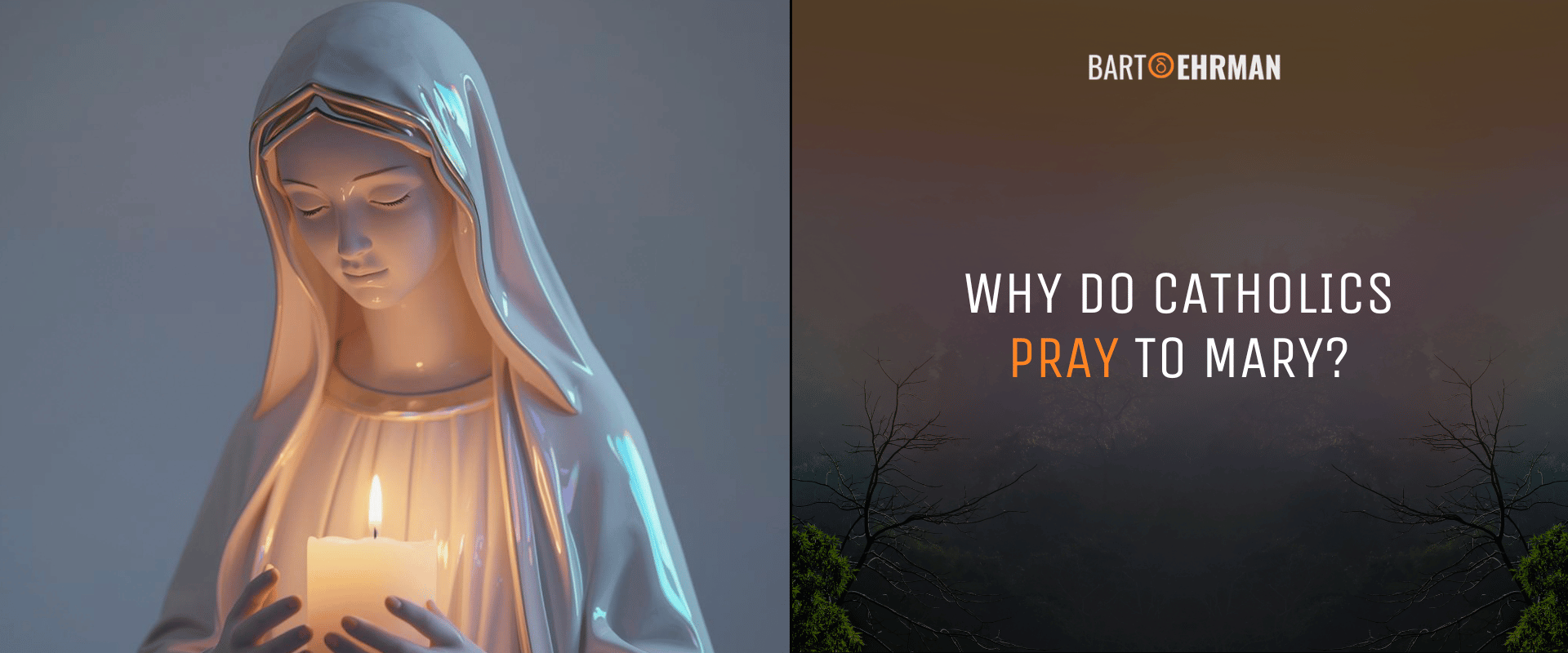
Why do Catholics Pray to Mary?
Written by Marko Marina, Ph.D.
Author | Historian
Author | Historian | BE Contributor
Verified! See our guidelines
Verified! See our editorial guidelines
Date written: April 30th, 2026
Disclaimer: The views and opinions expressed in this article belong to the author and do not necessarily match my own. - Dr. Bart D. Ehrman
Why do Catholics pray to Mary? Whenever this question comes around, I am reminded of the profound influence and importance of the Virgin Mary in my own country, Croatia.
Her name is so deeply woven into the collective memory and identity of the nation that it appears not only in churches and devotional practices, but even in moments of everyday life. This is perhaps most strikingly evident in the songs sung at wedding ceremonies, where invocations of Mary often set the tone for the entire celebration.
For many, this is simply part of the cultural and religious landscape, something inherited rather than questioned.
Yet for others (especially those outside the Catholic tradition) the prominence of Mary can raise a more pointed and sometimes puzzling question: why does she occupy such a central place in Catholic life and devotion?
From a historical perspective, this question opens up a much broader inquiry than it might initially appear.
It’s not simply a matter of identifying a single belief or practice, but of understanding a complex development that unfolds over time, shaped by theological reflection, liturgical practice, and evolving concepts of religious authority.
The practice of praying to Mary, in particular, often strikes observers as difficult to reconcile with the earliest Christian sources, especially the New Testament, where such forms of devotion aren’t explicitly attested.
How, then, did this practice emerge, and on what basis is it understood and justified within Catholicism?
This article approaches the question from a scholarly and historical angle. It begins by briefly outlining how authority is understood within the Catholic tradition, especially the relationship between Scripture and Tradition.
It then turns to the New Testament itself to examine what can be said about Mary in the earliest Christian texts. Finally, it traces the gradual rise of Marian devotion in the centuries after the New Testament, showing how theological developments and popular piety contributed to the prominent role Mary came to hold.
Only by situating the practice within this broader historical framework can we begin to understand why, for many Catholics, prayer to Mary isn’t an anomaly, but a meaningful and coherent expression of their faith.
However, before we begin exploring why Catholics pray to Mary, I think you could be interested in an engaging online course by Bart D. Ehrman titled In the Beginning: History, Legend, or Myth in Genesis?.
Across six accessible and thought-provoking lectures, Dr. Ehrman examines chapters of Genesis through a historical-critical lens, unpacking what we can (and cannot) know about creation, Adam and Eve, the flood, and the patriarchs. If you’re interested in how modern scholarship approaches some of the Bible’s most famous stories, this course offers a clear, compelling, and intellectually rigorous introduction.
Theological Background: The Catholic View on Scripture and Tradition
In our exploration of the reasons why Catholics pray to Mary, we have to begin with a broader theological context. Namely, while many Protestant traditions uphold the doctrine of sola scriptura (the idea that Scripture alone serves as the ultimate authority in matters of faith) the Catholic Church has, for centuries, promoted a different understanding of divine authority.
For Catholics, authority rests on a threefold foundation: Scripture, Apostolic Tradition, and the teaching authority of the Church (the Magisterium).
Within this framework, Apostolic Tradition holds a particularly important place, not as a secondary or derivative source, but as a living and dynamic transmission of the faith.
As Mark Zia explains in his book The Faith Understood: An Introduction to Catholic Theology:
(Affiliate Disclaimer: We may earn commissions on products you purchase through this page at no additional cost to you. Thank you for supporting our site!)
Tradition is the sacred memory of the Church, enabling the Church to never lose sight of her foundation in Christ and her heavenly mission of being the new ark of salvation for the human race. Indeed, Sacred Scripture is written principally in the Church’s heart rather than in documents and records, for the Church carries in her Tradition the living memorial of God’s Word, and it is the Holy Spirit who gives her the spiritual interpretation of the Scripture. Within this rich and venerable Tradition, there is contained the voluminous spiritual insights of the great Fathers, Doctors, and saints of the Church that lie within the ‘heart of the Church’.


This threefold structure of authority has significant implications for how doctrines and practices develop within Catholicism. Scripture remains foundational, but it’s not interpreted in isolation. Rather, it’s read within the living tradition of the Church and under the guidance of its teaching authority.
The Magisterium, for its part, serves to articulate and clarify this inherited faith in response to new historical circumstances, ensuring continuity while allowing for doctrinal development over time.
It’s precisely within this broader framework that the question of why Catholics pray to Mary must be situated. From a strictly Sola Scriptura perspective, the absence of explicit New Testament endorsement of Marian prayer poses a significant challenge, and for many Protestant traditions, this absence is decisive.
Catholic theology, however, approaches the issue differently. Because authority isn’t confined to the biblical text alone, but includes the accumulated theological reflection and devotional life of the Church, practices such as invoking Mary’s intercession can be understood as developments that emerge organically from the Church’s engagement with its foundational beliefs.
Seen in this light, Marian devotion isn’t perceived by Catholics as a departure from early Christianity, but as a legitimate outgrowth of it, nurtured within the Church’s broader interpretive and theological tradition.
This doesn’t mean that the practice can be directly traced in a straightforward way to the New Testament itself, but rather that it’s rooted in a way of reading and living the Christian message that extends beyond the text alone.
To understand how this process unfolded, however, we must first turn to the New Testament and examine what it actually says (and doesn’t say!) about Mary.
Mary in the New Testament: What Do We Know?
In his book Mary in Early Christian Faith and Devotion, Stephen J. Shoemaker notes:
In light of the prominence to which Mary would later rise in the Christian tradition, it is perhaps a bit surprising how little she figures in the New Testament and other early Christian literature from the first century or so. For instance, Mary is almost invisible in the earliest Christian writings that we possess, the letters of Paul. Paul mentions Mary just once and in the vaguest possible terms: without naming her, he remarks that ‘God sent his Son, born of a woman’ in his letter to the Galatians (4.4), written sometime in the early 50s ce. Here, Mary is little more than a biological fact, albeit an important one that guarantees the humanity of Christ for Paul and thus the reality of the Incarnation. But Mary herself has no broader significance and is not sufficiently important to merit even a name, let alone any interest in the details of her life or person.
This observation provides an important starting point: the earliest strata of the New Testament offer only minimal information about Mary.
The situation doesn’t change dramatically in the Gospel of Mark, generally considered the earliest Gospel. There, Mary is named, but her role remains limited and somewhat ambiguous. In one passage, Jesus is identified simply as “the son of Mary,” while in another, his family (including his mother) appears to misunderstand his mission, even attempting to restrain him.
Such traditions, as Shoemaker suggests, may reflect not straightforward historical memory but theological tensions within early Christianity, particularly in circles influenced by Pauline perspectives that sought to downplay the authority of Jesus’ family.
By contrast, later Gospels present a more developed and theologically significant portrait of Mary.
Matthew introduces the tradition of the virginal conception, emphasizing Jesus’ divine origin, while Luke offers the most extensive depiction: Mary is the recipient of the angelic announcement, the one who responds in faith, and the voice behind the Magnificat, a hymn that situates her within the broader story of Israel’s salvation.
In Luke, she is explicitly called “blessed among women” and is portrayed as a model disciple: one who hears and obeys the word of God. John’s Gospel, meanwhile, places Mary at key moments of Jesus’ ministry, from the wedding at Cana (where her request prompts his first sign) to the crucifixion, where she stands at the foot of the cross.
These traditions collectively elevate Mary’s significance, yet even here there is no clear evidence of prayer directed to her or of the kind of devotional practices that would later characterize Christian piety.
What emerges, then, is a diverse and theologically shaped set of traditions rather than a single, unified portrait.
The New Testament presents Mary as the mother of Jesus, at times as a figure of faith and obedience, and occasionally as one whose relationship to Jesus is marked by tension or misunderstanding.
It doesn’t, however, present her as an object of prayer or intercession. This distinction is crucial for understanding the broader question of why Catholics pray to Mary. Namely, the roots of Marian devotion aren’t found in explicit New Testament practice, but in how these early traditions were later interpreted, expanded, and integrated into the developing life of the Church.
To see how this transformation occurred, we must now turn to the centuries following the New Testament and trace the gradual rise of Marian devotion within early Christianity.
DID PAUL AND JESUS HAVE THE SAME RELIGION?
Jesus taught a message of repentance to prepare for the Kingdom of God while Paul taught faith in Jesus. Did they agree? Should they be considered the “co-founders” of Christianity?
Why Do Catholics Pray to Mary? The Rise of Devotion
Understanding why Catholics pray to Mary means, first and foremost, to look at the development of Mary’s figure in the centuries that followed after the New Testament documents were written.
As we have seen, the earliest Christian sources offer only a limited and theologically varied portrait of Mary, without any clear evidence of prayer directed to her.
Yet already in the 2nd century, important conceptual foundations began to emerge. Early Christian thinkers such as Irenaeus and Justin Martyr developed the influential parallel between Eve and Mary: just as Eve’s disobedience contributed to humanity’s fall, so Mary’s obedience played a role in salvation.
This typology didn’t yet involve prayer to Mary, but it significantly elevated her theological status and situated her within the broader drama of redemption. In this way, reflection on Christ (especially on his incarnation) naturally led to deeper reflection on his mother.
The 3rd century, however, presents a far more complex and uneven picture. As Stephen J. Shoemaker emphasizes, this period doesn’t show a steady or uniform rise in Marian devotion, but rather a diversity of perspectives.
Some prominent figures, such as Tertullian, held relatively low views of Mary, questioning even her lifelong virginity and emphasizing passages in which Jesus appears to distance himself from his family. Others, such as Origen, offered more elevated but still cautious assessments, portraying Mary as faithful yet not without doubt.
At the same time, beyond the writings of elite theologians, other forms of evidence point in a different direction.
Apocryphal texts and emerging devotional practices reveal a growing fascination with Mary, sometimes portraying her as a recipient of special revelation or as a figure with unique spiritual authority.
Most significantly, the famous Sub tuum praesidium papyrus (likely dating to the late 3rd century) preserves one of the earliest known prayers addressed directly to Mary, asking for her protection and deliverance.
This indicates that, even if formal theology had not yet fully articulated Marian doctrine, the practice of invoking Mary’s intercession had already begun to take shape in certain Christian communities.
Devotion to Mary After Constantine’s Conversion
From the 4th century onward, these early developments expanded rapidly and took on more institutional and doctrinal clarity. As Christianity became more firmly established within the Roman Empire with Constantine's conversion, Marian devotion found expression in liturgy, art, and public worship.
Churches were dedicated to Mary, feasts commemorating key events in her life were introduced, and prayers invoking her assistance became increasingly common.
At the same time, theological reflection intensified, particularly in connection with debates about the nature of Christ.
The designation of Mary as Theotokos or the “God-bearer” (formally affirmed at the Council of Ephesus) was intended to safeguard the full divinity of Christ, but it also had the effect of elevating Mary’s status within Christian thought and devotion.
In this context, turning to Mary in prayer came to be understood not as a departure from Christ-centered faith, but as an extension of it, grounded in her unique relationship to the incarnate Son.
At this stage, it’s also important to recognize that Marian devotion didn’t develop in a single, uniform way across the Christian world. In his book What Every Catholic Should Know About Mary, Terrence J. McNally notes:
The world in which Christianity grew up was divided into the Eastern and the Western Roman Empire. Two different societies and cultures existed: the capital of the West was Rome and the capital of the East was Byzantium or Constantinople (modern Istanbul). Latin was the predominant language of the West; Greek was the predominant language of the East. Thus we speak of the Fathers of the Church as being either Latin or Greek. These two distinct cultures produced two distinct Mariologies. The Roman West produced a more intellectual Mariology, one with carefully defined dogmas supported by logical theological arguments. The Greek East produced a Mariology of perhaps greater spiritual depth with less formally defined dogma.
This distinction helps explain why Marian devotion could take on different emphases.
Namely, in the East, it often developed through liturgical poetry, hymnography, and a deeply mystical sense of Mary’s role as intercessor and protector, while in the West it tended to be articulated through systematic theology and, eventually, formal doctrinal definitions.
In the centuries that followed (especially throughout the medieval period) these trajectories converged in the widespread and deeply rooted forms of Marian devotion that are familiar today.
Mary came to be invoked as a compassionate intercessor, a maternal figure who could advocate for believers before Christ.
Devotional practices such as the rosary, pilgrimages to Marian shrines, and the proliferation of Marian feasts all contributed to embedding her presence in the daily religious life of the faithful.
By this stage, the question of why Catholics pray to Mary was no longer a matter of innovation, but of continuity: the practice had become an integral part of the Church’s spiritual and liturgical tradition, supported by centuries of theological reflection and communal practice.
At its core, Marian devotion in the Catholic tradition rests on a specific theological logic: Mary isn’t worshiped as divine, but venerated as the foremost among the saints, uniquely close to Christ and therefore uniquely capable of interceding on behalf of believers.
In his book Catholic Beliefs and Traditions, John F. O’Grady explains:
Catholics will always revere the mother of Jesus. As his mother, Mary never replaces Jesus. Catholics do not worship Mary. Like all Christians, Catholics worship God alone and him whom God has sent, Jesus Christ. Medals, statues, rosaries, scapulars and novenas honoring Mary exist only as sacramentals. They remind people of the love of God through Jesus and the love of Mary the mother of Jesus for all disciples. If rings or pieces of jewelry can remind people of loved ones, other objects can remind people of Mary, of Jesus and of the one God of all.
Prayer to Mary is, therefore, understood from the perspective of the Catholic Church as a request for her intercession, analogous (though not identical) to asking a fellow believer to pray on one’s behalf.
What distinguishes Mary is her singular role in salvation history and her enduring presence within the communion of saints.
Seen in this light, Marian prayer isn’t an alternative to devotion to God, but a particular expression of it: one that has emerged gradually from the earliest centuries of Christianity and continues to shape Catholic faith and practice today.
Conclusion
Whenever I hear that familiar question (Why do Catholics pray to Mary?) I find myself returning, almost instinctively, to the image with which we began: a wedding in Croatia, where a song dedicated to the Virgin Mary quietly frames one of life’s most important moments.
For those who grow up within such a context, Mary’s presence rarely feels like a theological problem to be solved; it’s something lived, embodied, and woven into the rhythms of communal and religious life.
And yet, as this article has shown, what appears self-evident in practice is, in fact, the result of a long and complex historical process: one that moves from the relatively modest portrayal of Mary in the New Testament, through centuries of theological reflection, devotional innovation, and cultural expression.
Seen from this broader perspective, Marian devotion is neither an abrupt departure from early Christianity nor a simple continuation of it, but rather a development shaped by how Christians have understood authority, tradition, and the unfolding meaning of their faith over time.
The songs sung at weddings, the prayers whispered in times of need, and the countless artistic and liturgical expressions of Marian devotion all stand at the end of this long trajectory.
They are the lived outcome of a tradition that has sought to articulate Mary’s significance in relation to Christ and the life of the Church. Understanding this history allows us to see more clearly how and why such a practice came to be, and why, for many Catholics, turning to Mary in prayer continues to feel both natural and meaningful.
NOW AVAILABLE!
In The Beginning™ - History, Legend, & Myth in Genesis
In Part One of Bart's new "How Scholars Read the Bible" Series, dive into the stories of the first book of the Bible from a historical perspective.