
What is the Acts of Paul and Thecla?

Written by Joshua Schachterle, Ph.D
Author | Professor | Scholar
Author | Professor | BE Contributor
Verified! See our editorial guidelines
Verified! See our guidelines
Date written: July 11th, 2026
Disclaimer: The views and opinions expressed in this article belong to the author and do not necessarily match my own. - Dr. Bart D. Ehrman
What is the Acts of Paul and Thecla? This text, which circulated in the early centuries of Christianity, combines dramatic adventure, miraculous deliverance, and a powerful message of chastity and religious devotion, becoming one of the most popular Christian texts outside the New Testament.
In this article, I’ll look at the dating, contents, and historical reliability of the Acts of Paul and Thecla. I’ll also explore its remarkable influence on Christian traditions, views of women, and the development of sainthood. Whether read as history, theology, or both, the story of Thecla offers a valuable glimpse into the beliefs and doctrinal debates among early Christians.
(Affiliate Disclaimer: We may earn commissions on products you purchase through this page at no additional cost to you. Thank you for supporting our site!)
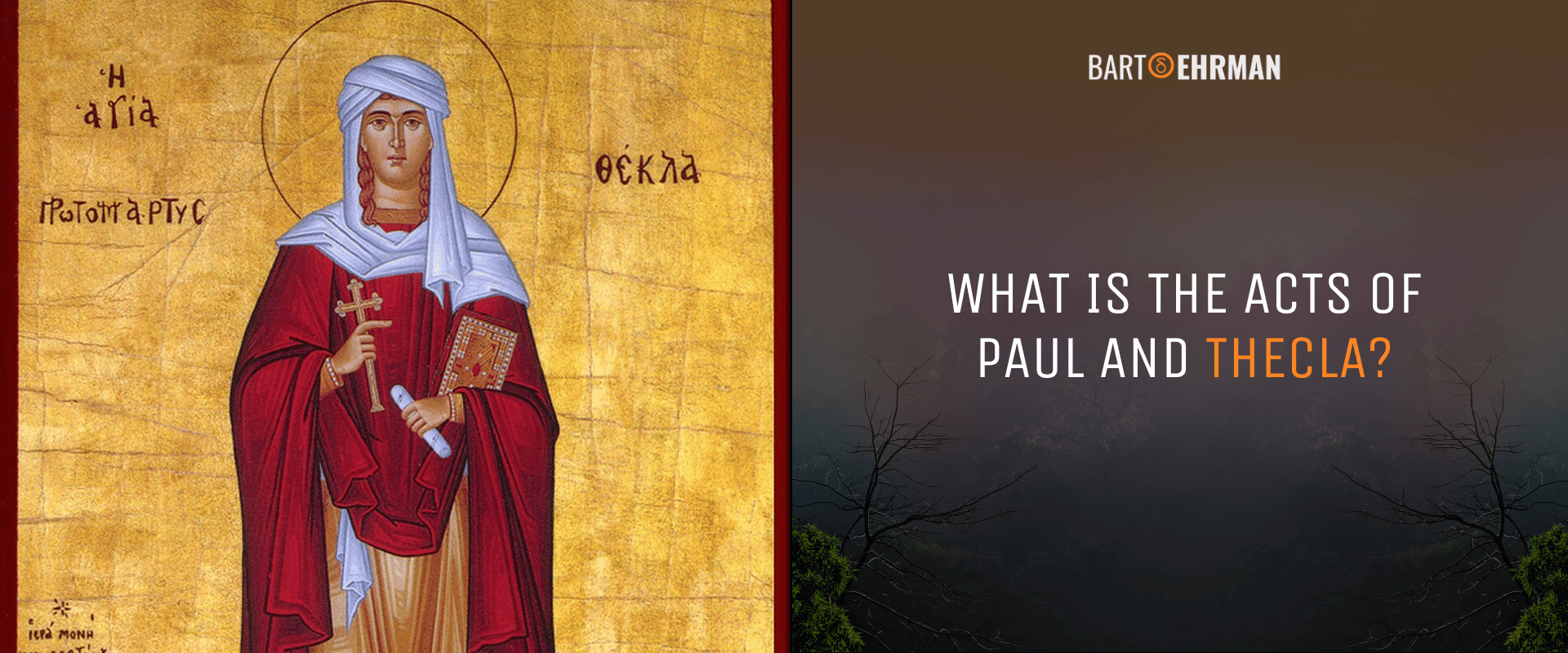
What Is the Acts of Paul and Thecla? Dating, Summary, and Historicity
Dating
The earliest attestation for the Acts of Paul and Thecla comes from Tertullian (155–220 CE), a Christian author from Carthage in North Africa who is also known as the father of Latin Christianity. Tertullian mentions the Acts of Paul and Thecla in his treatise On Baptism, which was written around 190 CE. This indicates that the Acts of Paul and Thecla must have been written earlier and, in fact, most scholars date the work to between 160 and 190 CE. There are also many manuscripts of it in multiple ancient languages, indicating that it was a widely disseminated and quite popular work.
Summary
The Acts of Paul and Thecla, also sometimes known as the Acts of Thecla, is one part of a larger work known as the Acts of Paul. It’s unclear whether it began as part of the Acts of Paul or was later incorporated into a collection of apocryphal tales about Paul. The story of Thecla is organized around two trials to which Thecla is subjected, one in her hometown of Iconium and another in Antioch (either in Syria or Pisidia).
Thecla is introduced as the daughter of a woman named Theocleia. She is betrothed to Thamyris, an influential dignitary within the city of Iconium. However, after hearing Paul preach about the necessity of chastity for salvation (more on this later), Thecla changes her mind about the marriage, deciding to reject her family and Thamyris to follow Paul. In response, Thamyris, who has significant influence in Iconium, has Paul arrested. Thecla, however, still refuses to marry, so she is sentenced to be burned at the stake (her mother is chief among those accusing her).
Nevertheless, she is miraculously saved from execution and, indeed, follows Paul. But when they get to Antioch, an aristocrat named Alexander finds Thecla attractive and offers Paul money for her. Paul claims not to know her, which prompts Alexander to try to take Thecla violently. Thecla fights off his advances, however, and assaults him. For this, she is arrested, but, according to Bart Ehrman’s Lost Scriptures: Books that Did Not Make It into the New Testament,
once more, in a remarkable series of episodes (in which, among other things, Thecla baptizes herself in a pool of ravenous seals), God intervenes on Thecla’s behalf, preserving her from death. She is eventually then reunited with her beloved apostle, Paul, who authorizes her to share fully in his ministry of teaching the word.


There are different versions of the Acts of Paul and Thecla in which details differ. For instance, in some manuscripts, after returning to her hometown to convert her mother to the Christian faith, she goes to live in Seleucia, Cilicia (modern day Türkiye). According to this version, she lived in a cave there for the rest of her 72 years, and became a healer. In other versions, she is able to go to Rome and is buried alongside Paul, indicating her high apostolic status.
Historicity
Despite the text’s popularity in the early centuries of Christianity, most scholars agree that it is probably a pious fiction for a couple of reasons. First, Bart Ehrman writes that Paul’s preaching in the story deviates from the message in Paul’s letters in a significant way. He writes that in the Acts of Paul and Thecla,
Paul is portrayed as a hard-core advocate of sexual renunciation, an apostle who preaches the joys of abstinence to audiences eager to escape the drudgeries of arranged marriages and to evade oppressive social arrangements that appear in the guise of established family. Not surprisingly, those who take Paul’s words to heart (in these tales) are usually women, destined otherwise to live under the oppressive yokes of their future husbands.
To be fair, Paul does write in his own letters that he believed that celibacy was the better mode of life, since it would be best to devote oneself entirely to the Lord (see 1 Corinthians 7). However, Ehrman notes that in his undisputed letters, “Never… does Paul make salvation contingent upon total abstinence.” In the Acts of Paul and Thecla, however, abstinence is Paul’s main message. Take a look, for instance, at a few statements from the sermon which initially attracts Thecla to Paul’s ministry (note that they are in the form of “beatitudes”, those well-known sayings of Jesus from the Sermon on the Mount in Matthew 5):
Blessed are those who have kept the flesh chaste, for they will become a temple of God;
Blessed are those who are self-controlled, for God will speak to them;
Blessed are those who have wives as if they did not have them, for they will be the heirs of God; . . .
Blessed are the bodies of the virgins, for these will be pleasing to God and will not lose the reward for their chastity; for the word of the Father will be an accomplished act of salvation for them on the day of his Son, and they will receive an eternal rest.
This is far more insistent upon celibacy-as-salvation than anything Paul ever wrote in his own letters, where he noted that
because of cases of sexual immorality, each man should have his own wife and each woman her own husband. The husband should give to his wife what is due her and likewise the wife to her husband (1 Cor 7:2–3).
Second, in addition to the story’s departure from the original Pauline message, we also have a claim from the abovementioned Tertullian, who said in On Baptism that he did not believe the Acts of Paul and Thecla to be an authentic account. In fact, he writes that a presbyter from Asia Minor had written the Acts of Paul and Thecla, and then was ousted after confessing his authorship. This may be true, since Tertullian was living during the time that the Acts of Paul and Thecla was written. However, Tertullian also wanted to discredit the story of Thecla because he was anxious to prevent any future women from having power in the church:
For how credible would it seem, that he who has not permitted a woman even to learn with over-boldness, should give a female the power of teaching and of baptizing (On Baptism, Ch. 17).
Interestingly, though, the fact that Tertullian feels the need to argue against the power of a woman in the Acts of Paul and Thecla shows that the role of women in churches was still being hotly debated in the 2nd century.
Another argument against the historicity of the Acts of Paul and Thecla, is that the author uses many tropes associated with pagan Greek romance novels, such as Chariton's Chaereas and Callirhoe or Longus's Daphnis and Chloe. However, instead of making marriage or romance the goal of the main characters, as in the ancient novels, the Acts of Paul and Thecla undermines these tropes to preach asceticism, virginity, and thus, total devotion to Christ.
For instance, while the pagan novels often begin with the well-trodden trope of love at first sight, The Acts of Paul and Thecla begins with Thecla sitting at her window for three days, mesmerized not by Paul’s physical appearance, which is described as ungainly, but by his message of chastity. Similarly, the pagan novels usually depicted the heroine protecting her virginity against aggressive suitors until her true love arrived. However, while Thecla indeed fights off suitors, somewhat mimicking the sexual tension of pagan romances, the Acts focuses entirely on the victory of chastity over sex and marriage.
So, why was the Acts of Paul and Thecla not included in the New Testament? First of all, for some of the same reasons it is usually not deemed historical: there were accusations of forgery, and the story tied salvation to celibacy, which was not consistent with Paul’s actual letters. Moreover, the text appeared long after most New Testament books had achieved scriptural status. It was therefore not widely thought of as apostolic Scripture.
In addition, some, like Tertullian, may have rejected the notion of Thecla as a powerful woman not tied to marital authority, although Paul clearly recognizes the leadership of women in some of his communities. For instance, in Romans 16, Paul mentions Phoebe, calling her a deacon of the church in Cenchreae and calls another woman named Junia "prominent among the apostles." He also mentions Prisca as a "fellow worker" who hosted a house church.

Influence in Early Christianity and Beyond
As I noted above, the relatively large number of manuscripts of the Acts of Paul and Thecla in different languages—Greek, Syriac, Armenian, Latin, Coptic, and Ethiopic—demonstrate that it was widely read in the ancient world. However, we can also see its influence in references to Thecla in the writings of early church fathers.
For instance, 4th-century theologian Gregory of Nyssa wrote of Thecla as a model Christian. He did so because she sacrificed herself, “dying” to the world through her asceticism. Another Christian author, Macarius Magnes, who wrote around the year 300 CE, detailed how the message of Christianity was "the sword, (Matt 10:34)” which cuts family members off from each other, “as it cut Thecla from Theocleia." Finally, Methodius of Olympus (d. 311 CE) wrote that Thecla received training from Paul in divine knowledge, for which she was renowned.
The martyrdom of Thecla is also frequently referred to in writings known as the Acts of the Martyrs. Of course, Christian martyrs are usually considered those who are killed for the sake of Christ, but Thecla is an exception. Her status of martyr is granted by ancient authors because despite the fact that she miraculously escapes death, she shows herself willing to be killed for her faith. For this reason, in the hagiography of Eugenia of Rome, Eugenia takes Thecla as her model for Christian womanhood.
In fact, according to Holy Women of Byzantium by Alice-Mary Talbot, Thecla's story inspired many later stories of women saints, including St. Anastasia the Patrician, St. Matrona of Perge, St. Euphrosyne of Alexandria, St. Apolinaria, St. Marina the Monk, and St. Theodora of Alexandria. These stories all allude to Thecla's story through shared themes and martyr language.
Meanwhile, whether she was a historical figure or not, Thecla is venerated as a saint in both the Catholic and Orthodox churches. In Maaloula, Syria, a Greek Orthodox convent, the Convent of Saint Thecla, was built near the cave that is traditionally said to be her tomb. It remains a pilgrimage site.
However, there is another cave-tomb in Seleucia (in modern Turkey) which also purports to be where Thecla was interred (see above where Seleucia is mentioned). It was a very popular site in the ancient world, described, for example, by the well-known pilgrim Egeria who came to it from Roman Spain in the mid-380s.
Recent Books on the Acts of Paul and Thecla
Meanwhile, a number of more recent works on the Acts of Paul Thecla have been written, showing that the text’s influence lives on. Among these is an academic work, an edited volume released in 2022 called Thecla and Medieval Sainthood: The Acts of Paul and Thecla in Eastern and Western Hagiography and edited by Ghazzal Dabiri and Flavia Ruani. Its many authors explore the themes and influence of this monumental work of Christian hagiography.
Then, there is Saint Thecla: Body Politics and Masculine Rhetoric by Rosie Andrious, also released in 2022. In an interesting interpretation, Andrious claims that the Acts of Paul and Thecla is actually about “Christian men struggling against the invasive violence of Rome,” suggesting that “the victimized, voyeuristic female representation of Thecla has very little to do with women and is, rather, a complex literary text that represents a power struggle between men.”
Perhaps the best-known recent work on Thecla however, is The Girl Who Baptized Herself: How a Lost Scripture About a Saint Named Thecla Reveals the Power of Knowing Our Worth by Meggan Watterson, released in 2025. In this less academically-inclined book, Watterson interprets the story of Thecla, finding ideas applicable to the lives of contemporary women. This book is a bestseller, and a review from Kirkus says that “Watterson uses Thecla’s story as an outlet for expressing her own rage toward patriarchy, status quo, lack of personal freedoms, and so much else.” However, Kirkus also says “the story of Thecla deserves a thoughtful study; this is not it.”
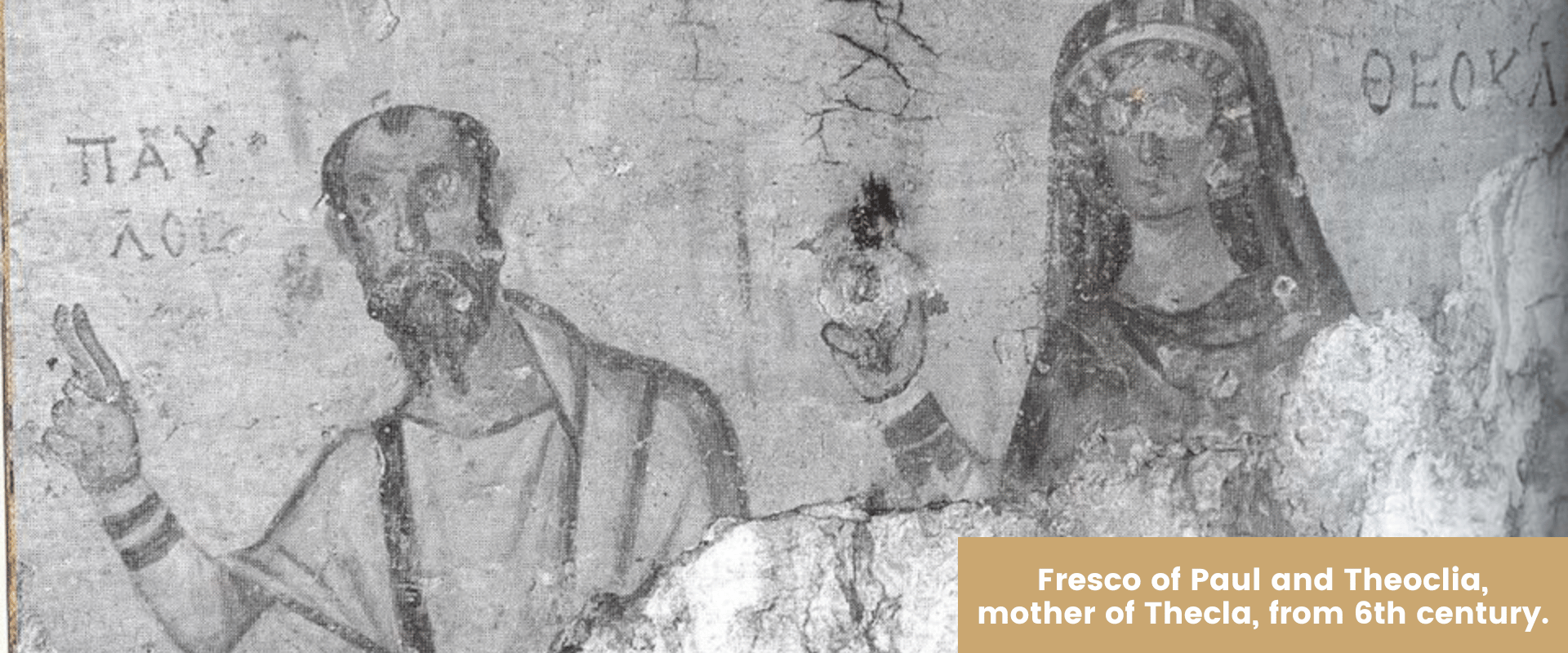
Conclusion: What Is the Acts of Paul and Thecla?
The Acts of Paul and Thecla is a 2nd-century text in which a young woman abandons her marital and familial obligations to follow a deeply ascetic Paul the Apostle. The book was written between 160 and 190 CE and was quite the ancient bestseller.
Structurally and thematically based on ancient Greek romance novels, it is the story of a woman who, upon hearing Paul preach that salvation required celibacy, left her betrothed and her mother to follow Paul on his preaching tours. She is twice threatened with execution, but miraculously escapes both times.
Most scholars agree that the story is fictional, partly because it distorts Paul’s views on Christian celibacy and partly because there were accusations of forgery even around the time the book was written. However, this did not prevent the popularity of the book. Additionally, Thecla, a heroine and martyr, became an ancient model for Christian women, so much so that she was recognized as a saint, and her cave-tombs are still visited by pilgrims.
As a testament to the fascination Thecla still holds, contemporary authors, both academic and otherwise, are still writing about her, in some cases to analyze the context in which the book was written and in others, to see what modern women can learn from her story.