
Solomon's Temple: History, Layout & Destruction

Written by Joshua Schachterle, Ph.D
Author | Professor | Scholar
Author | Professor | BE Contributor
Verified! See our editorial guidelines
Verified! See our guidelines
Date written: January 20th, 2026
Disclaimer: The views and opinions expressed in this article belong to the author and do not necessarily match my own. - Dr. Bart D. Ehrman
The construction of Solomon’s Temple represents one of the most significant developments in the religious, political, and cultural history of ancient Israel. Attributed to the son and successor of King David, the Temple embodied the consolidation of Israelite monarchy and the religious authority.
In this article, I’ll present the biblical descriptions of Solomon’s Temple, its proposed location and layout, relevant archaeological parallels, and its legacy. Through this analysis, I’ll situate Solomon’s Temple within its broader Iron Age context while acknowledging the limitations and complexities inherent in reconstructing a monument known primarily through sacred texts.
By the way, if you’re interested in learning more about Jewish history, check out Bart Ehrman’s course on the Hebrew Bible featuring scholar Dr. Joel Baden.
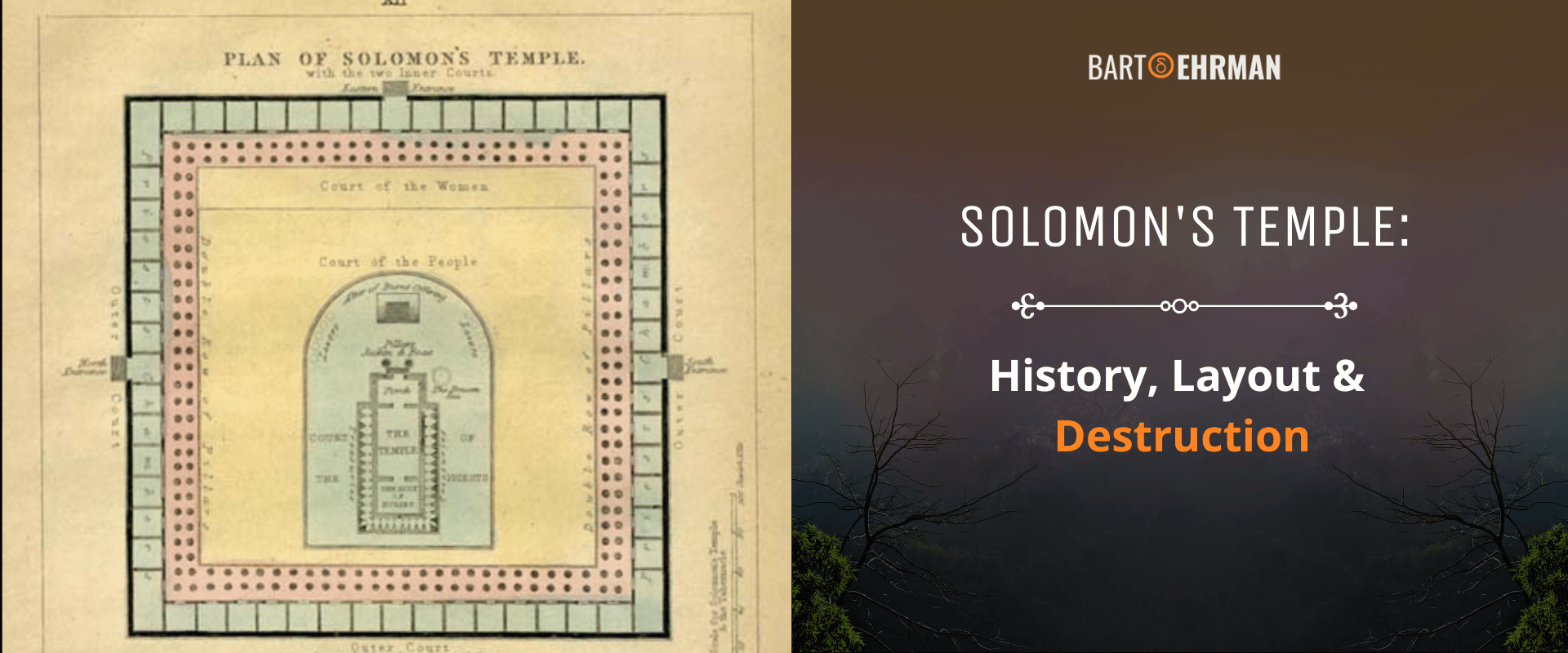
History of Solomon’s Temple in the Bible
Solomon became king of Israel and successor to his father David in the late 10th century BCE (traditionally around 970 BCE). He apparently hit the ground running, starting a massive building project that would impact Israel for centuries. In fact, Solomon wanted to build a temple to Yahweh, something his beleaguered father had been unable to do. This building would also be a grand gesture of thanksgiving to Yahweh for eliminating all the external enemies that David had had to fight for years.
The story of the construction of Solomon’s Temple is found in 1 Kings 5-8, in 1 Chronicles 22, 28–29 (specifically the preparations), and in 2 Chronicles 2–7 (the construction and dedication). In Writing and Rewriting the Story of Solomon in Ancient Israel, Isaac Kalimi notes that while the story in 1 Kings is written as a more straightforward history, 1 and 2 Chronicles add intriguing details. For example, the Chronicles say that God had previously given David a divine blueprint for the Temple, which was then passed down to Solomon. It also goes into far more detail about the skill of certain craftsmen involved in the Temple’s construction, and has a more deeply theological perspective of the Temple’s significance.
Keep in mind that up to this point in Israel’s history, there had been no Temple. Worship, sacrifices, and other prescribed rituals had been performed in the Tabernacle, a movable, elaborately decorated tent where the Ark of the Covenant was also kept. David had the Ark of the Covenant moved to Jerusalem (2 Samuel 6), but by the time Solomon started building the temple, the Tabernacle had been placed in the city of Gibeon, north of Jerusalem.
In order to get construction of the temple started, Solomon contacted an old friend of his father’s:
(Affiliate Disclaimer: We may earn commissions on products you purchase through this page at no additional cost to you. Thank you for supporting our site!)
Now King Hiram of Tyre sent his servants to Solomon when he heard that they had anointed him king in place of his father, for Hiram had always been a friend to David. Solomon sent word to Hiram, saying, “You know that my father David could not build a house for the name of the Lord his God because of the warfare with which his enemies surrounded him, until he put them under the soles of his feet. But now the Lord my God has given me rest on every side; there is neither adversary nor misfortune. So I intend to build a house for the name of the Lord my God… Therefore command that cedars from the Lebanon be cut for me. My servants will join your servants, and I will give you whatever wages you set for your servants, for you know that there is no one among us who knows how to cut timber like the Sidonians” (1 Kings 5:1-6).


Hiram, the king of the Phoenician city-state of Tyre, readily agreed to send these supplies and construction got underway. The general labor was performed by vast numbers of conscripted Israelite workers. According to 1 Kings 5:14, Solomon “sent them to the Lebanon, ten thousand a month in shifts; they would be a month in the Lebanon and two months at home.”
Most scholars agree that the Temple was built sometime in the 10th century BCE and existed until its destruction in the 6th century BCE by the invading Babylonian army (2 Kings 25:9-17). Solomon’s construction of this permanent structure would center worship of Yahweh in Jerusalem, unlike the mobile Tabernacle which was placed in different locations. This meant that devout Jews from all over Israel would now make regular pilgrimages to Jerusalem to engage in proper worship.
In addition, Solomon’s Temple solidified the intercessory role of the priests who would now remain in one stable place. Outside of its religious function, this massive structure also became a symbol of Israel’s national identity.
Location of the Temple of Solomon
In 2 Chronicles 3:1, we are told that
Solomon began to build the house of the Lord in Jerusalem on Mount Moriah, where the Lord had appeared to his father David, at the place that David had designated, on the threshing floor of Ornan the Jebusite.
While this site was obviously important for its significance in the life of David, it has an even older connection to Jewish lore. Mount Moriah is traditionally said to be the place where Abraham was ordered to sacrifice his son Isaac in Genesis 22:2, although the spelling of Moriah in Genesis is slightly different.
Then God said, 'Take your son, your only son, whom you love—Isaac—and go to the region of Moriyya. Sacrifice him there as a burnt offering on a mountain I will show you.
Unfortunately, there is no way to verify the exact location of Solomon’s Temple (more on that later). Since we know the Second Temple was later built in a place now known as the Temple Mount in Jerusalem, – its Western Wall still stands in Jerusalem – early rabbinic sources said that Solomon’s Temple had been built there as well. Of course, this would also mean that the (almost) sacrifice of Isaac had also happened in Jerusalem, but again, we have no archeological evidence so far to verify any of this. Unfortunately, this lack of evidence prevents historians from knowing much more about Solomon’s Temple.
Nevertheless, the Temple Mount remains the holiest site in Judaism. However, it is also home to the Dome of the Rock, the most ancient remaining work of Islamic architecture on earth. Additionally, some Christians view the site as sacred, although there are no Christian monuments there. However, in Jerusalem: Idea and Reality, Yaron Eliav notes that “Various passages of the New Testament use the images of the Temple and Jerusalem, whether to express the Heavenly Jerusalem or, on occasion, as a label for the actual community.”
As you can imagine, this has been a highly contested site for a very long time. For this reason, no systematic, controlled excavations are currently being done on the Temple Mount, although surrounding areas have been excavated.
Measurements and Layout of Solomon’s Temple
Scholars and archeologists have searched for centuries for any trace of Solomon’s Temple, but nothing has yet been found. For this reason, if we want to know about the layout and measurements of the Temple, we only have two sources. The first is the biblical account so let’s start there.
In The Seed of Wisdom, Gilbert Bagnani writes that scholars face a lot of difficulties when they attempt to decipher the measurements of Solomon’s Temple from 1 Kings and 2 Chronicles. The principal problem is that some of the architectural terms in the biblical accounts have lost their original meanings, leaving little or no idea of what they would have looked like.
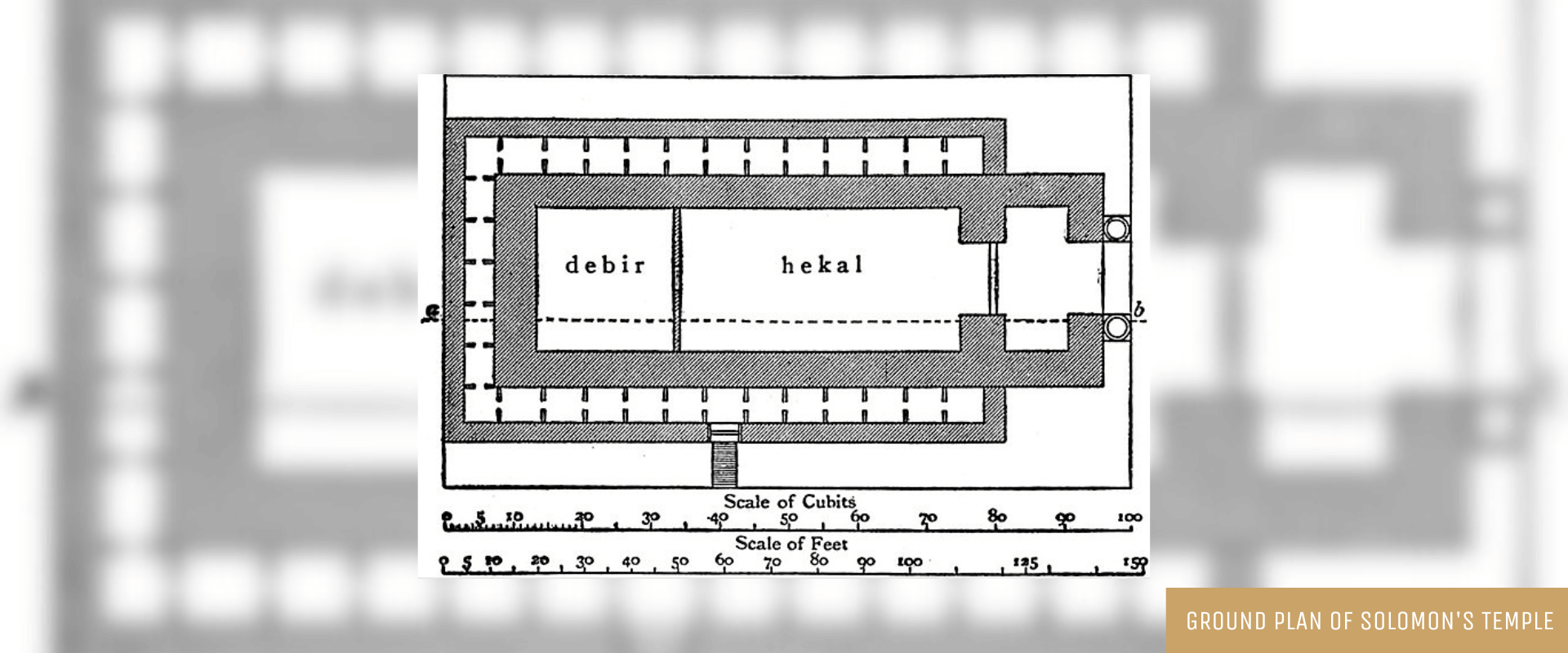
However, there are some things that can be confirmed from the biblical evidence. Based on those descriptions, archeologists believe the Temple was a rectangular building consisting of three main parts: the ulam, or porch, the heikal, or sanctuary, and the debir, or Holy of Holies. While ancient units of measurement — the main unit was the cubit, which probably measured about 21 ½ inches, but could vary — were not as precise or standard as those we use today, measurements given in the biblical accounts can give us a general idea of each part’s size. With that in mind, the biblical account says the entire temple was about 90 feet long, 30 feet wide, and 45 feet high.
In “The Temple of Solomon in Iron Age Context,” Yosef Garfinkel and Madeleine Mumcuoglu write that although we know that there were two large pillars in the porch, the biblical passage doesn’t tell us if it was entirely enclosed, an entryway with a roof, or a completely open courtyard. Nevertheless, the porch was about 15 feet by 30 feet.
The porch then led into the main sanctuary. This measured about 60 feet by 30 feet and was about 45 feet high. It contained a candelabrum, a large table and an altar covered in gold on which offerings were made. At the opposite end from the entrance of the sanctuary, there was a door, guarded by two cherubim figures, leading to the Holy of Holies. The walls were lined with wood onto which were carved more figures of cherubim, flowers, and palm trees.
Finally, the Holy of Holies measured 30 feet by 30 feet and was 30 feet high. Its walls were covered in gold and contained two carved wooden cherubim, each 15 feet high with wingspans of 15 feet. The wings of both cherubim touched each other in the center of the room and touched the walls on the opposite side. Because of its extreme holiness, the room had to be closed off from the rest of the Temple complex and thus had no windows. Most importantly, it also contained the Ark of the Covenant.
NOW AVAILABLE!
Finding Moses: What Scholars Know About The Exodus & The Jewish Law
Riveting and controversial, the "FINDING MOSES" lecture series takes you on a deep dive into the stories of Moses, the exodus, and a whole lot more...
An Intriguing Parallel: ‘Ain Dara Temple
Having used the biblical narrative to understand the dimensions of Solomon’s Temple, let’s examine a second source, a more concrete model of a temple built in the same era that scholars believe can tell us a lot about Solomon’s Temple, even though evidence for the Temple itself is conspicuously absent.
Hebrew Bible scholar John Monson writes that in northern Syria on the Turkish border, a newly-excavated “temple at ‘Ain Dara has far more in common with the Jerusalem Temple described in the Book of Kings than any other known building” discovered. So far, ‘Ain Dara has been dated closer in time to Solomon’s Temple than any other yet found.
The ‘Ain Dara Temple is believed to have been dedicated to the worship of Ishtar (also called Shaushka/Astarte), the goddess of fertility, love, and war, although this dedication is far from certain. Monson notes that ‘Ain Dara shares a lot of features with Solomon’s Temple based on the biblical description:
Most basically, both have essentially the same three-division, long-room plan: At ‘Ain Dara, it is an entry portico, an antechamber and main chamber with screened-off shrine; in Solomon’s Temple, it is an entry portico (’ulam), main hall (heikhal) and shrine, or holy of holies (debir). The only significant difference between the two is the inclusion of the antechamber in the ‘Ain Dara plan. With this exception the two plans are almost identical.
Monson says that ‘Ain Dara contains 33 of the 65 architectural features mentioned in the biblical description of Solomon’s Temple.
Without going into too much detail, Monson says
the date, size and numerous features of the ‘Ain Dara temple provide new evidence that chronologically anchors the Temple of Solomon in the cultural traditions of the tenth century B.C.E. The ‘Ain Dara temple thus corroborates the traditional date of Solomon’s renowned shrine.
History of Solomon’s Temple vs. Herod’s Temple
As I said earlier, the destruction of Solomon’s Temple by the conquering Babylonians occurred in 586 BCE. However, after decades in captivity, Israelites were allowed to return to Jerusalem to build the temple anew, using the original temple as a model, in 516 BCE. Then in around 20 or 19 BCE, the Hasmonean client king Herod the Great made additions and enhancements to the temple, forever cementing it as his legacy. So how did the two original Temples compare?
While Solomon’s Temple was undoubtedly an impressive structure, Herod’s Temple would be almost twice the size in both area and height. While Solomon’s Temple was massively important as the first permanent structure built for the worship of Israel’s God, Herod’s Temple became both a religious and a political statement, able to handle far more pilgrims, both Jew and Gentile, during the three major Jewish festivals — Passover, Pentecost, and Tabernacles - than its predecessor. As such, it ultimately made a larger historical impact on both Israel and surrounding nations than Solomon’s Temple had.
Conclusion
According to the Bible, Solomon was the wisest king of Israel and the son of the mighty King David. As one of his first royal acts, Solomon wanted to fulfill the dream of his father, who had been unable to build a permanent home for worship of Yahweh, by building a magnificent temple.
Solomon thus acquired materials and labor from the city-state of Tyre, adding his own conscripts to the construction and ultimately making an appropriately impressive statement of Israel’s faithfulness to Yahweh, as well as its strength as a nation.
While no actual evidence of this first Israelite Temple has yet been found, its location has been assumed to be on what is now known as the Temple Mount, largely due to the fact that the Second Temple was built there. Whatever the case, building this structure moved Israel’s religion from a nomadic existence in which a portable Tabernacle was the place of worship, to a permanent location, thus announcing that their God was mighty and his presence was situated securely in Jerusalem.
NOW AVAILABLE!
Finding Moses: What Scholars Know About The Exodus & The Jewish Law
Riveting and controversial, the "FINDING MOSES" lecture series takes you on a deep dive into the stories of Moses, the exodus, and a whole lot more...