
Melchizedek: New Insights into the Genesis’ King of Salem

Written by Joshua Schachterle, Ph.D
Author | Professor | Scholar
Author | Professor | BE Contributor
Verified! See our editorial guidelines
Verified! See our guidelines
Date written: January 10th, 2026
Disclaimer: The views and opinions expressed in this article belong to the author and do not necessarily match my own. - Dr. Bart D. Ehrman
Among the more enigmatic figures in the Hebrew Bible, Melchizedek occupies a remarkably disproportionate place in Jewish and Christian interpretive history. The sparse and ambiguous biblical data concerning Melchizedek invites a wide range of interpretive possibilities that later communities would eagerly exploit.
In this article, I’ll examine the development of Melchizedek’s significance across biblical and post-biblical traditions, tracing how a marginal character evolved into a theological archetype. By following Melchizedek’s trajectory through both Bible verses and later understandings, we’ll see that his enduring influence lies not in his prominence in the biblical story but in interpretive potential. We’ll see that the figure of Melchizedek illustrates how textual ambiguity can generate lasting religious meaning.
By the way, if you’re interested in learning more about biblical traditions, check out Bart Ehrman’s course on the Hebrew Bible featuring scholar Dr. Joel Baden.
Background in Genesis
Who is Melchizedek in the Bible? The Hebrew name Melchizedek (pronounced mel-KEE-zeh-dek) is composed of two Hebrew words. The first, mal-kee’, is derived from the word for king which is melekh. The second, ṣedeq, can be translated as “righteousness” but might also just be the proper name Zedek. The original text in Genesis where Melchizedek is presented does not clarify the best translation. In addition, I should note that outside of this biblical story, there is no evidence that Melchizedek actually existed in history.
Melchizedek is first introduced in Genesis 14:17-24 after Abram (soon to be renamed Abraham by God), returns from battling against a king named Chedorlaomer who, along with some other kings, had kidnapped Abram’s nephew Lot and taken all his possessions:
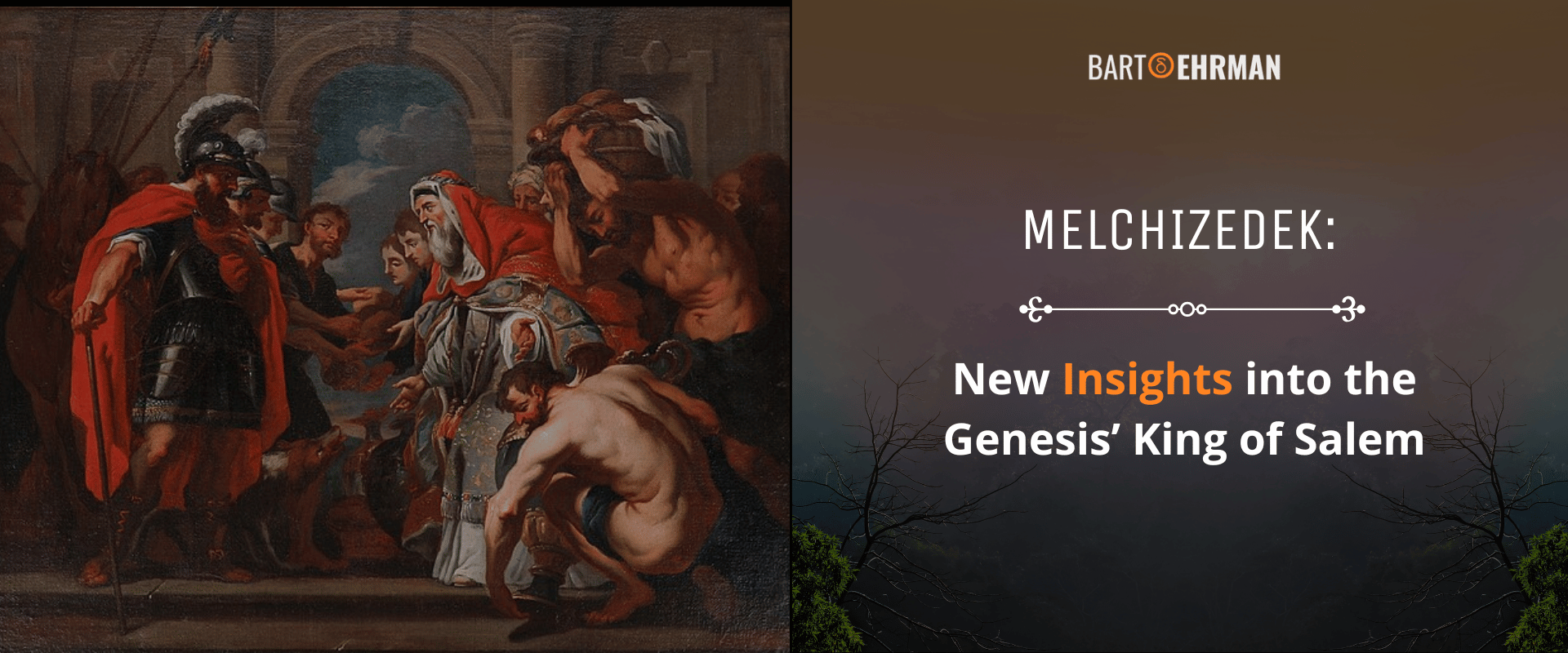
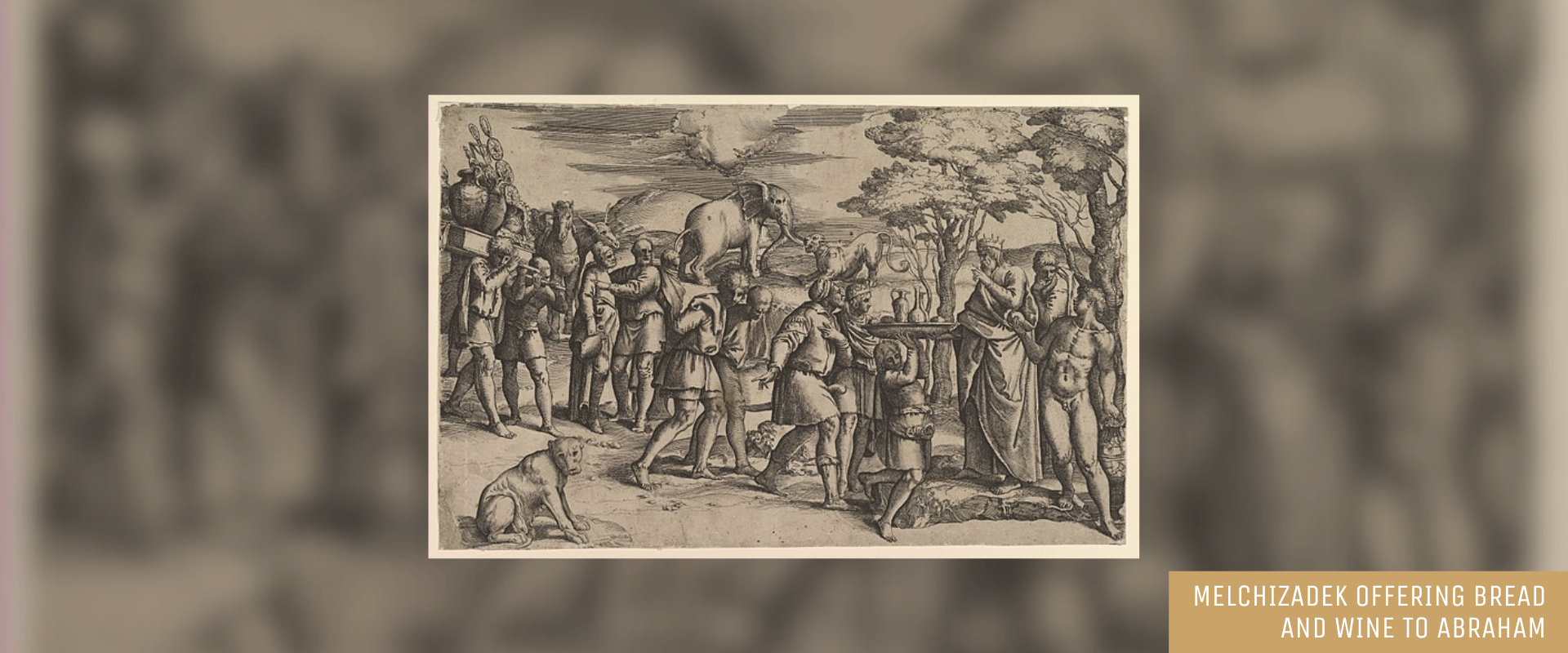
After his return from the defeat of Chedorlaomer and the kings who were with him, the king of Sodom went out to meet him at the Valley of Shaveh, that is, the King’s Valley. And King Melchizedek of Salem brought out bread and wine; he was priest of God Most High. He blessed him and said,
“Blessed be Abram by God Most High,
maker of heaven and earth,
and blessed be God Most High,
who has delivered your enemies into your hand!”
And Abram gave him one-tenth of everything. Then the king of Sodom said to Abram, “Give me the persons, but take the goods for yourself.” But Abram said to the king of Sodom, “I have sworn to God Most High, maker of heaven and earth, that I would not take a thread or a sandal strap or anything that is yours, so that you might not say, ‘I have made Abram rich.’ I will take nothing but what the young men have eaten and the share of the men who went with me: Aner, Eshcol, and Mamre. Let them take their share.”


We see two things happening here that will be significant for our interpretation of Melchizedek. First, as Bill Creasy points out, Melchizedek seems to come out of nowhere. Dr. Creasy notes that, in Genesis, most patriarchal characters are introduced with a genealogy. The introduction of Abraham, for example, is preceded by verses about his ancestry (Gen. 11:10-27). The fact that Melchizedek gets no such narrative treatment makes him seem mysterious, to say the least.
Second, Abraham, who is clearly a fighter in the early part of his story, is also portrayed in this passage as selfless and generous, in that he gives ten percent of the goods he retakes from Chedorlaomer to Melchizedek. While it’s not entirely clear why he does this, it is surely meant to show that Abraham was a good, heroic person. However, just to complicate things a bit further, Robert Alter, in his commentary on The Five Books of Moses, notes that the Hebrew in the passage is a bit ambiguous. Alter says it’s not entirely clear whether Abram gives one-tenth to Melchizedek or the other way around:
(Affiliate Disclaimer: We may earn commissions on products you purchase through this page at no additional cost to you. Thank you for supporting our site!)
Employment of the verb without a subject, not uncommon in biblical usage, occurs at the end of verse 20, where the Hebrew does not state what the context implies, that it is Abram who gives the tithe.
So what else do we find out about Melchizedek from this short passage?
He’s called both the King of Salem (Hebrew: Shalem) and a priest (Hebrew: Kohen) of “God Most High” (Hebrew: El Elyon). Today, many identify Salem with Jerusalem, although the Hebrew word Shalem also means “peace”— perhaps Melchizedek was the “king of peace.” All of these interpretations are speculative, however, since there are multiple ways to translate the passage. In fact, in his book Melchizedek, King of Sodom: How Scribes Invented the Biblical Priest-King, Robert Cargill proposes that the original section likely called Melchizedek the King of Sodom. Why would this be significant?
In case you didn’t know, scholars have determined that the book of Genesis had multiple authors and editors or redactors. Cargill believes that a later redactor changed the verse about Melchizedek, making two separate kings where there was originally only one:
Following the rise of the tradition of the destruction of Sodom in Gen. 19, redactors first sought to distance Abram from interactions with Melchizedek, king of Sodom. Therefore, the name of the Sodom in verse 18 was altered to Shalem — a city near Shechem which was already associated with Abram… The alteration of Sodom to Shalem alleviated the immediate problem of Abram being perceived as having positive interactions with the king of Sodom.
As we’ll see, this change, if it happened as Cargill suggests, would have a major impact on later Jewish and Christian interpretations of Melchizedek. For a guy only mentioned in three books in the entire Bible, his influence was surprisingly large. Notice also that Melchizedek brings Abram and his men bread and wine, something that will come to have major symbolic meaning later.
Melchizedek in the Psalms
The next and final mention of Melchizedek in the Hebrew Bible is found in Psalm 110:4. However, despite the shortness of the passage, there are some ambiguities in its translation. Here’s the New Revised Standard Updated Edition translation:
The Lord has sworn and will not change his mind,
“You are a priest forever according to the order of Melchizedek.”
But to whom is the Psalm speaking? The first part of the Psalm says
The Lord says to my lord,
“Sit at my right hand
until I make your enemies your footstool.”
This lord – with a lower-case l – is often associated with King David who is traditionally said to be the author of the Psalms. If this is the case, though, God is calling David both king and priest, connecting him directly to the verse in Genesis where Melchizedek was both king and priest. In other words, “the order of Melchizedek” means a special order of priest-kings. However, since Melchizedek can also be translated as “king of righteousness,” the New Jewish Publication Society’s English translation of the Hebrew Bible translates the phrase this way:
You are a priest forever, a rightful king by My decree.
This translation would make sense if the one being addressed is indeed David. However, the Babylonian Talmud, an authoritative compilation of ancient Jewish teachings, states that the addressee of this Psalm is actually Abram, while the Zohar — the main medieval text of Kabbalistic Judaism — believes the Psalm is addressed to Aaron, the brother of Moses and the first high priest ordained by God after the Israelites were freed from slavery. Unfortunately, there is no way to decide who is being addressed in the Psalm for certain.
NOW AVAILABLE!
Finding Moses: What Scholars Know About The Exodus & The Jewish Law
Riveting and controversial, the "FINDING MOSES" lecture series takes you on a deep dive into the stories of Moses, the exodus, and a whole lot more...
Melchizedek and Jesus in Hebrews
The most extensive use and mention of Melchizedek, however, comes not in the Hebrew Bible but in the New Testament book of Hebrews, written centuries after the completion of Genesis. Hebrews is the only NT book that mentions Melchizedek, as well as the only book that calls Jesus a high priest, specifically referring to him as the addressee of Psalm 110:
Although he was a Son, he learned obedience through what he suffered, and having been made perfect, he became the source of eternal salvation for all who obey him, having been designated by God a high priest according to the order of Melchizedek (Heb. 5:8-9)
The unknown author of Hebrews actually uses the lack of genealogy attributed to Melchizedek as a way to further identify him with Jesus, reasoning in one Bible verse that one who is “without father, without mother, without genealogy” also has “neither beginning of days nor end of life (Hebrews 7:3)” and is thus immortal. But in what way is Jesus a high priest, according to this author?
The function of the Jewish high priest was to mediate between God and the people. As such, he was the only person authorized to take on the concerns of the people and bring them directly to God in the most sacred part of the Temple, the Holy of Holies, thus obtaining God’s mercy. This is how the author of Hebrews puts it, describing Jesus’ role, in Heb 4:14-16:
Therefore, since we have a great high priest who has ascended into heaven, Jesus the Son of God, let us hold firmly to the faith we profess. For we do not have a high priest who is unable to empathize with our weaknesses, but we have one who has been tempted in every way, just as we are—yet he did not sin. Let us then approach God’s throne of grace with confidence, so that we may receive mercy and find grace to help us in our time of need.
In place of the Holy of Holies in the Temple, Jesus ascended to heaven and thus into God’s presence. However, despite his divinity, Jesus was also human and thus, like the high priest, understood human temptations. He was, therefore, the intercessor for people who believed in him and could thus obtain God’s mercy for them.
Furthermore, Hebrews 7:27 says that Jesus’ death has taken the place of the sacrificial function of the former high priests:
Unlike the other high priests, he does not need to offer sacrifices day after day, first for his own sins, and then for the sins of the people. He sacrificed for their sins once for all when he offered himself.
The line from Psalm 110, which Hebrews interprets as placing Jesus as a high priest in “the order of Melchizedek,” is repeated often in Hebrews. However, it turns out that the identification of Melchizedek with the Messiah precedes Christianity.
Other Interpretations of Melchizedek
In the Dead Sea Scrolls, Jewish writings that preceded the writings of the New Testament, an entire scroll, known to scholars as 11QMelch, is devoted to Melchizedek. In the Jewish Annotated New Testament, scholar (and my former professor!) Pamela Eisenbaum notes that in this scroll, Melchizedek “becomes a superhuman figure, who executes divine judgment.” This is unusual in early Jewish texts where only God is supposed to function as a judge. However, it also provides a theological bridge between Second Temple Judaism and early Christianity.
In the Nag Hammadi Library, a group of Gnostic Christian texts discovered in Egypt, there is a text called The Coming of the Son of God Melchizedek. This tractate explicitly says not that Jesus was in the order of Melchizedek but that he is Jesus. This “Melchizedek” is therefore said to have preached, died, and been resurrected. It also says that he will return and that he is a priest-king who metes out God’s justice.
Several more orthodox church fathers interpreted various Old Testament figures like Melchizedek as paradigms of Christ. Christ was thus called a new Adam by some and was sometimes identified with Abraham by others. However, with regard to Melchizedek, 3rd-century Christian author Clement of Alexandria also claimed that the bread and wine given by Melchizedek to Abraham and his men in Genesis was a prophetic representation of the Eucharist, which Christ would institute for the church before his death.
Conclusion
In many ways, the stories and representations of Melchizedek are odd. He is mentioned in only three books of the Bible — how could so many people deem him so significant? I would guess that given his place in the story of the all-important patriarch Abraham, the relative mystery and curiosity surrounding Melchizedek’s identity was only enhanced by the lack of information about him.
In the original Genesis story, Melchizedek is introduced as both a king of Salem and a priest. He plays a miniscule role in Abraham’s story, giving him bread and wine and blessing him after Abraham returns from saving his nephew. However, rather than disappearing, as some minor biblical characters did, an entire mythology would grow up around this figure.
In Psalm 110, God tells someone that he will conquer his enemies for him, later claiming that his addressee is a priest “according to the order of Melchizedek.” Whatever the truth of the matter, the interlocutor of this Psalm — whether David, Jesus, or someone else — would go on to fulfill a much larger role in texts such as the Dead Sea Scrolls and the book of Hebrews.
In fact, it’s only in the book of Hebrews that Melchizedek is finally allegorized into an archetype of Jesus. As such, Jesus himself is called a high priest, one who mediates between humans and God and brings God’s mercy to the people. This adds to the story of Jesus’ atoning sacrifice and goes on to affect Christian theology forever after.
For a guy who is barely mentioned in the Hebrew Bible, he sure got a lot of press!
NOW AVAILABLE!
Finding Moses: What Scholars Know About The Exodus & The Jewish Law
Riveting and controversial, the "FINDING MOSES" lecture series takes you on a deep dive into the stories of Moses, the exodus, and a whole lot more...