
Hasmonean Dynasty: Who Were the Maccabees? (Timeline)

Written by Joshua Schachterle, Ph.D
Author | Professor | Scholar
Author | Professor | BE Contributor
Verified! See our editorial guidelines
Verified! See our guidelines
Date written: December 24th, 2025
Disclaimer: The views and opinions expressed in this article belong to the author and do not necessarily match my own. - Dr. Bart D. Ehrman
The Hasmonean Dynasty occupies a central place in the political and religious history of the ancient Near East. It represents a rare instance in which a Jewish priestly family briefly secured Jewish independence during the tumultuous era of the Hellenistic kingdoms.
In this article, I’ll examine the origins, development, and demise of the Hasmonean Dynasty, from its roots in the Maccabean Revolt to its dissolution under Roman rule. By tracing the interplay of religion, politics, and foreign power, I’ll highlight the dynasty’s pivotal role in shaping the contours of late Second Temple Judaism and its enduring influence on the political and cultural transformations that followed.
By the way, if you’re interested in learning more about Jewish history, check out Bart Ehrman’s course on the Hebrew Bible featuring scholar Dr. Joel Baden.
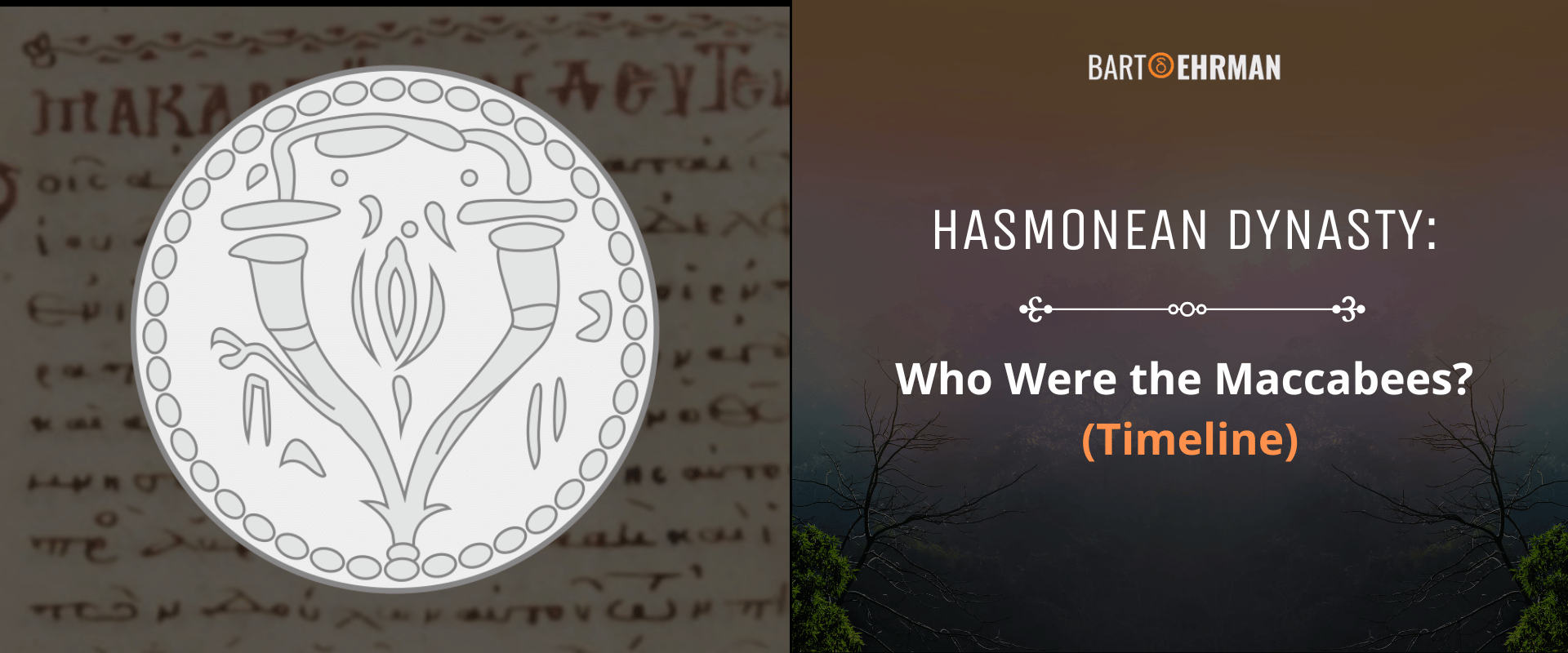
What Was the Hasmonean Dynasty?
A dynasty is a family line that holds power over successive generations. So, the Hasmonean Dynasty is the name historians call the lineage of rulers from the family known both as the Maccabees and/or the Hasmoneans. The first two Books of the Maccabees don’t use the name Hasmoneans for that family. Instead they simply refer to individuals in the family. Later traditions would refer to them as the Maccabees, after one of the early leaders of the family, Judas Maccabeus.
The name Hasmoneans, however, is attested in the writings of 1st-century Jewish historian Flavius Josephus. He writes of the origins of this family, saying that the name “Hasmonean” came from the name of one of the Maccabean ancestors, although Josephus writes the term in Greek rather than its original Hebrew which, according to A History of the Hasmonean State: Josephus and Beyond, was Hashmonai.
(Affiliate Disclaimer: We may earn commissions on products you purchase through this page at no additional cost to you. Thank you for supporting our site!)
Now at this time there was one whose name was Mattathias, who dwelt at Modin, the son of John, the son of Simeon, the son of Asamoneus, a priest of the order of Joarib, and a citizen of Jerusalem (The Jewish War, 12.265).


According to 1 Maccabees 2, the patriarch of the family, Mattathias, was one of the Hasmonean priests of the tribe of Levi who lived during the reign of Seleucid ruler Antiochus IV Epiphanes. It was Mattathias who started what became known as the Maccabean Revolt against the policies of Antiochus, which prohibited Jewish religious practices. In 167 BCE in the town of Modein (or Modin, in Josephus’ writing) where Mattathias lived, representatives of King Antiochus were sent to force Jewish people to sacrifice to the pagan gods of the Seleucids. Mattathias made a public and impassioned speech against this practice, leading to an incendiary incident:
When he had finished speaking these words, a Jew came forward in the sight of all to offer sacrifice on the altar in Modein, according to the king’s command. When Mattathias saw it, he burned with zeal, and his heart was stirred. He gave vent to righteous anger; he ran and slaughtered him on the altar. At the same time he killed the king’s officer who was forcing them to sacrifice, and he tore down the altar (1 Maccabees 2:23-25).
Having committed this crime against the king, Mattathias and his sons fled to the mountains, thus beginning the Maccabean Revolt. Mattathias soon died but the revolt continued, led by his sons Judas Maccabeus, John Gaddi, Simon Thassi, Eleazar Avaran, and Jonathan Apphus. The Revolt continued from 167 BCE to 160 BCE, when the Maccabees finally reconquered Jerusalem and were able to once again cleanse the Temple and dedicate it to God. However, Judea still technically remained under the control of the Seleucid Empire, and periodic battles with the Seleucids continued until 142 BCE.
The deuterocanonical books 1 and 2 Maccabees are our principal source for the origins of the Hasmonean Dynasty, beginning with the revolt and covering the years 175-134 BCE. However, because the Seleucid Empire was still in control over the rest of Judea, the Hasmoneans were only semi-autonomous within the land of Judea at that time. By the way, for more on the Maccabean Revolt, I recommend An Introduction to Second Temple Judaism: History and Religion of the Jews in the Time of Nehemiah, the Maccabees, Hillel, and Jesus by Lester Grabbe.
The Hasmonean Dynasty Begins
The Maccabean rebel leaders, Mattathias, Judas Maccabeus, and Jonathan Apphus did not claim the title of king for themselves, either before or after the conquest of Jerusalem. However, following the death of Jonathan Apphus, his brother Simon Thassi became the first of many Hasmonean kings in 142 BCE. He was named both High Priest and ethnarch (“ruler of the nation”) and thus inaugurated the Hasmonean Dynasty.
Governance of the Hasmoneans was then officially instituted by a decree in 141 BCE. According to 1 Maccabees 14:41, this occurred at a large gathering where the “Jews and their priests… resolved that Simon should be their leader and high priest forever, until a trustworthy prophet should arise.” In response, the Seleucid King, a later king who was also named Antiochus, wrote Simon a letter saying
I grant freedom to Jerusalem and the sanctuary. All the weapons that you have prepared and the strongholds that you have built and now hold shall remain yours. Every debt you owe to the royal treasury and any such future debts shall be canceled for you from henceforth and for all time. When we gain control of our kingdom, we will bestow great honor on you and your nation and the temple, so that your glory will become manifest in all the earth (1 Macc 15:7-9).
This would initiate the gradual process of freeing Judea from Seleucid control, a process which nevertheless would not be completed in Simon’s lifetime. Simon’s rule lasted until 135 BCE, when he and his two eldest sons were assassinated. Simon’s successor was therefore his third son, John Hyrcanus I.
Like his father, John Hyrcanus took the title of both High Priest and ethnarch. However, in 136 BCE, the Seleucid king Antiochus VII Sidetes attacked Jerusalem, apparently not content with the détente his ancestor had arranged with the Hasmoneans, and put Jerusalem under siege. Hyrcanus, according to Josephus, opened the tomb of King David and took out enough money — 3,000 talents — to pay tribute to Antiochus, who then ended the siege. This allowed Hyrcanus to continue to rule Judea semi-independently as a vassal of the Seleucids for the next three decades, until 104 BCE.
However, not long after the siege of Jerusalem, the Seleucid Empire began visibly weakening, spread thin from dealing with wars and uprisings in many parts of their kingdom. Thus in 110 BCE, John Hyrcanus I saw the opportunity to oust the Seleucids from Judea and gain Jewish independence. He captured several Seleucid territories, including Transjordan, Samaria, and Idumea. The Seleucids no longer had the resources to put up a fight and the Hasmoneans became an independent dynasty.
Ironically, given the reasons for the Maccabean Revolt, John forced the Idumeans, who were not ethnically Jewish, to convert from their own religion to Judaism. This forced conversion would eventually have dire consequences for the Hasmoneans.
NOW AVAILABLE!
Finding Moses: What Scholars Know About The Exodus & The Jewish Law
Riveting and controversial, the "FINDING MOSES" lecture series takes you on a deep dive into the stories of Moses, the exodus, and a whole lot more...
After the Death of John Hyrcanus I
John Hyrcanus intended for his wife, who is unfortunately unnamed in our sources, to rule after his death. However, in 104 BCE, his oldest son, Aristobulus I, to whom John had willed the position of High Priest, had other ideas. He imprisoned his three brothers and his mother, whom he starved to death in prison. He then took the throne, the first Hasmonean to claim the Greek title of king (Greek: basileus).
Although his position seemed secure, with his mother dead and brothers in prison, he contracted an unknown illness and died the following year in 103 BCE. At this point, Aristobulus’ widow released her three brothers-in-law from prison. One of them, Alexander Jannaeus, then became the next Hasmonean king and High Priest, reigning for almost 30 years, from 103-76 BCE. During his reign, he expanded the Hasmonean kingdom further by conquering the land of Iturea north of Galilee and forcing them to convert to Judaism.
When Alexander died in battle in 76 BCE, his wife, Salome Alexandra, took the throne and reigned from 76-67 BCE. She was, in fact, the sole reigning queen in the history of the Hasmonean Dynasty. Her son, Hyrcanus II, who was High Priest during her reign, became her successor to the throne after her death.
Hasmonean Civil War
Throughout this period, rival sects of Judaism called the Pharisees and the Sadducees began to vie for royal influence. We’re accustomed to thinking of these as religious groups — and they were – but according to Josephus, they operated more like political parties during the reign of the Hasmonean kings. Josephus says that the Pharisees, for example, had enormous influence over queen Salome Alexandra:
And now the Pharisees joined themselves to her, to assist her in the government. These are a certain sect of the Jews, that appear more religious than others, and seem to interpret the laws more accurately. Now Alexandra hearkened to them to an extraordinary degree, as being herself a woman of great piety towards God. But these Pharisees artfully insinuated themselves into her favor by little and little, and became themselves the real administrators of the public affairs: they banished and reduced whom they pleased; they bound and loosed [men] at their pleasure (Josephus, The Jewish War, 1.5.2).
Consequently, after Alexandra’s death, her oldest son, Hyrcanus II sought political favor with the Pharisees, while her younger son, Aristobulus II sought the same from the Sadducees. As the elder son, Hyrcanus II took the throne first in 67 BCE. However, after only three months, Aristobulus II attempted to take the throne for himself, starting a civil war which would last for the next four years.
While the kingdom was thus divided, Roman general Gnaeus Pompeius Magnus, better known as Pompey, moved in and conquered Jerusalem in 63 BCE, bringing Judea under the control of the Roman Empire. Both Hasmonean brothers sent gifts (or bribes) to Pompey, hoping to be granted the position of king under the Roman rule of Judea.
Pompey instead chose Hyrcanus II to be the High Priest, not king, of Judea under Rome. This incited Aristobulus to bring troops and attempt to cast Rome out of the region. However, Pompey defeated Aristobulus’ forces multiple times, ending the chance for him to rule in any capacity. Hyrcanus II remained High Priest from 63-40 BCE and then became ethnarch from 47-40 BCE.
In 40 BCE, Aristobulus' son, Antigonus II Mattathias, formed an alliance with the Parthians (from a part of modern-day Iran) and seized the throne in a coup, naming himself both king and High Priest. According to Josephus, Hyrcanus was captured and had his ears bitten off by Antigonus to disfigure him, a condition which would forever prohibit him from the office of High Priest. The Parthians then took Hyrcanus into captivity in Babylonia.
Antipater and Herod the Great
Meanwhile, a man named Antipater from the land of Idumea, one of the lands long ago and peoples conquered and forcibly converted to Judaism by the Hasmoneans, was a high-ranking government official under the rule of Hyrcanus II. When Antigonus deposed Hyrcanus and took the throne, Antipater’s son Herod — soon to be called Herod the Great — fled to Rome to ask for their support against Antigonus. While he was there, the Roman Senate declared Herod “King of the Jews,” a title which guaranteed Herod support for his fight against Antigonus.
Thus Herod and Sosius, the governor of Syria, gathered a large military force in 37 BCE and captured Jerusalem, sending Antigonus to Roman general Mark Antony to be executed. Herod himself took the throne of Judea.
But remember: Herod was not a Hasmonean! Although he was raised as a religious Jew, he was from Idumea, a non-Jewish region subjugated by the Hasmoneans. Therefore, when Herod took the throne of Judea for himself, he began a new dynasty, the Herodian Dynasty, and ended the Hasmonean Dynasty.
Herod then secured his position by marrying a Hasmonean princess, the granddaughter of Hyrcanus II, Mariamne. He did this for two reasons. First, it would protect his claim to the throne from Hasmonean attacks by literally aligning him with the Hasmonean family. Second, he hoped it would grant him favor and credibility with the Jews of Judea, since, although he wasn’t an ethnic Jew himself, he had married a Jewish woman.
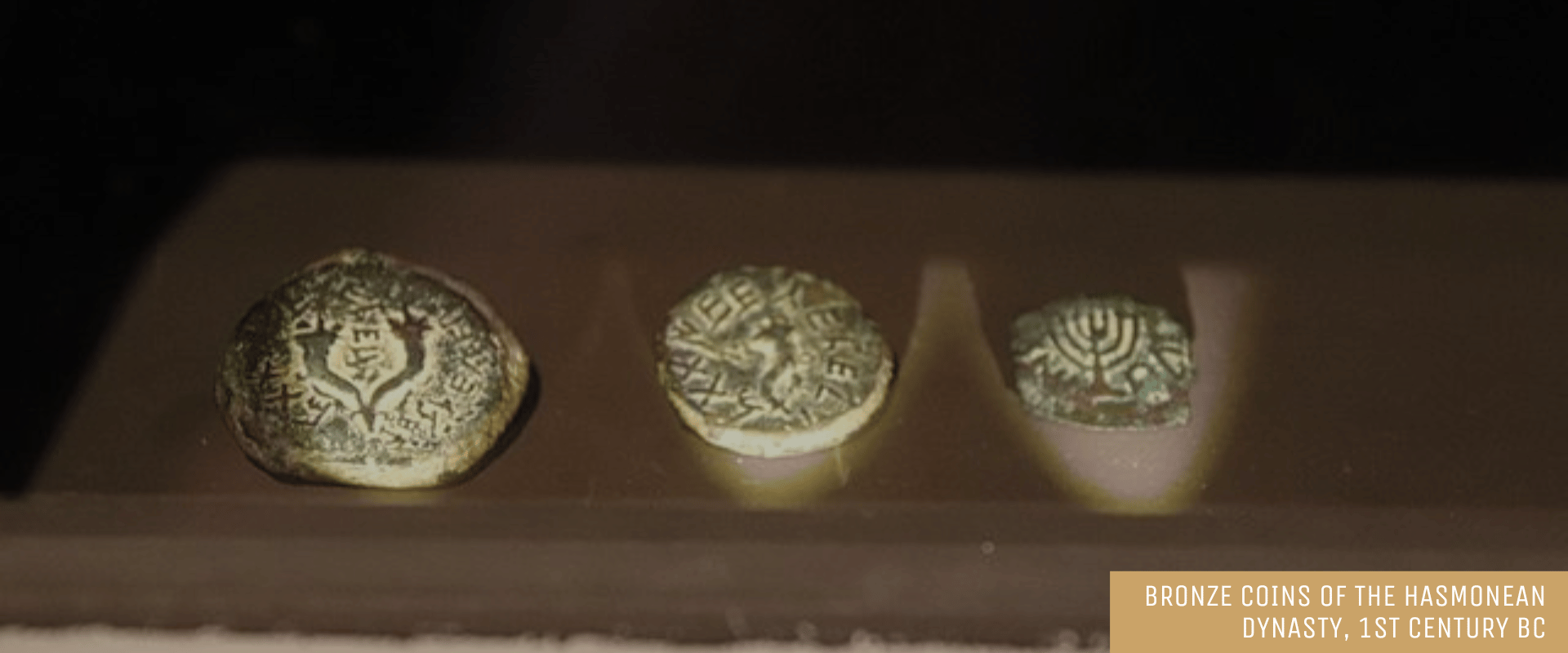
Timeline of the Hasmonean Dynasty
Below is a simple timeline of the events of the Hasmonean Dynasty, followed by a list of all the leaders/High Priests/Rulers discussed above.
167 BCE: Beginning of the Maccabean Revolt.
142 BCE: Simon Thassi becomes the first ruler, officially initiating the Hasmonean dynasty.
141 BCE: Simon secures partial independence from the Seleucids.
110 BCE: The Hasmonean kingdom becomes wholly independent of the Seleucids.
104-103 BCE: Reign of Aristobulus I.
103-76 BCE: Reign of Alexander Jannaeus.
76-67 BCE: Reign of Salome Alexandra, widow of Alexander Jannaeus.
67-63 BCE: After the death of Alexandra, Hyrcanus II and Aristobulus II start a civil war.
63 BCE: Pompey conquers Jerusalem, ending the Hasmoneans' independent rule and making Judea a client state of Rome.
63-40 BCE: Rome installs Hyrcanus II as High Priest.
40-37 BCE: Antigonus, along with the Parthian, takes the throne from Hyrcanus II. Herod the Great, with Rome’s support, defeats Antigonus.
37 BCE: Herod the Great marries the Hasmonean princess Mariamne and ends the Hasmonean Dynasty.
List of Hasmonean Leaders
Maccabean Rebel Leaders
Mattathias, 170–167 BCE
Judas Maccabeus, 167-160 BCE
Jonathan Apphus, 160-143 BCE — High Priest beginning in 152 BCE
Hasmonean Kings and High Priests
Simon Thassi, 142-134 BE (Ethnarch and High Priest)
John Hyrcanus I, 134-104 BCE (Ethnarch and High Priest)
Aristobulus I, 104–103 BCE (King and High Priest)
Alexander Jannaeus, 103-76 BCE (King and High Priest)
Salome Alexandra, 76-67 BCE (Queen)
Hyrcanus II, 67–66 BCE (King from 67 BCE; High Priest from 76 BCE)
Aristobulus II, 66-63 BCE (King and High Priest)
Hyrcanus II (restored), 63-40 BCE (High Priest from 63 BCE — Ethnarch from 47 BCE)
Antigonus, 40-37 BCE (King and High Priest)
Aristobulus III, 36 BCE (High Priest only)
Conclusion
The Hasmonean Dynasty began with a ragtag group of rebels called the Maccabees from a backwater Judean village. In response to their foreign king’s decrees, which attempted to suppress Jewish religious practices, the Maccabees fought for several years against the king’s forces. Eventually, they captured Jerusalem and were able to reclaim the Temple for their God.
This began a period of semi-autonomous rule in which this family, also known as the Hasmoneans, were given space by the ruling Seleucids to rule themselves, as long as they didn’t step out of line. However, when the Seleucid Empire weakened, the Hasmoneans were finally able to seize independence for their ruling family and expand their territory.
However, like any ruling dynasty, the Hasmoneans had their share of intrigues, including struggles for royal influence between the Sadducees and the Pharisees, a civil war between brothers over the throne, and a coup which eventually resulted in the end of the dynasty.
Imagine how important this dynasty was historically! Had the Maccabees not conquered Jerusalem, Judaism might have been eradicated at the hands of the Seleucids. Had the Hasmoneans not conquered Idumea, Herod the Great would not have been raised as a Jew and could never have become king of Judea. Finally, had the Romans not taken over Judea in response to the fight between Hyrcanus II and Aristobulus II, Jesus might not have been crucified, since the Romans, not the Jews, used crucifixion as a method of capital punishment.
It’s clear that for better or worse, the Hasmonean Dynasty determined much of the history of Second Temple Judaism.
NOW AVAILABLE!
Finding Moses: What Scholars Know About The Exodus & The Jewish Law
Riveting and controversial, the "FINDING MOSES" lecture series takes you on a deep dive into the stories of Moses, the exodus, and a whole lot more...