What Are the Books of the Maccabees?

Written by Joshua Schachterle, Ph.D
Author | Professor | Scholar
Author | Professor | BE Contributor
Verified! See our editorial guidelines
Verified! See our guidelines
Date written: December 24th, 2025
Disclaimer: The views and opinions expressed in this article belong to the author and do not necessarily match my own. - Dr. Bart D. Ehrman
The Books of the Maccabees occupy a distinctive position within Second Temple Jewish literature, offering a window into the political turbulence, religious conflict, and cultural negotiation that characterized Judea in the second and first centuries BCE. Although commonly referenced in relation to the Maccabean Revolt, the collection known as the “Books of the Maccabees” is far more diverse than the unity implied by its title.
In this article, I’ll survey the first four Books of the Maccabees, exploring their narrative content, historical context, and canonical status. Through these texts, we can better understand not only the Maccabean Revolt itself, but also the multifaceted ways ancient Jews interpreted and reinterpreted that pivotal moment in their history.
By the way, if you’re interested in learning more about Jewish history, check out Bart Ehrman’s course on the Hebrew Bible featuring scholar Dr. Joel Baden.
What Are the Books of the Maccabees?
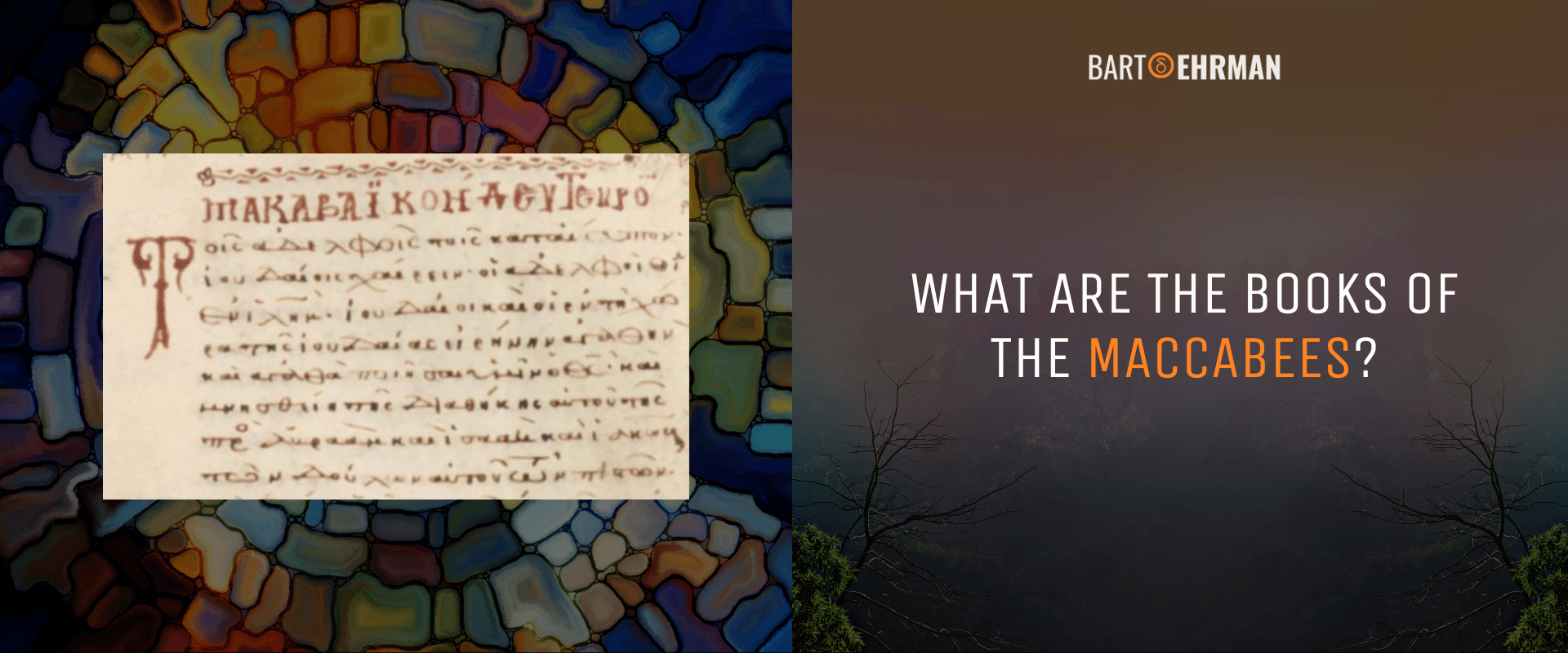
The Books of the Maccabees are a set of ancient Jewish texts, all of which relate in some way to the Maccabean Revolt, a revolutionary movement in Judea which occurred in the 2nd century BCE. While there are, in fact, eight books titled “Books of the Maccabees,” only the first 4 have any canonical status at all (and not with every religious group). For that reason, we’ll focus only on those first four books here. However, it’s important to put them in context by understanding what happened in the Maccabean Revolt.
The background of the Maccabean Revolt begins after Alexander the Great’s death. Alexander had conquered many lands but ended up dying in his early 30s, leaving the administration and leadership of those lands in question. Eventually, the territories were divided up by three factions, each controlling a different part of the empire conquered by Alexander. The Ptolemies remained in charge of Egypt, the Antigonids ruled Greece and Macedonia, and the Seleucids controlled Syria, including the territory of Judea.
After a succession of kings, Antiochus IV Epiphanes became the Seleucid ruler in 175 BCE. Previous Seleucid rulers had shown tolerance toward the people in their territories, allowing them to practice their own religions and cultures without interference. However, when Antiochus deposed the Jerusalem High Priest Jason, whom he had appointed, in favor of another named Menelaus, Jason gathered a military force and invaded Jerusalem violently, forcing Menelaus to flee. On top of this, devout Jews didn’t accept the authority of either of these High Priests since they were Seleucids and not Jews from the priestly clan of Zadok.
Hearing of this from afar, Antiochus furiously went to Jerusalem with his troops. According to 2 Maccabees 5:11-14,
When these happenings were reported to the king, he thought that Judea was in revolt. Raging like a wild animal, he set out from Egypt and took Jerusalem by storm. He ordered his soldiers to cut down without mercy those whom they met and to slay those who took refuge in their houses. There was a massacre of young and old, a killing of women and children, a slaughter of virgins and infants.


In order to further punish the Jews he held responsible for the conflict, Antiochus went to the Temple and purposely defiled it, converting it into a temple to Zeus. He also forbade Jewish religious practices such as burnt offerings and festivals. As the final insult, 1 Maccabees 1:47-48 says that he ordered Jews
to build altars and sacred precincts and shrines for idols, to sacrifice swine and other unclean animals, and to leave their sons uncircumcised.
These atrocities had two effects. First, some Jews willingly gave up their cultural and religious practices and became more Hellenized – that is, they adopted Greek language and culture – while others refused to do so. This created a divide between the two groups that would never entirely heal. Second, it sparked a Jewish revolt in rural areas, eventually leading to the defeat of Antiochus and the retaking of Jerusalem and the dedication of the Temple to God (1 Macc 4:36-59, 2 Macc 10:1-8). This dedication is now celebrated as the festival of Hanukkah, although the story of the miraculous oil that lasted eight days comes from a much later version written in the Talmud.
This revolt is what the Books of the Maccabees address, although sometimes in different ways and from very different angles. To understand this further, let’s look more closely at the first four books of the Maccabees.
1 Maccabees Summary
Written anonymously in Hebrew sometime between 134 BCE and 76 BCE (but only surviving in Greek manuscripts), 1 Maccabees tells the story of the Maccabean Revolt. While it was instigated by a Jewish priest named Mattathias against the anti-Jewish decrees of Antiochus IV Epiphanes, the revolt is then carried on by his sons and grandsons after his death.
The name of this Jewish rebel group, the Maccabees, is derived from the Hebrew word for “hammer.” This is the moniker given to Mattathias’ son, the rebel leader Judas Maccabeus. After Judas’ death, his brother Jonathan succeeds him as leader/ruler until he is double-crossed and killed by Seleucid king Diodotus Tryphon. Jonathan’s brother Simon then succeeds him, as the Hasmonean dynasty continues in Judea. The name “Hasmonean,” another name for the Maccabees, may come from one of their ancestors, although this is far from certain.
In The Maccabean Revolt: Anatomy of a Biblical Revolution, Daniel Harrington notes that while the book of 1 Maccabees certainly contains historical facts, it was mostly written as Hasmonean dynasty propaganda.
(Affiliate Disclaimer: We may earn commissions on products you purchase through this page at no additional cost to you. Thank you for supporting our site!)
2 Maccabees Summary
You might think a book called 2 Maccabees would be a sequel to 1 Maccabees but it’s not. Instead, it’s a retelling of the story of 1 Maccabees. Unlike 1 Maccabees, 2 Maccabees was written in Greek rather than Hebrew between 150-100 BCE. While its author is once again anonymous, he claims to be summarizing a five-volume work written by an otherwise unknown author named Jason of Cyrene. It’s impossible to know if this is actually true since no trace of Jason’s work survives. In The Oxford Handbook of the Apocrypha, Michael Duggan writes that the author of 2 Maccabees was probably a Greek-speaking Jew from Alexandria, Egypt.
This retelling of the Maccabean Revolt starts earlier than that of 1 Maccabees, specifically in 180 BCE with the Seleucid king Seleucus IV. Scholars tend to disagree about the intention of the author in retelling the story. In his commentary on 2 Maccabees, Daniel Schwartz writes that the focus of the story is the corruption and saving of Jerusalem. Daniel Harrington, on the other hand, believes the focus to be the Second Temple and its purification. Either way, the author depicts Judas Maccabeus and his family as the instruments of God who punish the iniquitous and purify Jerusalem. Years later, the Seleucid general Nicanor threatens to destroy the Temple. He is defeated, however, and the purity of the Temple is preserved.
NOW AVAILABLE!
Finding Moses: What Scholars Know About The Exodus & The Jewish Law
Riveting and controversial, the "FINDING MOSES" lecture series takes you on a deep dive into the stories of Moses, the exodus, and a whole lot more...
3 Maccabees Summary
Sometime between 100 BCE and 70 CE, 3 Maccabees was written in Greek by yet another Alexandrian Jew. However, regardless of its title, 3 Maccabees has almost nothing to do with the Maccabean Revolt told in the first two books. Instead, using many of the same themes of 2 Maccabees, it tells the story of an earlier persecution of Jews by a Ptolemaic king named Ptolemy IV Philopator. Scholars generally believe that the story is a legend since, unlike the Maccabean Revolt, there is no other historical evidence for this particular persecution.
The story of 3 Maccabees begins when Ptolemy attempts to visit the Jerusalem Temple, only to be miraculously prevented from entering the sanctuary of the Temple. Furious at this, he returns to Alexandria and decrees that all Jews in the Ptolemaic kingdom of Egypt have to pay a poll tax and be relegated to the position of slaves unless they renounce their religion and worship Dionysius. Most Jews refuse this, and Ptolemy orders that they be arrested and executed in the stadium. However, attempts to execute them repeatedly fail, thanks to divine intervention. Then God causes Ptolemy to fall asleep and when he wakes, he has entirely forgotten his anger against the Jews and instead honors them with festivals and banquets.
4 Maccabees Summary
While 3 Maccabees does not tell the story of the Maccabean Revolt, 4 Maccabees uses parts of the Maccabean Revolt to illustrate a philosophical idea, specifically the notion that reason controls emotion. It was written in Greek between 20 and 130 CE by another anonymous author.
It focuses mostly on the stories of martyrdom from 2 Maccabees chapters 6 and 7. These chapters tell of the torture and excruciating death of seven Jewish brothers and their mother as well as another Jew named Eleazar. These gruesome stories are framed as Antiochus IV Epiphanes’ attempt to make the martyrs renounce their Jewish faith. The author of 4 Maccabees writes that “All of these, by despising sufferings that bring death, demonstrated that reason controls the emotions.” This is an idea from the Greek philosophical school known as Stoicism, and shows the Hellenistic influence of the author. Like the Hellenized Jewish author Philo of Alexandria, the author defends the virtues of Judaism in a Hellenized world. He argues that the virtues cultivated in Judaism are similar to those of Greek and Roman heroes and philosophers.
The Books of the Maccabees in the Bible
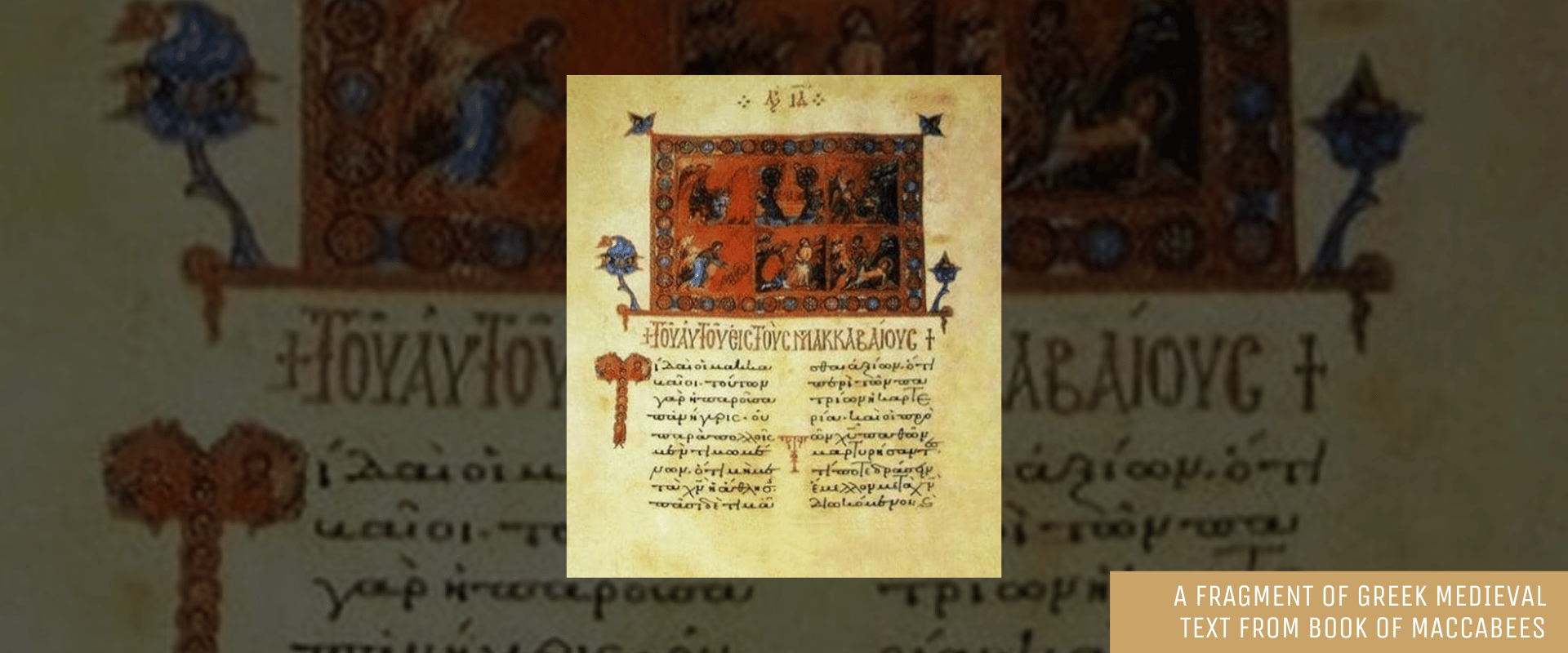
Some of the Books of the Maccabees are found in some forms of the biblical canon. However, it might surprise you to learn that none of them are found in the Tanakh, otherwise known as the Hebrew Bible. While Jews certainly value 1 and 2 Maccabees, which are the basis for the festival of Hannukah, they have never considered them to be Scripture. This may have to do with how late they were written, but there are no definite reasons why they were excluded from the Jewish canon.
In terms of Christian canons, Protestant Bibles do not usually contain the Books of the Maccabees, based partly on the Jewish exclusion of them. They also exclude them because of a reference in 2 Maccabees to prayers for the dead, a practice that Protestant reformer Martin Luther rejected. However, the Catholic Church considers the first two Books of the Maccabees canonical because they were included in the Septuagint, the Greek version of the Hebrew Bible.
Additionally, the Eastern Orthodox Church accepts the first three for the same reason (some later Septuagint manuscripts included the 3rd and 4th books as well). It’s likely for this reason that some versions of the King James Bible include the first two Books of the Maccabees in a separate section called the Apocrypha. Meanwhile, the Georgian Orthodox Church is the only church in which 4 Maccabees is considered part of the canon.
Conclusion
Unfortunately, we don’t know who wrote the Books of the Maccabees, ancient texts which all relate in some way to the Maccabean Revolt against the Seleucid King Antiochus IV Epiphanes, a ruler who attempted to eradicate Jewish religion. While 1 Maccabees tells the initial story of the rebellion and defeat of the corrupt king, 2 Maccabees retells the story with a bit more background and more of a focus on the purification of the Temple.
3 Maccabees, while it does not relate the story of the Maccabean Revolt at all, uses some of the same themes of fidelity to God, Jewish practices, and Jewish identity to tell the story of an earlier persecution of Jews in Egypt by a Ptolemaic King. Finally, 4 Maccabees uses only a small section of the book of 2 Maccabees to argue the Stoic philosophical idea that reason can and should control emotion.
While Jews and Protestants do not consider any of the books of the Maccabees to be canonical, Catholics accept the first two books and Eastern Orthodox Christians accept the first three. These books have tremendous historical and religious significance, but defining them as part of the canon has proven to be complicated through the centuries.
NOW AVAILABLE!
Finding Moses: What Scholars Know About The Exodus & The Jewish Law
Riveting and controversial, the "FINDING MOSES" lecture series takes you on a deep dive into the stories of Moses, the exodus, and a whole lot more...