Who Were the Ebionites?

Written by Marko Marina, Ph.D.
Author | Historian
Author | Historian | BE Contributor
Verified! See our guidelines
Verified! See our editorial guidelines
Date written: July 19th, 2026
Disclaimer: The views and opinions expressed in this article belong to the author and do not necessarily match my own. - Dr. Bart D. Ehrman
Who were the Ebionites? Wait, who? Whenever this question comes up in my classroom, which, to be honest, isn’t very often, I am reminded of just how vast and complicated the history of Christianity really is.
Today, most people know Christianity as a global religion with thousands of branches, churches, and denominations, each with its own claims about God, Jesus, Scripture, salvation, the meaning of different verses in the Bible, and the proper shape of Christian life.
Speak with an Eastern Orthodox priest, a Roman Catholic theologian, a Baptist pastor, or a Pentecostal preacher, and you may encounter deep conviction in each case, but also real differences over authority, ritual, theology, and practice. They might believe Jesus died for our sins or share views on other substantial matters but differ in numerous other views.
Christianity, in other words, has never been a simple, monolithic thing.
But not every stream of Christianity survived the long passage of time. Some movements that once mattered deeply to ancient believers have become little more than a footnote in the life of an ordinary Christian today, even though they remain an important chapter in textbooks on early Christian history.
The Ebionites are one such example. They were followers of Jesus who appear to have remained deeply committed to Jewish law, Jewish identity, and a view of Jesus that differed sharply from what later became mainstream Christian doctrine.
They force us to ask a basic but unsettling historical question: what counted as “Christianity” before the boundaries of “orthodoxy” and “heresy” had hardened? And what exactly did Ebionites believe? What were their practices?
To answer these questions, we first need to enter the diverse and contested world of the 2nd century, where groups like the Ebionites weren’t yet museum pieces, but living participants in the struggle to define the meaning of Jesus.
In case you really want to dig deeper into the diverse world of 2nd-century Christianity, Bart D. Ehrman’s 8-lecture course, Earliest Christian Heresies, is the perfect place to start.
The course explores the messy, fascinating reality of early Christianity, when followers of Jesus disagreed over God, creation, Scripture, salvation, and even the identity of Christ himself. Was Jesus human, divine, both, or something else entirely? Was the creator of the world the same God revealed by Jesus? And who had the right to define the “true” gospel? If those questions intrigue you, this course will take you straight into the debates that shaped Christianity for centuries.
(Affiliate Disclaimer: We may earn commissions on products you purchase through this page at no additional cost to you. Thank you for supporting our site!)

Who Were the Ebionites? A Brief Contextualization of 2nd-Century Christianity
In his bestseller Lost Christianities, Bart D. Ehrman notes:
(Affiliate Disclaimer: We may earn commissions on products you purchase through this page at no additional cost to you. Thank you for supporting our site!)
The wide diversity of early Christianity may be seen above all in the theological beliefs embraced by people who understood themselves to be followers of Jesus. In the second and third centuries there were, of course, Christians who believed in one God. But there were others who insisted that there were two. Some said there were thirty. Others claimed there were 365. In the second and third centuries there were Christians who believed that God had created the world. But others believed that this world had been created by a subordinate, ignorant divinity. (Why else would the world be filled with such misery and hardship?) Yet other Christians thought it was worse than that, that this world was a cosmic mistake created by a malevolent divinity as a place of imprisonment, to trap humans and subject them to pain and suffering.


The point is that early Christians disagreed about the most basic and fundamental questions imaginable: How many divine beings are there? Who created the world? Is the material world good, flawed, or evil? Who was Jesus? What did his death accomplish? Which writings should be treated as authoritative? And what kind of life should his followers live?
The second century, therefore, wasn’t an age in which one clearly defined “Christianity” stood over against a few obvious deviations. It was a period of intense experimentation, competition, and self-definition.
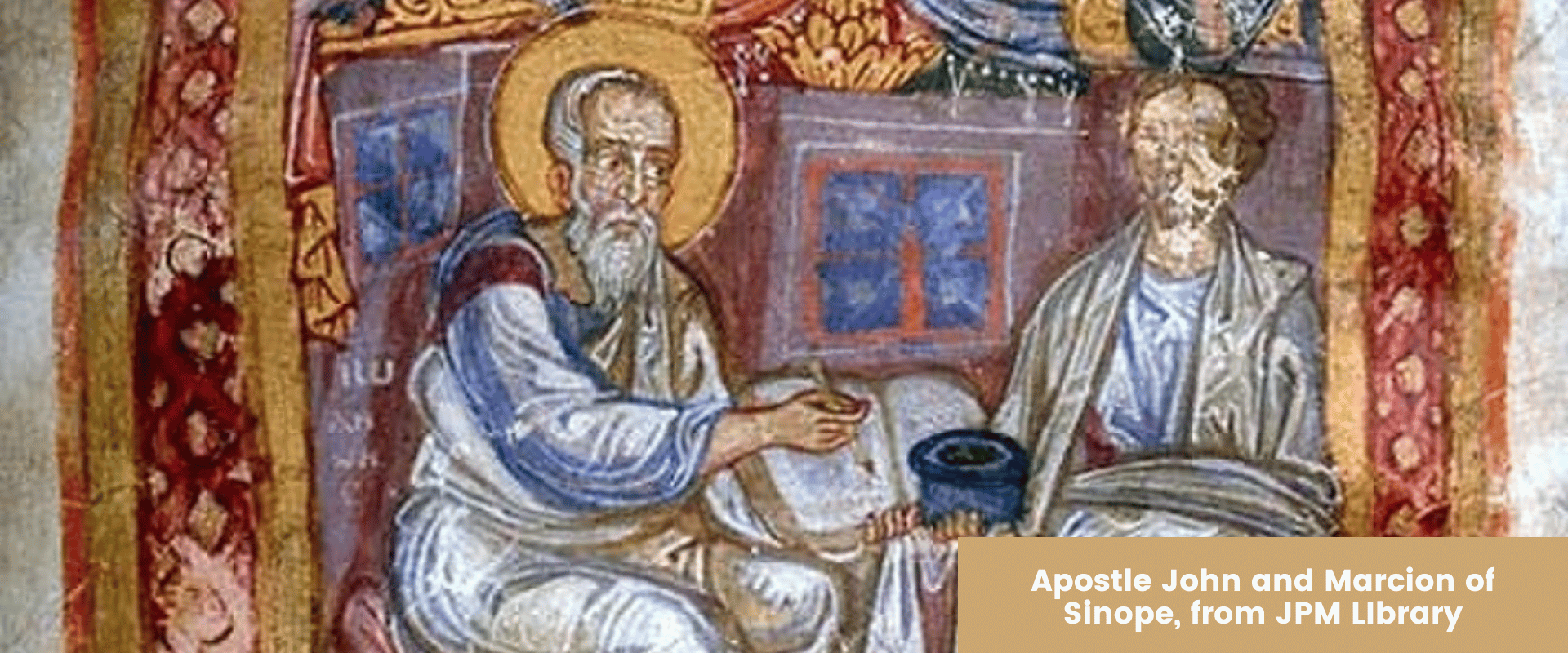
Some Christians, such as Marcion of Sinope and his followers, the Marcionites, drew a sharp distinction between the God of the Jewish Scriptures and the God revealed by Jesus.
Other Christians, often grouped by ancient heresiologists under labels such as Gnostics, developed complex mythological systems in which salvation involved liberation from ignorance and from the powers associated with the lower material world.
Still others (as we’ll soon see!) insisted that Christianity couldn’t be separated from Israel’s Scriptures, Israel’s God, and Israel’s law. What later Christian writers would call “heresy” was often, from the perspective of those who practiced it, simply the true interpretation of Jesus and his message.
Furthermore, the boundaries between these groups were often more flexible and open than later accounts suggest.
Paula Fredriksen, in her book Ancient Christianities, rightly points out:
In the second century... Christian ‘institutions’ were often, at higher social registers, more like literary salons. Texts were read within the social networks of the author. Many different teachers floated between these salons. The goal of the heresiologist - the Christian rhetorician, if you will, a “specialist” of heresies - was to cement allegiance to his point of view. Accusations of intellectual incoherence and of moral profligacy, of a lack of unanimity and discipline, of female dominance in leadership roles (a gendered code for confusion and disorder): all were tropes of derogation aimed variously at pagan, Jewish, and especially Christian contemporaries. Intra-Christian diversity, if we consider how heresiology bulks in Christian literature, was perceived as the gravest threat of all.
I think this is a crucial reminder. Ancient descriptions of “heretical” groups were rarely neutral reports. They were attempts to classify, criticize, and contain forms of Christianity that seemed dangerous to the author’s own vision of the faith.
This doesn’t mean that every group was identical or that doctrinal differences were insignificant. On the contrary, the differences were profound.
But it does mean that second-century Christianity should be imagined less as a finished building and more as a crowded construction site: communities, teachers, texts, rituals, and theological claims were still being assembled into more stable forms.
It was in this contested world (a world in which the relationship between Jesus, Judaism, Scripture, law, and salvation was still being debated) that the Ebionites emerged as one of the most important types of Christianity.
What Sources Do We Have for the Ebionites?
Before we can answer the question “Who were the Ebionites?” with appropriate clarity, it’s necessary to take a brief look at the nature of the sources we have about them. This is especially important because the Ebionites present us with a difficult historical problem.
Unlike some Gnostic-like communities, whose writings became available to modern scholars through discoveries such as the Nag Hammadi library, we do not possess a surviving collection of texts written by the Ebionites themselves.
Almost everything we know about them comes from outsiders, and usually from outsiders who regarded them as theological opponents.
Ancient Christian writers sometimes quote or describe gospel traditions that appear to be connected with Ebionite circles, but even these fragments are indirect evidence, preserved within the works of authors whose main purpose wasn’t neutral description, but heresiological classification and critique.
The earliest major source for the Ebionites is Irenaeus, bishop of Lyons, writing in the late 2nd century.
In his massive work Against Heresies, Irenaeus attempted to define and defend what he understood to be the true apostolic faith by contrasting it with a wide range of rival “heretical” teachings.
His account of the Ebionites is brief but extremely important! As Simon Claude Mimouni explains in the book Le christianisme des origines à Constantin (Christianity: From Its Origins to Constantine):
“Irenaeus of Lyons is the first Christian author to use the term ‘Ebionite’ to designate this movement; he is also the first to declare it heretical, since, in addition to their messianic belief, which he found unacceptable, its members continued to observe the Jewish Law. In order more effectively to consign them to heresy, Irenaeus maintained that the Ebionites had been affected by ideas deriving from Gnosticism, allowing themselves to be drawn into abstruse speculations – something that is by no means certain.” (my translation)
After Irenaeus, the Ebionites appear in the writings of Origen, one of the most important Alexandrians in early Christian intellectual history and a major theologian and biblical scholar of the 3rd century.
Origen refers to them in several works, including Against Celsus and his biblical commentaries, and his testimony is particularly valuable because it suggests that the label “Ebionite” may not have referred to one perfectly uniform group.
Later sources continue this heresiological tradition. Eusebius of Caesarea, the early 4th-century bishop and author of Church History, discusses the Ebionites as part of his broader narrative about the development of the church and the rise of groups he considered heretical.
His account depends in part on earlier writers and reflects his own concern to distinguish the “orthodox” church from movements he believed had misunderstood Christ and the apostolic message.
The most detailed ancient discussion comes from Epiphanius of Salamis, a 4th-century bishop whose massive heresiological work, the Panarion, catalogues dozens of groups he regarded as dangerous deviations from true Christianity.
Epiphanius preserves a great deal of information, including references to gospel traditions associated with the Ebionites, but his account is also late, polemical, and often difficult to evaluate.
Since these are hostile sources, they cannot be taken at face value. Irenaeus is perhaps the best example of this.
Karen King rightly points out:
Irenaeus’ rhetoric works hard to draw sharp lines of differentiation between himself and his opponents. In the process, those theological views he shares with them are obscured and differences are accentuated, producing a highly polarized portrait. He sets the agenda of the debate in how he characterizes these ‘others.’ Generally speaking, Irenaeus condemns his opponents as heretics because, he claims, they rejected the God of the Hebrew Bible as the true God and creator of the cosmos. Against what he saw as the clear evidence of Scripture, they denied the divine goodness of both the creator and the creation. The heretics practiced asceticism, but only as hatred of the flesh.
Although King is speaking especially about Irenaeus’ treatment of Gnostic-like opponents, the methodological point applies more broadly.
The discovery of the Nag Hammadi texts revealed that some of the communities attacked by heresiologists had more complex and nuanced theological concerns than their opponents admitted.
That discovery should make us cautious whenever we reconstruct a group only through the writings of those who condemned it.
That, obviously, doesn’t mean we should abandon everything early Church authors had to say about the Ebionites or any other religious community of that period.
Hostile sources can preserve real information, especially when different authors, writing in different contexts, report similar features.
But it does mean that we must draw a careful line between what seems historically plausible and what may be driven primarily by the polemical effort to discredit, marginalize, or destroy the “other.”
The Ebionites, then, have to be approached through a double lens: they were almost certainly real Jewish followers of Jesus, but the image we possess has been filtered through the categories and anxieties of their opponents.
With these methodological warnings in mind, we can now turn to what the Ebionites probably believed and how they appear to have practiced their faith.
DID PAUL AND JESUS HAVE THE SAME RELIGION?
Jesus taught a message of repentance to prepare for the Kingdom of God while Paul taught faith in Jesus. Did they agree? Should they be considered the “co-founders” of Christianity?
Who Were the Ebionites? Beliefs and Practices
The first question is deceptively simple: what does the name “Ebionite” mean? Ancient Christian writers usually connect it with the Hebrew word ’ebyon, meaning “poor.” That etymology is plausible, but its exact significance is harder to determine.
Did the name refer to actual economic poverty? Was it a title of piety, identifying believers who saw themselves as the humble poor before God? Or was it a polemical label used by opponents who wanted to mock them as “poor” in understanding?
In Jewish and biblical tradition, poverty could carry deep religious meaning; the “poor” could be imagined as those who depended radically on God.
At the same time, later Christian heresiologists exploited the name negatively, using it to suggest intellectual or theological deficiency. As Mimouni explains:
“At present, most scholars consider the Ebionite movement to be a development from an earlier group that lived in Palestine and designated itself by the name “the poor.” In other words, according to this view, ‘Ebion’ is not the name of the movement’s founder, but rather a heresiological corporate designation.” (my translation)
This brings us to a deeper methodological problem: were “the Ebionites” really a single, clearly bounded movement? Here we need to be cautious.
As Roger Bagnall explains:
With various justification, traditional modern scholarship has similarly tended to follow Epiphanius in the postulation of two main types of Jewish Christians, a moderate Nazoraean group and a radical Ebionite wing. Continuing study of the sources, increasing awareness of the wide diversity among early Christians, and growing recognition of the anachronistic nature of the heresiologists’ reconstructions (especially Epiphanius’) have, however, brought into question the supposition of a specific group called ‘Ebionites.’ There seems to have been a broad spectrum of early Jewish Christian groups, just as there was a broad spectrum of early Gentile Christian groups. Designations (and self-designations) for and among the early Christians were diverse and fluid; supposition of distinctive self-designations for each and every group is an anachronistic importation from later heresiologists who avowedly undertook efforts to deny the name “Christian” to anyone with divergent views.
This is also why terms such as Nazarene and Ebionite have to be handled carefully.
Ancient and modern writers have often used them to distinguish different kinds of Jewish followers of Jesus, but the boundaries between these labels were not always clear, and they may not map neatly onto self-contained religious communities.
Still, even if the boundaries of the group were fluid, the sources do allow us to identify several recurring features associated with Ebionite-like Jewish Christians.
Did You Know?
According to Epiphanius, the Ebionites told a rather scandalous story about Paul. They allegedly claimed that Paul was not really Jewish by birth, but Greek; that he went to Jerusalem, fell in love with the daughter of a priest, converted to Judaism in order to marry her, and then, after being rejected, turned angrily against circumcision, the Sabbath, and the Jewish Law.
In other words, their anti-Pauline polemic explained Paul’s theology as the result of romantic frustration! This is almost certainly polemical legend rather than biography, but it shows just how sharply far some heresiologists could go to marginalize Ebionites.
But what about their core beliefs? Sakari Häkkinen notes that the earliest available description presents the Ebionites as believers in one creator God, users of the Gospel according to Matthew, opponents of Paul, observers of circumcision and Jewish customs, and practitioners of a Jewish way of life.
That first point shouldn’t be passed over too quickly. Unlike some Christian groups accused of distinguishing the supreme God from a lower creator deity, the Ebionites seem to have affirmed the God of Israel as the one God and creator of the world.
So, their problem, for writers such as Irenaeus, wasn’t that they rejected the creator God, but that they understood Jesus and the continuing authority of the Jewish law differently from what would become mainstream Christian teaching.
Their attachment to the Torah appears to have been one of their defining characteristics. According to the ancient reports, they practiced circumcision, observed Jewish customs, and continued to live in ways recognizably shaped by Jewish religious identity.
This doesn’t mean that they were “Jews instead of Christians,” as if those categories were already neatly separated. Rather, they were Jewish followers of Jesus who didn’t believe that faith in Jesus required abandoning the law of Moses.
Häkkinen rightly emphasizes that their rejection of Paul was connected to this issue. Paul was remembered, at least by some Jewish-Christian circles, as the apostle who had relativized circumcision, Sabbath observance, and the Torah for Gentile believers.
For Ebionite-like Christians, this wasn’t a brilliant theological breakthrough but a dangerous betrayal. That is why ancient sources repeatedly report that they rejected Paul as an apostate from the Law.
What Did Ebionites Teach About Jesus?
What did Ebionites teach about Jesus? Here, things get even more interesting! The patristic sources generally attribute to them what scholars often call a “low” Christology.
In its simplest form, this means that they regarded Jesus as the Messiah, but not as a preexistent divine being who became incarnate.
Also, early Church authors claim that Ebionites denied the virgin birth and believed Jesus to be the natural son of Joseph and Mary.
Yet the picture isn’t entirely uniform: Origen and Eusebius suggest that some of those they called Ebionites may have accepted the virgin birth while still holding a less exalted view of Christ than their catholic opponents.
As Mimouni notes:
In Against Celsus (5.61) and in the Commentary on Matthew (16.12), Origen distinguishes between two categories of Ebionites: one perfectly orthodox, the other entirely heterodox – the latter could then have emerged from a split with the former for doctrinal reasons: belief or non-belief in the virginal birth of Jesus.
Additionally, Justin Martyr, writing several generations before Origen, describes a comparable situation among Jewish Christians in his Dialogue with Trypho, though he doesn’t use the term “Ebionite” for them.
The safest reconstruction is therefore not that every Ebionite believed exactly the same thing, but that Ebionite-like Christians tended to understand Jesus primarily as a (Jewish!) human being chosen, empowered, or adopted by God.
This is where Häkkinen’s discussion is especially useful. He notes that the Ebionite view is often described as “adoptionist,” because Jesus becomes God’s Son in a special way, especially at his baptism.
But he also draws attention to another possible description: “possession Christology.” In this model, Jesus isn’t simply adopted by God in an abstract legal sense; rather, the Spirit (or the heavenly Christ) descends upon him at baptism and empowers him for his mission.
This helps explain why the baptism of Jesus was so important in Ebionite gospel tradition. According to Epiphanius, the gospel associated with the Ebionites lacked birth and infancy narratives and began with John the Baptist.
In its baptism scene, the heavenly voice declares not only “You are my beloved Son,” but also “Today I have begotten you.”
Whatever the precise wording of their gospel, the theological emphasis is clear: Jesus’ identity as Son of God was closely tied to divine election and empowerment.
Ebionites: Practices and Scripture
Other practices are harder to reconstruct. Epiphanius attributes to the Ebionites vegetarianism, daily purifying washings, a rejection of sacrifice, synagogue-like community organization, and an annual Eucharistic meal.
This is one reason the Ebionites sometimes appear in modern discussions of the question, “What did Jesus eat?”.
Some later Jewish-Christian traditions seem to imagine Jesus and John the Baptist in ways compatible with vegetarian or anti-sacrificial practice. Still, we should be careful!
Some of these details may preserve real features of certain Jewish-Christian communities. Others may come from texts or traditions that Epiphanius associated with the Ebionites but that did not necessarily belong to them in any straightforward way.
The same caution applies to their literature. Irenaeus says they used Matthew; Eusebius speaks of the Gospel according to the Hebrews; Epiphanius seems to have known a Greek gospel harmony associated with them, often called by modern scholars the Gospel of the Ebionites.
The safest conclusion is that Ebionite-like Christians used gospel traditions shaped by Jewish-Christian theology, but we should resist the temptation to reconstruct their library with too much confidence.
Conclusion
In his analysis of the Ebionites, Mimouni concludes:
The Ebionites, whose historical reality is beyond doubt, even if we are embarrassed when it comes to specifying their origins and tracing their contours, are Christians of Jewish origin who separated from the Nazoreans around the end of the first century, for essentially doctrinal reasons... Ebionism was certainly a marginal group in the Christian galaxy of the first centuries of our era, but according to some scholars it may have been an important religious movement. One reason is invoked for this: it is possible that the Christians with whom Muhammad and his group of disciples came into contact in the seventh century belonged to the Ebionite movement, whose adherents may still have existed in northern Arabia at that time. If that was the case, it would then seem possible to think of a direct influence between Ebionite Jewish Christianity and early Islam.
Mimouni’s proposed connection between Ebionite Jewish Christianity and early Islam is fascinating, but it remains a hypothesis that cannot easily be proven.
What is much clearer is that, by the end of the 3rd century, Jewish Christianity had been pushed increasingly to the margins of the Christian world. The reasons weren’t accidental. As the movement that would become “orthodox” Christianity consolidated its institutions, Scriptures, and theological language, Jewish-Christian groups such as the Ebionites became harder and harder to accommodate.
Their marginalization was connected to several factors at once. They continued to observe the Jewish law at a time when most Christian communities were becoming predominantly Gentile. They rejected, or at least deeply distrusted, Paul, who would become one of the central theological authorities of the emerging “orthodox” Christianity.
And they understood Jesus in ways that clashed with the developing conviction that Christ was not merely a human being chosen by God, but the preexistent Son of God incarnate.
In short, the Ebionites stood on the wrong side of several boundaries that later became decisive: law and gospel, Judaism and Christianity, Paul and the Torah, human Messiah and divine Christ.
This doesn’t mean that the Ebionites were simply “wrong” Christians waiting to be corrected by later orthodoxy. That is how their opponents wanted them to be remembered.
From a historical perspective, they are better understood as one form of early Jewish Christianity: followers of Jesus who remained committed to Israel’s God, Israel’s Scriptures, and Israel’s way of life.
They remind us that the separation between Judaism and Christianity wasn’t immediate, simple, or uniform. For many early followers of Jesus, confessing him as the Messiah didn’t mean leaving Jewish identity behind.
That is why the Ebionites matter. They show us a road Christianity largely didn’t take, but one that was historically real and theologically meaningful for those who walked it.
Their story forces us to look again at the earliest centuries of Christianity as a contested landscape of competing memories, Scriptures, practices, and interpretations.
The Ebionites may have disappeared from living Christian tradition, but the questions they raise remain central: Who was Jesus? What is the place of the Jewish law? Who gets to define authentic Christianity? And how many forms of devotion to Jesus were possible before one of them became dominant?
NOW AVAILABLE:
The Genius of Mark: Jesus the Secret Messiah
Mark is the most brilliant AND most underrated Gospel of the New Testament. But, did Mark have first-hand knowledge of Jesus’ life or was he just makin’ stuff up? Explore the answer in this course.