
What is the Nag Hammadi Library?

Written by Marko Marina, Ph.D.
Author | Historian
Author | Historian | BE Contributor
Verified! See our guidelines
Verified! See our editorial guidelines
Date written: June 11th, 2026
Disclaimer: The views and opinions expressed in this article belong to the author and do not necessarily match my own. - Dr. Bart D. Ehrman
Have you ever heard of the famous Nag Hammadi library? Whenever I hear that name, I am reminded that history is not a fixed body of knowledge, neatly arranged once and for all, but a living discipline constantly reshaped by new evidence.
Every major discovery has the potential not only to enlarge what we know about the past, but also to force us to rethink what we thought we already understood.
For anyone who imagines that the historian’s task is simply to repeat settled facts from generation to generation, the Nag Hammadi library offers a powerful reminder that the past is often more complex, more surprising, and more contested than our inherited narratives suggest.
This is especially true when we turn to the history of early Christianity. Many modern readers assume that the basic contours of Christian origins are already clear: Jesus preached, the apostles followed, the New Testament was written, and the church gradually spread throughout the Roman world.
There is, of course, truth in that broad outline. But it’s only part of the story.
The first centuries of Christianity featured intense creativity, disagreement, experimentation, and debate over the most fundamental questions: Who was Jesus? What kind of world do we inhabit? What does salvation mean? Which writings should be trusted? And who had the authority to answer such questions?
One discovery in the Egyptian desert would dramatically expand the evidence available for exploring these questions, and would give modern scholars a much richer, and more complicated, picture of early Christian diversity.
But before we step into the world of Egyptian desert and amazing discoveries, I want to mention Bart D. Ehrman’s 8-lecture course, Earliest Christian Heresies.
It explores the fascinating and often surprising world of early Christian diversity: groups that disagreed over whether Christ was human, divine, both, or neither; whether the creator of the world was the Father of Jesus or a lower, ignorant deity; and who truly possessed the “real” gospel.
If this article sparks your interest in the strange, contested, and intellectually vibrant world of early Christianity, Bart’s course is the perfect next step.
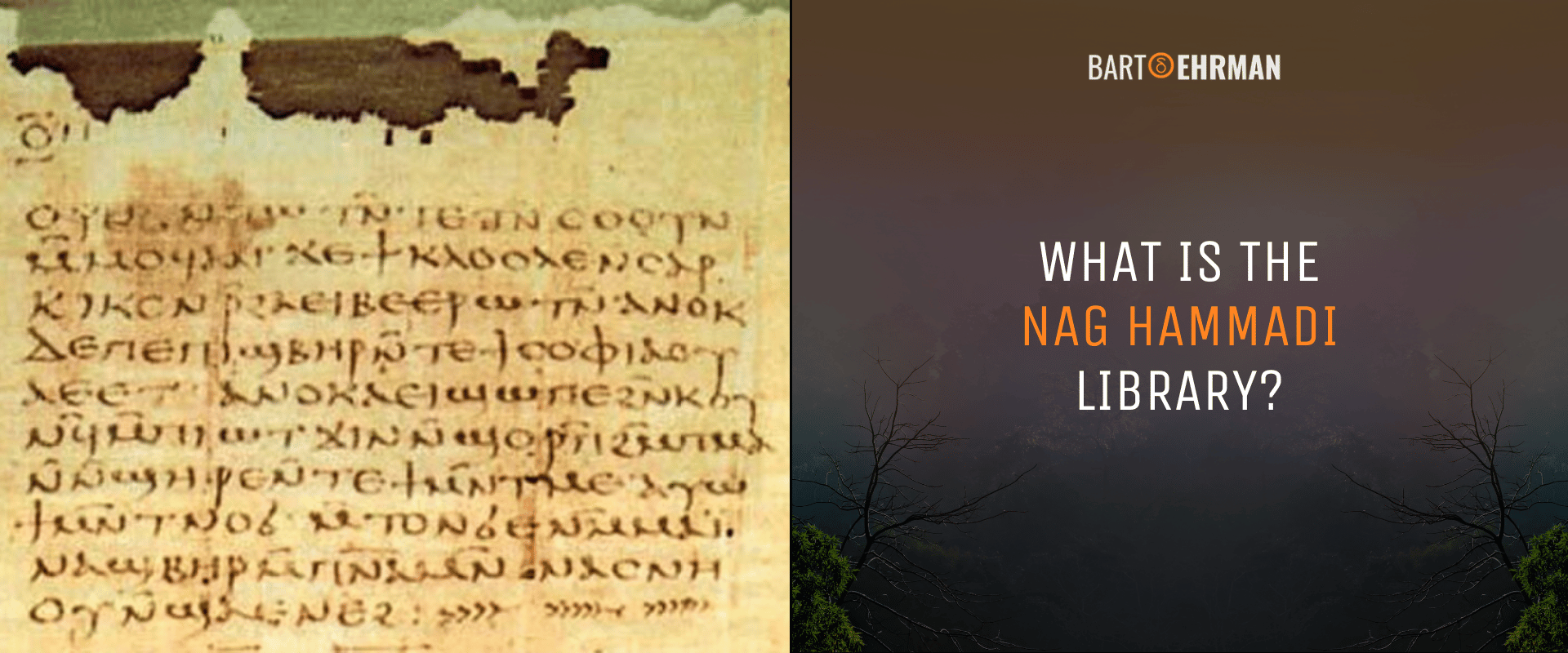
The Discovery: How the Nag Hammadi Library Came to Light
In his book A History of Gnosticism, Giovanni Filoramo notes:
(Affiliate Disclaimer: We may earn commissions on products you purchase through this page at no additional cost to you. Thank you for supporting our site!)
The Nag Hammadi library primarily represents a considerable corpus to the scholar previously accustomed to work upon a few scattered documents. . . . Of these texts forty-one were previously quite unknown; of the remainder six are either duplicates of writings already extant, and six were previously known. Many of those texts (about thirty) have come to us in good condition, and only ten are particularly fragmentary.


That is a remarkable statement. But before we turn to the contents and historical significance of the documents discovered beneath the Egyptian sand, we should step back and look at the story of the discovery itself.
It’s a story that involves not trained archaeologists carefully excavating an ancient site, but local peasants, a sealed jar, hopes of hidden treasure, fear of spirits, accidental destruction, antiquities dealers, and eventually, the slow realization that something extraordinary had come to light.
The story begins in Upper Egypt, near the modern city of Nag Hammadi, located at the great bend of the Nile, south of Cairo and north of Luxor.
Marvin Meyer describes the landscape vividly as a meeting point between the fertile “black land” of the Nile Valley and the surrounding “red land” of the desert.
It was near this borderland, by the cliffs of Jabal al-Tarif, that several Egyptian fellahin were reportedly gathering sabakh, a kind of natural fertilizer, around December 1945.
According to the account later given by Muhammad Ali al-Samman, he and others were digging near a large boulder when they uncovered a large storage jar sealed with a bowl. At first, Muhammad Ali hesitated.
A sealed jar might contain a jinni, a spirit best left undisturbed. But it might also contain gold. Hope defeated fear. He broke the jar open. Something golden seemed to fly out into the sunlight, but what remained inside wasn’t treasure in the ordinary sense. It was a collection of very old books.
These books weren’t immediately recognized as significant. Muhammad Ali reportedly wrapped them in his turban and carried them back to his home in al-Qasr. Some damage had already occurred: parts of the codices were torn, and later, according to the story, his mother used some of the dry papyrus leaves to help light a household oven.
It’s difficult not to wince at that detail, but it also reminds us of the contingencies often surrounding the survival of ancient texts.
Manuscripts do not pass neatly from antiquity into modern libraries. They survive through accidents, climate, neglect, trade, local circumstance, and, sometimes, sheer luck. In this case, books that had been preserved for centuries in the dry Egyptian desert nearly disappeared after their rediscovery, before anyone fully understood their historical and cultural value.
The codices then began a complicated journey through local hands and the antiquities market. Some were reportedly sold for small amounts, or even exchanged for ordinary goods, before dealers became involved.
Eventually, most of the material made its way to the Coptic Museum in Old Cairo, though one codex (the so-called Jung Codex) left Egypt for a time before being returned. The story didn’t end once scholars became aware of the find.
As with other major manuscript discoveries of the 20th century, publication was slow, access was restricted, and scholarly disputes delayed the wider study of the texts.
But in time, through facsimile editions, translations, and international scholarly collaboration, the Nag Hammadi library became available to researchers. The dramatic story of its discovery thus leads directly to the next question: what exactly had been hidden in that jar near the cliffs of Upper Egypt?
What Was Found? The Contents of the Nag Hammadi Library
So what exactly was found inside that jar? The short answer is: a remarkable collection of ancient books.
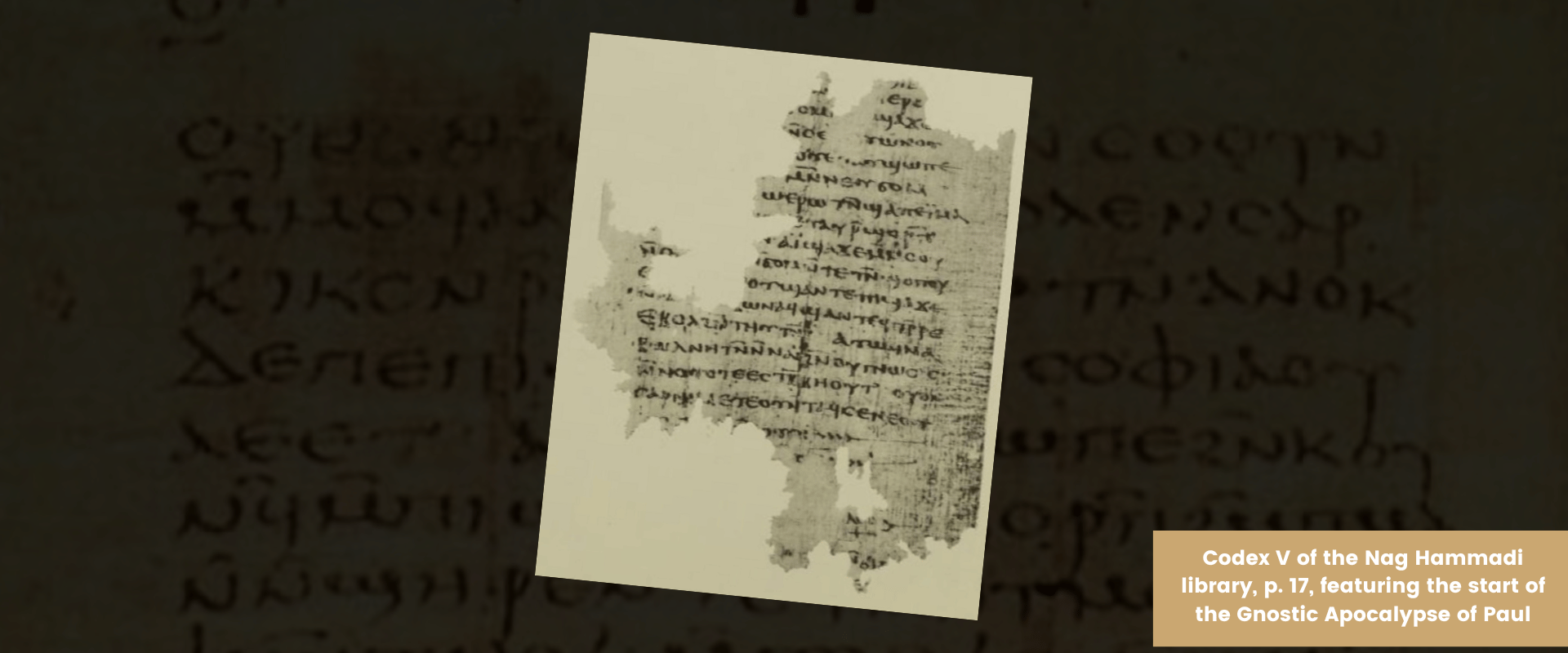
More precisely, the Nag Hammadi library consists of 13 leather-bound papyrus codices containing 52 texts. Since some are duplicates or different versions of the same work, scholars usually speak of forty-six separate writings, or “tractates.”
The manuscripts themselves date from the 4th century C.E., but many of the works they preserve are almost certainly older.
The codices are written in Coptic, the final stage of the ancient Egyptian language, though scholars generally agree that many of these texts were originally composed in Greek and later translated into Coptic.
In other words, what was discovered in Upper Egypt wasn’t a single book, nor a Bible, nor a unified theological manifesto, but a diverse library of religious and philosophical writings copied and preserved in late antique Egypt.
The contents are strikingly varied. Most of the tractates can be described as Jewish or Christian, or at least as deeply engaged with Jewish and Christian traditions, because they draw on figures, stories, and themes from the Hebrew Bible, the New Testament, and other Jewish and Christian writings.
Adam and Eve, Seth, Jesus, the apostles, and other biblical figures appear throughout the collection. But not every text in the Nag Hammadi codices is straightforwardly Jewish or Christian. One of the most surprising examples is a Coptic translation of a passage from Plato’s Republic, a work written centuries before Christianity.
Other texts belong more broadly to the world of ancient philosophy, religious speculation, revelation discourse, and late antique spirituality. This variety is one reason why scholars are cautious about treating the Nag Hammadi library as the product of one single group, sect, or movement.
Additionally, many of the writings are apocalypses or revelations. In this kind of literature, a heavenly figure, a divine revealer, or a legendary human being discloses hidden truths to a chosen recipient.
Sometimes the revelation concerns the structure of the cosmos; sometimes it explains the origin of the world; sometimes it foretells future events; and sometimes it offers secret teaching about the soul, salvation, or the divine realm.
In the Revelation of Adam, for example, Adam speaks to his son Seth and reveals mysteries about creation and future generations. Other tractates take the form of theological treatises, sermons, hymns, philosophical reflections, or letters.
The collection therefore gives us access not simply to “alternative gospels,” as popular treatments sometimes suggest, but to a much broader world of ancient religious imagination.
That said, several texts in the collection are, indeed, called “gospels. But even if you think of them as Gnostic gospels, they do not look like the familiar gospels of the New Testament.
The canonical Gospels are narrative accounts that tell the story of Jesus’ ministry, teaching, death, and resurrection.
The Gospel of Thomas, by contrast, is a sayings collection. It doesn’t narrate Jesus’ birth, miracles, trial, crucifixion, or resurrection.
Instead, it presents a sequence of sayings attributed to Jesus, some of which resemble things said in the New Testament, while others sound much more enigmatic or mystical.
The Gospel of Philip is different again: it’s not a narrative gospel either, but a collection of reflections on sacraments, names, spiritual union, and salvation. It became famous in modern popular culture largely because of its references to Mary Magdalene, though those passages are often interpreted in highly sensationalized ways.
A number of Nag Hammadi texts are associated with what scholars have traditionally called “Gnosticism,” though scholars have increasingly debated that term.
In older scholarship, the collection was often described rather simply as a “Gnostic library.” That label is, to a degree, understandable!
After all, many of the texts emphasize themes commonly associated with ancient Gnostic thought: the saving power of knowledge, the soul’s alienation from the material world, the distinction between the highest God and lower cosmic rulers, and the idea that human beings need revelation to understand their true origin and destiny.
Texts such as the Apocryphon of John, The Hypostasis of the Archons, and On the Origin of the World are especially important for understanding these mythological and theological patterns.
Gnosticism: Terminology and Definition
Many scholars today are very careful not to imagine “Gnosticism” as one clearly organized religion with a single doctrine, hierarchy, or canon. And they are certainly right. The Nag Hammadi texts, themselves, are excellent proof. They are too diverse to justify assuming the existence of a one single “Gnostic” religion. So, what should we do with the term “Gnosticism” itself?
I am inclined to follow those scholars who still find the term useful, provided that it is used carefully (and often in the plural, “Gnosticisms”) to describe a range of related religious outlooks rather than a single unified movement.
In this sense, the term can refer to forms of spirituality marked by a distinctive metaphysical orientation.
As April DeConick has argued, such movements became transgressive not merely because they were “different,” but because they crossed boundaries that other Christians regarded as fundamental: the unity of the creator and the Father of Jesus, the authority of received scripture, the public character of Christian teaching and ritual, and the subordinate place of human beings before God.
In that respect, these forms of spirituality were also countercultural within the wider ancient Mediterranean world, which generally prized tradition, public religion, continuity, and reverence for ancestral norms.
In any case, the significance of the Nag Hammadi library for the study of early Christianity has been enormous. As Karen King observes in What Is Gnosticism?:
The decades since the discovery near Nag Hammadi have seen a flurry of scholarly activity. The sheer volume of the material and its intellectual complexity have required enormous efforts. Painstaking studies focused on the philological and exegetical problems of specific works initially constituted the bulk of the research. Work on Coptic language and codicology, as well as on questions of composition, use of sources, and genre, has made significant advances... Certain Nag Hammadi works appear to be closely related to heresies described by the early Christian polemicists. There are, however, some significant discrepancies between the descriptions of the polemicists and the contents of Nag Hammadi works; such discrepancies indicate where and how the rhetorical strategies, theological interests, and ecclesiastical politics of the polemicists may have shaped their descriptions of heretical groups and affected the reliability of their 'reports'.
This is precisely why the discovery matters so much. It gave scholars direct access to texts that had often been known only through the hostile reports of ancient Christian opponents.
But how exactly do these writings differ from the stream of Christian thought that, by the end of the 4th century, had triumphed and become known as the mainstream or dominant form of Christianity?

How Do These Texts Compare to Traditional Christian Tenets and Scriptures?
In his book Gnosis and Faith in Early Christianity, Riemer Roukema notes:
From the middle of this [2nd] century the church produced a number of bishops and scholars who attacked these gnostics in writings. As part of their discussions of the deviant views they summarized many of their texts or quoted parts of them. So it is part of the irony of history that unintentionally these ‘church fathers’ have become important witnesses to the heresies that they wanted to dispute.
This is an important point. Long before the discovery near Nag Hammadi, scholars already knew that some ancient Christians held views that later church leaders considered deeply problematic.
But for the most part, they knew those views through the writings of their opponents: figures such as Irenaeus, Tertullian, Hippolytus, and Epiphanius.
These authors are often called heresiologists, meaning Christian writers who described, classified, and attacked teachings they regarded as false or deviant.
The Nag Hammadi library changed that situation dramatically: it allowed scholars to read many such writings directly, rather than only through the hostile summaries of ancient heresiologists.
Despite the efforts of church authors to refute and marginalize these texts and the groups associated with them, we shouldn’t imagine the 2nd and 3rd centuries as a world of neatly separated “churches” with clear membership rolls and fixed doctrinal boundaries.
The social reality was probably much messier. Identity boundaries were still being negotiated, and individuals may have moved between different teachers, study circles, house churches, ritual groups, and Christian communities.
People of Jewish background, gentiles, philosophers, seekers, ascetics, and ordinary believers could encounter a range of writings and teachings that later Christians would classify as orthodox, heretical, apocryphal, or somewhere in between.
Nor should we forget that much of early Christianity remained deeply entangled with early Judaism, even when some Christian groups began to reinterpret (or reject) parts of that inheritance in radical ways.
Still, there were real and significant differences between many of the “Gnostic-like” writings found at Nag Hammadi and the beliefs, scriptures, and practices of the stream of Christianity that eventually became dominant.
One major difference concerned the identity of the creator God. In what became mainstream Christian theology, the God who created the world in Genesis was the same God who sent Jesus Christ. Creation might be fallen, damaged, or corrupted by sin, but it was still the work of the one good God.
By contrast, several Nag Hammadi texts draw a sharp distinction between the highest, transcendent God and the lower creator of the material world. In some texts, this creator figure is ignorant, arrogant, or even hostile. That wasn’t a minor disagreement. For writers such as Irenaeus, separating the Father of Jesus from the God of Israel threatened the very foundation of Christian faith.
A second major difference concerned the human problem and the nature of salvation. In many forms of emerging orthodox Christianity, the central human problem was sin: human beings had disobeyed God, stood in need of forgiveness, and were redeemed through Christ’s death and resurrection.
Many Nag Hammadi texts, however, place much greater emphasis on ignorance. Human beings do not know who they truly are, where they come from, or how they have become trapped within the structures of the material cosmos.
Salvation, therefore, often comes through revelation (through gnosis, or saving knowledge) by which the soul awakens to its true origin and destiny.
This doesn’t mean that ethics disappear, but the center of gravity shifts. The decisive issue isn’t simply guilt before God, but ignorance of one’s divine source and captivity within a flawed cosmic order.
A third difference concerned scripture, authority, and interpretation. Many Nag Hammadi writings do not simply reject biblical traditions; they reread them.
Genesis, the words of Jesus, apostolic figures, and biblical symbols are taken up and interpreted in strikingly different ways. Adam, Eve, Seth, the serpent, the creator, and the apostles can all appear in roles that differ sharply from those assumed in later church teaching.
This is one reason these writings were so troubling to heresiologists: they weren’t always external attacks on Christianity, but alternative interpretations from within or near Christian tradition itself.
They claimed access to deeper meanings, hidden revelations, and more advanced forms of spiritual understanding. The question, then, wasn’t merely which books Christians should read, but who had the authority to interpret them.
And that brings us to the final issue raised by Nag Hammadi: how one stream of Christianity came to define itself as orthodox, while others were increasingly pushed outside the boundaries of acceptable belief.
But that larger story (the making of “orthodoxy” and the marginalization of “heresy” in early Christianity) will have to wait for another article.
Conclusion
My students often ask me about the famous Nag Hammadi library. To be honest, most of them first hear about these texts through claims that they reveal Jesus’ secret wife, hidden church conspiracies, or some explosive truth suppressed for centuries: thank you, The Da Vinci Code!
But the real story is both less sensational and far more interesting. The Nag Hammadi texts do not give us a simple “true Christianity” hidden behind the New Testament.
They do not allow us to throw away everything historians thought they knew about Jesus, the apostles, or the early church.
What they do give us is something more historically valuable: direct access to religious voices, myths, interpretations, and spiritual experiments that were once largely known only through the writings of their opponents.
And that, in the end, is why the Nag Hammadi library matters so much. It reminds us that early Christianity wasn’t born as a neat, uniform system with all its doctrines, scriptures, and boundaries already settled.
It was a world of debate, imagination, conflict, and competing claims about God, Jesus, creation, salvation, and authority. Some of those claims eventually became orthodox.
Others were condemned, forgotten, buried—and, in this case, rediscovered in the Egyptian desert. So no, Nag Hammadi isn’t interesting because it proves every modern conspiracy theory about Christianity.
It’s interesting because it shows us something far better: the strange, rich, and contested world out of which Christianity as we know it eventually emerged.