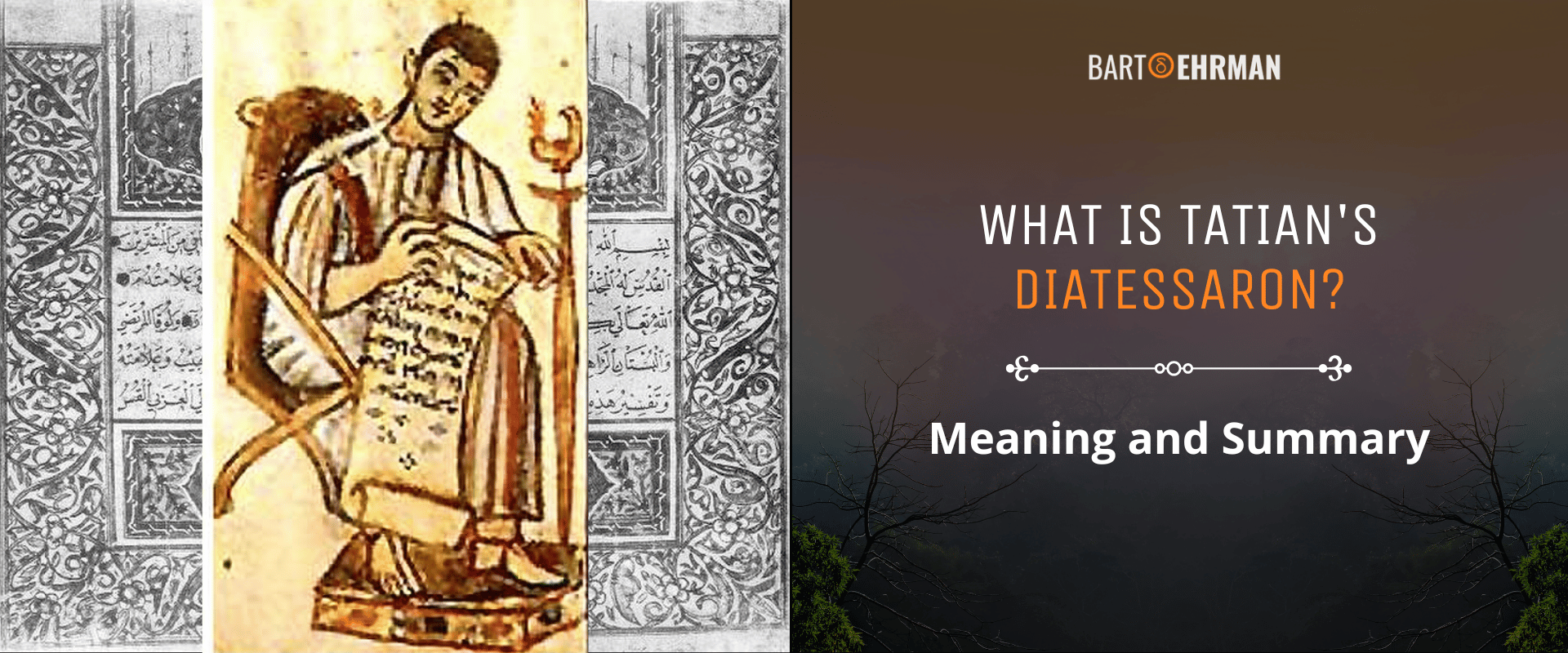
What is Tatian's Diatessaron? Meaning and Summary
Written by Joshua Schachterle, Ph.D
Author | Professor | Scholar
Author | Professor | BE Contributor
Verified! See our editorial guidelines
Verified! See our guidelines
Date written: September 12th, 2026
Disclaimer: The views and opinions expressed in this article belong to the author and do not necessarily match my own. - Dr. Bart D. Ehrman
The New Testament contains four canonical Gospels which tell the story of Jesus from distinct perspectives. While these accounts often overlap, they also differ in chronology, wording, and emphasis. Could these four books be reconciled into a single, continuous narrative? An attempt to answer that question resulted in Tatian's Diatessaron. What is Tatian's Diatessaron, exactly?
It was a remarkable work from the second century CE by a Christian apologist named Tatian that combined all four Gospels into a single unified account of Jesus' life.
In this article, we'll examine who Tatian was, what the word “diatessaron” means, how he blended the four Gospels into one narrative, what material he omitted or changed, and why his work continues to be important for biblical scholarship today.
If you’re interested in this topic, by the way, check out the annual New Insights into the New Testament conference.
Who Was Tatian?
Tatian—also known as Tatian the Syrian, Tatian the Assyrian, or Tatian of Adiabene—was a Christian apologist and teacher in the 2nd century CE. He was born around 120 CE to a pagan family in northern Mesopotamia (modern-day Iraq and parts of Syria). This means, by the way, that his first language would have been Syriac, a later form of the Aramaic language spoken by Jesus and his disciples. Although we know very little about Tatian’s early life, it’s clear from his text Address to the Greeks that he was highly educated in Greek philosophy and rhetoric, a fact which also indicates that his family was relatively wealthy.
As a young man, he traveled extensively throughout the Roman Empire exploring various schools of philosophy and eventually becoming disenchanted with them. We can see this in Address to the Greeks where he ridicules many of the most famous Greek philosophers, including Plato, Heraclitus, and Empedocles. Tatian then arrived in Rome, where he met the Christian theologian and philosopher Justin Martyr, who had his own Christian philosophical school in Rome. Tatian then converted to Christianity and became Justin’s pupil.
After Justin’s death in 165 CE, Tatian apparently opened his own school in Rome. However, Tatian’s history after Justin’s death is more difficult to trace with any certainty. We have some information about Tatian from early church fathers. For instance, in Against Heresies, the bishop Irenaeus, a contemporary of Tatian’s, writes that Tatian was ousted from the church in Rome. This was due to both his extreme views on asceticism, and for being influenced by the Gnostic leader Valentinus.
The 4th-century church historian Eusebius even said that Tatian had founded the Encratites, a severely ascetic 2nd-century sect of Christians who prohibited marriage and the consumption of meat and wine. It’s impossible to know whether this information was entirely accurate or simply perpetuated by widespread rumors.
Despite this, Tatian will always be best known as the author of the Diatessaron. What should people know about the Diatessaron meaning? The word itself is Greek for “out of four,” an indication of the aim of the work to make one book out of the four New Testament Gospels. In short, then, the Diatessaron was a Gospel harmony, a single, sequential organization of the stories and sayings found in the four canonical Gospels, Matthew, Mark, Luke, and John.
Like the Didache, another 2nd-century Christian book, the Diatessaron became highly influential in some regions. In fact, it was the standard text of the four Gospels in Syriac-speaking churches until the 5th-century. After that, Syriac-speaking churches used the four separate Gospels in the Peshitta or Classical Syriac version.
(Affiliate Disclaimer: We may earn commissions on products you purchase through this page at no additional cost to you. Thank you for supporting our site!)
What Prompted the Diatessaron’s Compilation?
As I said above, Tatian started his Christian life as the student of Justin Martyr. In describing Christian worship practices in his community, Justin says they would read selections from the Gospels, which he called the “memoirs of the apostles” (see Justin’s First Apology, chapters 66–67).
However, in his book Ancient Christian Gospels: Their History and Development, Helmut Koester writes that Justin's Gospel quotations combine parallel sayings from the Synoptic Gospels (Matthew, Mark, and Luke) with varying narrative details. Because of this, Koester argues that rather than going back and forth between separate Gospel scrolls, Justin may have read from a text that had already made the Synoptic traditions into a single, harmonized whole.
This opens up the possibility that Tatian’s Syriac version of a Gospel harmony, that is, the Diatessaron, was borrowed from Justin’s version in Greek, although this cannot be proven. In fact, scholars still debate whether the Diatessaron was originally written in Syriac or Greek, since Tatian was well-educated in both. So, one reason Tatian might have compiled his Gospel harmony was to follow his teacher’s example and make the four Gospels into one readable whole.
In addition, pagan philosopher Celsus had criticized the Gospels, claiming that they were filled with internal contradictions and fabrications, and arguing that stories like the virgin birth and the resurrection were historically implausible and poorly composed compared with Greek myths. It’s possible, then, that inconsistencies between each of the four Gospels may have seemed problematic for educated Christians such as Tatian who wished to eliminate such contradictions to validate their own Scriptures.
Finally, Naomi Koltun-Fromm notes that for pedagogical purposes, “a harmony, namely a single text that brings together the disparate gospel stories, is easier to digest and could get the message out in a simpler and direct fashion to the masses.” We know that Tatian was a teacher, so in addition to any other motives, he may simply have seen his Gospel harmony as a useful teaching tool.
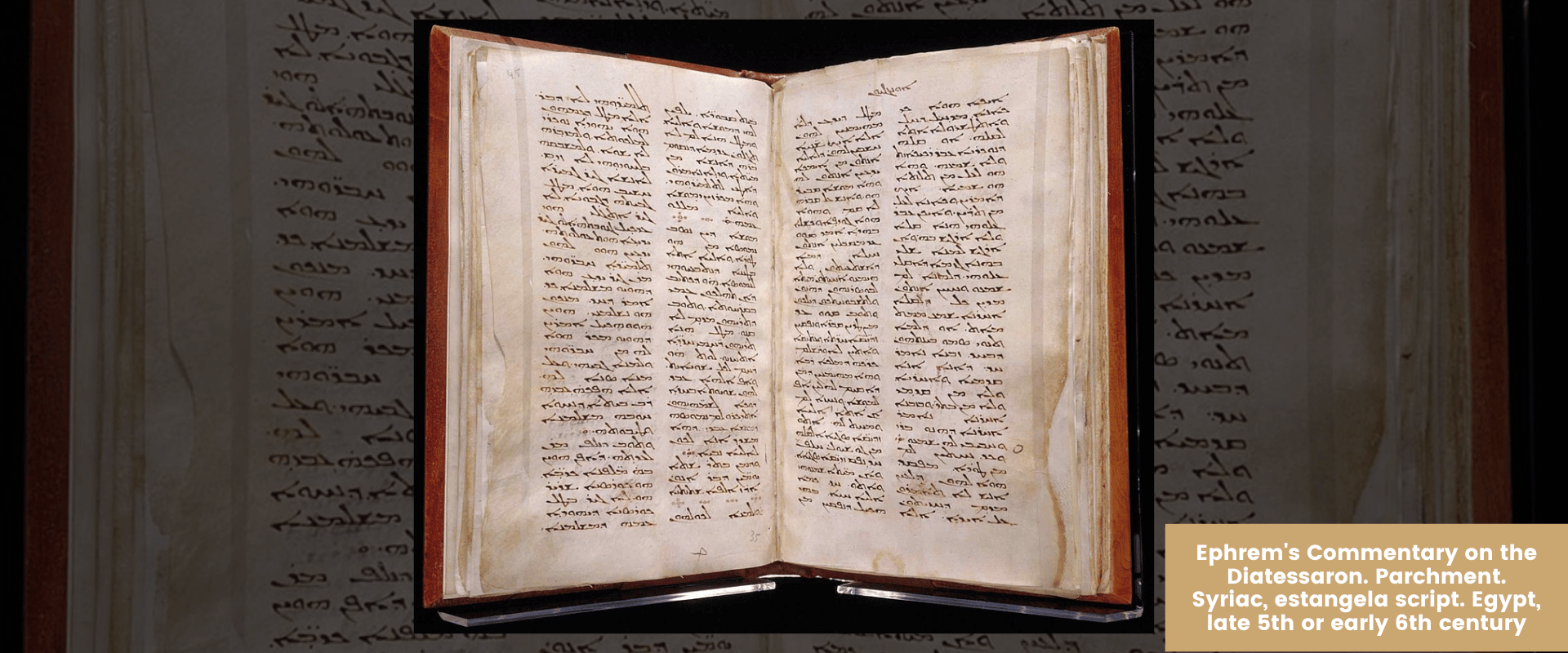
By the way, before looking at the contents of the text, I should note that part of the difficulty with modern study of the Diatessaron is that we have no complete direct copies of it. As William L. Petersen writes,
Today no direct copies of the Diatessaron survive. Its text must be reconstructed through a painstaking collation and comparison of numerous ‘witnesses’ to the Diatessaron: an assortment of translations (into both Eastern and Western languages) and patristic quotations.


Having explained some of the background of the Diatessaron, I’ll next give a brief summary of the text.
DID PAUL AND JESUS HAVE THE SAME RELIGION?
Jesus taught a message of repentance to prepare for the Kingdom of God while Paul taught faith in Jesus. Did they agree? Should they be considered the “co-founders” of Christianity?
Diatessaron Summary
In an article on the Diatessaron, Leslie McFall notes that
Tatian's harmony follows the gospels closely in terms of text but, in order to fit all the canonical material in, he created his own narrative sequence, which is different from both the synoptic sequence and John's sequence; and occasionally creates intervening time periods that are found in none of the source accounts.
This creates a problem, though: are the benefits of putting all the Gospel material into one unit worth losing the original chronologies? You’ll have to decide. Here, I’ll provide a (very) basic summary of Tatian’s text, taken mostly from the reconstruction of the Diatessaron by the German theologian Theodor Zahn in 1881 (English translation by Hope Hogg).
The beginning of the text uses the prologue from the Gospel of John ("In the beginning was the Word..."). As you read the rest of the text, it makes sense that the text both begins and ends with passages from John, as John’s Gospel is the best preserved in the Diatessaron.
In fact, 96% of John is retained in the text, whereas only 50% of Mark, 66% of Luke, and 76.5% of Matthew are retained, at least in the Arabic manuscript, according to G.F. Moore. This may reflect a belief in the preeminent significance of John’s Gospel for Tatian, but it may also simply be due to the high volume of shared material among the Synoptic Gospels.
In terms of Jesus’ infancy and childhood, the Diatessaron combines the birth narratives from Matthew and Luke into a single childhood sequence. It eliminates the long genealogical material from both Gospels, possibly because they don’t entirely agree with each other or possibly because they interrupt the narrative. Interestingly, in the 5th century, a bishop and church father named Theodoret retroactively accused Tatian of leaving out these genealogies to eliminate Jesus’ human descent from David.
In terms of Jesus’ ministry, Tatian’s text creates a blended timeline of Jesus's baptism, temptations, teachings, and miracles, rearranging parallel episodes from the Synoptics and John.
Finally, Tatian generally unifies the various stories of Jesus’ final week, the crucifixion narratives, the empty tomb appearances, and the ascension by coordinating details from all four accounts.
So what parts of the Gospels are left out of the Diatessaron?
As you can see from the Gospel percentages above, the text omits many duplicate passages from the Synoptics, but it also excludes individual Gospel genealogies in their original formats. In addition, it irons out apparent differences in location and chronology between the Synoptic Gospels and John, usually in favor of John’s version.
But what about contradictions? Does the Diatessaron resolve all of them? McFall notes that the chronological sequence of the text is consistent within itself, but not entirely consistent with all separate canonical Gospels. When the Gospels differ, the Diatessaron simply chooses one or another alternative wording and adds consistent details from the other Gospels. while omitting apparent duplicate matter, especially across the Synoptics. Interestingly, though, McFall notes that only 56 verses from all four Gospels are not represented in the Diatessaron.
The Diatessaron and the Pentateuch: Comparative Analysis
In an 1890 article, the aforementioned G.F. Moore made a comparison of the redaction or editing methods of the Pentateuch and the Diatessaron. Why compare these two texts? Despite the centuries between their compositions, scholars have long known that both were compilations and harmonizations of various sources (for more on that process in the Pentateuch, see this article).
Using source criticism, a scholarly method that examines internal textual clues like contradictions, repeated stories, and vocabulary shifts to distinguish between textual sources, most critical scholars have concluded that the text was compiled from multiple independent, written sources rather than a single author such as Moses. The Diatessaron is the same type of text in this sense, although unlike the Pentateuch, we have versions of its original sources and can pin down where each part came from.
Naomi Koltun-Fromm notes that
A gospel harmony in some important sense seeks to erase both the narrative and the theological differences between the gospels by harmonizing them, but in so doing radically alters and distorts the perspective of each individual text. Clearly, the harmonizers gave little thought to the original authors’ feelings and in some sense butchered their predecessor’s work in the process. Yet they did so because they felt compelled to tell an accessible and meaningful theological narrative.
G.F. Moore and later scholars thus believed that by studying how Tatian harmonized the Gospels into one narrative, Pentateuchal scholars could better understand how similar methods had been used in the compilation of the Pentateuch.
Conclusion
What is Tatian's Diatessaron? As we can see from the above discussion, it occupies a unique place in early Christian history. Rather than producing a new Gospel or rejecting the four canonical accounts, Tatian wove them together into a single continuous account. In doing so, he created one of the earliest and most influential examples of biblical harmonization.
However, the Diatessaron also raises important questions. Does combining multiple accounts make a story clearer, or does it obscure the distinctive voices of the individual authors? By smoothing over chronological differences, removing duplicate material, and resolving apparent contradictions, Tatian produced a coherent life of Jesus—but one that no longer fully reflects the theological emphases and literary structures of Matthew, Mark, Luke, and John. As modern readers increasingly appreciate each Gospel as a unique work with its own perspective, the Diatessaron serves as a reminder that early Christians often approached these texts quite differently.
Beyond its historical significance, the Diatessaron provides a fascinating window into the concerns of second-century Christianity. It reflects a desire to make the Gospel message easier to teach, easier to read, and perhaps easier to defend against critics. Whether one sees Tatian's project as a brilliant synthesis or an overzealous editorial exercise, it demonstrates how early Christians wrestled with the existence of four authoritative yet distinct accounts of Jesus' life.
NOW AVAILABLE:
The Genius of Mark: Jesus the Secret Messiah
Mark is the most brilliant AND most underrated Gospel of the New Testament. But, did Mark have first-hand knowledge of Jesus’ life or was he just makin’ stuff up? Explore the answer in this course.