
The Peter-Paul Debate: Who Won?

Written by Marko Marina, Ph.D.
Author | Historian
Author | Historian | BE Contributor
Verified! See our guidelines
Verified! See our editorial guidelines
Date written: July 7th, 2026
Disclaimer: The views and opinions expressed in this article belong to the author and do not necessarily match my own. - Dr. Bart D. Ehrman
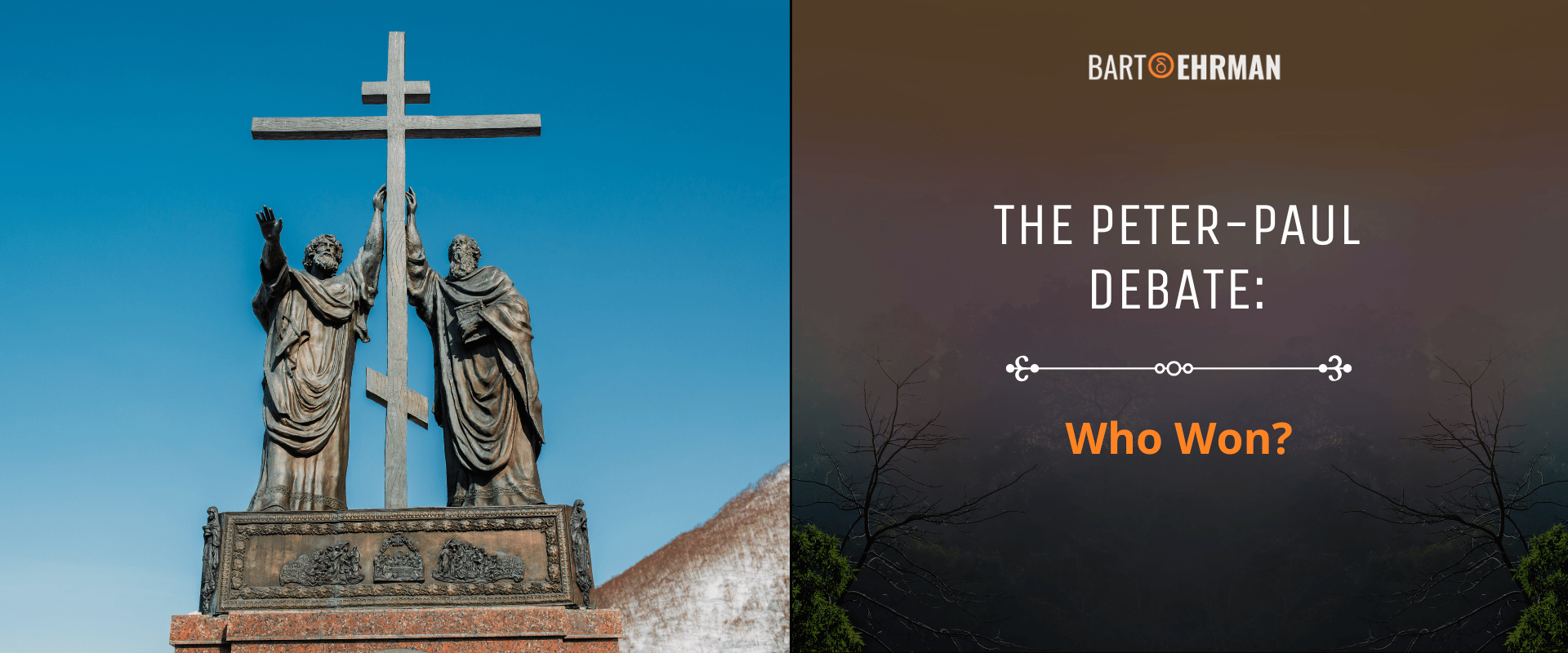
Peter and Paul are probably among the most important figures in the history of the early Church. They are remembered as two great apostles: Peter, the leading disciple of Jesus during his earthly ministry, and Paul, the missionary whose letters became foundational for Christian theology. Did they ever meet? Yes, they knew each other, but perhaps didn’t see everything the same way, as you’ll soon see.
According to later Christian tradition, both men eventually died as martyrs in Rome. Some later traditions even imagined Peter and Paul as apostles who, in a symbolic sense, came to die together, and their joint feast on June 29 helped generate the popular idea that they may have died on the same day.
Historically, that precise claim is difficult to verify, but both men came to occupy an enormous place in Christian memory.
This is especially true in the Catholic tradition, where Peter’s significance is anchored in the idea that he was the first pope.
And yet, behind this later image of apostolic unity lies a more complicated historical reality. Many people who know each other or work together sometimes disagree. So, too, Peter and Paul may not always have managed to get along. In fact, our earliest sources suggest that they disagreed over some crucial questions facing the nascent Christian movement.
That disagreement wasn’t simply a matter of personality or temperament. It concerned the identity and future direction of the Jesus movement itself. Today, we know that people who preach the same gospel may not share the same views on everything. Such was the case for Peter and Paul.
As the message about Jesus spread beyond its original Jewish setting and began attracting non-Jews, early believers had to ask difficult questions: On what terms could Gentiles join the people of God? Did they need to adopt Jewish practices? Could Jewish and Gentile followers of Jesus share the same table as equal members of one community?
These questions may sound technical, but they helped determine what Christianity would become.
To understand what happened between Peter and Paul to cause the debate, then, we need to look carefully at two major sources that tell the story in strikingly different ways: Paul’s Letter to the Galatians and the Acts of the Apostles.
Only then can we return to the main question: if Peter and Paul really did clash over the future of the Christian movement, who won?
But this isn’t the only controversial issue in the world of early Christianity. In his 8-lecture course Paul and Jesus: The Great Divide, Dr. Bart D. Ehrman explores one of the most important questions about Christian origins: did Paul faithfully continue Jesus’ message, or did he transform the Jewish religion of Jesus into the Christian religion about Jesus?
From the historical Jesus’ proclamation of God’s coming kingdom to Paul’s focus on Jesus’ death and resurrection, this course examines the similarities, tensions, and striking differences between the two most influential figures behind the emergence of Christianity.
Galatians and Paul’s Version of the Conflict
In his book An Introduction to the New Testament and the Origins of Christianity, Delbert Burkett notes:
(Affiliate Disclaimer: We may earn commissions on products you purchase through this page at no additional cost to you. Thank you for supporting our site!)
The book of Acts relates the transformation of Christianity from a Jewish sect into a world religion composed primarily of Gentiles. This transformation did not come easily. In the early days, many Jewish believers insisted that salvation belonged to the Jews. After all, God’s promises in the scriptures were directed to Jews. Jesus himself was a Jew. As long as the gospel was confined to Jerusalem, no major challenge to this view arose. Once the message began to spread beyond Jerusalem, however, some of the Hellenists preached to Gentiles in Antioch (Acts 11:19–20). Apparently, the more conservative Judaic Christians had a hard time accepting this development. The story of Peter preaching to Cornelius in Acts 10–11 seeks to justify the Gentile mission to the more doubtful members of the community. The problem, however, was not easily resolved.


 pop Quiz!
What happened when christianity's two biggest apostles went head to head?
Paul openly rebuked Peter in Galatians and took swipes at the Jerusalem leaders as “super-apostles” who “added nothing” to his message. Later Christian writings from outside the Bible indicate an even deeper rift between Paul and Peter, so why does Acts paint them as best friends? Join Dr. Bart Ehrman to explore the evidence of rivalry and conflict in this free two-lesson course, "Did Peter Hate Paul?"
100% free, no credit card required or upsells... promise!
The problem Burkett identifies is precisely the issue that stands behind the confrontation between Peter and Paul: once Gentiles began entering the Jesus movement, early believers had to decide whether they could belong as Gentiles, or whether they had to adopt the practices that marked Jewish covenant identity.
The earliest evidence of this problem comes from Paul’s Epistle to the Galatians. This is one of the earliest New Testament sources, usually dated by historians somewhere between 48 and 52 C.E.
Paul addresses his letter to “the churches of Galatia,” that is, to multiple communities in the Roman province of Galatia.
The immediate reason for the letter is Paul’s belief that these communities have moved in a troubling direction after his previous work among them.
Other teachers appear to have arrived and convinced, or at least attempted to convince, the Galatian believers that Gentile followers of Jesus should accept circumcision and observe key aspects of the Jewish Law.
Paul writes in response with urgency, frustration, and alarm. For him, the issue isn’t secondary. It concerns the very basis on which Gentiles can belong to the people of God.
To explain his position, Paul tells the Galatians part of his own story. He insists that the message he preached didn’t come from human authorities, not even from the Jerusalem apostles, but through a revelation of Jesus Christ.
He describes his limited contact with the Jerusalem leaders and emphasizes that his mission to the Gentiles had its own divine authorization.
In Galatians 2, Paul then recalls a meeting in Jerusalem where he went with Barnabas and Titus. Titus was a Gentile believer, and according to Paul, he wasn’t compelled to be circumcised.
Paul presents this as an important moment of recognition: James, Cephas (that is, Peter) and John, whom he calls “pillars,” acknowledged the grace given to him and agreed that he should go to the Gentiles while they continued their mission among the circumcised.
But Galatians doesn’t leave the matter there. Paul next describes an incident in Antioch, one of the most important early centers of the Jesus movement outside Jerusalem.
According to Paul, Peter had been eating with Gentile believers. This matters because shared meals weren’t merely casual social occasions; they expressed fellowship and communal belonging.
As Bruce J. Malina reminds us in the book Handbook of Biblical Social Values:
People all over the world use food and drink both as nourishment and as ways of saying something to each other. A meal to which others are invited is a form of communication, with important social messages being exchanged between the host and those invited, those who should/ might have been invited but were not, and those who decline the invitation... Meal-taking and feasting in the contemporary Western world is considerably different. The foods we eat and the way in which we eat reflect our goals and values. Fast foods create the illusion of home-cooked meals and are intended to replace traditional family meals. The truth is, the speed with which foods can be prepared eliminates the necessity of a family eating together, or even eating the same food. These modern practices are definitely changing the nearly three-centuries old Western 'tradition' of a time-consuming, elaborate, manifestly hierarchical and communal meal partaken around a dining room table.
Yet when certain people came from James, Peter withdrew and separated himself from the Gentiles. Paul says that other Jewish believers followed Peter’s example, including Barnabas.
In Paul’s telling, this was a public failure with serious consequences. Peter’s withdrawal suggested that Gentile believers were not fully equal members of the community unless they lived like Jews.
Paul says that he opposed Peter “to his face” because Peter “stood condemned.” This is the sharpest moment in the letter and the clearest evidence that the reason to argue wasn’t only theoretical.
In Galatians, Paul presents himself as defending the principle that Gentiles do not need to become Jews in order to belong fully to the Christ-following community.
Peter, by contrast, is portrayed as acting inconsistently: he had shared fellowship with Gentiles, but then withdrew under pressure from others.
This is Galatians’ version of the conflict. It’s tense, direct, and unresolved. But Acts tells the story of the Gentile mission in a very different way, and it is to that account that we must now turn.
Peter and Paul in the Book of Acts: A More Harmonious Portrait
In their book The New Testament: A Historical Introduction, Bart D. Ehrman and Hugo Mendez note:
The book of Acts is most like this final kind of history, one that traces the key events of a people from the point of their origin down to near the present time, to show how their character as a people was established. Scholars sometimes call this genre general history. Unlike biographies, ancient histories have a number of leading characters — sometimes, as in Josephus, a large number of them. Like biographies, however, they tend to utilize a wide range of subgenres, such as travel narratives, anecdotes, private letters, dialogues, and public speeches.
This is important for understanding how Acts presents the early Christian movement. It’s not a letter written in the middle of a controversy, as Galatians is. It’s a narrative account of Christian beginnings, tracing the spread of the message about Jesus from Jerusalem to Judea, Samaria, and, eventually, into the wider Greco-Roman world.
It’s within this book that we find a second source of information concerning the relationship and possible conflict between Paul and Peter.
However, the Book of Acts gives us a considerably different picture.
Written probably somewhere between 80 and 90 C.E., Acts presents the Gentile mission not primarily as the result of a heated dispute between leading apostles, but as part of a divinely guided expansion of the Church.
In this account, Peter isn’t portrayed as someone who resists the inclusion of Gentiles. Quite the opposite: he becomes one of the first major figures to recognize that Gentiles can receive God’s favor.
In Acts 10–11, Peter has a vision in which he is told not to call unclean what God has made clean. He then visits Cornelius, a Gentile centurion, and witnesses the Holy Spirit coming upon Cornelius and his household. Peter concludes that God “shows no partiality” and defends this conclusion before believers in Jerusalem.
This story is crucial because, in Acts, Peter’s experience with Cornelius prepares the way for the later acceptance of the Gentile mission.
When some believers object to Peter’s association with uncircumcised Gentiles, Peter explains what happened and emphasizes that God himself gave the Holy Spirit to them. The issue, therefore, isn’t presented as a personal quarrel between Peter and Paul.
Instead, Acts portrays the matter as something God clarifies through visions, inspired speech, and the visible gift of the Spirit. Peter’s role is especially important: the same apostle who had been a central figure in the Jerusalem community now becomes a witness to God’s acceptance of Gentiles.
The question appears again in Acts 15, in the episode often called the Jerusalem Council. Not only did Peter and Paul live at the same time, but they were both in attendance.
Some believers from Judea teach that Gentile converts must be circumcised according to the custom of Moses. Paul and Barnabas dispute this, and the matter is brought to Jerusalem. There, the apostles and elders gather to consider the issue.
Peter speaks first, reminding the assembly that God had already chosen him to bring the message to Gentiles and that God made no distinction between Jewish and Gentile believers, giving both the Holy Spirit.
Paul and Barnabas then describe the signs and wonders God has done among the Gentiles through their mission.
Finally, James offers a judgment: Gentiles shouldn’t be burdened with circumcision, but they should observe certain basic requirements, including abstaining from things polluted by idols, from sexual immorality, from what has been strangled, and from blood.
In Acts, then, the problem of Gentile inclusion is resolved through discussion, testimony, and communal agreement.
Peter and Paul do not appear as public opponents. Peter, Paul, Barnabas, and James all contribute to a process that leads to a shared decision.
The result is a more harmonious portrait than the one we find in Galatians: the leaders of the early movement may have faced a difficult question, but Acts presents them as ultimately united in recognizing that Gentiles can belong to the people of God without undergoing circumcision.
Now that we have seen two different accounts of what happened, the question of historicity naturally arises. Which source gives us a more reliable description of the conflict, and what can historians actually know about the relationship between Peter and Paul?
DID PAUL AND JESUS HAVE THE SAME RELIGION?
Jesus taught a message of repentance to prepare for the Kingdom of God while Paul taught faith in Jesus. Did they agree? Should they be considered the “co-founders” of Christianity?
Historical-Critical Analysis: What Probably Happened?
Our comparison of Galatians and Acts has shown two quite different portrayals of the conflict between Paul and Peter. So how should historians proceed? Obviously, we cannot take either source simply at face value.
First and foremost, the Book of Acts isn’t an objective historical account of the development of the nascent Christian movement, even if we take into account the standards of Greco-Roman historiography measured against historians such as Thucydides and Polybius.
As Daniel Marguerat notes in his book The First Christian Historian:
Luke is situated precisely at the meeting point of Jewish and Greek historiographical currents. His narrative devices are heavily indebted to the cultural standard in the Roman Empire, that is, history as the Greeks wrote it. However, contrary to the ideal of objectivity found in Herodean and Thucydidean historiography, Luke recounts a confessional history. Jacob Jervell [a Norwegian theologian and New Testament scholar] is right to insist on this: Luke does not set out the destiny of a religious movement moving toward Rome from its origin in the Near East, but the expansion of a mission that he intends from the very start to make known as ‘a history of salvation’. The quest for causality which animates the Graeco-Roman historian is exclusively theological for Luke. He shows a complete lack of interest in other causes. This characteristic incontestably links Luke’s narrative with biblical historiography. Judaeo-Christian historia has no other ambition than to point to God behind the event.
At the same time, while the Epistle to the Galatians offers us earlier and first-hand testimony, this source also cannot be taken at face value.
While Olof D. Linton has identified what he believed to be clear parallels between traditions reflected and opposed by Paul in Galatians 1–2 and those recorded in Acts, we should be cautious.
Nicholas Taylor, in his book Paul, Antioch and Jerusalem, warns us by noting:
The corollary of this is that Paul's account of the events is not necessarily an older and more authentic tradition than that later incorporated into Acts. The parallels [Biblical scholar Olof Ditlef] Linton identifies may or may not be convincing, but the principle nevertheless stands that the objective historical truth cannot be presumed to be recorded in any particular source, and the evidence of all available material must be critically examined in order to reconstruct the events as accurately as possible.
So, where does that leave us? In a nutshell, historians must evaluate each source separately and on its own merits, without strong a priori prejudices.
Acts is later, theologically shaped, and deeply interested in showing the orderly expansion of the Christian mission from Jerusalem to Rome. But that doesn’t mean it preserves no historical memory.
Galatians is earlier and written by one of the participants, but it’s also a polemical letter in which Paul is defending his authority and his gospel against opponents. Its immediacy makes it invaluable; its rhetorical context makes it complicated.
The historian’s task, then, isn’t simply to choose Galatians and discard Acts, or to harmonize both accounts as if there were no tension between them.
It’s to ask what each source is trying to do, where they agree, where they differ, and what kind of historical reality might explain both.
On that basis, one point seems highly probable: there really was a major dispute in the earliest Christian movement over the status of Gentile believers.
The issue wasn’t whether Gentiles could be attracted to the worship of Israel’s God. Such Gentile sympathizers already existed in various Jewish contexts.
The sharper question was whether Gentiles who believed in Jesus had to become Jews in a fuller sense: whether they had to be circumcised, adopt the Mosaic Law, and live according to Jewish ritual and dietary practices.
As Taylor rightly emphasizes, circumcision shouldn’t be reduced to a single physical act. In this context it functioned as a marker of a whole way of life: covenant identity, Torah observance, food practices, communal boundaries, and the question of who could sit at the same table with whom.
The debate between Peter and Paul was therefore part of a much larger question: would the Jesus movement remain a Jewish renewal movement into which Gentiles could enter by adopting Jewish identity, or would it become a mixed community in which Gentiles could belong as Gentiles?
The Jerusalem meeting probably produced some kind of agreement, but its exact content is harder to reconstruct.
Galatians suggests that Paul’s law-free mission to the Gentiles was recognized by the Jerusalem leaders and that Titus, a Gentile companion of Paul, was not compelled to be circumcised.
That is historically significant. It suggests that Paul didn’t leave Jerusalem defeated. At least on the question of circumcision, his Gentile mission received some form of recognition.
But Acts presents this agreement in a more formal and harmonious way, as if the whole church reached a Spirit-guided consensus through the speeches of Peter, Paul, Barnabas, and James.
As Hans Conzelmann explains, Acts 15 occupies the center of Luke’s narrative because it functions as a major turning point: from this moment on, the Gentile mission can proceed with Jerusalem’s authorization.
This is excellent theology and narrative structure, but it’s not necessarily a transcript of what happened. Historically, the meeting probably settled less than Acts implies!
The unresolved issue appears most clearly in Antioch. If the Jerusalem meeting had solved everything, the confrontation in Galatians 2 would be difficult to explain.
Paul says that Peter had been eating with Gentile believers, but then withdrew when certain people came from James. This suggests that the agreement over Gentile circumcision didn’t automatically settle the practical question of mixed table fellowship.
Could Jewish followers of Jesus eat regularly with Gentile followers of Jesus who did not observe Jewish dietary regulations? That wasn’t a minor social matter. As noted, in antiquity, shared meals expressed communal belonging.
To withdraw from table fellowship was to create a visible distinction between insiders and outsiders, or at least between more and less acceptable members of the group.
From Paul’s perspective, Peter’s withdrawal compromised the truth of the gospel because it implied that Gentiles remained second-class members unless they adopted Jewish practices.
From Peter’s possible perspective (though we don’t have direct access to his perspective!), however, the issue may have been more pragmatic: pressure from Jerusalem, concern for stricter Jewish believers, or an attempt to preserve unity between communities with different standards of observance.
This means that the conflict was probably not a simple personal battle between two stubborn apostles. It involved several centers of authority: Jerusalem, Antioch, James, Peter, Barnabas, Paul, Jewish believers, and Gentile believers.
Taylor’s analysis is especially helpful here. He reminds us that the Antioch incident wasn’t triggered by Paul or Peter alone, but by the arrival of people associated with James. Peter’s conduct then influenced other Jewish believers, including Barnabas.
Paul’s reaction was forceful, but Galatians never tells us that Peter admitted fault, that Barnabas returned to Paul’s side, or that the Antiochene church accepted Paul’s argument. That silence matters. If Paul had clearly won the confrontation in Antioch, we might expect him to say so.
Instead, the narrative breaks off after Paul’s rebuke. Historically, then, it’s quite possible that Paul lost the immediate dispute at Antioch, or at least failed to persuade the community as a whole.
So, who won? The most precise answer is: Peter, or the Jerusalem-Antioch compromise, may have won the immediate confrontation, but Paul’s position won the long-term future of Christianity.
In the short run, Paul seems to have become isolated from Barnabas and from the Antiochene base from which he had previously worked. But in the long run, the form of Christianity that became dominant didn’t require Gentile believers to be circumcised or to observe the Mosaic Law as Jews.
On that central question, Paul’s vision prevailed. Yet even this victory wasn’t remembered simply as Paul’s triumph over Peter. Acts reshaped the memory of the conflict into a story of apostolic consensus, in which Peter, James, and Paul all ultimately stand on the same side.
Historically, the road was much rougher. Theologically and institutionally, later Christianity preferred to remember unity. Paul won the future of the Gentile mission; Acts helped ensure that the victory would be remembered not as a rupture, but as the shared decision of the apostolic church.
Conclusion
There is a nice small Church of St. Peter and Paul near my place in Zagreb. Every time I pass by it, I’m reminded of the profound influence both of these apostles had in the development of Christianity.
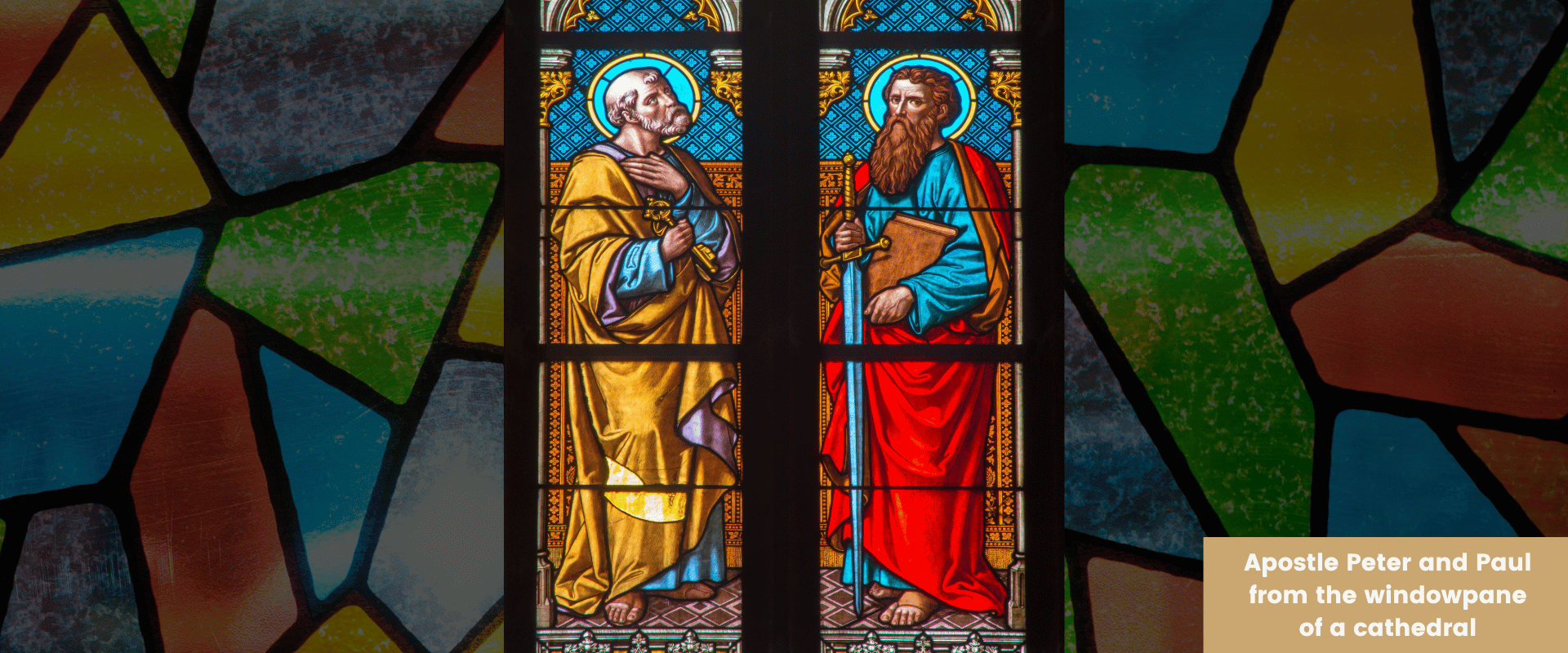
In Christian memory, they stand together: two pillars of the Church, two martyrs of Rome, two apostolic witnesses whose authority helped shape Christian identity for centuries.
The historian has to look behind later memory and ask a more difficult question: how did that unity come to be remembered, and what tensions did it conceal?
Galatians gives us a glimpse of one such tension. Acts gives us a later, more harmonious narrative in which the same basic problem is absorbed into a story of agreement, guidance, and apostolic consensus.
So, who won the Peter-Paul debate? If we mean the immediate confrontation at Antioch, the answer may well be Peter, or at least the Jerusalem-Antioch compromise represented by Peter, James, and Barnabas.
Paul’s own account never tells us that the community accepted his rebuke. But if we mean the long-term development of Christianity, Paul’s position clearly prevailed.
Gentile believers didn’t have to become Jews. Circumcision didn’t become a requirement for Christian identity.
The Church that emerged from these early disputes became overwhelmingly Gentile. Sociologists suggest that already by the beginning of the 2nd century, most believers came from the Gentile background. Historians agree.
Yet even that victory was remembered through the language of unity rather than defeat. In that sense, Paul won the future, but Acts helped shape the memory: not a Christianity born from apostolic rupture, but one that could still imagine Peter and Paul standing together.
DID PAUL AND JESUS HAVE THE SAME RELIGION?
Jesus taught a message of repentance to prepare for the Kingdom of God while Paul taught faith in Jesus. Did they agree? Should they be considered the “co-founders” of Christianity?