
Nephilim: Uncovering the Giants of Genesis 6

Written by Joshua Schachterle, Ph.D
Author | Professor | Scholar
Author | Professor | BE Contributor
Verified! See our editorial guidelines
Verified! See our guidelines
Date written: July 21st, 2025
Disclaimer: The views and opinions expressed in this article belong to the author and do not necessarily match my own. - Dr. Bart D. Ehrman
For centuries, the Nephilim have intrigued readers of the Bible with their cryptic, fleeting mention in Genesis. What is a Nephilim? The biblical references to these mysterious beings are brief and puzzling, yet they have sparked millennia of speculation, theological interpretation, and myth-making.
In this article, I’ll explain the origins of the Nephilim in the Hebrew Bible. I’ll examine the linguistic roots of the word Nephilim, the historical and cultural context of their appearances, and how ancient Jewish writers sought to understand and elaborate on their meaning. I’ll peel back the layers of biblical text and later tradition to uncover how the Nephilim evolved from shadowy figures into towering giants of ancient lore.
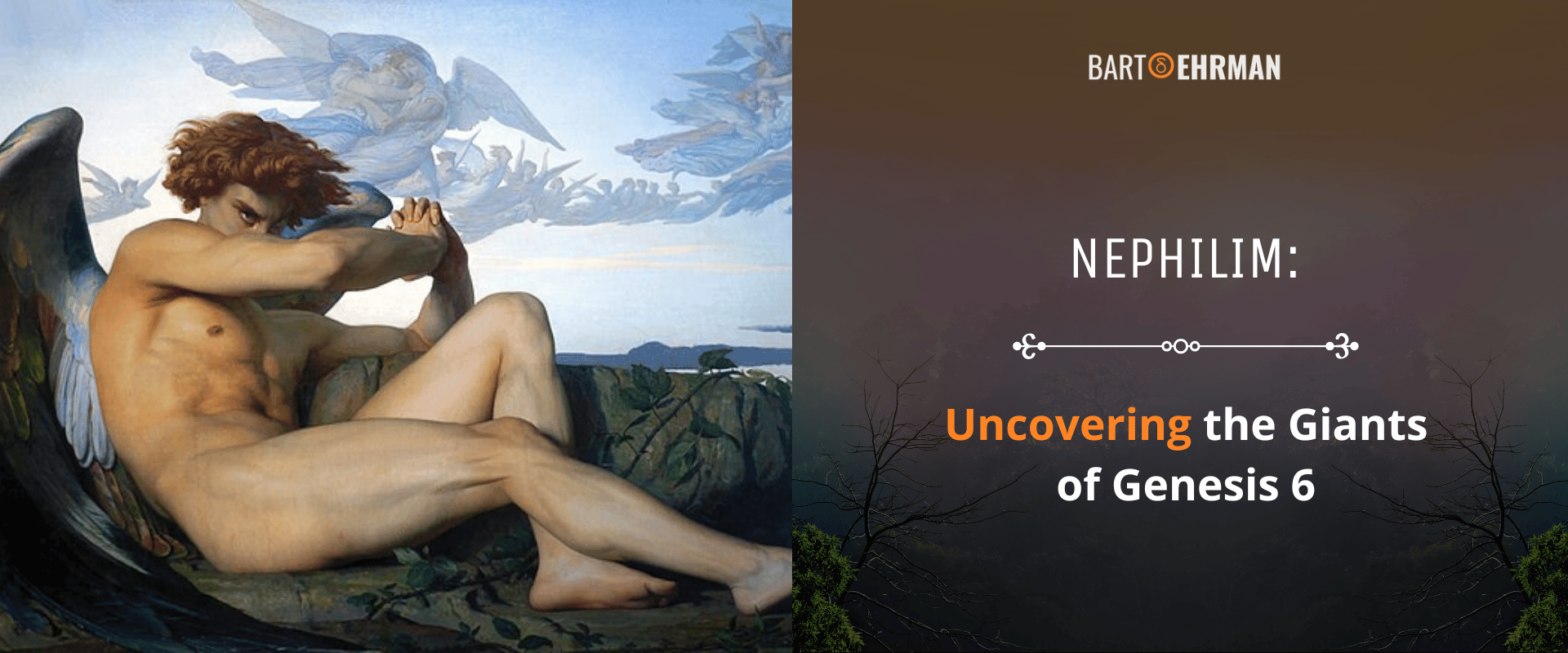
What Are the Nephilim?
The Hebrew word Nephilim comes from the root neh-peh-le which means “to fall.” The word can therefore be translated literally as “the fallen ones.” In Fall of the Angels, Hebrew Bible scholar Ronald Hendel notes that the word Nephilim is a passive construction, literally meaning “the ones who have fallen.”
(Affiliate Disclaimer: We may earn commissions on products you purchase through this page at no additional cost to you. Thank you for supporting our site!)
Despite this meaning, most ancient translations from Hebrew, including the Septuagint (the ancient Greek version of the Hebrew Bible), the Latin Vulgate, and the Samaritan Pentateuch (a version of the Pentateuch written in Samaritan Aramaic), have simply called the Nephilim “giants.” As we will see, there are contextual reasons for this in the Hebrew Bible’s references to these mysterious figures. However, like many barely-mentioned characters in the Bible, the Nephilim took on a life of their own.
Where Are the Nephilim in the Bible?
The first reference to the Nephilim in the Hebrew Bible (in terms of the current order of biblical books) is in Genesis 6:1-4 just before the story of Noah’s Ark. It is a curious, fragmentary, and ambiguous reference that, at first glance, doesn’t seem to fit with the story that follows:
When people began to multiply on the face of the ground, and daughters were born to them, the sons of God saw that they were fair, and they took wives for themselves of all that they chose. Then the Lord said, “My spirit shall not abide in mortals forever, for they are flesh; their days shall be one hundred twenty years.” The Nephilim were on the earth in those days—and also afterward—when the sons of God went in to the daughters of humans, who bore children to them. These were the heroes that were of old, warriors of renown.


If you’re like me, this passage leaves you with some major questions, especially since it doesn’t seem to have much to do with the “wickedness of humans” that follows in verse 5 and sets the stage for the Great Flood.
Who were these “sons of God?” Were they fallen angels? Other gods? And in the midst of this story, why does God limit the number of years humans can live? Does it mean that the offspring of the sons of God and human women were living too long? Were the Nephilim the sons of god or their offspring? Were the Nephilim giants? Finally, is this sexual congress between the sons of God and human women good, bad, or neutral? If it is bad, why are their offspring characterized as heroes?
Clearly, this passage needs some unpacking. I’ll address these questions before showing you where else and in what context the Nephilim are mentioned elsewhere in the Hebrew Bible. By the way, while the New Revised Standard Translation merely calls them “Nephilim” without translating the word, older English translations such as the King James Version simply translated the word as “giants.”
First, who were these “sons of god”? Although long-standing traditions in Judaism and the Christian church have claimed that these were fallen angels in league with Satan, John Drummond states that the original audience for this passage would have believed them to be members of the divine council over which God presided. This was a common assumption among ancient Near Eastern cultures, and is found in several instances in the Bible, such as this passage from Psalm 82:1-2:
God has taken his place in the divine council;
in the midst of the gods he holds judgment:
“How long will you judge unjustly
and show partiality to the wicked?”
This “divine council,” with God as its leader, included gods, “lesser heavenly beings in the service of the Most High,” according to John Drummond. This means that the offspring of these divine beings and humans would have produced what the ancient Greeks would call demi-gods, powerful beings who are both divine and human (like Hercules, for instance). This is why their offspring, the Nephilim, are called heroes and warriors. However, unlike the ancient Greeks, Israelites seem less comfortable with the notion of semi-divine beings.
This is why, according to Drummond, the author of the biblical passage chooses to call these warrior heroes “the fallen ones.” While the passage never explicitly condemns the sexual union of humans and gods, it implies that it was wrong in some sense since their offspring are “fallen,” perhaps for exhibiting pride in their power. It may be, Drummond says, that sexual activity between gods and humans is meant to be seen as a symptom of the wickedness of humans, which leads to God’s destruction of the earth by flood.
By the way, in his article “Of Demigods and the Deluge,” Ronald Hendel writes that Genesis 6:1-4 was likely a fragmentary story which the author of that section felt the need to weave into the flood narrative. He did so by implying that women mating with the sons of God was one part of the evil exhibited by people which elicited God’s wrath. While it may not fit easily before the flood story, Hendel’s interpretation makes some sense of its inclusion and placement. Furthermore, Hendel writes that the limiting of human life-span in verse 3 matches God’s introduction of death as the end of human life at the end of the Garden of Eden story.
NOW AVAILABLE!
Finding Moses: What Scholars Know About The Exodus & The Jewish Law
Riveting and controversial, the "FINDING MOSES" lecture series takes you on a deep dive into the stories of Moses, the exodus, and a whole lot more...
Where Else Do We Find the Nephilim in the Hebrew Bible?
It turns out that other references to the Nephilim are scanty at best. The first mention after Genesis 6 appears in Numbers 13:33. In this passage, the Israelites have arrived at Canaan, the Promised Land. Before attempting to conquer the current inhabitants, Moses sends in spies to do some reconnaissance. While two spies, Joshua and Caleb, suggest going in and conquering the land immediately, the other 10 spies do not agree:
Then the men who had gone up with him said, “We are not able to go up against this people, for they are stronger than we.” So they brought to the Israelites an unfavorable report of the land that they had spied out, saying, “The land that we have gone through as spies is a land that devours its inhabitants, and all the people that we saw in it are of great size. There we saw the Nephilim (the Anakites come from the Nephilim), and to ourselves we seemed like grasshoppers, and so we seemed to them.”
This is the first explicit reference to the Nephilim as giants, since the size of the Nephilim was not referred to in the Genesis passage. But who were these Anakites, who seem to be offspring of the Nephilim in this passage? The Anakim (or Anaqim) were a group of Canaanites who lived in southern Canaan, where the Israelites were planning to enter. It’s unclear from the passage if the Anakites were truly believed to be the offspring of the Nephilim and, thus, giants, or if the fearful spies were merely not brave enough to face them in battle and used hyperbolic statements to discourage Moses from attacking them.
Another group often identified with the Nephilim in the Hebrew Bible are the Rephaim, who are also said to be giants. According to Jonathan Yogev, there is a possible reference to the Rephaim as divine (or believing themselves to be divine) in Ezekiel 28:2:
Because your heart is proud
and you have said, “I am a god;
I sit in the seat of the gods,
in the heart of the seas,”
yet you are but a mortal and no god,
though you compare your mind
with the mind of a god.
In Hebrew, the word Rephaim simply means “the dead.” This makes their references in the Hebrew Bible puzzling to say the least. Like the Anakites, they are said to be one of the peoples conquered by the Israelites in Canaan. However, later references seem to characterize them as mere representations of those who have died:
The dead will not live, the Rephaim will not rise, you punished them and brought them to ruin; you wiped out all memory of them.
Isaiah 26:14
While it’s not clear in the Bible whether the Israelites truly equated the Nephilim and the Rephaim, by the 3rd century BCE, Drummond notes that pseudepigraphical books such as the Book of Enoch and the Book of Jubilees clearly believed that the Nephilim were the ghastly giant offspring not of gods but of fallen angels and human women.
The last time a form of the word Nephilim comes up in the Hebrew Bible is in Ezekiel 32:27. However, in this later context, it seems to mean something different:
And they do not lie with the fallen [Hebrew: nō·p̄ə·lîm] warriors of long ago who went down to Sheol with their weapons of war, whose swords were laid under their heads and whose shields are upon their bones; for the terror of the warriors was in the land of the living.
In this case, the word Nephilim merely refers to those fallen in battle, not those fallen in a moral or divine sense.
This is the last we hear from the Nephilim in the Bible. However, as I indicated earlier, later Jewish authors would take up the Nephilim, in their own writings—a kind of fan fiction expanding on the story of the Great Flood— and develop these characters much further.
The Nephilim in Later Writings
In Genesis 5:21-24, we are introduced to an apparently minor character named Enoch. It’s a very brief but intriguing passage:
When Enoch had lived sixty-five years, he became the father of Methuselah. Enoch walked with God after the birth of Methuselah three hundred years and had other sons and daughters. Thus all the days of Enoch were three hundred sixty-five years. Enoch walked with God; then he was no more, because God took him.
The idea that Enoch did not die but was somehow taken by God instead bred a lot of speculation within Judaism about Enoch and what had happened to him. Centuries later, this resulted in a collection of texts known as the Book of Enoch which adds details to the flood story and tells what Enoch saw after arriving in heaven.
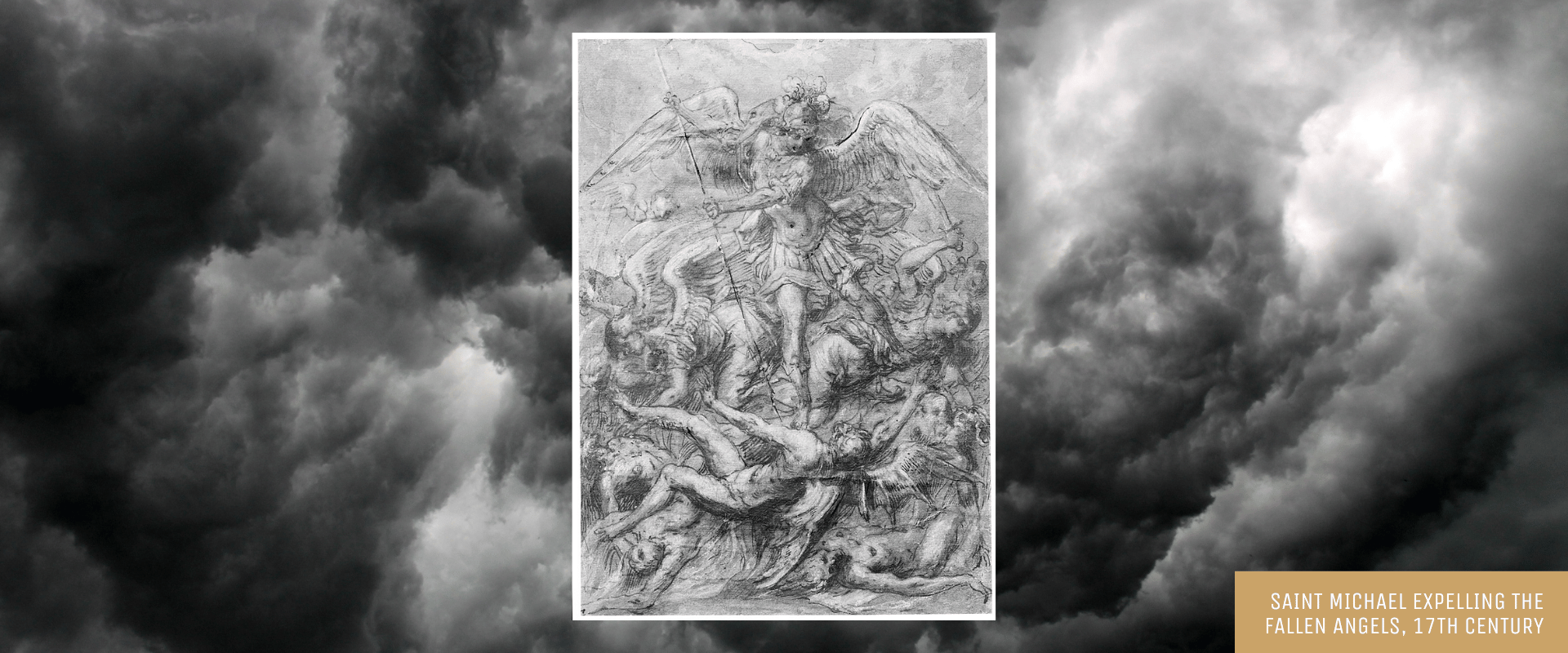
According to Megan Sauter, the Book of Enoch reimagined the role of the Nephilim for generations of Jews. In it, we meet a group of beings known as the Watchers, fallen angels who had children with human women and produced giant offspring— the Nephilim. How tall were the Nephilim? The Book of Enoch says they were 300 cubits tall. Since a cubit was about 18 inches, this would put their height at 450 feet, a monstrous height indeed!
However, the Watchers also shared secret knowledge with the Nephilim which led to the world’s degeneracy. It was the Nephilim, then, who brought wickedness to the people of the world which then motivated God to destroy all but Noah and his family and start over. As a result, the Nephilim are destroyed along with everyone else in the flood.
Thus ends the brief but significant story of the Nephilim in both biblical and extrabiblical texts.
Conclusion
The Nephilim are first referred to in a short, enigmatic passage in Genesis in which heavenly beings mate with earthly women and produce semi-divine offspring. The reference comes up again in a later passage in the Pentateuch in which Moses and the Israelites are preparing to conquer a Canaanite people called the Anakites, who are seemingly offspring of the Nephilim. These Anakites are said to be giants, which implies that the Nephilim were also,, although the original passage doesn’t say so.
Later Hebrew Bible references to the Nephilim, like that in the book of Ezekiel, seem not to refer to these mythical giants but rather to simply mean “those who have fallen in battle.” This makes sense since the root of the word Nephilim means “to fall.”
The brevity of passages about the Nephilim, as well as their apparently divine character, led authors in later centuries to add to their legend, especially in the Book of Enoch. Not only does this non-canonical book expand on the story of the Great Flood from Genesis, but it also says that the Nephilim were responsible for God’s great wrath. It seems that, enabled by their fathers— fallen angels called the Watchers—the Nephilim brought evil into the world, causing God to simply destroy it, along with the Nephilim, and start over.
While from a historical point of view the Nephilim may never have existed, writings about them revealed ancient beliefs about the line between humanity and divinity and the consequences of crossing that line.
NOW AVAILABLE!
Finding Moses: What Scholars Know About The Exodus & The Jewish Law
Riveting and controversial, the "FINDING MOSES" lecture series takes you on a deep dive into the stories of Moses, the exodus, and a whole lot more...