
Maccabean Revolt: Summary & Timeline

Written by Joshua Schachterle, Ph.D
Author | Professor | Scholar
Author | Professor | BE Contributor
Verified! See our editorial guidelines
Verified! See our guidelines
Date written: December 4th, 2025
Disclaimer: The views and opinions expressed in this article belong to the author and do not necessarily match my own. - Dr. Bart D. Ehrman
The Maccabean Revolt is often remembered as a dramatic struggle for religious freedom, a fight in which a small band of Jewish rebels stood firm against a powerful empire. Yet the historical roots of this conflict stretch far deeper than the revolt itself.
In this article, I’ll look into a Maccabean Revolt definition, the sweeping historical forces that led to the Maccabean Revolt, the events that sparked it, and its long-term impact. From foreign conquests to the rise of an independent Jewish kingdom, the story reveals how empires, local politics, and religious conviction collided to create one of the most enduring episodes in Jewish history.
By the way, if you’re interested in learning more about Jewish history, check out Bart Ehrman’s course on the Hebrew Bible featuring scholar Dr. Joel Baden.
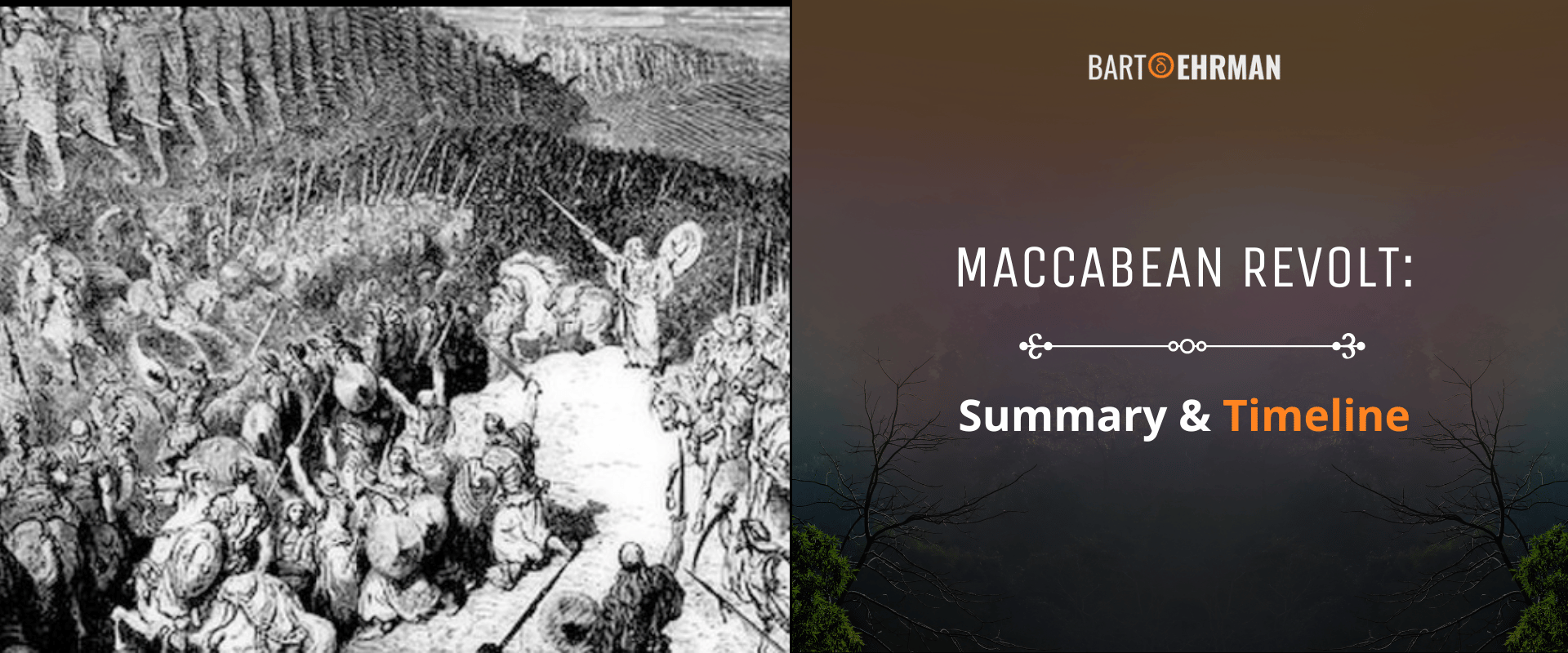
Maccabean Revolt Definition, Dates, and Setting
Believe it or not, the background to the Maccabean Revolt in Judea actually begins with Alexander the Great, the Macedonian king best known for creating one of the largest empires of the ancient world.
In 332 BCE, the Persian Empire had controlled Judea for about two centuries. However, that year, Alexander, on his years-long military campaign stretching from Greece to India, defeated the Persians, bringing Judea under Greek control. This lasted for 11 years, until Alexander’s death in 323 BCE.
In his book Alexander the Great and the Hellenistic Age, Peter Green writes that though there are many differing ancient stories about the aftermath of Alexander’s death, the most plausible is that he designated one of his generals, Perdiccas, as his successor. However, Green writes, Perdiccas was assassinated 2 years later, leading to 40 years of war between three main Greek factions: the Ptolemies who controlled Egypt, the Seleucids who controlled Syria, and the Antigonids who controlled mainland Greece, Macedonia, and the surrounding Islands.
(Affiliate Disclaimer: We may earn commissions on products you purchase through this page at no additional cost to you. Thank you for supporting our site!)
Nearest to the land of Judea were the Ptolemies, based in Alexandria, Egypt, and the Seleucids, based in Damascus, Syria. Judea, therefore, fell within the scope of the Seleucid dynasty.
In addition, after Alexander’s death, Hellenization, the spread of Greek language and culture, did affect Judea. However, in The Image of the Jews in Greek Literature: The Hellenistic Period, Bezalel Bar-Kochva writes that such changes were mostly driven by Jews themselves. The official policy of both the Seleucids and the Ptolemies was to allow the people they subjugated to continue to practice their own religions and cultures. However, all that changed when a Seleucid king named Antiochus IV Epiphanes took the throne.
At first, Antiochus maintained the previous Seleucid policy of tolerance toward Judean practices. Nevertheless, he was the first Seleucid king to meddle in Jewish religious affairs by replacing the Jewish High Priest Onias III with his own brother Jason (after Jason had bribed him). The High Priest, while not the king, still wielded a lot of political power in Jerusalem.
Jason’s first move as High Priest was to declare that Jerusalem was now a self-governing city, with Jason himself choosing who could be called citizens and who could vote. It was around this time that Antiochus IV Epiphanes decided he wanted to take over Egypt from the Ptolemies.
According to 1 Maccabees, the deuterocanonical book included in some biblical canons, Antiochus invaded Egypt with a large army and “Ptolemy turned and fled before him and many were wounded and fell (1 Macc 1:18).” Having vanquished his enemy, Antiochus returned to Jerusalem with his army around 169 BCE. But his return was not peaceful, as 1 Maccabees tells us. When he arrived, he entered the Temple, the most sacred place for Jews, and did the unthinkable:
He arrogantly entered the sanctuary and took the golden altar, the lampstand for the light, and all its utensils. He took also the table for the bread of the Presence, the cups for drink offerings, the bowls, the golden censers, the curtain, the crowns, and the gold decoration on the front of the temple; he stripped it all off. He took the silver and the gold and the costly vessels; he took also the hidden treasures that he found.
(1 Macc 1:21-23).


Unsurprisingly, plundering the Temple would not please devout Jews who were already feeling besieged by having a Seleucid High Priest forced upon them. 1 Maccabees also says that, two years later, Antiochus IV Epiphanes, living at his headquarters in Antioch, Syria, sent troops to Jerusalem to collect tribute for him.
Deceitfully he spoke peaceable words to them, and they believed him, but he suddenly fell upon the city, dealt it a severe blow, and destroyed many people of Israel. He plundered the city, burned it with fire, and tore down its houses and its surrounding walls. They took captive the women and children and seized the livestock. Then they fortified the city of David with a large strong wall and strong towers, and it became their citadel. They stationed there a sinful nation, men who were renegades. These strengthened their position; they stored up arms and food, and, collecting the spoils of Jerusalem, they stored them there and became a great menace (1 Macc 1:30-35).
Meanwhile, another wealthy Seleucid man, Menelaus, offered Antiochus an even bigger bribe than Jason had to be made High Priest of Jerusalem. When this happened, Jason was so incensed that he launched a series of attacks aimed at taking down Antiochus’ government. Antiochus fought back, but the Jewish people living in Jerusalem and elsewhere paid the price as collateral damage.
According to Judaism and Hellenism: Studies in their Encounter in Palestine during the Early Hellenistic Period by Martin Hengel, thousands of Jews in Jerusalem were killed while even more were forced into slavery. Meanwhile, Antiochus confiscated land from Jason and his followers as a punishment for their sedition. Finally, the Temple in Jerusalem was turned into a temple to Zeus. Pious Jews were infuriated, seeing this as a contamination of the holiest Jewish site, the very dwelling place of God.
In his massive work The Jewish War, 1st-century CE Jewish historian Flavius Josephus noted that
For Antiochus the unexpected conquest of the city (Jerusalem), the looting, and the wholesale slaughter were not enough. His psychopathic tendency was exacerbated by resentment at what the siege had cost him, and he tried to force the Jews to violate their traditional codes of practice by leaving their infant sons uncircumcised and sacrificing pigs on the altar. These orders were universally ignored, and Antiochus had the most prominent recusants butchered.
(The Jewish War, 1.34-35)
The situation was ripe for insurrection.
Mattathias and the Maccabean Revolt
The Maccabean Revolt would begin with the family of a man named Mattathias. First Maccabees 2:1 tells us that “In those days, Mattathias son of John son of Simeon, a priest of the family of Joarib, moved from Jerusalem and settled in Modein [modern day Modi’in].” Mattathias had five sons: John Gaddi, Simon Thassi, Eleazar Avaran, Jonathan Apphus, and Judas Maccabeus. It is from Judas Maccabeus that the name Maccabees, derived from the Hebrew and Aramaic words for “hammer,” originated.
As a priest, Mattathias was understandably enraged by the defilement of the Jerusalem Temple. In 1 Maccabees 2:7-9, there is a poetic lament attributed to him:
“Alas! Why was I born to see this,
the ruin of my people, the ruin of the holy city?
The people sat idle there when it was given over to the enemy,
the sanctuary given over to strangers.
Her temple has become like a person without honor;
her glorious vessels have been carried into exile.
Her infants have been killed in her streets,
her youths by the sword of the foe.”
In Antioch and Jerusalem: The Seleucids and Maccabees in Coins, David Jacobson writes that the prohibition on Jewish religious practices that Antiochus IV Epiphanes had started in Jerusalem now expanded to the rest of Judea, including Modein where Mattathias and his sons lived. Jews were forced to perform sacrifices in honor of Zeus. In 167 BCE, however, Mattathias fought back:
A local Jewish priest, Mattathiah (Mattathias) the Hasmonean, emphatically refused to sacrifice to Zeus. He slayed a Jew, who was about to offer a sacrifice, and also the administrative official charged with enforcing the decrees. To emphasize his zeal for the Torah, he instantly demolished the offending altar.
Following this, Mattathias and his sons fled the town for the nearby mountains. A year later, Mattathias died, but his son, Judas Maccabeus, along with his brothers, began a guerilla warfare campaign against Antiochus. In his book The Wars of the Maccabees, John Grainger writes that since they could not immediately attack Antiochus’ forces from the mountains, the Maccabees instead began assaults on Hellenized Jews, those who had accepted the prohibitions on Jewish practices and fully embraced the Greek culture of the Seleucids.
Their tactics were brutal. Roaming the Judean countryside, they demolished altars to Greek gods in small villages, circumcised boys by force, razed whole villages, and even forced Hellenized Jews off their own lands. With time, their movement grew, their guerilla tactics becoming more and more effective. In Judas Maccabaeus: The Jewish Struggle Against the Seleucids, Bezalel Bar-Kochva writes that the Maccabees gradually started to win smaller battles like the Battle of Beth Horon against Antiochus’ armies.
In 165 BCE, Antiochus IV Epiphanes left to visit Babylonia, leaving his general Lysias in charge. Soon after, writes Bar-Kochva, the Maccabees won a substantial battle at Emmaus, after which both sides met to negotiate terms for a settlement, an effort that failed. The following year, 164 BCE, after the Maccabees won the Battle of Beth Zur, news was received that Antiochus IV had died in Persia. The Seleucid troops accepted defeat for the time being and retreated to their territories in Syria.
NOW AVAILABLE!
Finding Moses: What Scholars Know About The Exodus & The Jewish Law
Riveting and controversial, the "FINDING MOSES" lecture series takes you on a deep dive into the stories of Moses, the exodus, and a whole lot more...
Victory of the Maccabees
In triumph, the Maccabees marched into Jerusalem. They performed ceremonies to cleanse the Temple, once again making it acceptable to their God. It’s important to remember that although this had been a decisive victory for the Maccabees, the Seleucids still controlled all the lands around Jerusalem. The war was not over.
However, the Maccabees negotiated with Lysias, now in charge after the death of Antiochus, who agreed to lift the ban on Jewish religious practices. This satisfied the Hellenized Jews who were more moderate. The hardliners like the Maccabees, however, felt they had to entirely purge their land of any Greek influences, a goal that the Hellenized Jews could not agree with.
By the way, this time, after the rededication of the Temple, is the origin of the holiday known as Hanukkah. The story behind it is that, after years of the Temple’s corruption, the Maccabees found that there was not enough consecrated oil in the Temple to light the ceremonial menorah for more than one day. However, that small portion of oil miraculously lasted for eight days, the time it would take to prepare more oil. This has been celebrated by Jews ever since.
Outcomes of the Maccabean Revolt
As I noted above, the Seleucids did not go away entirely. While the recapturing of Jerusalem was a major turning point for the Maccabees, fighting with the Seleucids would continue for several years until a lasting peace, a sort of détente between the two, was achieved in 134 BCE. Part of the reason for this was the continuing divide between staunch conservatives like the Maccabees, who wanted to completely expel every trace of Greek influence from Judean culture, and the Hellenistic Jews who valued Greek culture and language.
However, as a result of their victory, the Maccabees, also known as the Hasmoneans, would establish an independent monarchy in Judea for the next 80 years. This began with the remaining sons of Mattathias who ruled Judea as governors, not kings, until the death of the last, Simon. Simon’s son, John Hyrcanus, then became high priest in 134 BCE. His son, Aristobulus, would be the first Hasmonean ruler to call himself king.
Nevertheless, the irony of the situation is that by the time of Aristobulus’ rule, even the Hasmoneans had adopted much of Greek language and culture, a fact that would remain the case throughout the Hasmonean dynasty. This dynasty would only end in 37 BCE, when Herod the Great would defeat the last Hasmonean king and become the client king of Rome.
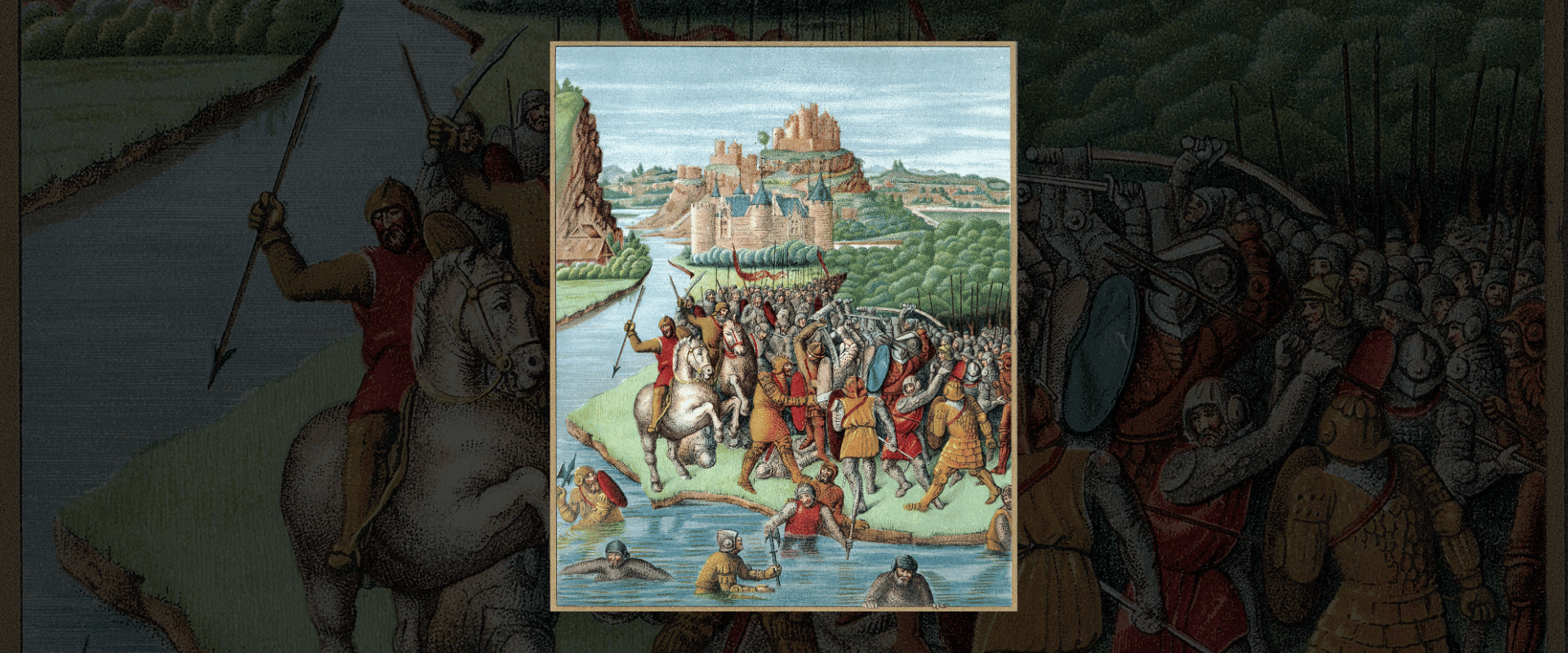
Conclusion: Maccabean Revolt Summary
To this day, the Maccabean Revolt remains a symbol to Jews of resistance to tyranny, sustaining their identity, and faithfulness to their religion.
Alexander the Great conquered Judea, along with many other lands of the near east.After his unexpected death, his generals divided the conquered lands among themselves with the Seleucids taking over Judea. While they allowed the Jews to continue practicing their religion for a time, eventually the king Antiochus IV Epiphanes decreed that Jewish practices, such as circumcision and kosher eating, were prohibited. What’s more, he took over the Temple, dedicating it to Zeus.
This was an outrage, and it was the priest Mattathias who would finally stand up to this tyranny. His sons would form a guerilla army and begin a campaign against Antiochus, eventually resulting in the recapture of Jerusalem and the rededication of the Temple to God. Although this didn’t end the fighting with the Seleucids, it did lead to the establishment of the Hasmonean dynasty, which would rule Judea for decades.
NOW AVAILABLE!
Finding Moses: What Scholars Know About The Exodus & The Jewish Law
Riveting and controversial, the "FINDING MOSES" lecture series takes you on a deep dive into the stories of Moses, the exodus, and a whole lot more...