
“In the Beginning God Created” - Exploring the First Verse in the Bible

Written by Marko Marina, Ph.D.
Author | Historian
Author | Historian | BE Contributor
Verified! See our guidelines
Verified! See our editorial guidelines
Date written: March 27th, 2026
Disclaimer: The views and opinions expressed in this article belong to the author and do not necessarily match my own. - Dr. Bart D. Ehrman
“In the beginning God created the heavens and the earth.” Few sentences from the Bible are as widely recognized as this opening line from the Book of Genesis.
I first encountered it many years ago in Sunday school when I was still in elementary school. At the time, it sounded enormously impressive: the idea that a divine being could stand behind the creation of everything we see, including the sky, the earth, the stars, and, ultimately, ourselves.
Like many people raised in a religious setting, I initially heard the verse as a straightforward description of how the universe began. Over the years, however, my understanding of this famous line has changed considerably.
As I began studying the Bible from a critical-historical perspective, I learned that the verse is far more complex (and far more interesting) than it might first appear.
Genesis 1:1 has played an extraordinary role in the religious imagination of Jews and Christians for centuries, and it has also influenced Islamic understandings of creation.
The verse does more than appear before a section that describes how God created the heavens and earth. It serves as the gateway to the entire biblical narrative, introducing a book that tells foundational stories about the origins of the world, humanity, and the people of Israel. Because of its position as the first verse in the Bible, it has often been read as a sweeping theological statement about the creation of everything that exists.
Yet when scholars examine the verse in its ancient context (paying close attention to the Hebrew language, the literary structure of Genesis, and the broader cultural world of the ancient Near East), new questions emerge.
Does the verse actually describe the absolute beginning of the universe? Is “in the beginning God created” the best way to translate the Hebrew? And how does this famous line function within the larger creation narratives that follow in Genesis 1 and 2?
Exploring these questions helps us see that even a single sentence at the start of the Bible can open a fascinating window into the history, language, and interpretation of one of the most influential texts ever written.
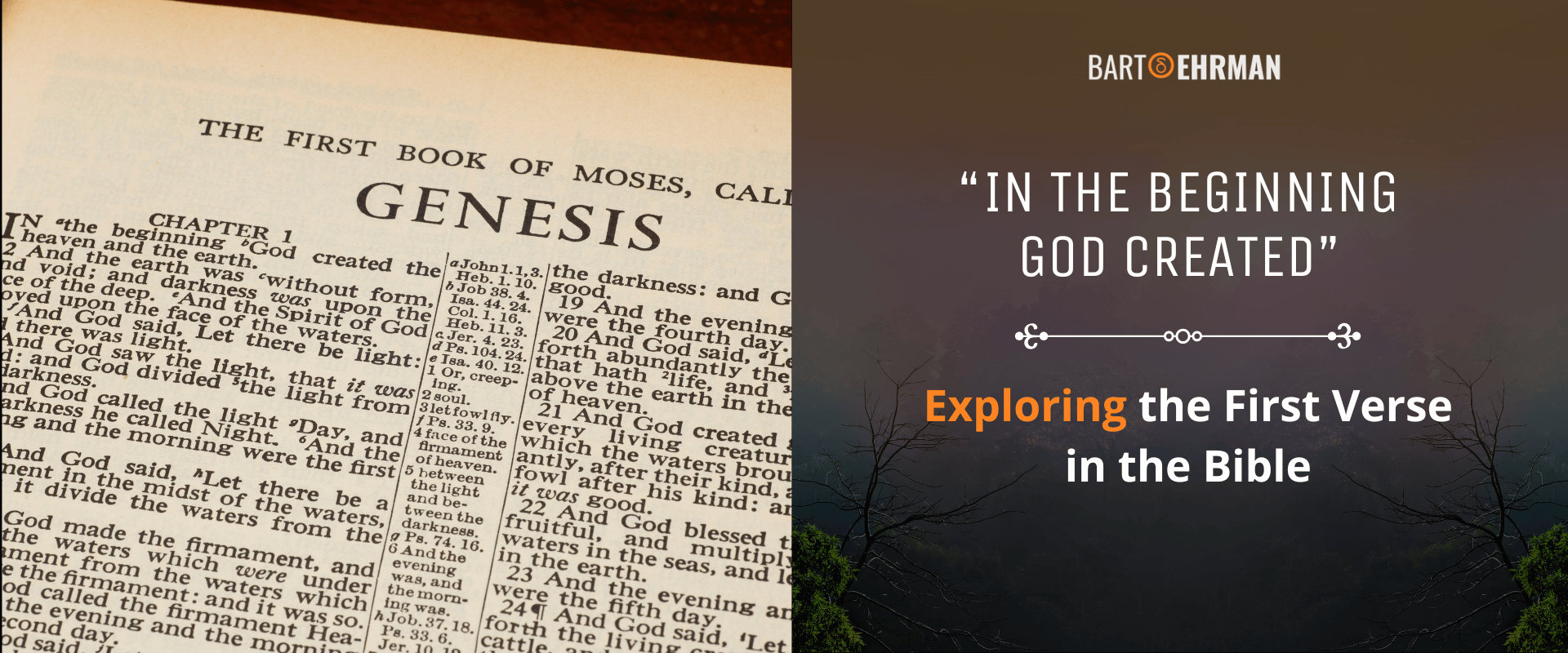
The Book of Genesis in the Biblical Tradition
Christoph Uehlinger, in his book Introduction à l'Ancien Testament (Introduction to the Old Testament), makes an observation worth quoting:
(Affiliate Disclaimer: We may earn commissions on products you purchase through this page at no additional cost to you. Thank you for supporting our site!)
“Like most literary monuments, the Bible gathers the greatest number of readers in its opening pages, known as the ‘primeval history’ [see below for more on this phrase]. How many people have one day decided to read the Bible by beginning at the beginning – that is, with Genesis – only to give up after two or three books, or even after only a few chapters? The first chapters of Genesis therefore have an undeniable advantage over all the others in that they are simply unavoidable.” (my translation)


His remark highlights a simple but important fact: for countless readers across centuries, Genesis is the entry point into the Bible itself.
The famous opening line (“In the beginning God created the heavens and the earth”) stands at the threshold of one of the most widely read texts in human history.
It’s therefore not surprising that the Book of Genesis has held enormous importance not only within Judaism, but also within Christianity and Islam.
From a historical-critical perspective, Genesis represents a foundational collection of ancient Israelite traditions that were shaped, edited, and transmitted over many centuries before taking the form in which we know them today.
These traditions became central to Jewish religious identity, and, later, they were adopted and reinterpreted by early Christians, who read them as part of the sacred scriptures of Israel. Many of the same narratives and figures also appear in the Qur’an, demonstrating the far-reaching influence of Genesis within the broader family of Abrahamic religions.
As such, the Book of Genesis contains a sequence of events and figures that have profoundly shaped the religious imagination of Western civilization.
The opening chapters recount the creation of the world and humanity, followed by the story of Adam and Eve in the Garden of Eden and the account of the first act of violence between Cain and Abel.
The narrative then moves to the story of Noah and the great flood and to the famous episode of the Tower of Babel, which explains the diversity of languages and peoples.
The second half of the book turns to the stories of the patriarchs: figures who became central to the religious traditions that look back to Abraham as a founding ancestor.
These narratives follow Abraham and Sarah, their son Isaac, Isaac’s son Jacob, and Jacob’s twelve sons, whose descendants form the tribes of Israel.
The final chapters focus especially on Joseph, whose dramatic rise to power in Egypt sets the stage for the later story of Israel’s presence in Egypt and, eventually, the events described in the Book of Exodus.
Before turning to the opening verse itself, however, it’s helpful to consider where exactly it appears within the literary structure of Genesis. The famous words “In the beginning God created the heavens and the earth” introduce the first of the book’s creation accounts, a carefully structured narrative that unfolds across the opening chapters of Genesis.
Understanding the placement of this verse within those chapters will help clarify how the creation story is presented before we examine the verse more closely.
“…God Created the Heavens and the Earth”: Situating the Famous Quote
The famous words “In the beginning God created the heavens and the earth” appear at the very opening of the Book of Genesis and at the beginning of the Bible itself.
Within the literary structure of Genesis, however, this verse introduces what scholars commonly call the Primeval History, the first major section of the book that extends from Genesis 1 through Genesis 11.
These chapters recount events that concern the whole of humanity rather than any particular people.
As Ephraim A. Speiser notes, this opening portion of Genesis functions as a broad preface to the rest of the biblical narrative, providing a universal backdrop before the story narrows to the ancestors of Israel, beginning with Abraham in Genesis 12.
The first verse introduces the opening creation account that occupies Genesis 1:1–2:3. This narrative is carefully organized and unfolds through a structured sequence of six creative stages, followed by a seventh day of divine rest.
The story begins with the creation of light, which separates day from night. Next comes the formation of the sky, dividing the waters above from the waters below. Dry land then appears, along with seas and vegetation.
The fourth stage introduces the celestial bodies (the sun, the moon, and the stars), while the fifth brings forth living creatures of the waters and the birds of the air.
Finally, land animals are created, followed by human beings, described as male and female, who appear as the culmination of the creative process. The account concludes with God resting on the seventh day, establishing a rhythm that later Jewish tradition connected with the Sabbath.
Immediately following this narrative, however, the Book of Genesis presents another account of creation beginning in Genesis 2:4.
Unlike the highly structured sequence of the first story, this second narrative proceeds in a different order and with a different literary style. Here, the earth is initially described as barren, after which a man is formed from the dust of the ground. God then plants the Garden of Eden, introduces various animals, and ultimately creates the woman from the man.
The two accounts present the origins of the world and humanity in distinct ways, reflecting different traditions that were eventually brought together in the opening chapters of Genesis.
Understanding this literary context helps clarify the position of the verse “In the beginning God created the heavens and the earth.” Rather than standing alone, the line functions as the introduction to the first of these creation narratives and to the larger Primeval History that frames the early chapters of the book.
With that broader setting in view, we can now turn our attention more closely to the verse itself and ask what it meant in its ancient context, and whether the familiar translation captures the nuances of the original Hebrew.
But before we go into that, I must invite you to explore these questions in greater depth through the course “In the Beginning: History, Legend, or Myth in Genesis.”
In this online series of six engaging 30-minute lessons, renowned Bible scholar Dr. Bart D. Ehrman examines the Book of Genesis from a historical and literary perspective. Drawing on modern biblical scholarship, the course explores how these ancient texts were written, what kinds of stories they contain, and how scholars today understand the creation narratives, the Garden of Eden, the Flood, and other foundational traditions.
NOW AVAILABLE!
Finding Moses: What Scholars Know About The Exodus & The Jewish Law
Riveting and controversial, the "FINDING MOSES" lecture series takes you on a deep dive into the stories of Moses, the exodus, and a whole lot more...
The First Verse: Scholarly Context and Exegesis
“In the beginning God created the heavens and the earth” stands at the head of the creation narrative that extends from Genesis 1:1 to 2:3.
As Bill T. Arnold notes in his Commentary on Genesis, this section functions as a kind of “creation overture” for the entire biblical story, establishing the worldview that underlies the rest of Scripture.
The narrative unfolds in a carefully structured sequence of seven days in which God brings order to the cosmos through a series of divine commands: light and darkness are separated, the waters are divided, dry land and vegetation appear, and eventually, animals and human beings are created.
The opening statement, therefore, introduces not merely a single event, but the whole literary composition that follows, presenting the creation of “the heavens and the earth,” a Hebrew expression meaning the totality of the universe.
At the same time, modern scholarship cautions against reading these chapters as “history” in the modern sense of the word. Christoph Uehlinger observes in his discussion of Genesis that the label “history” can be misleading when applied to these opening biblical narratives.
He explains:
These belong rather to the realm of myth and legend, genres which by their very nature transcend time and history. We would therefore be well advised to regard these chapters not as ‘history’ in the strict sense, but rather as a ‘cycle of origins’ – a narration of primordial ‘deeds,’ or even a prologue intended to convey to the reader of the ensuing history an essential knowledge of the fundamental conditions of human existence, one particular aspect of which the epic narrative will subsequently unfold.” (my translation)
In other words, these verses aim less to document empirical beginnings than to articulate fundamental “truths” about the relationship between God, the cosmos, and human beings. In that sense, the statement “In the beginning God created” functions as a theological affirmation about the divine source of reality rather than a scientific description of the universe’s beginnings.
This insight also becomes clearer when scholars examine the literary composition of Genesis itself. Most critical scholars recognize that the early chapters of Genesis combine material from different literary traditions.
Genesis 1:1–2:3 is widely associated with the so-called Priestly source, a tradition characterized by its structured style, interest in ritual and order, and emphasis on the seven-day creation framework.
The second creation narrative, beginning in Genesis 2:4b, by contrast, reflects a different literary voice, often attributed to the Yahwist or non-Priestly tradition.
These two accounts present creation in distinct ways: in Genesis 1, humanity appears at the climax of a cosmic sequence, whereas in Genesis 2 the human being is formed earlier and placed in the garden before animals and plants emerge in the story.
The presence of these differing perspectives suggests that the Book of Genesis preserves multiple ancient traditions about the origins of the world, woven together into the narrative that has come down to us.
Another key to understanding the verse “In the beginning God created the heavens and the earth” lies in its broader ancient Near Eastern context.
As Arnold emphasizes, the creation account in Genesis shares certain themes with other ancient texts, such as the Babylonian Enuma Elish or the Mesopotamian Epic of Gilgamesh, which also reflect on cosmic beginnings.
Christoph Uehlinger likewise points out that ancient Israelite authors participated in a cultural world in which stories about the origins of the universe circulated widely. Yet the Genesis narrative also differs significantly from these myths.
Whereas many ancient creation stories describe violent struggles among competing gods, Genesis portrays a single deity who brings the world into existence through speech alone: “And God said… and it was so.”
The opening declaration (“In the beginning God created”) thus expresses a distinctive theological vision of a sovereign creator who orders the cosmos without rivalry or conflict.
Within this context, scholars have long debated how the opening words of Genesis should actually be translated.
The traditional rendering (“In the beginning God created the heavens and the earth”) which, in a way, goes back to the King James Version (KJV), treats the verse as a complete sentence describing the first act of creation.
Yet some scholars have proposed an alternative translation: “In the beginning, when God began to create the heavens and the earth…” This is a preferred translation for a significant number of scholars, as illustrated by the NRSV edition of the Bible.
In this interpretation the verse serves as a temporal clause introducing the situation described in the following verse, where the earth is described as tohu wabohu or “formless and void.”
As Bill T. Arnold explains, the ambiguity arises from the Hebrew word berēʾšît, which can be understood either as an absolute beginning or as the start of a process.
John Day, in his study From Creation to Babel, notes that both interpretations have been discussed extensively in modern scholarship, although he still regards the traditional translation as the most natural reading of the Hebrew text.
In any case, the debate illustrates how a single phrase (“In the beginning God created”) can open complex questions about language, theology, and cosmology.
In the end, the enduring power of this opening verse lies precisely in its capacity to invite such reflection.
Whether read in its ancient literary context, compared with other Near Eastern creation traditions, or analyzed through the lens of modern philology, Genesis 1:1 continues to function as a profound statement about the origin of the cosmos.
Rather than offering a scientific explanation of how the universe began, the verse introduces a narrative that explores the meaning and order of creation from a particular religious perspective.
For readers across centuries and cultures, the words “In the beginning God created the heavens and the earth” have served as an entry point into a broader conversation about the nature of reality, the place of humanity in the world, and the enduring question of how everything began.
Conclusion
In the end, the famous opening line of Genesis continues to resonate because it invites readers into a deeper exploration of how ancient authors understood the world and humanity’s place within it.
When examined through the lens of modern scholarship (taking into account the literary structure of Genesis, the presence of multiple traditions within the text, and the broader cultural context of the ancient Near East), the verse “In the beginning God created the heavens and the earth” emerges as far more than a simple statement about cosmic beginnings.
It’s the gateway to a rich and complex narrative tradition that reflects the religious imagination of ancient Israel while continuing to shape the beliefs and discussions of later generations.
By situating this famous line within its historical, linguistic, and literary context, we can better appreciate both its original meaning and the enduring influence it has exercised on the way people think about creation, the cosmos, and the human story itself.
NOW AVAILABLE!
Finding Moses: What Scholars Know About The Exodus & The Jewish Law
Riveting and controversial, the "FINDING MOSES" lecture series takes you on a deep dive into the stories of Moses, the exodus, and a whole lot more...