
How Many Books Did Paul Write? (Fewer Than You Think!)

Written by Joshua Schachterle, Ph.D
Author | Professor | Scholar
Author | Professor | BE Contributor
Verified! See our editorial guidelines
Verified! See our guidelines
Date written: November 7th, 2025
Disclaimer: The views and opinions expressed in this article belong to the author and do not necessarily match my own. - Dr. Bart D. Ehrman
When we open the pages of the New Testament and read the letters attributed to the apostle Paul, we’re stepping into the ancient world of early Christianity—a world filled with growing churches, theological debates, and communities struggling to understand what it meant to follow Jesus. These letters, known as the Pauline Epistles, are some of the most influential writings in Christian history. But what exactly are they? Who were they written to, and why?
Relatedly, how many books did Paul write in the New Testament? In this article, I’ll explore that question, as well as what makes a letter genuinely Pauline and how scholars determine authenticity of authorship. Furthermore, we’ll uncover the story behind these foundational texts—and how they shaped the early church and Christian theology.
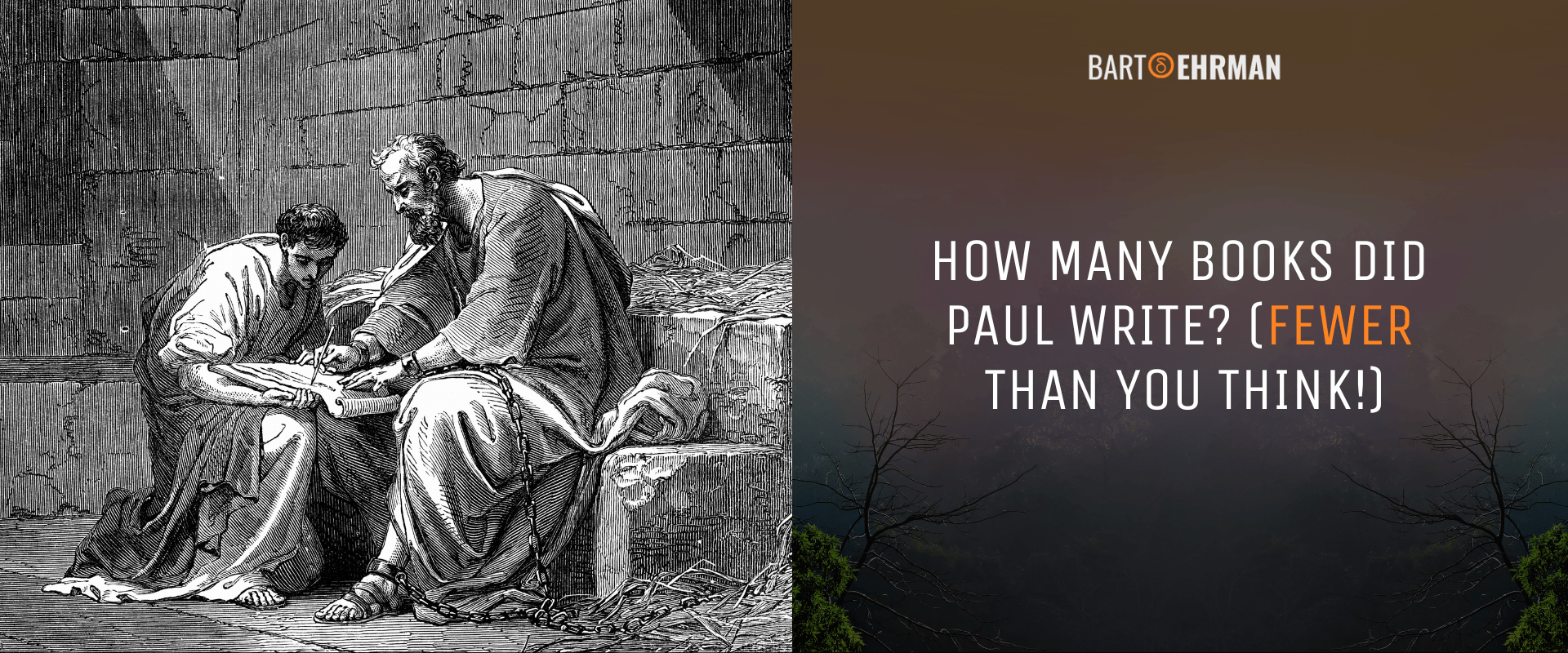
How Many Books Did Paul Write in the Bible?
The word “epistle” comes from the Greek word epistolē meaning “letter” or “message.” The Pauline Epistles, then, are the letters in the New Testament that claim to be written by Paul. In short, when we read Paul’s letters, we’re reading someone’s mail. This is an important point. Although Christians have considered these letters as general theology and spiritual advice for centuries, they were actually letters meant for specific groups of people and related to specific occasions and/or questions. This is one way scholars gauge the authenticity of the Pauline letters. Those that weren’t written for specific people and occasions are suspect.
There are a total of 13 Pauline letters in the New Testament, letters in which the author claims to be Paul. Scholars generally break these epistles down into three categories (the names of which I’ll explain later):
Undisputed Epistles
1 Thessalonians
Galatians
1 Corinthians
2 Corinthians
Philemon
Philippians
Romans
Deutero-Pauline Epistles
Ephesians
Colossians
2 Thessalonians
Pastoral Epistles
1 Timothy
2 Timothy
Titus
The Undisputed Letters
I’ve already mentioned that there are 13 letters supposedly written by Paul. You can probably tell from the way I put that sentence that, according to most scholars, Paul did not actually write all of them. In order to answer the question “How many of the New Testament books did Paul write?” we’ll need to figure out which of those 13 were actually written by him.
So how do we know which letters Paul really wrote and which were only written in his name by someone else? One way is by seeing which early Christian sources in the first few centuries of Christianity mention the letters. For instance, in New Testament Interpretation: Essays on Principles and Methods, F.F. Bruce notes that the seven undisputed letters—so-called because the vast majority of scholars believe Paul definitely wrote them— are either cited or referred to by most of our earliest sources. They are also on every ancient list of scriptural canons we have. This indicates that ancient Christians, much closer to Paul in time, believed these to be authentically Pauline.
(Affiliate Disclaimer: We may earn commissions on products you purchase through this page at no additional cost to you. Thank you for supporting our site!)
Furthermore, as I said earlier, these letters are all occasional (with one exception), a true mark of Paul’s authorship. For example, our earliest Pauline letter, 1 Thessalonians, was written to a Christian group Paul had started in the city of Thessaloniki in Greece. The occasion was that some members of the group had died since Paul’s last visit, prompting those who remained alive to ask whether the dead would still be saved when Jesus returned. Paul had apparently received this question in a letter from them and wrote the letter to answer it and encourage them.
This is equally true of five of the other undisputed letters. Some of the undisputed epistles show Paul defending his version of the gospel against different interpretations brought by other apostles, while others have him mediating conflicts between members of the addressed group. Romans is the one exception to this among the undisputed letters.
Romans is the only undisputed letter of Paul written to a Christian group not founded by Paul himself. We don’t actually know who founded this group, but it appears to have been well-established by the time Paul wrote to them in the mid-50s CE. So what was the reason for the letter?
In fact, in Romans 1:10-13, Paul writes that in his prayers he has been:
asking that by God’s will I may somehow at last succeed in coming to you. For I long to see you so that I may share with you some spiritual gift so that you may be strengthened—or rather so that we may be mutually encouraged by each other’s faith, both yours and mine. I do not want you to be unaware, brothers and sisters, that I have often intended to come to you (but thus far have been prevented), in order that I may reap some harvest among you, as I have among the rest of the gentiles.


Since he didn’t know the members of the Roman church and had never been there, his letter offers more general theology and advice. In fact, in A Brief Introduction to the New Testament, Bart Ehrman writes that “Nowhere, for example, does Paul indicate that he has learned of their [particular] struggles and that he is writing to convey his apostolic advice.” So why did Paul write this letter at all, and how do scholars know he wrote it?
Near the end of the letter to the Romans, Paul writes
But now, with no further place for me in these regions, I desire, as I have for many years, to come to you when I go to Spain. For I do hope to see you on my journey and to be sent on by you, once I have enjoyed your company for a little while (Romans 15:23-24).
Ehrman notes that this suggests that Paul wants the Romans “to provide support, moral and financial, for his westward mission; possibly he would like to use Rome as the base of his operation to the regions beyond.” By explaining his view of the gospel of Christ, Paul hopes to ingratiate himself with the Roman church, who may have heard disagreeable things about him and his message.
Despite the uniqueness of this letter, most scholars agree with Charles Cranfield who, in his Commentary on the Epistle to the Romans, says that Paul’s authorship of this letter can be confirmed “by the internal evidence” including “linguistic, stylistic, literary, historical and theological” evidence.
How many books did Paul write? According to just about every biblical scholar, there are at least seven letters fitting that description. What about the other two categories?
DID PAUL AND JESUS HAVE THE SAME RELIGION?
Jesus taught a message of repentance to prepare for the Kingdom of God while Paul taught faith in Jesus. Did they agree? Should they be considered the “co-founders” of Christianity?
The Deutero-Pauline Letters
The word deutero is a Greek word meaning “second” or “secondary.” The Deutero-Pauline letters, then, are letters of a second tier, less certain to have been written by Paul than the undisputed letters. In other words, some scholars believe them to be authentically written by Paul, although most do not. In their book Social-Science Commentary on the Deutero-Pauline Letters, for instance, Bruce Malina and John Pilch write that there are several reasons for believing that Paul could not have written them:
The contents point to a period after Paul’s death; the interpretation of Jesus is not Paul’s; the concern for non-Israelites mirrors a situation after Paul… In other words, these letters clearly attest to a Pauline tradition, to persons writing during a second and third generation after Paul.
On the other hand, most prominent evangelical Christian scholars believe these three letters were written by Paul. These scholars include Clinton E. Arnold, who makes an interesting case for the authenticity of Ephesians, and Luke Timothy Johnson, writing in The Cambridge Companion to St Paul, who argues that all three of the Deutero-Paulines were written by Paul.
However, the majority of scholars believe that the letters were merely written in Paul’s name. Why? For one thing, in 2 Thessalonians, the author disagrees with the Paul of 1 Thessalonians on the topic of Christ’s second coming. In that first letter, Paul writes that Christ’s return will be sudden and unexpected. In 2 Thessalonians, “Paul” writes that they will know when Christ is about to come because of a series of events that will occur. This directly contradicts 1 Thessalonians’ view of an unpredictable, cataclysmic event, in other words.
What about Ephesians and Colossians? Bart Ehrman writes that Ephesians features a different writing style than Paul’s undisputed letters. Unlike the short, declarative sentences of those letters, Ephesians uses long, complex sentences.
Then, there’s the content of Ephesians. The Paul of Ephesians, for instance, includes himself as one of those who, before finding Christ, was carried away by his passions (2:1-10). However, in his undisputed letters, Paul regularly says that before encountering Christ, he was “blameless” (see Philippians 3:4, for example). These same arguments— different style and different content—apply to Colossians as well.
So, if we go along with most critical scholars, we still have only seven letters undeniably written by Paul. What about the Pastoral letters, 1 and 2 Timothy and Titus?
The Pastoral Letters
Like the Deutero-Pauline letters, the Pastoral letters are considered by most scholars to have been written by someone after Paul’s death. Interestingly, though, these same scholars tend to believe that a single author wrote all three of the Pastorals in Paul’s name. Let’s look at why most scholars claim that these were forgeries.
In a blog post, Bart Ehrman notes that all three of these letters contain vocabulary that is unusual for a letter written by Paul:
apart from personal names, there are 848 different words found in the Pastorals; of these, 306 occur nowhere else in the Pauline Corpus of the New Testament (even including the Deutero-Paulines). This means that over one-third of the vocabulary is not Pauline. Strikingly, over two-thirds of these non-Pauline words are used by Christian authors of the second century.
This indicates not only that the Pastorals were not written by Paul, but that they were written long after his death, which is traditionally believed to have occurred in the mid-60s CE.
In addition, Ehrman notes that
these letters reveal a church situation after Paul’s day when proto-orthodox Christians were appealing to the authorities of the clergy, the creed, and the canon of Scripture to support their views, in contrast to those of “false teachers.”
How does this prove that the Pastorals were written after Paul’s time? First of all, there was no clergy in Paul’s original communities. While he himself taught them and was thus a kind of leader, it’s clear that when he was gone, many of the churches’ worship meetings were fairly chaotic (see 1 Corinthians 14:26-40) because there was no priest or even an established liturgy yet. Nor was there a mutually agreed-upon scriptural canon. All of these were 2nd-century developments, pointing to a later time of composition for the Pastorals.
By the way, many early Christians believed that Paul wrote the book of Hebrews. This was questioned, even by some ancient Christian authors. First-century church historian Eusebius, for example, quotes 3rd-century Christian author Origen as saying that the style of Greek in Hebrews is very different from Paul’s. What other evidence contradicts Pauline authorship of Hebrews?
First, unlike all the Pauline epistles, the author never claims to be Paul and writes anonymously. Second, the theology of this book differs so completely from Paul’s theology in the undisputed letters that there really can be no question: Paul did not write the book of Hebrews.
So, if we were to ask “How many books did Paul write in the Bible?” and appealed to the opinion of the majority of scholars, the answer is clear: we can be certain that Paul wrote just seven books of the New Testament.
Conclusion: How Many of the New Testament Books Did Paul Write?
Thirteen books in the New Testament, almost half of the 27 books of the whole NT canon, say they were written by Paul. Upon closer analysis, however, it’s clear that not all of these books could have been written by him.
How many books did Paul write, according to most scholars? They view the seven undisputed letters as authentically Pauline. Their theology is consistent, as is Paul’s short-sentence style, and they are generally addressed to communities founded by Paul. While Romans is an exception to that, the very fact that Paul is clearly writing to the Romans to boost his credibility with them and get funding for further missionary work from them, as well as the theology matching the other undisputed letters, gives it the stamp of authenticity.
The Deutero-Pauline letters—Ephesians, Colossians, and 2 Thessalonians—are believed by the majority of scholars to be forgeries. While most evangelical Christian scholars defend the authenticity of these books, their views of the Second Coming—that it will be predictable through signs—and their interpretation of Jesus points to concepts that developed in a time after Paul’s death.
Finally, the Pastoral letters—1 and 2 Timothy and Titus – contain completely different vocabulary from the undisputed letters, as well as references to clergy which did not develop within the church until the 2nd century. They, too, were likely forged in Paul’s name.
Given all of this information, we can say with relative certainty that Paul wrote only seven letters in the New Testament, or around 25% of the books in the NT.
DID PAUL AND JESUS HAVE THE SAME RELIGION?
Jesus taught a message of repentance to prepare for the Kingdom of God while Paul taught faith in Jesus. Did they agree? Should they be considered the “co-founders” of Christianity?