
How Apologists Use (and Misuse) Manuscripts (vIDEO)
Welcome to the home of Episode 207 of the Misquoting Jesus Podcast with Bart Ehrman. Below, you can watch the entire episode, read its description, and see links to related resources.
links mentioned in this episode:
episode description
Disclaimer: We use an AI generation tool for episode summaries.
Bart Ehrman and Megan Lewis examine how Christian apologists use biblical manuscripts to defend claims about the reliability, authorship, and truth of the Bible. Ehrman explains what manuscripts are, why scholars compare handwritten copies, and why having many manuscripts does not automatically establish that a text has been preserved perfectly—or that its claims are true.
The discussion challenges three prominent arguments. First, the Dead Sea Scrolls’ Great Isaiah Scroll is often presented as virtually identical to the later Masoretic Text. Ehrman acknowledges their substantial similarities but emphasizes that they differ in thousands of places, and that the Isaiah evidence cannot establish how every biblical book was copied. The shorter Greek version of Jeremiah and a corresponding Dead Sea Scroll manuscript illustrate how significantly textual traditions could diverge.
Second, the fragment known as P52 is often cited as evidence that the Gospel of John was written close to the lifetime of Jesus. Ehrman questions both the certainty of its dating and the conclusions drawn from it: an early copy does not establish eyewitness authorship or historical accuracy.

Misquoting Jesus
Never Miss an Episode of Misquoting Jesus
Get key insights, episode summaries, and exclusive content you won't hear on the podcast.
By signing up, you agree to receive marketing emails. Unsubscribe anytime.

PLUS: Get our free course:
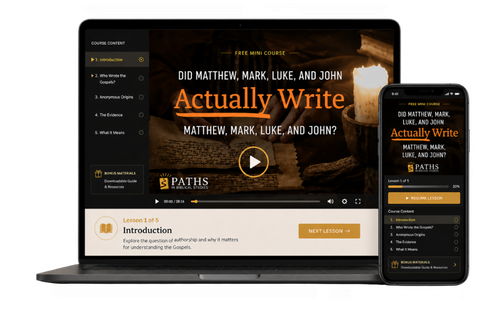
Did Matthew, Mark, Luke, and John Actually Write the Gospels?
PLUS: Get our free course:
Did Matthew, Mark, Luke, and John Actually Write the Gospels?
Third, the discussion examines the controversial history of Papyrus 137, a fragment incorrectly promoted as a first-century copy of Mark. The conversation then turns to textual variants, including passages concerning the Trinity, the woman caught in adultery, and the ending of Mark.
The central takeaway is that knowing what an author wrote is different from knowing whether what the author wrote is true. Manuscript evidence is indispensable to historical scholarship, but individual claims must be evaluated on their own merits. Ehrman also raises a deeper theological question: if God inspired the Bible’s original wording, why was that wording not miraculously preserved through subsequent copying?
ready to dive deeper?
Related Courses offered by Bart Ehrman and/or Paths in Biblical Studies:
Related Articles (Free Resources):
ways to watch or listen to the misquoting jesus podcast:
And many more! Just search for the show title in your favorite podcast app!