
Honor Your Father and Mother: Meaning & Verses

Written by Joshua Schachterle, Ph.D
Author | Professor | Scholar
Author | Professor | BE Contributor
Verified! See our editorial guidelines
Verified! See our guidelines
Date written: April 2nd, 2026
Disclaimer: The views and opinions expressed in this article belong to the author and do not necessarily match my own. - Dr. Bart D. Ehrman
Few biblical teachings are as familiar—or as deceptively simple—as the command to “honor your father and mother.” This directive, traditionally the fifth of the Ten Commandments, has shaped moral thinking for thousands of years, appearing straightforward on the surface yet revealing surprising depth when examined closely. What does it truly mean to “honor” one’s parents? Is it merely about obedience, or does it point to something richer—something rooted in culture, language, and evolving religious thought?
In this article, I’ll explore the “honor your father and mother” verse across its many dimensions, beginning with its earliest form in Exodus and tracing how its meaning develops through different translations, historical contexts, and biblical traditions. Looking closely at the language, history, and interpretations surrounding this well-known verse, we can get a deeper understanding not only of what it meant in the past, but what it might still demand of us today.

Different Translations of the Commandment
As with any important biblical text, there are multiple forms of the fifth Commandment, some of which contain different wording. Let’s look initially at what is likely the oldest version we have, from Exodus 20:12. Below is the NRSV translation from the authoritative Hebrew version known as the Masoretic Text:
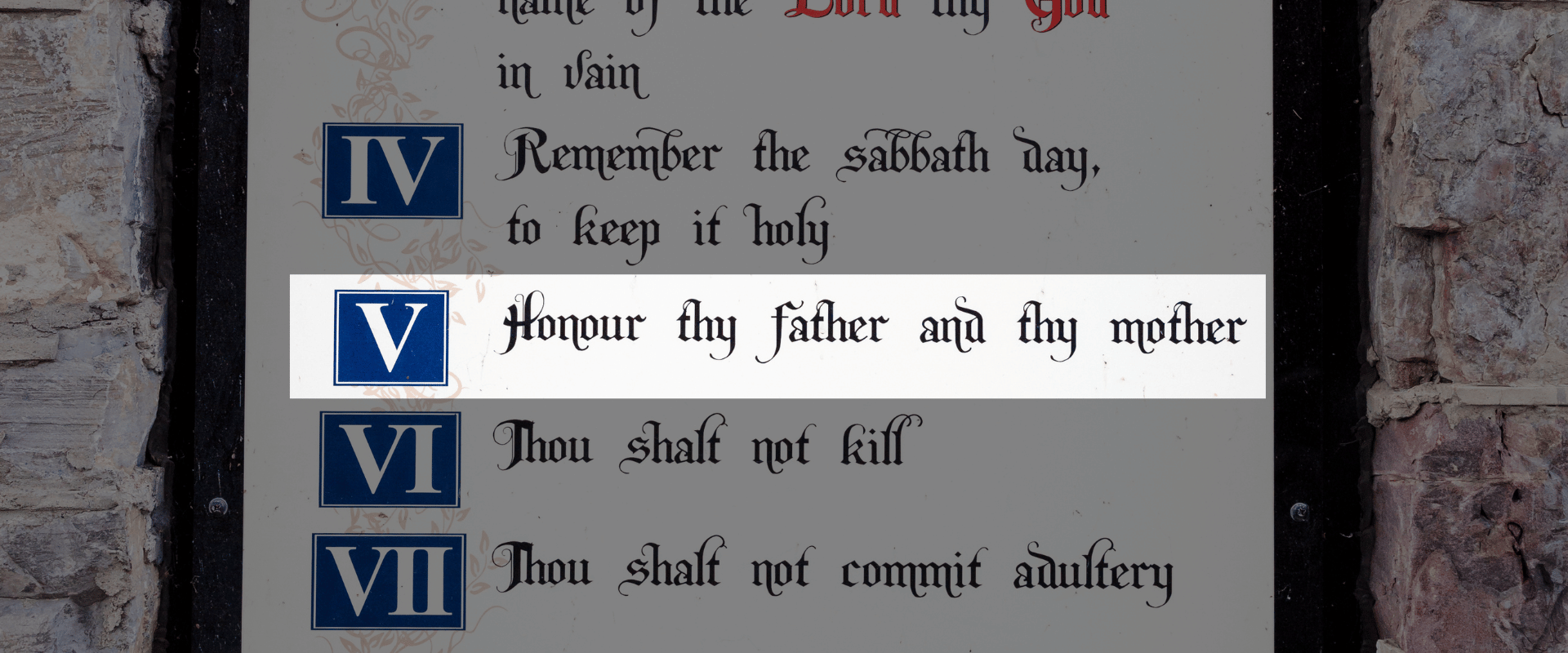
Honor your father and your mother, so that your days may be long in the land that the Lord your God is giving you.


A note on translation is important here. The Hebrew word translated as “honor” is kab·bêḏ. While the adjective form kabad means “to be heavy” or even “to be a burden,” the active form, kab·bêḏ, means “to give weight or significance to.” In other words, the literal translation of the Commandment says to treat your mother and father as weighty or important, to honor and/or respect them, in other words.
I note this translation because the Greek Old Testament, known as the Septuagint, uses a different verb for “honor.” In the Septuagint, the fifth Commandment begins with the word tima. This word certainly does mean “honor” but can also mean “to set the value” of something. In other words, while this Commandment in Greek instructs people to honor their parents, it also wants them to establish for themselves the value of their parents. Then, they are not just honoring them because of their genetic connection but also because they are people who literally add value to their children’s lives.
In most English translations, the wording of the Commandment is remarkably similar. In addition to the NRSV above, here are five other English translations of Exodus 20:12:
Honour thy father and thy mother: that thy days may be long upon the land which the Lord thy God giveth thee. (KJV)
Honor your father and your mother, so that you may live long in the land the Lord your God is giving you. (NIV)
Honor your father and your mother, that you may have a long life in the land the Lord your God is giving you. (NAB).
Honor your father and mother, that you may have a long, good life in the land the Lord your God will give you. (The Living Bible)
Despite huge differences in the wording of many biblical passages in different translations, this Commandment is fairly straightforward in lexical terms.
Different Versions of This Commandment in the Hebrew Bible
The closest we have to a direct repetition of this Commandment in the Old Testament is found in Deuteronomy 5:16, although it is slightly different:
Honor your father and your mother, as the Lord your God commanded you, so that your days may be long and that it may go well with you in the land that the Lord your God is giving you.
Notice that in this version, the reward for honoring parents is not merely a long life but also that things “go well” for you in the Promised Land. This is a recontextualizing of the narrative surrounding the granting of the Ten Commandments. In the Exodus version, Moses receives this Commandment directly from God on Mount Sinai while the Israelites are still wandering in the wilderness. While they hope to arrive in the Promised Land, they are told to follow this Commandment simply to have a long life in whatever situation they are in.
In Deuteronomy, however, the Israelites are about to enter the Promised Land when Moses gives the long speech which includes the Ten Commandments. In fact, obedience to the Commandments is required by God for the Israelites to take possession of the land. The promised reward, then, includes the success of the attempt to take the land forcibly from its current inhabitants.
Both this version and the Exodus version also include, in later verses, the designated punishment for not honoring one’s parents: “Whoever curses father or his mother shall be put to death” (Exodus 21:17). The harshness of this penalty shows the extreme significance given to honoring one’s parents. In fact, Deuteronomy 21:18–21 makes the punishment for disobeying parents both more specific and harsher:
If someone has a stubborn and rebellious son who will not obey his father and mother, who does not heed them when they discipline him, then his father and his mother shall take hold of him and bring him out to the elders of his town at the gate of that place. They shall say to the elders of his town, ‘This son of ours is stubborn and rebellious. He will not obey us. He is a glutton and a drunkard.’ Then all the men of the town shall stone him to death. So you shall purge the evil from your midst, and all Israel will hear and be afraid.
Why would such an extreme sentence be given merely for disobeying—and thus dishonoring—one’s parents? The answer to that lies in the family structure of ancient Israel.
NOW AVAILABLE!
Finding Moses: What Scholars Know About The Exodus & The Jewish Law
Riveting and controversial, the "FINDING MOSES" lecture series takes you on a deep dive into the stories of Moses, the exodus, and a whole lot more...
How and Why Ancient Israelites Honored their Parents
In Families in Ancient Israel, Carol Meyers writes that honoring parents could literally be a matter of life and death for ancient Israelite families, and not just because harsh punishments awaited those who disobeyed. Meyers notes that ancient Israelites were an agrarian society, raising crops for their own consumption. Meyers notes that this mode of living affected how personal identity was conceived:
(Affiliate Disclaimer: We may earn commissions on products you purchase through this page at no additional cost to you. Thank you for supporting our site!)
The profound interdependence of family members in self-sufficient agrarian families thus created an atmosphere of corporate family identity, in which one could conceive not of personal goals and ventures but only of familial ones… In the merging of the self with family, one can observe a collective, group-oriented mind-set, with the welfare of the individual inseparable from that of the living group.
For this reason, Meyers says that the kind of individual identity that is the basis of most modern societies simply did not exist for ancient Israelites. She goes on to note that the very survival of the individuals in a family depended on parents being able to pass down knowledge and skills related to farming to their offspring:
the diverse and technical nature of the various subsistence activities required the exercise of considerable parental guidance; and responding to parental directives meant that children had to “honor” their parents, as in the Fifth Commandment of the Decalogue.
So why the extreme punishments outlined in Exodus and Deuteronomy for those who failed to obey parents? Meyers writes that
The extreme penalties attached to legal strictures that aimed at ensuring parental authority (Exodus 21:15, 17) are most likely a function of the critical importance of establishing the household authority of mother and father, especially over adult children. When subsistence resources are scarce, as in early Israel, the exercise of parental authority is even more marked.
In other words, disobeying parents in a precarious agrarian society could mean the difference between life and death, not only for the one disobeying but for the whole family. Since identity was essentially collective, honoring the authority of the family patriarch and matriarch was absolutely essential. There was no room for error.
“Honor Your Father and Mother” Meaning in the New Testament
Pauline literature, especially those letters written in Paul’s name by later followers, preserves the mandate to honor father and mother, although predictably, the context is quite different from that of Exodus and Deuteronomy.
In fact, in the face of the urban reality of most early Christians, agrarian survival was not the main priority. However, “Paul,” in a section of writings in Ephesians and Colossians known as the Household Codes, gives specific instructions to communities on how a Christian household should operate:
Children, obey your parents in the Lord, for this is right. “Honor your father and mother”—this is the first commandment with a promise— “so that it may be well with you and you may live long on the earth” (Eph 6:1–3).
Children, obey your parents in everything, for this is your acceptable duty in the Lord (Col 3:20).
It’s important to note here that the purpose of the Commandment in these writings, as well as others from the Decalogue, has changed. Whereas before, honoring parental authority was basically a matter of life and death, here it is simply a religious duty undertaken to please God. Since Christians believed in an afterlife of rewards and punishments, this did ultimately have high stakes, but the rewards and punishments were less immediate than those implied in the Pentateuch.
So what about the Gospels? Did Jesus honor his parents and encourage others to do the same?
Did Jesus Honor His Parents?
In a story from Luke 2:41–52, a 12-year-old Jesus goes to Jerusalem with his parents for Passover. When the festival is over, Jesus’ parents leave, believing Jesus to be among other travelers they know. When they don’t find him, they rush back to Jerusalem, only to find Jesus in the Temple, talking and listening to religious teachers:
When his parents saw him they were astonished, and his mother said to him, “Child, why have you treated us like this? Your father and I have been anxiously looking for you.” He said to them, “Why were you searching for me? Did you not know that I must be in my Father’s house?” But they did not understand what he said to them. Then he went down with them and came to Nazareth and was obedient to them, and his mother treasured all these things in her heart.
Note that Jesus acted either on his own initiative, or perhaps based on what he felt God wanted, by not leaving obediently with his parents when they left. However, the last sentence of the passage says that he obeyed them from then on. Many biblical interpretations of this passage say that in this scene, Jesus was modeling the correct order of authority, with God first and family second. But what about during Jesus’ ministry? Did he honor his parents in that later context?
In a scene from Mark 3:31–35, Jesus is speaking to a crowd when his family comes calling:
Then his mother and his brothers came, and standing outside they sent to him and called him. A crowd was sitting around him, and they said to him, “Your mother and your brothers are outside asking for you.” And he replied, “Who are my mother and my brothers?” And looking at those who sat around him, he said, “Here are my mother and my brothers! Whoever does the will of God is my brother and sister and mother.”
A faith-oriented note on this passage in The Orthodox Study Bible, says that “Christ’s relatives have not yet understood His identity and mission. He points to a spiritual family based on obedience to the will of My Father.” While this is certainly a common religious interpretation, it’s difficult in the context of the Ten Commandments, to discount how Jesus seems to have no particular regard for his mother in this scene.
This is essentially confirmed by Lawrence Wills, writing on the Gospel of Mark in The Jewish Annotated New Testament. Wills notes that “New religious movements often create “fictive families” of social networks outside of traditional families, with members called ‘brothers and sisters,’ ‘saints,’ and so on.” In other words, the new “family” found within the group often supersedes the members’ original families in importance.
A further example of Jesus’ attitude toward honoring parents can be found in Luke 12:51–53, where Jesus says the following:
Do you think that I have come to bring peace to the earth? No, I tell you, but rather division! From now on five in one household will be divided, three against two and two against three; they will be divided:
father against son
and son against father,
mother against daughter
and daughter against mother,
mother-in-law against her daughter-in-law
and daughter-in-law against mother-in-law.”
The Orthodox Study Bible interprets this passage without explicitly referring to Jesus’ claims to divide families:
Genuine peace is reconciliation to God through faith in Christ and surrender to truth. Genuine peace has division as a byproduct because not everyone wants truth. In the fallen world, divisions are necessary for truth to be manifest
However, in the HarperCollins Study Bible, David Teide notes that in this passage we see that “the promise of peace becomes a threat of division if the Messiah is rejected.” Again, this could simply be interpreted as an encouragement to prioritize God above family, but since the commandment to honor parents came from God, it’s not easy to reconcile Jesus’ attitude with it.
Furthermore, in Luke 14:26, Jesus is even more explicit about his attitude toward family:
“Whoever comes to me and does not hate father and mother, wife and children, brothers and sisters, yes, and even life itself, cannot be my disciple”.
The Orthodox Study Bible says “The command to hate one’s kindred and his own life also is not to be taken literally. Rather we are to hate the way our relationships with others can hinder our total dedication to the Kingdom of God, which takes precedence even over family ties.” While this might make sense in a religious sense, Teide writes that the word hate is “prophetic hyperbole for the uncompromising loyalty required toward Jesus and the true family of disciples.” In other words, the command to honor your father and mother seems to be supplanted by the command to follow Jesus.
Conclusion
The fifth Commandment—“Honor your father and your mother, so that your days may be long in the land that the Lord your God is giving you—seems completely straightforward. As we’ve seen, though, there are layers of culture and necessity underlying even its simplest iterations.
For the ancient Israelites, living in a subsistence-level agrarian society, skills and knowledge necessary for survival had to be passed down effectively. This could only be done if the source of those skills and knowledge—parental figures—were granted the significance and authority that ensured children would listen to them. In this sense, honoring parents was literally a matter of life and death.
For early Christian writers, on the other hand, this Commandment was one of the foundational principles on which to base a Christian household.. Since God, the reputed source of this command, was also the Father of Jesus Christ, following its directive meant loving and valuing God by respecting one’s parents.
The story gets more complicated in the Gospels, however. Jesus seems to frequently disrespect his family members, including his parents. He willfully stays behind in Jerusalem to visit the Temple, he ignores his mother and brothers when they come to visit him, and he tells people he has come to divide families, thus encouraging loyalty to him over loyalty to parents.
Religious interpretations of Jesus’ behavior say that he was merely modeling the priority that should be given to God over family, with family a close second. This is harder to reconcile, however, with Jesus’ words in the Gospels, a fact which creates a tension between the commands of the Old Testament and those of Christ himself.
If you’d like to know more about this and other Old Testament topics, check out Bart Ehrman’s course “The Hebrew Bible” featuring scholar Dr. Joel Baden.
NOW AVAILABLE!
Finding Moses: What Scholars Know About The Exodus & The Jewish Law
Riveting and controversial, the "FINDING MOSES" lecture series takes you on a deep dive into the stories of Moses, the exodus, and a whole lot more...