
Biblically Accurate Angels: What Do Cherubim & Seraphim Look Like? (Images)

Written by Marko Marina, Ph.D.
Author | Historian
Author | Historian | BE Contributor
Verified! See our guidelines
Verified! See our editorial guidelines
Date written: July 25th, 2025
Disclaimer: The views and opinions expressed in this article belong to the author and do not necessarily match my own. - Dr. Bart D. Ehrman
Have you ever wondered if there’s some divine being guarding you every step of the way? Whether or not that thought has crossed your mind, angels occupy a central role in Christian tradition, protecting, guiding, warning, and sometimes terrifying those to whom they appear. But are examples of biblically accurate angels as easy to find in Scripture as they are in culture?
It’s enough to walk through the halls of the Vatican Museums to grasp just how prominent these celestial figures have become in Christian art and imagination.
From golden-winged cherubs in Renaissance frescoes to glowing guardians in modern iconography, angels have long captivated the faithful and fascinated artists. But beyond their cultural significance lies a more intriguing (and, for many, surprising) question: What do biblically correct angels look like?
The answer may challenge more than a few popular assumptions.
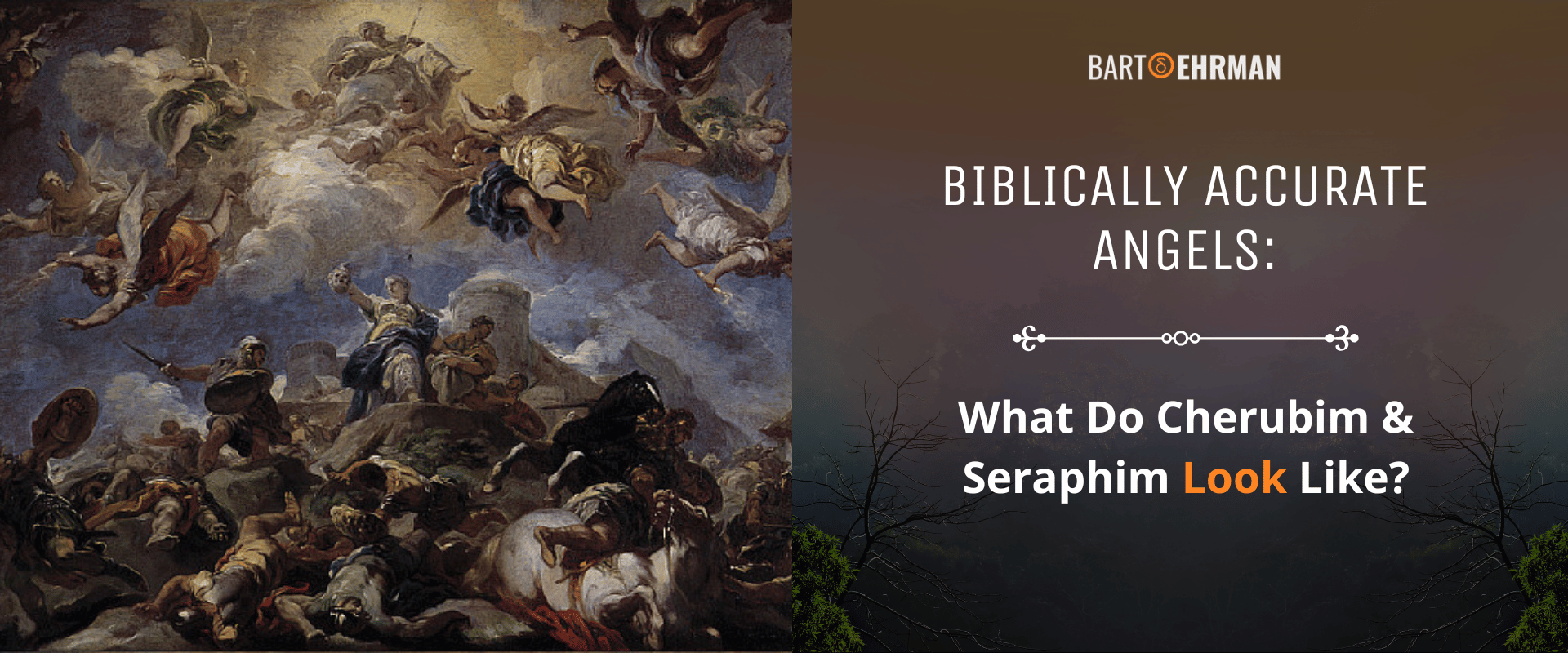
Contrary to the gentle, winged beings often depicted in holiday cards or cathedral ceilings, the biblical record offers strikingly different portrayals. And as we'll see, these descriptions aren’t just artistic curiosities. Rather, they are theologically rich, symbolically complex, and often deeply strange.
Across the pages of the Bible, angels serve many functions, appear in a variety of forms, and defy modern notions of what is “heavenly.”
In this article, we’ll take a closer look at what Scripture actually says about these mysterious beings. We’ll explore how they operate, how they’re categorized, and most provocatively, how they’re described.
From radiant messengers to multi-winged guardians, biblical texts portray realistic angels in ways that are as awe-inspiring as they are alien. So, before you imagine a serene figure in flowing robes, prepare to encounter something far more unexpected.
Angels in the Bible: A Brief Overview
If the Abrahamic religions have anything in common, then angels are prime examples of such shared characteristics Judaism, Christianity, and Islam all recognize these spiritual beings as part of the divine economy, even if they differ in details.
Since definition is the basis for any historical analysis, we should ask ourselves: What are angels, and how should we understand their importance?
The word angel comes from the Greek noun “ἄγγελος” (angelos), meaning “messenger.” It’s the term used throughout the Greek translation of the Hebrew Bible (the Septuagint) to render the Hebrew mal’akh, which carries the same meaning.
“From the outset”, French historian Philipe Faure notes, “emphasis is thus placed on the function most commonly assigned to the angel: transmission.” (My translation)
(Affiliate Disclaimer: We may earn commissions on products you purchase through this page at no additional cost to you. Thank you for supporting our site!)
Yet, as simple as the translation might seem, the biblical tradition develops these figures into much more than celestial letter carriers. In their book Angels A to Z, Evelyn Oliver and James R. Lewis explain:
Angels are the traditional intermediary spiritual beings between god and humanity. They are defined by their function of message bearer, although this role does not exhaust their activities. Originating in Zoroastrianism, they are particularly (though not exclusively) found in the Western family of religions—Judaism, Christianity, and Islam—where God is conceived as being so elevated he does not intervene directly in the world.


This concept of divine mediation lies at the heart of the angelic tradition in biblical literature. Angels operate as extensions of God’s will, but their role goes beyond the mere task of delivering God’s messages and instructions.
Richard Webster rightly points out that “angels in many forms in the Bible.” This diversity in form reflects the diversity of their functions within the Biblical narratives.
“Of the forty-six books of the Old Testament,” Joan C. Cruz writes, “angels are mentioned in thirty-one. In these books, we learn about the activities of the Angels as they are directed by God. They adore, rebuke, reprove, comfort, instruct, chastise, prophesy, destroy, protect, assist, guard, interpret, advise, announce births, locate the lost, and deliver messages of God; they also intercede and pray for us, they afflict, punish, and even kill.”
So, sometimes they appear as anonymous messengers, as when three visitors come to Abraham (Genesis 18), or when an angel comforts Elijah in the wilderness (1 Kings 19).
At other times, they bear names and specific roles. Gabriel, for example, announces the birth of John the Baptist and Jesus in the Gospel of Luke (Luke 1), while Michael serves as a heavenly warrior in apocalyptic visions (Daniel 10; Revelation 12).
In still other stories, the “angel of the Lord” seems to function as a visible manifestation of God’s presence, as in the burning bush encounter with Moses (Exodus 3) or the wilderness appearance to Hagar (Genesis 16).
All of this makes clear that biblically accurate angels shouldn’t be reduced to a single visual or theological type. Their actions vary widely across biblical texts, and so do the forms they take. While some appear as ordinary humans, others are described in bewildering, almost surreal terms.
This range in appearance and activity reflects the fact that Biblical authors envisioned different kinds of angels performing different kinds of tasks.
Before we explore how these beings are physically described, it’s worth asking: what are the main categories of angels in the Bible, and how do those categories help us understand realistic angels as they were originally imagined in the Christian (biblical) tradition?
What Are the Main Categories of Biblical Angels?
Among the various angelic figures in the Bible, several distinct categories emerge, each with its own theological role and narrative function. While later traditions developed elaborate hierarchies, even the Biblical texts themselves recognize different kinds of angelic beings serving different divine purposes.
#1 – Cherubim are among the first angels mentioned in the Hebrew Bible. After Adam and Eve are expelled from the Garden of Eden, God stations cherubim at its entrance to guard the way to the tree of life (Genesis 3:24).
#2 – Seraphim, though mentioned only explicitly in the Book of Isaiah, play a distinct and exalted role in biblical tradition. In Isaiah’s vision, they appear in the divine throne room, proclaiming God’s holiness and participating in acts of purification.
#3 – A unique and somewhat enigmatic figure in the biblical landscape is the “angel of the Lord.” This angel appears in several key moments, speaking to Hagar, confronting Balaam, and calling to Moses from the burning bush. Interestingly enough, in many of these narratives, the angel speaks directly as God.
#4 – Finally, two named angels appear prominently in biblical literature: Gabriel and Michael. Gabriel functions as a revealer and herald of divine messages, especially in Daniel and Luke (e.g., Jesus’ birth). Michael, by contrast, is portrayed as a heavenly warrior who defeats the forces of evil.
As we move on in our task of describing biblically accurate angels, it’s time to turn our attention to one of the most striking (and often misunderstood) aspects of their portrayal: Their physical appearance.
What Do Angels Look Like? Revealing Biblically Accurate Angels
What constitutes real angels as described in Scripture? To answer that question while remaining within the realm of critical scholarship, we must take a closer look at how the Bible describes these divine beings.
Contrary to popular depictions of angels as winged humans dressed in white robes, the biblical portrayals are far more varied, and at times, utterly bewildering.
In some passages, angels appear in fully human form, indistinguishable from ordinary people. In Genesis 18-19, for example, three “men” visit Abraham by the oaks of Mamre. Though not explicitly called angels until later, two of them proceed to Sodom and are then identified as divine messengers.
They walk, speak, eat, and are treated with the kind of hospitality due to human guests.
Other biblical descriptions, however, portray angels as mysterious and otherworldly. The prophet Daniel, using apocalyptic language, describes an angelic figure in a vision as “a man clothed in linen, with a belt of gold... his body like beryl, his face like lightning, his eyes like flaming torches, his arms and legs like the gleam of burnished bronze.”
The most striking descriptions, though, come from prophetic visions, particularly in Ezekiel and Isaiah. Among the most complex and awe-inspiring of these angelic beings are the cherubim and seraphim. Who are they?
Evelyn Oliver and James R. Lewis note:
The cherubim are the first angels mentioned in the Bible, when they are placed by God at the gates of Eden to prevent Adam and Eve from returning to the Garden.
While their initial appearance in Genesis 3:24 is brief, later biblical texts offer far more elaborate portrayals. As Friedhelm Hartenstein explains in his article:
They [Cherubim and Seraphim] represent various aspects of YHWH’s kingdom in heaven and on earth. Despite the fact that there are more allusions to these mythological beings in the Hebrew Bible, the most important impact in Jewish writings derived from the descriptions in the visionary reports in Isa 6 and Ezek 1-3; 8-11.
What Do Cherubim Look Like?
In Ezekiel 1 and 10, the prophet sees cherubim as heavenly beings with four faces (human, lion, ox, and eagle), four wings, straight legs with feet like calves' hooves, and bodies covered with eyes. They move in unison with “wheels within wheels,” which are also filled with eyes.
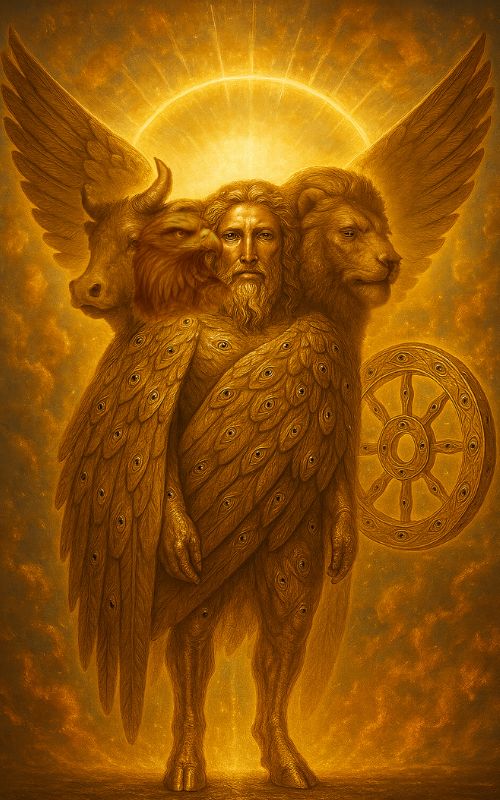
This depiction of a biblically accurate cherubim features its four symbolic faces—human, lion, ox, and eagle—along with radiant bronze-like skin, wings covered in eyes, and the mysterious ‘wheel within a wheel’ beside it. You may use, share, or reproduce this image with attribution and a link to this article.
What Do Seraphim Look Like?
In Isaiah 6, seraphim are described as having six wings: two covering their faces, two covering their feet, and two for flying—as they cry out “Holy, holy, holy is the Lord of hosts.” These fiery beings surround the throne of God and emphasize divine transcendence and holiness.

This artistic rendering of a biblically accurate seraphim captures its radiant brilliance and six majestic wings, as described in Scripture. You are welcome to use, share, or reproduce this image with attribution and a link back to this article.
The Book of Revelation continues this tradition of astonishing imagery. In Revelation 4, John describes “four living creatures” around God’s throne, each with a different face, covered with eyes in front and behind, and possessing six wings.
Across these texts, one thing becomes clear: The realistic angels of Scripture aren’t uniform in appearance, and their forms often mirror their roles. Some resemble human envoys, while others reflect cosmic realities, divine attributes, or the overwhelming mystery of God's presence.
In the next section, we’ll organize these descriptions in a clear comparative table to help us make sense of the complex and fascinating visual landscape of angelic beings in the Bible.
Biblically Accurate Angels: Comparative Table and Verses
Angelic Type | Biblical Passage | Description |
|---|---|---|
Cherubim | Genesis 3:24 | Positioned at Eden’s gate, guarding the way with a flaming sword. |
Ezekiel 1:5-14; 10:1-22 | Four faces (man, lion, ox, eagle); four wings; legs like calves; full of eyes; move with “wheels within wheels.” | |
Seraphim | Isaiah 6:1-7 | Six wings: two cover face, two cover feet, two for flying; proclaim God’s holiness. |
Unnamed Angel | Daniel 10:5-6 | Body like beryl, face like lightning, eyes like flaming torches, arms and legs like bronze. |
Angels at Jesus’ Tomb | Matthew 28:3 | Appearance like lightning; clothing white as snow. |
Living Creatures | Revelation 4:6-8 | Four distinct faces; six wings; covered with eyes; continually praise God. |
Conclusion
Walking through the Vatican Museums, it’s easy to be swept away by the serene beauty of angelic sculptures and paintings: Golden-haired cherubs floating above altarpieces, gentle guardians with feathered wings flanking the Madonna, or glowing messengers frozen in mid-flight.
For anyone familiar only with artistic representations, encountering the scriptural descriptions of angels (whether Ezekiel’s many-faced cherubim or Isaiah’s six-winged seraphim) can be startling, even unsettling. The angels of art comfort us. The angels of Scripture confront us with divine mystery.
And yet, it’s precisely this sense of mystery, awe, and otherness that lies at the heart of biblically accurate angels. They aren’t meant to be decorative or sentimental. They are agents of God’s will (messengers, warriors, purifiers, and guardians) whose forms defy earthly categories because their purposes, according to the Biblical tradition, transcend earthly concerns.
join bart ehrman's new conference!
New Insights into the Hebrew Bible
March 20-22 | 13 Bible Scholars | Early-Bird Pricing
Inaugural conference will focus on the book of Genesis