
What is the Apocalypse of Peter?

Written by Marko Marina, Ph.D.
Author | Historian
Author | Historian | BE Contributor
Verified! See our guidelines
Verified! See our editorial guidelines
Date written: July 15th, 2026
Disclaimer: The views and opinions expressed in this article belong to the author and do not necessarily match my own. - Dr. Bart D. Ehrman
What is the Apocalypse of Peter? Most readers have heard of Dante’s famous journey through hell, purgatory, and paradise. His Divine Comedy has shaped the Western imagination so deeply that its images of the afterlife still echo through literature, art, film, and popular culture, even, more recently, through Dan Brown’s Inferno.
For many people, Dante’s poem remains the classic literary map of the world beyond death: sinners punished according to their crimes, the righteous rewarded, and the entire universe arranged according to divine justice.
But Dante didn’t invent the Christian imagination of heaven and hell. Centuries before the Divine Comedy, early Christians were already telling stories about visionary journeys, final judgment, terrifying punishments, and the blessed destiny of the righteous.
The Book of Revelation is, of course, the best-known Christian apocalypse. Yet it was far from the only one. The early Christian world produced a wide range of apocalyptic writings, many of which claimed to reveal hidden truths about the end of history, the heavenly realm, or the fate of the soul after death.
One of the most fascinating of these texts is the Apocalypse of Peter. Though almost entirely unknown to modern readers outside academic circles, it was once read seriously by some Christians and even stood close to the edges of what would later become the New Testament.
So what exactly is the Apocalypse of Peter? What does it say about the afterlife? Is it “Gnostic”? When was it written, how was it discovered, and why did it ultimately remain outside the Christian canon?
To answer these questions, we need to enter the strange and vivid world of early Christian apocalyptic imagination.
The Apocalypse of Peter: Summary
In his book New Testament Apocrypha, Wilhelm Schneemelcher notes:
(Affiliate Disclaimer: We may earn commissions on products you purchase through this page at no additional cost to you. Thank you for supporting our site!)
The significance of the Apocalypse of Peter as an important witness of the Petrine literature is not to be underestimated. Peter is the decisive witness of the resurrection event. Hence he is also deemed worthy of further revelations, which he hands on with authority... In its description of heaven and hell the Apocalypse draws on the abundance of ideas from the East which has also left its deposit in the writings of late Jewish Apocalyptic and the mystery religions.


With these words, Schneemelcher rightly captures why the Apocalypse of Peter matters.
This isn’t merely an odd little text with a taste for gruesome punishments. It’s part of a larger early Christian attempt to imagine what apostolic authority, resurrection, final judgment, and the world beyond death might look like when narrated through the figure of Peter.
We are obviously dealing, then, with a very important early Christian source. But what does it actually tell us? What are the claims that made this text so significant?
At its broadest level, the Apocalypse of Peter presents Peter as the privileged recipient of a revelation about the fate of souls after death. It’s a kind of visionary journey through the afterlife, where the apostle is shown both the punishments of the wicked and the blessed destiny of the righteous.
This idea wasn’t a novelty. As Bart D. Ehrman notes in his book Journeys to Heaven and Hell:
Even though this is the first surviving full-fledged katabasis in the Christian tradition, it would be a mistake to think the author of this account was the first follower of Jesus to envision an otherworld journey. Precedents of various kinds appear already in books that later became part of the New Testament. Most famously, our earliest biblical author, Paul, claims that he was taken up to the ‘third heaven’ where he experienced ‘visions and revelations’ that were of such divine significance they were to remain unspoken (2 Cor 12:1-5). He does not say these visions involved the realms of the dead, but they were certainly interpreted that way later. Luke’s parable of Lazarus and the rich man is clearly a vision of the postmortem fates of a person above and another below, not a journey by an outsider to either place, although it has been discussed in that way in recent years.
Going back to the text itself, in the Ethiopic version (more on manuscript traditions and versions in the next section), the work opens on familiar biblical ground: Jesus is seated on the Mount of Olives, and his disciples ask him about the signs of his coming and the end of the world.
Jesus warns them against false Christs and describes his future coming in glory, accompanied by angels, with the cross going before him. The Father will set a crown on his head, and Christ will judge the living and the dead, rewarding each person according to their works.
From there, the text moves into a dramatic vision of resurrection and judgment. Peter sees the souls of all human beings and the separation of the righteous from sinners. The dead are raised; even flesh devoured by beasts and birds is restored, because nothing is impossible for God.
The angel Uriel plays a prominent role in the resurrection of the dead, and the whole created order becomes involved in the final act of divine judgment. This is one of the text’s central ideas: nothing remains hidden, nothing is lost, and every human life is finally brought into the open before God.
The most famous part of the Apocalypse of Peter, however, is its catalogue of punishments. Here the text becomes almost unbearably vivid, and, from a modern point of view, at times so extreme that one is tempted to say that the author did not believe in subtlety as a literary virtue.
Blasphemers are hung by their tongues; adulterous women are suspended by their hair over boiling mire; murderers are tormented in a place filled with venomous creatures; false witnesses suffer punishment through the very mouths and tongues with which they lied; the rich who neglected widows and orphans are thrown onto fiery stones sharper than swords; and usurers stand in a foul lake of pus, blood, and boiling mire.
The logic is clear: punishment corresponds to sin. The afterlife becomes a moral mirror in which the hidden truth of earthly behavior is exposed.
Yet it would be misleading to reduce the Apocalypse of Peter to a guided tour of hell. The text also offers striking visions of the blessed.
In both the Ethiopic and Greek Akhmim traditions, Peter and the disciples behold radiant figures whose beauty exceeds ordinary human description. The righteous dwell in a luminous region filled with unfading blossoms, spices, incorruptible plants, blessed fruit, shining garments, angelic attendants, and communal praise.
The Ethiopic and Greek Akhmim witnesses do not preserve the text in exactly the same form: the Ethiopic version gives a fuller continuous narrative, while the Akhmim fragment preserves important parallel material, sometimes with different wording and arrangement.
But both witnesses show that the work is structured around a powerful contrast between the misery of the wicked and the glory of the righteous.
Before asking why such a text didn’t become part of the New Testament, however, we need to look more closely at when it was written.
The Apocalypse of Peter: Manuscript Traditions, Discovery, and the Date of Composition
When we are dealing with any ancient document, it’s important to begin with the actual manuscripts. What do we have exactly?
Naturally, I would love to tell you that we possess hundreds of manuscripts of the Apocalypse of Peter, carefully copied across the centuries and waiting patiently for modern scholars to compare them.
But ancient history is rarely so generous. In the case of the Apocalypse of Peter, the surviving evidence is much thinner, more fragmented, and (as often happens with apocryphal literature) much more interesting than one might expect.
Thomas J. Kraus, in the book The Apocalypse of Peter in Context, emphasizes that manuscripts aren’t simply containers of texts. They are archaeological objects, and their material form matters: their layout, scribal hands, binding, provenance, and the other writings copied alongside them can all shape how we understand the text.
In very simplified terms, the Apocalypse of Peter survives in two Ethiopic manuscripts and two Greek witnesses.
The Ethiopic manuscripts come from the Lake Tānā region in Ethiopia and preserve the fullest form of the work now available to us.
They aren’t ancient manuscripts in the strict sense. As it turns out, one is usually dated to the 15th or early 16th century, the other to the 18th century, but they are crucial because they transmit a much fuller version of the text than the Greek fragments do.
The Greek evidence is more fragmentary but equally important.
The most famous Greek witness is the so-called Akhmim Codex, found near Akhmim, ancient Panopolis, in Egypt in 1886/1887. This codex contained several texts, including the Gospel of Peter, the Apocalypse of Peter, portions of 1 Enoch, and a text connected with the martyrdom of Julian of Anazarbus.
Kraus warns that older claims about the circumstances of the discovery (for example, the idea that the tomb in which the codex was found must have belonged to a monk) shouldn’t simply be repeated as established fact.
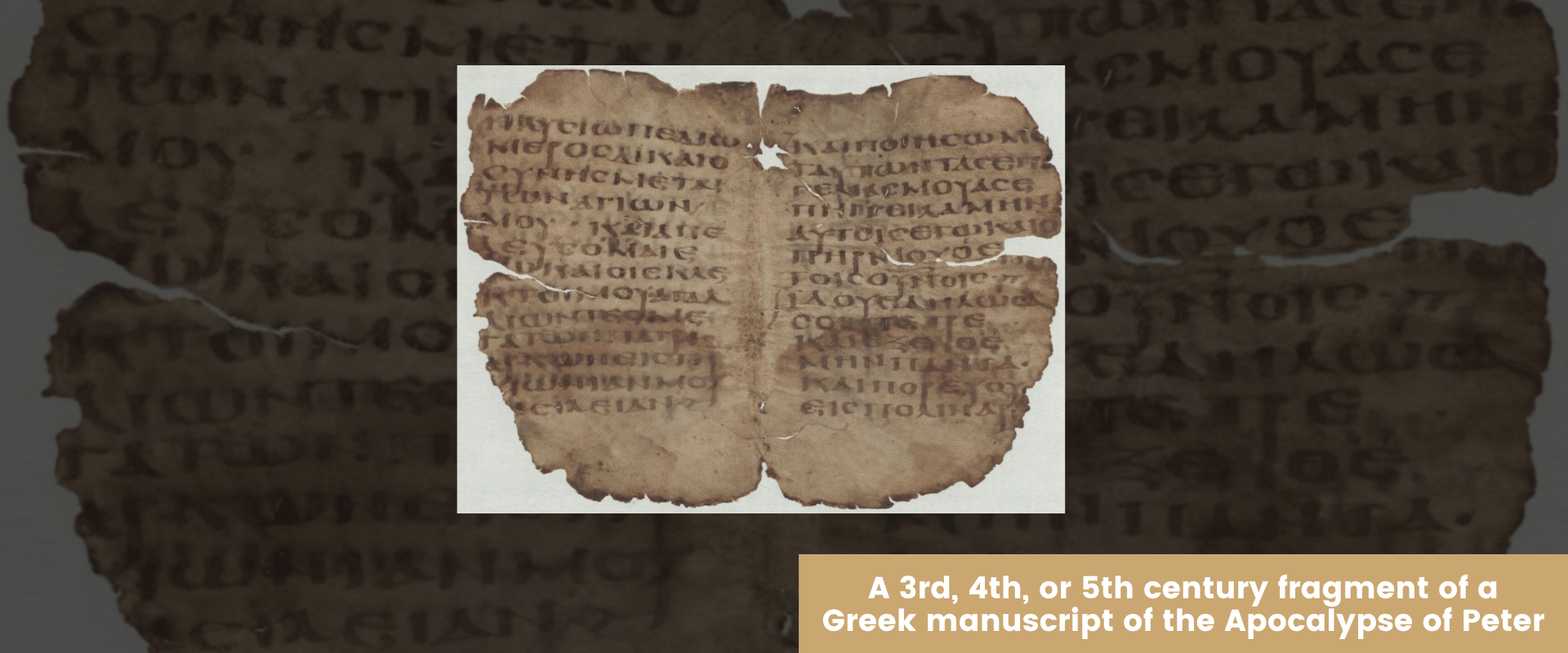
The manuscript itself is generally dated to the late 6th or early 7th century. There is also a second Greek witness: a tiny miniature codex, represented by the Rainer fragment in Vienna and the Bodleian fragment in Oxford.
This little book is especially significant because it is probably the oldest surviving manuscript witness to the Apocalypse of Peter, usually dated to the second half of the 5th century.
Now that we have seen what kind of manuscripts we have, our next question becomes: when was the Apocalypse of Peter actually composed? This distinction matters.
The date of our oldest surviving manuscript isn’t the same thing as the date when the text itself was first written. A 5th-century manuscript can preserve a 2nd-century work, just as a modern printed Bible can preserve texts written almost two thousand years ago.
In the case of the Apocalypse of Peter, most scholars date the original composition much earlier than our surviving manuscripts.
In the critical edition titled Das Petrusevangelium und die Petrusapokalypse: Die griechischen Fragmente mit deutscher und englischer Übersetzung (The Gospel of Peter and the Apocalypse of Peter: The Greek Fragments with German and English Translation), Thomas J. Kraus and Tobias Nicklas note:
“In comparison with the partly almost unmanageable amount of literature on canonical texts, but also with the extensive engagement with important early church authors, some Christian apocrypha lead a shadowy existence and receive little attention in the study of the first centuries of emerging Christianity. This is especially striking in the case of the so-called Apocalypse of Peter (AP), or ‘Revelation of Peter,’ a ‘journey to the afterlife’ of the ‘prince of the apostles,’ which is commonly dated to the first half of the 2nd century and therefore certainly belongs among the oldest preserved examples of Christian literature outside the canon.” (my translation)
That last point is crucial: despite its fragmentary transmission, the Apocalypse of Peter isn’t a late medieval fantasy about hell. It’s usually placed very early, in the same broad period in which many Christian communities were still negotiating questions of authority, revelation, persecution, judgment, and the boundaries of Scripture.
But where, more precisely, should we locate its composition?
Richard Bauckham famously argued that the text arose in Palestine during the Bar Kokhba revolt, around 132–135 CE.
On this view, the text’s warnings about false messiahs, its concern with martyrdom, and its interpretation of Israel’s role in the last days reflect a concrete crisis in which Jewish Christians faced danger in the context of Bar Kokhba’s messianic movement.
The thesis has the advantage of giving the text a clear historical setting: a community under pressure, reading its suffering through the language of apocalyptic expectation.
However, many recent scholars haven’t been convinced by Bauckham’s arguments. For instance, Tobias Nicklas, in his essay, raised several important objections!
He asks whether our evidence for the Bar Kokhba movement is really strong enough to support such a precise reconstruction.
Nicklas rightly questions whether a text supposedly tied so closely to a failed eschatological expectation could have become influential so quickly after that expectation collapsed; whether the focus on a single false messiah is textually secure; and whether a Palestinian Jewish-Christian setting adequately explains the text’s Greek language, its use of Septuagintal traditions, and its striking references to places such as Acherusia and Elysium.
He therefore considers an Alexandrian setting in the first half of the 2nd century, perhaps in a Christian-Jewish community shaped by both Jewish apocalyptic and wider Hellenistic traditions, to be the more plausible option.
However, Nicklas is aware that this is far from certain. He concludes:
“If the preceding reflections leave the impression that more questions now remain open than before, then one goal has certainly been achieved. I continue to regard Bauckham’s and Norelli’s very precise chronological and geographical placement of the Apocalypse of Peter as questionable, and I am also not sure whether the rather complex model recently proposed by Bremmer – according to which the text emerged partly in Palestine and partly in Egypt – is necessary. Whether it really helps us to locate the text historically in a hypothetical Christian-Jewish community in Alexandria in the first half of the 2nd century – perhaps in connection with the Jewish Diaspora revolt – I cannot say with certainty. Nevertheless… I currently regard the composition of the text in the Alexandrian milieu as the most probable solution. In any case, the description of the afterlife found in the Apocalypse of Peter seems to indicate quite clearly that we are dealing with a group of Christians who find themselves in a crisis situation – or at least perceive their situation as such – a community that sees itself as threatened by persecutions leading even to martyrdom, and that can recognize in Peter, who also died as a martyr, a model for itself.” (my translation)
Similarly, Bart Ehrman concludes:
A number of scholars have been convinced [by Bauckham’s thesis]; others, including some of the most recent contributors, have found the evidence thin and have proposed interesting counterevidence by a time of composition a couple of decades in either direction... In any event, the book must have been written before the end of the second century, since it is known to Clement of Alexandria, who, as we will see, considered it Scripture. After that it became relatively popular in proto-orthodox Christian circles and was accepted as canonical by other significant witnesses up to the fourth century.
So the safest conclusion is this: the Apocalypse of Peter was probably composed in the first half of the 2nd century, most likely in a Greek-speaking Christian environment, and it reflects a community that understood itself as threatened, pressured, and in need of reassurance that divine justice would ultimately prevail.
Its exact place of origin remains debated. Palestine, Alexandria, and broader Egyptian-Jewish or Christian-Jewish contexts have all been proposed.
But wherever it was written, the text was early, influential, and known widely enough to be cited, discussed, and in some circles even treated as a serious candidate for authoritative Christian reading.
That brings us naturally to the next question: if the Apocalypse of Peter was so early and so influential, why did it not make it into the New Testament?

The Apocalypse of Peter and the Question of Canon
The canonization of the New Testament was a gradual and uneven process. Some books that eventually made it into the canon were still questioned by important Christian writers for centuries, while other books that remained outside the canon were read, valued, and even treated as Scripture by some early Christians.
In other words, the New Testament didn’t simply drop from heaven as a finished table of contents.
Its boundaries emerged over time, through debate, usage, theological judgment, and the changing needs of Christian communities.
One of the best illustrations of this process is precisely the Apocalypse of Peter. Written, as we saw, probably in the first half of the 2nd century, this book came surprisingly close to canonical status.
Bruce Metzger, in his book The Canon of the New Testament, summarizes the evidence well:
We first hear of this work in the Muratorian Canon, where it stands after the Apocalypse of John, with the warning that ‘some of our people do not wish it to be read in church’ (lines 72-3). Clement of Alexandria accepted it as the work of Peter and wrote comments on it. On the other hand, it was considered uncanonical by Eusebius and by Jerome. Yet other Christians had a high regard for the book, for, according to the testimony of Sozomen, the fifth-century church historian, in his day it was customary in some of the churches of Palestine to read from the Apocalypse of Peter every year on Good Friday.
The Muratorian Fragment is especially important because it places our text alongside the Apocalypse of John, while noting that some Christians didn’t want it read publicly in church. That qualification matters.
It suggests a text that was accepted by some, resisted by others, and still very much under discussion. Clement of Alexandria’s use of the text points in the same direction. He appears to have treated it as a Petrine writing and as Scripture.
Methodius, near the end of the 3rd or beginning of the 4th century, also seems to cite material from the Apocalypse of Peter as coming from “divinely inspired Scriptures.” So the issue wasn’t that no one took the book seriously. Quite the opposite: enough Christians took it seriously that later Christian leaders had to decide what to do with it.
Bart Ehrman has recently emphasized in Journeys to Heaven and Hell just how striking this is when compared with another Petrine text: 2 Peter.
Today, 2 Peter is in the New Testament and the Apocalypse of Peter isn't. But in the 2nd and 3rd centuries, the situation wasn’t so obvious.
The Apocalypse of Peter appears to have been better known, more widely used, and more often treated as authoritative than 2 Peter. Yet by the 4th century, the situation began to reverse. 2 Peter moved toward canonical acceptance, while the Apocalypse of Peter increasingly fell under suspicion.
This shows that canonization wasn’t merely about whether a book claimed apostolic authorship. Both texts claimed Petrine authority. What mattered was also whether a text’s theology was judged useful, safe, and compatible with emerging “orthodox” consensus.
So why did the Apocalypse of Peter lose? It's tempting to say that it was rejected because its punishments were too grotesque or because educated Christians found it vulgar. But that explanation is too simple.
Ancient Christians weren’t exactly allergic to terrifying depictions of judgment. The deeper issue may have been theological.
In one of its early textual forms, preserved especially in the Rainer fragment, the Apocalypse of Peter appears to have taught that the righteous would intercede for sinners suffering in punishment and that God would grant their request.
In other words, divine mercy would finally triumph even over hell. A strikingly similar idea appears in the Sibylline Oracles, a collection of Jewish and Christian prophetic poems written in the voice of a pagan prophetess: the pious ask God to rescue people from fiery punishment, and God transfers them to eternal life near the Acherusian lake.
This parallel is important because it suggests that such a universalistic reading of the Apocalypse of Peter wasn’t a late misunderstanding but part of an early stream of its reception.
That may have become the book’s fatal problem. As debates about eternal punishment, universal salvation, and later Origenist theology intensified, the idea that even the damned might finally be rescued became increasingly dangerous.
The text wasn’t necessarily rejected because it was “Gnostic,” nor because every Christian immediately recognized it as fraudulent. It was rejected because, in the eyes of many later church leaders, it no longer sounded like what Peter ought to have taught.
If Peter was the great apostolic witness to Christ, then a book claiming his authority had to support what was coming to be recognized as orthodox teaching. The Apocalypse of Peter had once stood close to the borders of Scripture; eventually, those borders hardened without it. Before we conclude, however, one more question remains: did the ancient worldview commonly called “Gnosticism” have anything to do with this fascinating and controversial text?
Is the Apocalypse of Peter a Gnostic Document?
In her book The Gnostic New Age, April D. DeConick writes:
The Gnostics were the first to view traditional religion as the opiate of the masses, the drug that keeps people satisfied to serve the gods and their kings as obedient slaves and vassals. Gnostic spirituality offered a new orientation that insisted that human beings are more than the mortal creations of the gods. Conventional religions, they thought, mask the true God of worship, a transcendent God who is the ultimate reality and the primal source of all existence. This God of goodness and love transcends all gods and all religions. This God can only be known through direct personal contact, when the Gnostic unites with him in a profound transcendent religious experience.
This is a useful starting point because it reminds us that “Gnosticism” isn’t simply a synonym for “weird early Christianity.”
It refers to a set of religious ideas and practices centered on hidden knowledge, alienation from the ordinary structures of the cosmos, and access to a transcendent divine reality beyond the visible world.
For most people today, “Gnosticism” (a term some scholars argue is inappropriate, though I believe it retains terminological value if used with caution) is known mainly through the remarkable discovery of the Nag Hammadi library in Egypt in 1945.
These texts opened an extraordinary window into ancient Christian and non-Christian mythological speculation, different interpretations of Jesus, and communities or study circles that didn’t fit comfortably within what later became orthodox Christianity.
Gnostic or gnosticizing Christians produced gospels, revelations, dialogues, and theological myths, many of which were eventually rejected by the emerging orthodox Church.
So where does the Apocalypse of Peter belong? Is this Petrine vision of heaven, hell, judgment, and salvation one of those Gnostic books?
It's not! At least not the Apocalypse of Peter we have been discussing in this article. The early Christian Apocalypse of Peter is an apocalyptic text, not a Gnostic one.
Its main concerns are resurrection, final judgment, divine justice, punishment of sinners, reward of the righteous, and the fate of souls after death. It doesn’t teach that the material world was created by an ignorant or hostile lower deity, as many Gnostic texts claimed.
It doesn’t present salvation as the awakening of a divine spark trapped in matter. Nor does it center on secret metaphysical knowledge that liberates the soul from the cosmic powers.
Its world is much closer to Jewish and Christian apocalyptic expectation: God will judge the world, expose hidden evil, vindicate the righteous, and punish the wicked.
The confusion comes from the fact that there is another ancient text also called the Apocalypse of Peter: the Coptic Apocalypse of Peter from Nag Hammadi. That work is very different.
It belongs to a gnosticizing theological environment and contains, among other things, a striking interpretation of Jesus’ suffering in which the true, spiritual Christ is distinguished from the visible figure who suffers.
So when someone asks whether the Apocalypse of Peter is Gnostic, the first response has to be: which one?
The Coptic Nag Hammadi Apocalypse of Peter can reasonably be discussed in connection with Gnostic Christianity. But the early Christian apocalypse about Peter’s vision of heaven and hell shouldn’t be classified that way.
Conclusion
The Apocalypse of Peter, then, is far more than a bizarre catalogue of infernal punishments, though it certainly has enough boiling mire, fiery stones, and venomous creatures to make Dante look almost restrained.
One can only imagine how different Sunday school might have been if this text had made it into the Bible: “Today, children, we’ll learn why usurers are standing in a lake of pus.”
It’s one of the earliest surviving Christian attempts to map the afterlife, to imagine divine justice in vivid narrative form, and to place Peter himself at the center of apocalyptic revelation.
Its manuscript tradition is fragmentary, its date and place of origin remain debated, and its canonical status was once far more serious than most modern readers would expect.
Some Christians treated it as Scripture; others resisted it; and eventually, especially as debates over eternal punishment and universal salvation sharpened, it was left outside the New Testament.
It’s not, at least in the form discussed here, a Gnostic text, but an early Christian apocalypse shaped by Jewish, Christian, and wider Mediterranean images of judgment and salvation.
For precisely that reason, the Apocalypse of Peter remains a fascinating witness to a world in which the boundaries of Scripture, orthodoxy, and the afterlife itself were still being imagined, argued over, and drawn.