

The Garden of Eden: Where It Was, What It Meant, and Whether It Was Real

Written by Marko Marina, Ph.D.
Author | Historian
Author | Historian | BE Contributor
Verified! See our guidelines
Verified! See our editorial guidelines
Date written: November 18th, 2026
Disclaimer: The views and opinions expressed in this article belong to the author and do not necessarily match my own. - Dr. Bart D. Ehrman
Toward the end of Voltaire’s celebrated philosophical novel Candide (1759), we encounter a memorable exchange between the protagonist and his old tutor, Pangloss. “I also know,” Candide remarks, “that we must cultivate our garden.”
Pangloss responds: “You are right, for when man was first placed in the Garden of Eden, he was put there ut operaretur eum, that he might cultivate it; which shows that man was not born to be idle.”
By invoking the Latin translation of Genesis 2:15, Voltaire draws attention to a frequently overlooked detail of the biblical narrative: work was already part of human existence before the Fall, rather than merely a punishment imposed afterward.
The exchange thus contributes to one of the most celebrated conclusions in Western literature while reminding us how profoundly the biblical image of Eden has shaped reflections on the human condition.
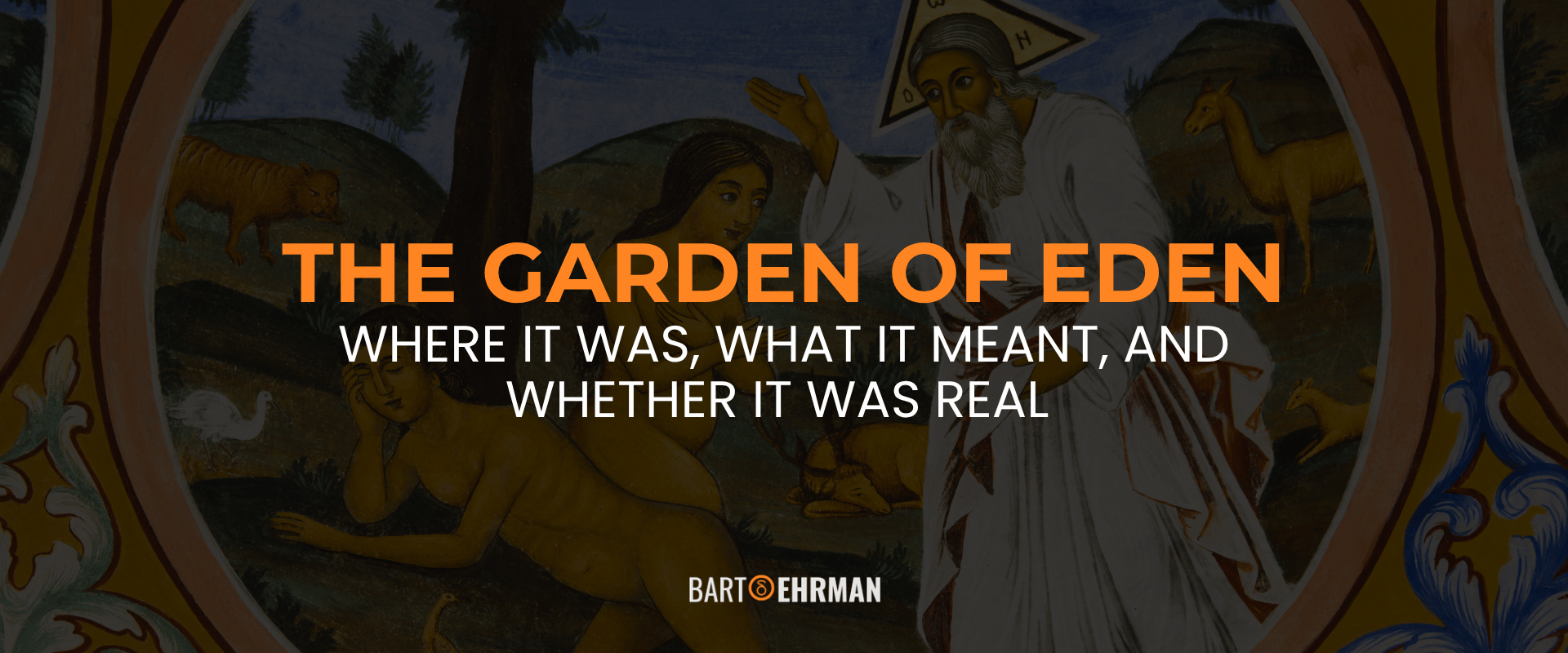
What is the Garden of Eden? It is among the most recognizable settings in the history of Western religious and cultural imagination.
For centuries, it has inspired theologians, philosophers, artists, and ordinary readers, who have understood it variously as a lost paradise, a historical location, or a symbol of humanity’s original relationship with God.
But what does the Bible actually tell us about this mysterious garden? Is the Garden of Eden real, and could people, at least in principle, locate it on a map? What did its story mean to those who first told it and to the early Christians who subsequently interpreted it?
These are the questions we’ll explore, approaching Eden not simply as a familiar biblical story but as a fascinating subject of historical investigation.
What Does the Bible Say About the Garden of Eden?
As James K. Hoffmeier observes in Genesis: History, Fiction, or Neither?:
(Affiliate Disclaimer: We may earn commissions on products you purchase through this page at no additional cost to you. Thank you for supporting our site!)
If any passage in the Bible has been called ‘myth’ it is Genesis 2:8-3:24.” He points to the narrative's extraordinary features, including the creation of Eve from Adam's rib, mysterious trees, a talking serpent, direct communication between God and humanity, and supernatural guardians at Eden's entrance.


Where is the Garden of Eden found in the Bible? The place to which Hoffmeier refers first appears in Genesis 2:8, where God plants a garden in a region called Eden and places there the first human, Adam, whom he has formed from the dust of the ground.
Since the Garden of Eden story comes from Genesis, have you ever wondered who actually wrote this book and the rest of the Pentateuch, traditionally attributed to Moses? Join Yale biblical scholar Joel Baden for his fascinating 10-lecture course, “The Bible by Committee: How the Pentateuch Was Really Written?,” and discover how scholars uncover the different sources, contradictions, and literary traditions that shaped the Bible's first five books.
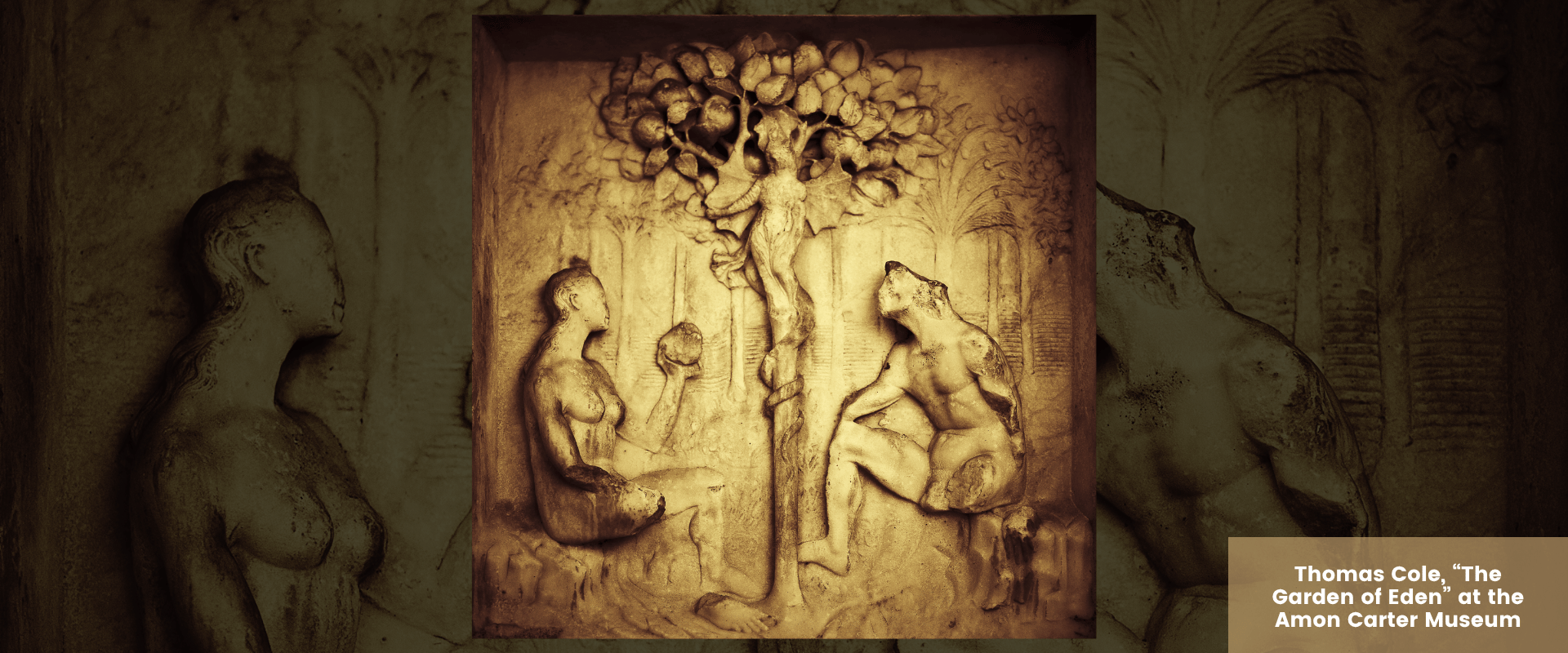
According to the narrative, the garden contains abundant vegetation and two particularly significant trees: the Tree of Life and the Tree of the Knowledge of Good and Evil.
Adam is instructed to cultivate and care for the garden but forbidden to eat from the latter tree. God subsequently creates animals and, finally, a woman as a suitable companion for Adam.
The story takes a dramatic turn in Genesis 3, when a serpent persuades the woman to eat the forbidden fruit, which she then shares with Adam.
Their disobedience brings a series of consequences: the serpent is cursed, the woman is told that childbirth will involve pain, and the man is condemned to a life of difficult agricultural labor. God then expels the human couple from the garden, preventing them from gaining access to the Tree of Life and living forever.
Cherubim, supernatural beings associated with the divine realm, are stationed to guard the way back. Thus ends the biblical account of humanity's brief residence in Eden, a narrative that would profoundly influence subsequent Jewish and Christian understandings of the human condition.
But where is the Garden of Eden located, according to the Bible?
Interestingly, Genesis provides what appear to be geographical clues. According to Genesis 2:10–14, a river flows from Eden to water the garden before dividing into four branches: the Pishon, the Gihon, the Tigris, and the Euphrates.
The first two are associated with the lands of Havilah and Cush, respectively, while the latter two are recognizable rivers of ancient Mesopotamia, broadly corresponding to parts of modern-day Iraq and neighboring regions.
The mention of the Tigris and Euphrates is especially important. As Ziony Zevit explains in his book What Really Happened in the Garden of Eden?:
Mention of the Tigris and the Euphrates, easily located, situated the Garden in earthly geography. People of Iron Age Judah and Israel knew about these rivers and the direction of their flow, the latter better than the former. During the reigns of David and Solomon (tenth century BCE) and again during the peaceful four-de cades-long reigns of Azaryahu (also known as Uzziah) in Judah and Jeroboam II in Israel during the first half of the eighth century BCE, Israelite political influence extended north up to the Orontes River in contemporary Lebanon and northeast across the desert to the banks of the Euphrates in Syria. The Euphrates was so well known that it is referred to in Exodus 23:31 simply as “the river.”
Based on that information, where was the Garden of Eden located, then? You might think that its exact location is clear. However, things are not that simple.
For instance, the precise identities of the Pishon and Gihon remain uncertain, which makes it difficult to establish the garden's precise geographical location.
So, are we dealing with a description of an actual place, or does the biblical author have something else in mind? To explore this question, we must turn to how biblical scholarship understands the story of Eden and its place within the religious imagination of ancient Israel.
Was the Garden of Eden Real? Its Origins and Meaning
In his Commentary on Genesis, Bill T. Arnold writes:
The human has been put in the garden for a distinct purpose. He is not there solely for self-gratification or enjoyment, but as the representative of Yahweh God to cultivate the earth and as the one responsible for keeping or protecting it. Gen 1 emphasized the intimate relationship between God and humanity in the ‘image of God’ concept (1:26-27). Here the intimacy is expressed in very different terms. God has entrusted the garden to the human, as his sole representative on earth, to develop it and guard it as humanity's home; a place where humans will have all their needs satisfied, and will live in freedom with each other and with God.
Clearly, then, the Garden of Eden occupies a fundamental place in the biblical understanding of humanity's origins and relationship with God. But how should we understand this remarkable story?
Perhaps the best starting point is to revisit one of its most intriguing questions: where exactly was this mysterious garden supposed to be located?
E. A. Speiser famously argued that the geographical background of Eden should be sought in southern Mesopotamia, near the head of the Persian Gulf.
Drawing on linguistic and geographical evidence, Speiser proposed that the four rivers mentioned in Genesis originally converged in this region, creating a fertile landscape that ancient Mesopotamian traditions associated with abundance and prosperity.
However, this interpretation has not gone unchallenged.
In the already-mentioned book, Zevit questioned Speiser's interpretation of the Hebrew text, particularly Genesis 2:10.
According to Zevit, the passage describes a river flowing out of Eden and subsequently giving rise to four rivers, rather than four rivers converging into one.
Where was the Garden of Eden found, from his perspective? Zevit consequently proposed a location much farther north, in the mountainous regions of eastern Anatolia, near the headwaters of the Tigris and Euphrates. For Zevit, the Pishon and Gihon might correspond to the ancient Halys (modern Kızılırmak) and Araxes (modern Aras) rivers, respectively. Although both scholars offer geographically informed interpretations, neither reconstruction has been conclusively established.
But does the geographical specificity of Genesis mean that the Garden of Eden actually existed? Relatedly, does the Garden of Eden still exist?
From a historical perspective, the answer to the first question remains uncertain. As for the latter, no archaeological evidence has established the existence of the garden as described in Genesis, and identifying possible geographical settings does not demonstrate the historicity of the events narrated there.
Nevertheless, as Zevit observes, the references to recognizable rivers may have served an important literary purpose. By situating Eden within a seemingly familiar geographical world, the biblical author gave the narrative an impression of tangible reality, while the abundance of flowing water evoked fertility and agricultural prosperity.
Indeed, the story itself belongs to a much broader ancient Near Eastern cultural environment. Speiser, for example, identified significant connections between the Eden narrative and Mesopotamian traditions, including the Epic of Gilgamesh.
In that epic, the transformation of the wild man, Enkid, through his encounter with a woman brings him wisdom and a new awareness of his humanity, while simultaneously separating him from his previous existence among animals.
The parallels with Adam and Eve's acquisition of knowledge, awareness of nakedness, and loss of their original condition are striking, although they do not establish that the biblical author directly borrowed from the surviving version of the epic.
These literary connections also help illuminate the deeper meaning of the Garden of Eden.
One of the narrative's central concerns is the acquisition of knowledge and its consequences for human existence. Speiser argued that the Hebrew expression traditionally translated as “knowledge of good and evil” shouldn’t be restricted to moral discernment.
Rather, it encompasses a broader capacity to distinguish and experience different aspects of life, including intellectual and physical awareness.
This interpretation helps explain why Adam and Eve become conscious of their nakedness immediately after eating the forbidden fruit.
Scholarly Insights
Eden: A Place of Pleasure or Just a Plain?
Did you know that even the meaning of the word Eden remains a subject of scholarly debate? The biblical scholar E. A. Speiser argued that the Hebrew name Eden derives from the Sumerian word eden, meaning “plain” or “steppe,” which entered Hebrew through the Akkadian edinu.
However, other scholars, including A. R. Millard, have challenged this explanation, favoring a Semitic origin associated with ideas of “delight,” “abundance,” or “fertility.” Interestingly, this debate raises a fascinating question: did the biblical authors inherit an ancient geographical name, or did the name itself evoke the extraordinary abundance associated with the garden?
Although no universally accepted explanation has emerged, these competing theories reveal how even a single biblical word can open a window into the linguistic and cultural world of the ancient Near East.
Yet the story is equally concerned with another fundamental feature of the human condition: mortality.
In Genesis 3:22–24, God expels the human couple specifically to prevent them from eating from the Tree of Life and living forever.
Here, too, Speiser identifies parallels with Mesopotamian literature, particularly the stories of Adapa and Gilgamesh, both of which explore humanity's inability to attain everlasting life. These comparisons suggest that the Eden narrative participates in a wider ancient conversation about the boundaries separating human beings from the divine.
Ultimately, then, the historical importance of the Garden of Eden doesn’t depend entirely on whether its precise location can be established.
The narrative offers an ancient explanation for some of the most fundamental realities of human existence: why human beings possess knowledge, why they experience hardship, and why they cannot escape death.
At the same time, its geographical details and literary motifs reveal the cultural world in which Israelite traditions developed.
For historians and other scholars, therefore, the Garden of Eden is a window into the religious imagination of the ancient Near East.
And as we shall see, early Christian thinkers would approach this same narrative in strikingly different ways, debating whether Eden should be understood as a physical location, a spiritual reality, or both.
NOW AVAILABLE!
Finding Moses: What Scholars Know About The Exodus & The Jewish Law
Riveting and controversial, the "FINDING MOSES" lecture series takes you on a deep dive into the stories of Moses, the exodus, and a whole lot more...
How Did Early Christians Interpret the Garden of Eden?
Exploring every early Christian author who discussed or interpreted the Garden of Eden would be an impossible task within the limits of this article. After all, the story of Adam and Eve occupied an important place in early Christian reflections on creation, human nature, sin, and salvation.
Instead, we will focus on two particularly illuminating examples: Origen of Alexandria (c. 185-253 C.E.) and Augustine of Hippo (354-430 C.E.). Although separated by more than a century and writing in different intellectual environments, both thinkers devoted considerable attention to the opening chapters of Genesis.
Yet their interpretations reveal important differences in how early Christians understood the relationship between biblical narratives, historical reality, and spiritual meaning.
Origen, one of the most influential Christian intellectuals of the 3rd century, approached the Garden of Eden through his broader conviction that Scripture frequently communicated spiritual truths through figurative language.
In his treatise On First Principles, he questions the plausibility of interpreting the narrative in strictly physical terms. Could God really have planted trees like an ordinary farmer? Could eating fruit from a particular tree literally grant eternal life or knowledge of good and evil? And should readers imagine God physically walking through the garden while Adam hid behind a tree?
For Origen, such descriptions were indications that the biblical author intended to communicate deeper spiritual realities rather than simply recount observable events.
The Garden of Eden, therefore, wasn’t merely a geographical location awaiting discovery but part of a scriptural narrative whose significance demanded interpretation beyond its literal wording.
Obviously, this doesn’t mean that Origen rejected the historical character of Scripture in general. Rather, he believed that certain passages, including the description of Eden, could not adequately be understood if restricted to their apparent physical meaning.
Having explored Origen's interpretation, we can turn to another figure whose influence on Western Christianity would prove difficult to overstate: Augustine of Hippo.
As historian John O'Meara observes in his article:
Augustine made at least four attempts to expound the story of Creation as given in Genesis, of which the best known is the allegorical attempt in the Confessions. He was, however, a far greater realist than is commonly believed, and was imbued with something like what we would call the scientific spirit... He wanted to see how much of the story of Creation in Genesis could be rationally understood.
Indeed, Augustine's engagement with Genesis developed over several decades, culminating in his substantial treatise The Literal Meaning of Genesis.
Unlike Origen, Augustine maintained that the Garden of Eden had actually existed as a physical place and that Adam and Eve had inhabited it with real human bodies.
However, as O'Meara emphasizes, this conviction didn’t prevent Augustine from recognizing figurative elements in the biblical narrative.
For instance, Augustine considered an excessively literal understanding of God's formation of Adam from the dust of the ground inadequate, suggesting that the passage required a more sophisticated interpretation.
Augustine's position becomes particularly clear in The City of God, where he explicitly addresses the relationship between the historical and spiritual meanings of paradise.
He rejects the suggestion that the garden's trees and other features existed only as allegorical representations, while simultaneously acknowledging that they could communicate deeper theological truths.
Thus, the four rivers of Eden could symbolize the cardinal virtues, while the Tree of Life could represent divine wisdom.
Augustine also considers interpretations in which the garden prefigures the Church, its rivers symbolize the four Gospels, and the Tree of Life represents Christ. None of these symbolic meanings, however, required him to abandon his conviction that Eden had been a real place.
The contrast with Origen is therefore instructive.
Whereas Origen questioned the physical plausibility of the narrative's descriptions and emphasized their spiritual significance, Augustine sought to preserve the historical reality of paradise while allowing for allegorical interpretation.
Their approaches remind us that early Christian understandings of Eden were neither uniform nor reducible to a simple opposition between literal and symbolic readings.
Conclusion
Voltaire, with whom we started this article, approached the Garden of Eden, and the biblical creation narrative more broadly, with characteristic Enlightenment skepticism, regarding it as an implausible story shaped by older Near Eastern traditions.
Contemporary scholarship, however, approaches Eden not simply as an absurd fable to be dismissed, but as an ancient narrative that deserves serious historical and literary investigation.
Although scholars have proposed different geographical locations for Eden, none has been conclusively established, nor is there independent evidence that the garden existed as described in Genesis.
Yet the story remains historically significant, revealing how ancient Israelites understood fundamental questions concerning human knowledge, mortality, and the relationship between humanity and the divine.
As the contrasting interpretations of Origen and Augustine demonstrate, its meaning continued to evolve as Christian thinkers engaged with the biblical text in new intellectual and theological contexts.
Ultimately, whether or not Eden was a real place, its story has occupied a remarkably enduring place in humanity's attempts to understand its own existence.
NOW AVAILABLE!
Finding Moses: What Scholars Know About The Exodus & The Jewish Law
Riveting and controversial, the "FINDING MOSES" lecture series takes you on a deep dive into the stories of Moses, the exodus, and a whole lot more...