
Did Ancient Near Eastern Myths Inspire the Bible? List and Examples

Written by Joshua Schachterle, Ph.D
Author | Professor | Scholar
Author | Professor | BE Contributor
Verified! See our editorial guidelines
Verified! See our guidelines
Date written: September 13th, 2026
Disclaimer: The views and opinions expressed in this article belong to the author and do not necessarily match my own. - Dr. Bart D. Ehrman
The Bible is often read as a unique and self-contained collection of sacred texts. Yet the people who wrote and preserved the biblical traditions lived in a world filled with older civilizations, religions, myths, and literary traditions whose stories frequently dealt with the same fundamental questions found in the Bible: How was the world created? Why does evil exist? Why do humans suffer? Why do civilizations rise and fall? And what happens when humanity rebels against the divine? These similarities have led scholars to ask an important question: Did ancient Near Eastern myths inspire the Bible?
In this article, I’ll examine several of the most significant examples of ancient Near Eastern influence on the Bible. By comparing biblical passages with earlier Mesopotamian and Canaanite texts, we can see not only where similarities exist, but also how biblical authors reshaped older traditions to express their own distinctive theological ideas.
If you’re interested in this topic, by the way, check out Bart Ehrman’s course Digging Up Eden, featuring Dr. Shawna Dolansky.
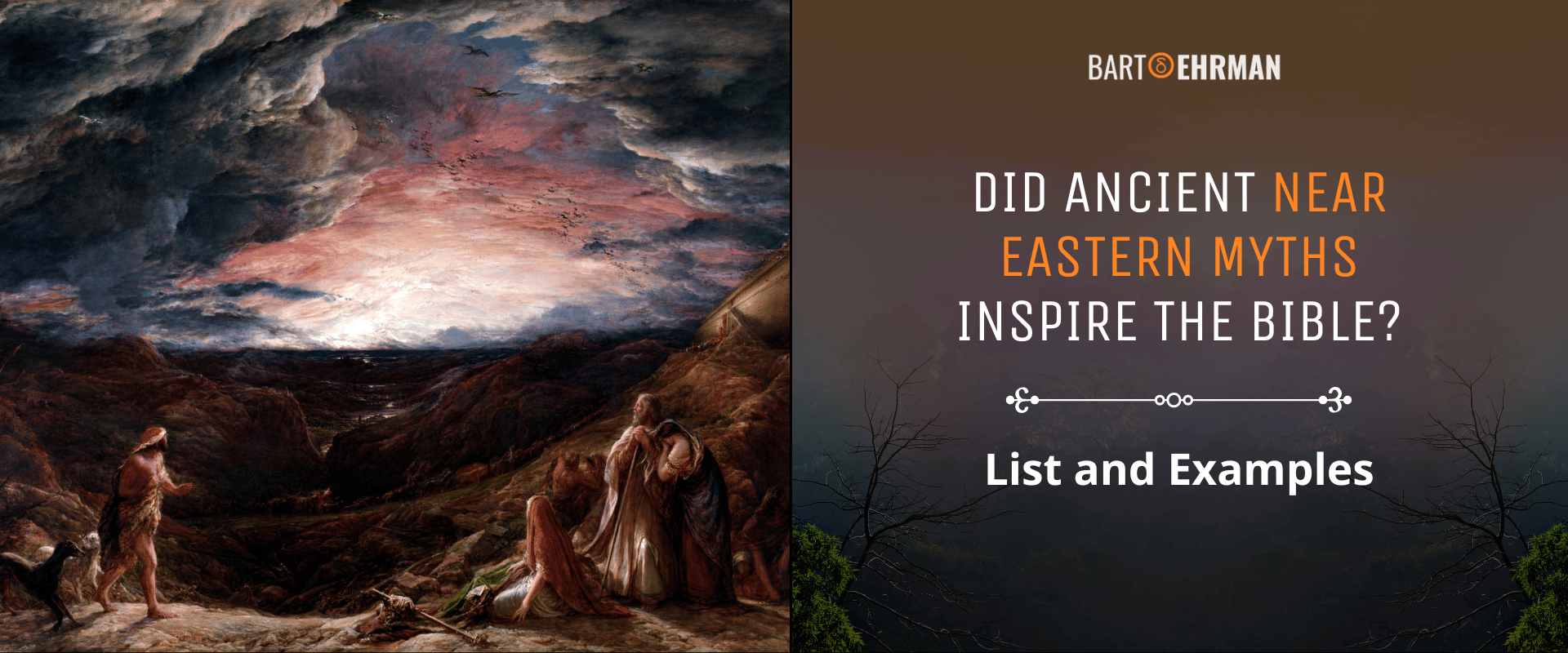
Tehom and Tiamat
In the beginning God created the heavens and the earth.
And the earth was without form, and void; and darkness was upon the face of the deep. And the Spirit of God moved upon the face of the waters (Gen. 1:1-2 KJV).


The Hebrew word meaning “deep” in this verse is tehom. Linguistically, this word is related to the name of the Babylonian goddess Tiamat, both words sharing a common Semitic root meaning “primordial waters.” Dr. Christine Hayes notes that in the Babylonian epic Enuma Elish, finalized between 1100 and 1200 BCE, Tiamat appears as the ocean itself, but also as a ferocious beast resembling a dragon:
(Affiliate Disclaimer: We may earn commissions on products you purchase through this page at no additional cost to you. Thank you for supporting our site!)
When on high the heaven had not been named,
Firm ground below had not been called by name,
Naught but primordial Apsu, their begetter,
[And] Mummu-Tiamat, she who bore them all,
Their waters co-mingling as a single body (Enuma Elish).
Note that both the creation story from Genesis and the Enuma Elish begin with a dark, formless, aquatic chaos that comes before the creation of the world. However, in the Babylonian myth, Tiamat is a divine dragon-goddess who battles and is ultimately destroyed by Marduk, the national god of the Babylonians in the Enuma Elish.
When Tiamat opened her mouth to consume him [Marduk],
He drove in the Evil Wind that she close not her lips.
As the fierce winds charged her belly,
Her body was distended and her mouth was wide open.
He released the arrow, it tore her belly,
It cut through her insides, splitting the heart.
Having thus subdued her, he extinguished her life.
He cast down her carcass to stand upon it.
Hayes writes that Marduk then takes Tiamat’s corpse and cuts it in two like a clam shell. From the top half he creates the dome of sky. With the other half he creates the Earth. We can see the parallel between this and the Genesis account:
And God said, “Let there be a dome in the midst of the waters, and let it separate the waters from the waters.” So God made the dome and separated the waters that were under the dome from the waters that were above the dome. And it was so. God called the dome Sky. And there was evening and there was morning, the second day.
And God said, “Let the waters under the sky be gathered together into one place, and let the dry land appear.” And it was so. God called the dry land Earth, and the waters that were gathered together he called Seas.
The difference in the Genesis story, though, is that the biblical writer demythologizes tehom, making the waters inanimate and passive rather than a deity to be conquered. However, the similarities between the two accounts—separating the waters and the sky—is evident. Moreover, critical scholars argue that Genesis was finalized between the 6th and 5th centuries BCE, long after the Enuma Elish.
In 1895, German biblical scholar Hermann Gunkel published his book Creation and Chaos in the Primeval Era and the Eschaton, which argued for Genesis’ dependence on the Enuma Elish. Most critical scholars since then have likewise argued that the Genesis creation account is at least partially an adaptation of the Enuma Elish story.
Gilgamesh, Atrahasis, and the Great Flood
We’ve already seen the influence of the Enuma Elish on the Genesis account of the creation of the world. However, there is another ancient epic that also influenced Genesis. The Epic of Gilgamesh is an ancient Mesopotamian poem and also the most ancient extant example of narrative writing we have. Like the Enuma Elish, the final form of The Epic of Gilgamesh (finalized between 2100 BCE and 1200 BCE) was written before the final form of Genesis and seems to have influenced it in at least two ways.
In the Mesopotamian story, the hero Gilgamesh is depicted as powerful but reckless. In order to curb his worst tendencies, the gods create a rival for him named Enkidu. The first half of the story ends with Gilgamesh and Enkidu in a sacred cedar forest, a place both holy and abundant. However, the two then defile this holy place by killing its guardian, Humbaba, and his sons.
Adam Miglio points out a notable similarity. It concerns this part of Gilgamesh and the Genesis story:
In Genesis 2–3, the man and woman are placed in a divine garden only to desecrate it and invite the curse of God on the ground, serpent, and all wild beasts (Genesis 3:14, 17). Also, in the Epic of Gilgamesh, Gilgamesh and Enkidu enter the Cedar Forest, only to transgress against this divine abode and thereby desecrate it and the creatures within.
However, more direct similarities between The Epic of Gilgamesh and Genesis are evident in the flood stories both contain. Another ancient epic, The Epic of Atrahasis, contains a flood story as well. Let’s look at all three for comparison.
What are the causes of the worldwide flood in all three? In fact, they vary, although all of them attribute the flood to divine intervention. Genesis 6:5–7 says
The Lord saw that the wickedness of humans was great in the earth and that every inclination of the thoughts of their hearts was only evil continually. And the Lord was sorry that he had made humans on the earth, and it grieved him to his heart. So the Lord said, “I will blot out from the earth the humans I have created—people together with animals and creeping things and birds of the air—for I am sorry that I have made them.”
In Genesis, God’s perception of evil in human beings provides him with a reason to exterminate them (except, of course, Noah and his family). However, while in Gilgamesh no explicit reason is given, the flood seems to be prompted by a vague divine frustration with humans.
In the Epic of Atrahasis, though, we see a cause that is quite distinct from Noah’s story.
The land became wide and the people became numerous. The land bellowed like wild oxen. The god was disturbed by their uproar. Enlil heard the clamor and said to the gods, "Oppressive has become the clamor of [hu]mankind. By their uproar they prevent sleep.
So we have a range of reasons for the flood, from humans behaving immorally in Genesis, to being too loud in Atrahasis. But what about the rest of the story? What other parallels are there?
Pete Enns finds many shared facets of these stories. In all three we see
· a flood and building a huge boat by divine command
· pitch seals the boat
· the boat is built to precise dimensions (the biblical boat is much larger)
· animals come on board
· a Noah figure and his family are saved (Gilgamesh includes some others)
· the boat comes to rest on a mountain
· a raven and doves were sent out (Gilgamesh includes a swallow)
· animals will fear humans
· the deity/deities smell the pleasing aroma of the sacrifices afterwards
· a sign of an oath is given (lapis lazuli necklace for Gilgamesh)
While the theologies of the three tales are different, Enns notes that the “literary evidence from ancient Mesopotamia makes it very likely that Genesis 6-9 is Israel’s version of a common and much older ancient Near Eastern flood story.”
The Tower of Babel
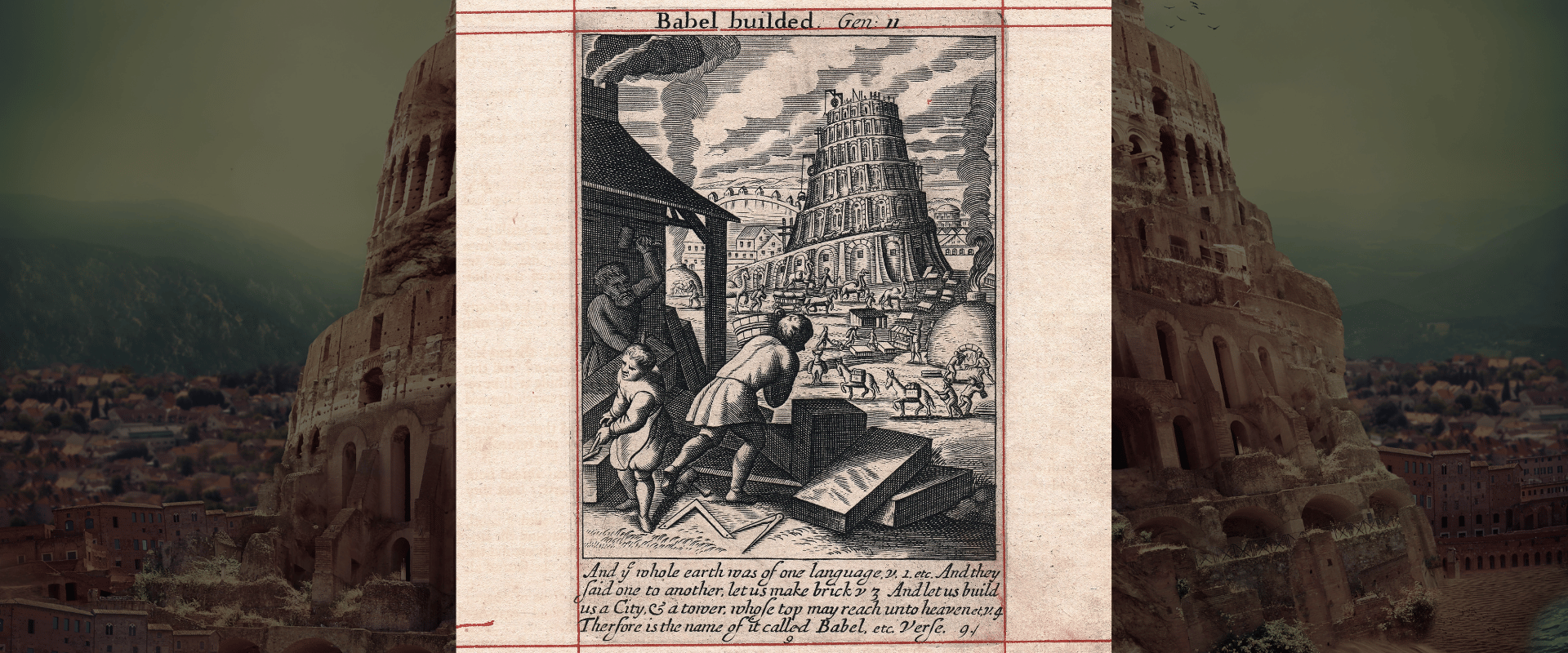
The story of the Tower of Babel is another famous tale from Genesis influenced by earlier Near Eastern stories. The brief story is found in Genesis 11:1–9. To summarize briefly, all people are initially said to share the same language. They decide to undertake a massive building project: “Come, let us build ourselves a city and a tower with its top in the heavens, and let us make a name for ourselves; otherwise we shall be scattered abroad upon the face of the whole earth” (11:4).
When God comes down to look at the city, he worries that because they are all united in one language, they will soon be unstoppable. He therefore confuses their language so they can no longer understand each other, thereafter scattering them across the earth. The city is named Babel, meaning “confusion” or “mixing” in Hebrew, because God confused the language there.
Critical scholars often associate the Tower of Babel with actual historical structures found in ancient Mesopotamia. The most common of these structures designated as possible inspirations for the story is Etemenanki, a ziggurat dedicated to the Babylonian god Marduk, whom I mentioned earlier. In his book Understanding the Bible, Stephen Harris argues that Etemenanki is the likeliest physical inspiration for the Tower of Babel, since the story was probably formed initially during the Babylonian exile.
In addition, there are Near Eastern stories quite similar to the Tower of Babel. For instance, in a Sumerian story known as Enmerkar and the Lord of Aratta, Enmerkar, the ruler of the city of Uruk, begins building an enormous ziggurat and demands building materials from the land of Aratta. Emerkar then recites an incantation beseeching the god Enki to reestablish the linguistic unity of the inhabited regions, implying that the world had at one time been monolingual.
Meanwhile, the Eridu Genesis, an ancient Sumerian epic, includes a passage about the unity of human speech before the gods intervened. There are also stories from the Neo-Assyrian empire in which the gods are said to punish other nations for their arrogance through destruction, scattering, or confusion, as God does in the Tower of Babel story.
NOW AVAILABLE!
Finding Moses: What Scholars Know About The Exodus & The Jewish Law
Riveting and controversial, the "FINDING MOSES" lecture series takes you on a deep dive into the stories of Moses, the exodus, and a whole lot more...
Sargon and Moses
Sargon of Akkad was the first king of the Akkadian Empire, which subjugated many Sumerian city-states in the 24th to 23rd centuries BCE. As such, he was incredibly well-known all over the Near East, including Palestine. Over time, his exploits were gradually mythologized. An ancient Mesopotamian cuneiform text known as the Sargon Birth Legend purports to be Sargon telling the story of his own birth, a tale which might seem familiar if you know the book of Exodus:
My city of birth is Azupiranu, which lies on the bank of the Euphrates. My mother, a high priestess, conceived me, in secret she bore me. She placed me in a reed basket, with bitumen she caulked my hatch. She abandoned me to the river from which I could not escape.
Compare that passage with this one from Exodus 2:2–3 in which Egypt’s Pharaoh has just commanded that every male Israelite infant be killed:
The woman conceived and bore a son [Moses], and when she saw that he was a fine baby, she hid him three months. When she could hide him no longer she got a papyrus basket for him and plastered it with bitumen and pitch; she put the child in it and placed it among the reeds on the bank of the river.
In his book The Ancient Near East: An Essential Guide, John McLaughlin writes not only that “traditions connected with the birth of Sargon are reflected in the story of Moses” but also that “the details of Moses’ birth were not unique in the ancient world.” What’s more, beyond specific stories of the infants both being placed in baskets and sent down the river, both stories include the infants being rescued: Sargon is found and pulled from the water by a humble laborer, while Moses is found and rescued by Pharaoh’s daughter.
The Moses/Sargon resemblance is genuine and noteworthy, but whether Exodus directly borrowed from the Sargon Birth Legend remains uncertain. Both may participate in a broader ancient Near Eastern “exposed child” literary motif.
Scholars note that the abandoned infant is a classic Near Eastern literary theme, often showing that a figure of seemingly low origins is destined for divinely favored greatness. Others include the story of King Oedipus from ancient Greece and a legendary retelling of the birth of the Persian ruler Cyrus the Great by the ancient historian Herodotus.
The Multi-Headed Serpent
Take a look at this passage from Isaiah 27:1:
On that day the Lord with his cruel and great and strong sword will punish Leviathan the fleeing serpent, Leviathan the twisting serpent, and he will kill the dragon that is in the sea.
Now look at Psalm 74:14:
You [Yahweh] crushed the heads of Leviathan;
you gave him as food for the creatures of the wilderness.
These verses refer to the earlier Near Eastern mythological imagery of the multi-headed sea serpent Lotan/Leviathan found in the Ugaritic Baal Cycle, a collection of ancient Canaanite clay tablets written between 1400 and 1200 BCE and narrating the cosmic battles and journeys of the storm and fertility god Baal Hadad. Here is a passage from the Baal Cycle:
Though you smote Lotan the wriggling serpent, finished off the writhing serpent, Encircler-with-seven-heads, the skies will be hot, they will shine when I tear you in pieces.
The biblical Leviathan appears to draw on the same Northwest Semitic chaos-monster tradition represented by Ugaritic Lotan, which is explicitly described as a seven-headed serpent. Texts from ancient Ugarit describe gods battling with a serpent named Lotan, while in Hebrew, the name of the multi-headed dragon is Leviathan. Lotan is the older, Canaanite/Ugaritic word, while Leviathan is its Hebrew equivalent. The biblical Leviathan appears to draw on the same Northwest Semitic chaos-monster tradition represented by Ugaritic Lotan, which is explicitly described as a seven-headed serpent.
In addition, Maicol A. Cortés notes this multi-headed monster tradition continues into later apocalyptic literature, reappearing as the seven-headed dragon in Revelation 12. Cortes writes “The leviathan symbolizes the chaos and the destruction that opposes God’s people. This mythological creature bears similarities with the dragon and the sea beast of Revelation.” In other words, whereas the sea dragon in the Hebrew Bible represents a threat to the Israelites, it represents a similar danger to Christians in Revelation.
Storm Deity Imagery: Baal and Yahweh
As I noted above, in the Ugaritic Baal Cycle, the god Baal Hadad is portrayed as a storm god. His very identity, along with all his conflicts and his sovereignty, is expressed through intense weather-related phenomena, including thunder, lightning, clouds, and rain, all of which symbolize cosmic dominance as well as agricultural fertility.
Baal Hadad is a storm deity associated with thunder, lightning and rain, and is famously described in Ugaritic texts as the “Rider on the Clouds.” He also wields divine clubs that function as literal manifestations of thunderbolts to crush his cosmic enemies. Finally, thunder is depicted as Baal's majestic and terrifying voice echoing from the clouds, shaking the mountains and striking fear into the hearts of assembly gods and mortals alike.
These same storm motifs associated with Baal are attributed to Yahweh in Hebrew Bible texts. For instance, Psalm 29:3–6 calls thunder the "voice of the Lord" over the waters, which breaks strong cedars, shakes the wilderness, and strips forests bare. In Psalm 18, flashing lightning bolts are described as God's fiery arrows that scatter his enemies and God rides on the wings of the wind, making dark storm clouds and thick darkness his secret hiding place and traveling chariot. He sits enthroned above the flood and the crashing waves and holds ultimate control to quiet a raging storm into a gentle whisper.
Meanwhile, in the Book of Job, storm imagery represents God’s supreme power, unsearchable wisdom, and majestic presence. God answers Job directly out of a whirlwind in Job 38:1, using inclement weather as the manifestation of divine dominion.
Conclusion
The evidence presented here suggests that the Bible did not emerge in an isolated cultural vacuum. Ancient Israel existed within the broader world of the ancient Near East, and biblical writers were familiar—directly or indirectly—with stories, symbols, and literary traditions that circulated throughout Mesopotamia, Canaan, and the surrounding regions. From the primordial waters of tehom and the flood narratives of Mesopotamia to the Tower of Babel, the story of Moses’ birth, Leviathan, and the imagery of the storm god, the parallels are too numerous to dismiss as mere coincidence.
At the same time, identifying parallels does not necessarily mean that the biblical authors simply copied earlier myths. In many cases, the similarities become most interesting precisely because the biblical writers transform the older traditions. In Genesis, for example, the primordial waters are not a goddess who must be defeated by another deity, but simply part of creation, completely subject to the command of the one God. Likewise, the biblical flood story shares a recognizable literary framework with Mesopotamian flood traditions while giving the event a radically different theological explanation.
This distinction is important. Cultural influence and theological originality are not mutually exclusive. A biblical writer could borrow a story, image, or literary motif while simultaneously reshaping it to communicate Israel's own understanding of God, humanity, creation, and history. Indeed, the deliberate transformation of older traditions may be one of the most significant features of these biblical texts.
So, did ancient Near Eastern myths inspire the Bible? The evidence strongly suggests that they did, at least for some biblical stories and imagery. But “inspired by” should not automatically be understood as “copied from.” The relationship is more complicated than simple plagiarism. The biblical authors appear to have participated in an ancient literary conversation, taking familiar traditions and adapting them to a distinct theological vision. The similarities help us understand where some biblical stories came from; the differences help us understand what the biblical authors were trying to say.
NOW AVAILABLE!
Finding Moses: What Scholars Know About The Exodus & The Jewish Law
Riveting and controversial, the "FINDING MOSES" lecture series takes you on a deep dive into the stories of Moses, the exodus, and a whole lot more...