
Who is Junia in the Bible?

Written by Marko Marina, Ph.D.
Author | Historian
Author | Historian | BE Contributor
Verified! See our guidelines
Verified! See our editorial guidelines
Date written: August 26th, 2026
Disclaimer: The views and opinions expressed in this article belong to the author and do not necessarily match my own. - Dr. Bart D. Ehrman
Who is Junia in the Bible? This seemingly straightforward question opens onto a series of controversial issues concerning the origins of Christianity, issues that reflect both ancient and modern debates about the position of women in the Church.
I attended Catholic religious instruction throughout elementary and secondary school, yet I do not recall Junia (pronunciation: JOO-nee-uh) ever being mentioned, much less discussed as a potentially important figure in the earliest Christian movement.
Many readers may have had a similar experience. Compared with figures such as Mary Magdalene, Peter, Paul, or the Virgin Mary, Junia remains largely unknown outside scholarly discussions of the New Testament.
Her relative absence from popular Catholic education, however, shouldn’t be taken as evidence that she was unimportant.
To some extent, it reflects the questions and concerns that have shaped the way Christians have interpreted and taught their own history. The role of women in the Church remains a disputed subject, particularly in traditions such as Roman Catholicism, where debates continue over women’s leadership, ministry, and participation in ecclesiastical authority.
Because Junia stands close to the center of some of these discussions, her identity and status have often been interpreted through the lens of later assumptions about what women could (or could not) have done in the earliest Christian communities.
For that reason, Junia offers more than an obscure name preserved in a biblical greeting. Her brief appearance raises broader questions about women in the first Christian generations, the meaning of apostolic authority, the difficulties involved in translating ancient texts, and the influence of later theological debates on biblical interpretation.
In this article, we’ll examine where Junia appears in the New Testament, what can reasonably be said about her identity and role, why some interpreters understood her as a man rather than a woman, and how her reception became part of the continuing Christian debate over women and authority in the Church.
But before we explore the world of significant early Christian women, you should definitely think about exploring Bart D. Ehrman’s 8-lecture course, Paul and Jesus: The Great Divide. In this engaging series, Dr. Ehrman examines the important similarities (and some striking differences) between Jesus and Paul, two pivotal figures in the formation of the early Christian movement.
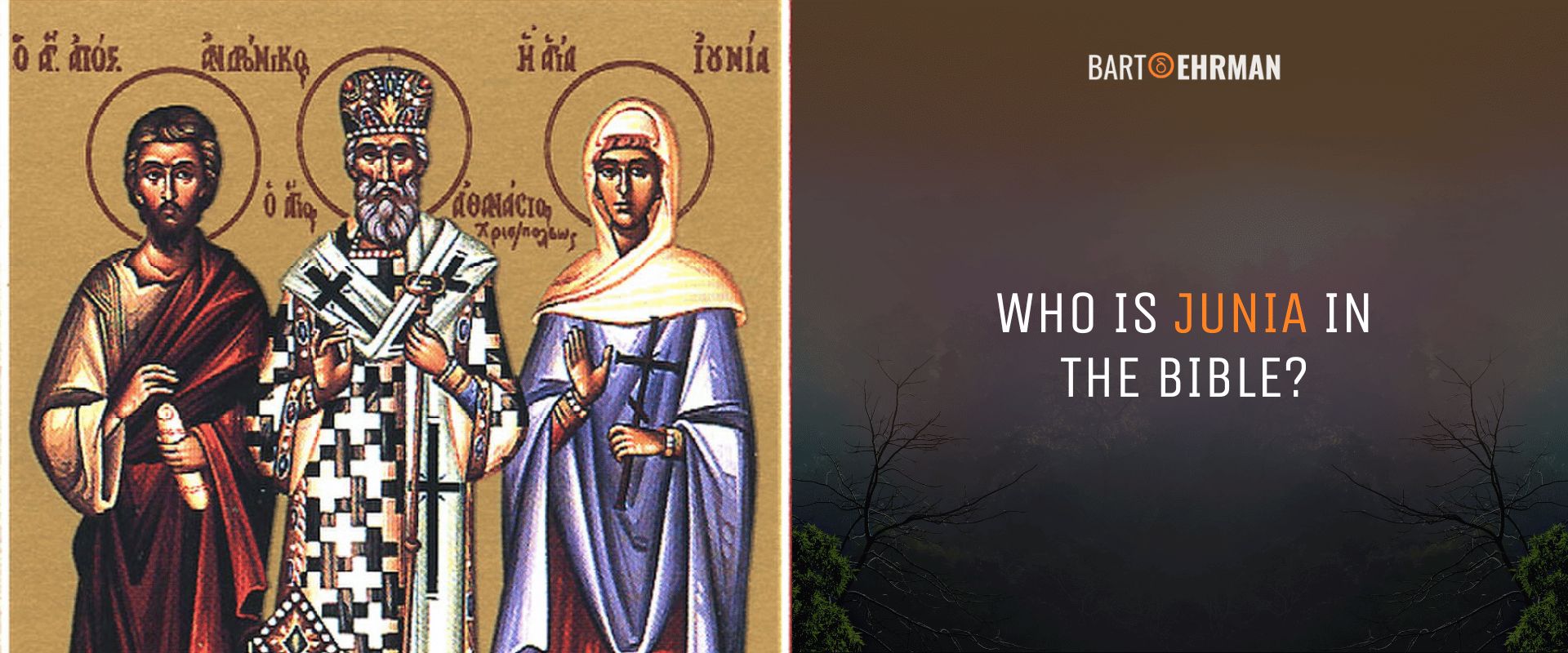
The First Woman Preacher in the Bible: Junia and Romans 16
In his book Introducing the New Testament, Mark A. Powell writes:
(Affiliate Disclaimer: We may earn commissions on products you purchase through this page at no additional cost to you. Thank you for supporting our site!)
A prominent Roman Catholic scholar once said that it would be only ‘a slight exaggeration to say that Western Christianity is divided into Catholic and Protestant churches today because of Paul’s letter to the Romans and disputes over how it is to be interpreted.’ In fact, the first Protestant textbook on Christian doctrine ever written organized its topics according to an outline of Romans (Philipp Melanchthon, Loci communes, published in 1521). In the twentieth century, the theological giant Karl Barth began his program of neoorthodoxy with a commentary on Romans (1933). And in the present day, Paul’s letter to the Romans is still regarded as ‘home base’ for many Lutheran theologians, and yet it is vigorously studied by Christians of all persuasions. The most widely used and highly respected critical commentaries on the letter are volumes by an Anglican (James Dunn), a Roman Catholic (Joseph Fitzmyer), a Methodist (Robert Jewett), and two Baptists (Douglas Moo, Thomas Schreiner). Clearly, the letter has been a theological sounding board for Christians of all persuasions.


It’s precisely in this enormously influential letter that the name Junia appears. But in what literary and historical context does Paul mention her, and what exactly does he say?
Junia appears near the end of the letter, in Romans 16, where Paul sends greetings to a remarkable number of individuals and groups associated with the Christian communities of Rome.
At first glance, this portion of the letter may look like little more than a list of names. Yet these greetings offer one of our most valuable glimpses into the social world of 1st-century Christianity.
They reveal a decentralized network of house congregations connected by missionaries, patrons, coworkers, slaves, freedpersons, Jews, Gentiles, men, and women.
Paul’s repeated instruction that the Roman Christians “greet” these people wasn’t merely a polite formality. In the honor-conscious culture of the Roman world, publicly greeting someone conferred recognition and affirmed that person’s standing within the community.
The number of people greeted here has nevertheless raised a historical question.
Paul hadn’t yet visited Rome, so how could he have known so many Christians living there? Some scholars have therefore proposed that Romans 16 was originally addressed to the church in Ephesus rather than Rome.
François Vouga, however, identifies another plausible explanation:
“In a letter in which he prepares for his visit to Rome, presenting both himself and his gospel so that he might be well received there, Paul commends himself through every acquaintance he can name. The high degree of mobility within the Roman Empire made this task easier.” (my translation)
In other words, the Roman Empire was a highly mobile society, and many Christians whom Paul had encountered elsewhere may subsequently have moved (or returned) to the capital.
Their presence in Rome gave Paul potential allies within the city’s diverse Christian communities. By naming these individuals publicly, he could draw upon those existing relationships while also encouraging the letter’s recipients to recognize their standing and contribution.
As Robert Jewett explains in his Commentary on Romans, Paul’s greetings were therefore intended both to honor particular Christian leaders and to encourage mutual recognition among the different congregations in Rome.
The large number of women included in the list is especially noteworthy. Paul names women who labored in the Christian mission, supported congregations, hosted assemblies, and worked alongside male missionaries.
Junia should be understood within this broader environment: she wasn’t an isolated exception appearing in a community otherwise led entirely by men, but one of several women whom Paul openly acknowledged in connection with the work and leadership of the earliest churches.
Paul’s specific greeting reads: “Greet Andronicus and Junia, my compatriots and my fellow prisoners, who are outstanding among the apostles, who were in Christ even before me.”
Each element of this description is significant.
By calling them his “compatriots,” Paul probably identifies them as fellow Jews. His reference to them as “fellow prisoners” indicates that they had suffered imprisonment in connection with their Christian activity, perhaps during a period when they worked alongside Paul.
Most strikingly, he describes them as “outstanding among the apostles” (ἐπίσημοι ἐν τοῖς ἀποστόλοις).
Finally, Paul says that they were “in Christ” before him, meaning that they had joined the Christian movement before his own conversion. Together, these statements portray Junia as an exceptionally early, experienced, and highly honored participant in the Christian mission.
Junia’s significance, then, comes from the extraordinary concentration of praise contained in a single verse.
She belonged to the earliest generation of believers, had endured imprisonment, and was associated with the apostolic mission at a level that commanded Paul’s public recognition.
So far, however, we have assumed that Junia was a woman.
A substantial later tradition instead claimed that Paul was referring to a male disciple named Junias. Is that reading historically and linguistically plausible, or does it reflect later assumptions about who could be counted among the apostles?
To answer that question, we must take a closer look at the textual and historical evidence.
Who Is Junia in the Bible? Male or Female
In his book Junia: The First Woman Apostle, Eldon Jay Epp notes:
During the past few decades Rom 16:7 has been recognized as of pivotal importance in determining what leadership roles women assumed in earliest Christianity. This case is of special interest also because of the striking changes over some seventeen centuries in the way this passage has been understood, including – for a significant portion of that time – an interpretation that obviously reflects gender bias. In very recent times, as this bias has been exposed and, in a limited fashion, overcome, Rom 16:7 has been chief among several passages prominent in the exploration of and debate over the appropriateness of full ordination for women in various Christian communions, for this text – depending on the linguistic, text-critical, and exegetical decisions made – offers the one place where Paul used the word ‘apostle’ to describe a woman.
The question “Who is Junia in the Bible?” therefore involves more than identifying an otherwise obscure early Christian. It also requires us to examine how linguistic evidence, manuscript conventions, and later assumptions about women’s leadership have shaped how people have interpreted this name meaning and its broader significance.
So, was Junia really a woman? Although some theologians and biblical editors in the 19th and 20th centuries interpreted the name as Junias, thereby turning Paul’s associate into a man, the cumulative evidence points toward a much simpler conclusion: Junia was a woman whom Paul regarded as a highly distinguished member of the early Christian movement and, most probably, as a female apostle.
The initial difficulty arises from the Greek form found in Romans 16:7, Ἰουνίαν. This is an accusative singular, and the earliest important New Testament manuscripts were generally written without accents.
In isolation, therefore, the surviving letters do not conclusively indicate whether an ancient reader should understand a feminine Junia or a proposed masculine Junias. The accents found in later editions represent the judgments of scribes and editors rather than information preserved in the earliest form of the text.
The absence of early accents, however, doesn’t leave the two interpretations equally probable.
Junia was a common Roman female name, borne both by members of the gens Junia and by freedwomen connected with that family and their descendants.
The proposed masculine name Junias, by contrast, hasn’t been securely attested in ancient literary texts, inscriptions, papyri, or other documentary sources.
Some scholars attempted to explain it as an abbreviated form of the masculine name Junianus, drawing an analogy with other shortened Greco-Roman names.
Yet the theory remains hypothetical: the supposed abbreviation itself is unattested, and scholars have argued that the normal process of contraction wouldn’t naturally have produced Junias from Junianus.
The masculine interpretation consequently requires the reconstruction of a name whose existence cannot otherwise be demonstrated, whereas the feminine interpretation employs a familiar and well-documented Roman name.
As Peter Lampe observes in Die stadtrömischen Christen in den ersten beiden Jahrhunderten: Untersuchungen zur Sozialgeschichte (The Urban Roman Christians in the First Two Centuries: Studies in Social History).
"In the majuscule manuscripts, it is impossible to distinguish between Ἰουνιᾶν (the accusative of the masculine name ‘Junias’; this is how the medieval minuscule manuscripts understood it) and Ἰουνίαν (the accusative of ‘Junia’). The following considerations favor Ἰουνία: (1) Ἰουνιᾶς – possibly a shortened form of ‘Junianus’ – is nowhere attested in antiquity. (2) Medieval minuscule scribes could more readily imagine a man than a woman in an active missionary role. From the perspective of medieval scribes, Ἰουνία would have been the lectio difficilior. Andronicus and Junia may have traveled from place to place as a missionary married couple, as 1 Corinthians 9:5 attests concerning the ‘other apostles.’” (my translation)
Lampe’s argument is important because it distinguishes manuscript evidence from later interpretation.
The unaccented majuscule manuscripts do not identify the person as male. Rather, the masculine reading emerged when later scribes and editors supplied an accent that made Junias possible: at a time when a male missionary or apostle may have appeared more plausible to them than a female one.
Furthermore, the broader literary and historical context of both undisputed and disputed letters of Paul points toward the same conclusion. Elisabeth Schussler Fiorenza, in her book In Memory of Her, notes:
When we read the occasional Pauline references to women in their own setting, we recognize that the Pauline and the post-Pauline literature know of women not merely as rich patronesses of the Christian missionary movement but as prominent leaders and missionaries who – in their own right – toiled for the gospel. These women were engaged in missionary and church leadership activity both before Paul and independently of Paul. Without question they were equal and sometimes even superior to Paul in their work for the gospel. As Jewish Christian missionaries, these women might have belonged to the Christian communities in Galilee, Jerusalem, or Antioch which stand at the very beginnings of the Christian missionary movement.
The earliest reception history of Romans 16:7 provides additional evidence for the feminine reading. Greek and Latin Christian commentators throughout the first millennium regularly understood Paul to be referring to a woman, sometimes identifying Junia as the wife of Andronicus.
The most famous testimony comes from John Chrysostom, who wrote:
And indeed to be apostles at all is a great thing. But to be even among these of note, just consider what a great encomium this is! But they were of note owing to their works, to their achievements. Oh! How great is the devotion (φιλοσοφία) of this woman, that she should be even counted worthy of the appellation of apostle!
Chrysostom’s language is unmistakable: he understood Junia as a woman and interpreted Paul as including her among the apostles, not merely as someone admired by them. Other ancient commentators, including Origen, Jerome, Theodoret of Cyrrhus, and John of Damascus, likewise treated the name as feminine.
The evidence of early biblical translations points in the same direction.
Old Latin, Vulgate, Coptic, and Syriac versions provide no positive indication that their translators understood the name as masculine.
The feminine interpretation also remained standard in Greek New Testaments for centuries and in English translations from William Tyndale onward, almost without exception, until the late 19th century.
The transformation of Junia into Junias was therefore not the recovery of an ancient interpretation that had been forgotten.
It was a comparatively late development, promoted despite the common occurrence of the female name, the absence of a securely attested masculine equivalent, and the testimony of early Christian readers.
A closer examination of the philological, historical, and reception-historical evidence thus resolves Junia’s gender with a high degree of probability: Paul was speaking about a woman.
Yet the dispute has remained controversial because it reaches beyond the grammatical form of one ancient name.
Once Junia is recognized as a woman (and probably as someone Paul included among the apostles) Romans 16:7 becomes part of a much broader debate over the positions women occupied in the earliest Christian communities and the roles they should be permitted to hold in the Church today.
DID PAUL AND JESUS HAVE THE SAME RELIGION?
Jesus taught a message of repentance to prepare for the Kingdom of God while Paul taught faith in Jesus. Did they agree? Should they be considered the “co-founders” of Christianity?
Junia and Debates About Women in the Church
In her already mentioned study of women’s roles in early Christianity, Elisabeth Schüssler Fiorenza notes:
This biblicist-historicist understanding [a perspective that sees the Bible as a historically monolithic and accurate description of God’s word] of early Christian beginnings still prevails in many textbooks and in the consciousness of many Christians and theologians. According to this understanding, Jesus instituted the church, ordained the twelve, and determined the institutional forms of the church. The apostles continued the mission and work of Jesus, and their message in turn is codified in the New Testament as Holy Scripture. All later developments are predicated on God’s revelation in Scripture, and the true church has never deviated from the apostolic tradition. However, such an ideological construct of early Christian beginnings is no longer scientifically acceptable and is theologically destructive of the self-identity of Christian women who, according to this portrayal of early Christian development, were members but not leaders within the church.
Fiorenza is actually criticizing the assumption that the later institutional structure of the Church (including its division of male and female roles) was already established by Jesus and then transmitted unchanged through the centuries.
Historical evidence instead reveals a more diverse and contested process in which forms of authority and ministry developed gradually.
The continued relevance of this disagreement became especially visible in June 2026.
The Vatican’s Dicastery for Divine Worship and the Discipline of the Sacraments rejected a request from the German Bishops’ Conference to permit a properly commissioned layperson, in exceptional circumstances, to preach the homily during the Eucharist.
The request formally concerned qualified lay Catholics in general, not women alone, although the possibility of women preaching was one of its clearest practical implications.
In a letter dated June 17 and made public on June 23, the Dicastery maintained that the reservation of the homily to an ordained priest or deacon wasn’t merely a disciplinary regulation from which an exception could be granted.
It argued instead that preaching within the Eucharistic celebration is intrinsically connected to the sacramental mission of ordained ministers. Laypeople may preach in other contexts, but not deliver the homily at Mass.
Whether or not this decision reflects precisely the “biblicist-historicist understanding” criticized by Fiorenza, it illustrates why women’s authority remains one of the most disputed issues among Christian denominations, dating back to long ago but remaining relevant today.
Some churches ordain women as deacons, priests, or bishops; others maintain that ordained ministry is restricted to men.
Junia stands near the center of this dispute because Romans 16:7 appears to preserve evidence of a woman whom Paul included among the apostles.
Her existence complicates any uncomplicated claim that women were merely passive members of the earliest churches while teaching, missionary work, and authority belonged exclusively to men.
The history of Junia’s interpretation also mirrors the broader development identified by Fiorenza.
Romans 16 presents a Christian network in which women such as Phoebe, Prisca, Mary, Tryphaena, Tryphosa, Persis, and Junia were praised for service, labor, missionary collaboration, and leadership.
As Christian institutions became increasingly formalized, however, ecclesiastical offices were defined more narrowly and overwhelmingly occupied by men.
Women continued to exercise considerable influence as martyrs, patrons, ascetics, deaconesses, teachers, and founders or leaders of monastic communities, but their access to sacramental and institutional authority became more restricted.
Fiorenza argues that the more thoroughly the Christian movement was institutionalized, the more women’s offices tended to be subordinated, confined to ministry among other women, or pushed toward the margins.
Junia’s gradual transformation into the supposedly male Junias offers a particularly striking illustration: once an apostolic role came to be imagined as necessarily masculine, some interpreters found it easier to reinterpret the woman than to reconsider their assumptions about apostleship.
Junia doesn’t, by herself, resolve every modern theological dispute about women’s ordination.
The apostolic activity of the 1st century cannot simply be equated with later offices such as priest or bishop, and different Christian traditions define the relationship between Scripture, tradition, and ordained ministry in different ways.
Nevertheless, Junia remains historically significant because her reception reveals how interpretations of the Bible can be affected by later institutional expectations.
The debate surrounding her is therefore not only about whether one ancient Christian was a woman.
It’s also about who is remembered as a leader, whose authority is permitted to become part of Christian history, and whether the possibilities visible in the earliest churches should influence the Church today.
Conclusion
Who is Junia in the Bible? She was an early Jewish follower of Jesus, a fellow prisoner of Paul, and a highly honored missionary who had joined the Christian movement before Paul himself.
The combined linguistic, historical, and reception-historical evidence strongly indicates that Junia was a woman, while Paul’s description of her and Andronicus as “outstanding among the apostles” most naturally suggests that she belonged to a broader apostolic circle, even though this role cannot simply be equated with later offices such as priest or bishop.
Her significance therefore extends far beyond the identification of one person in Romans 16:7.
Junia offers important evidence that women exercised substantial authority and participated actively in the earliest Christian mission, while the later tendency to reinterpret her as the male Junias illustrates how ecclesiastical assumptions can influence biblical interpretation.
Her story doesn’t by itself resolve modern debates about women’s ordination, but it remains a powerful reminder that the social and institutional world of early Christianity was more diverse than later Christian traditions have sometimes acknowledged.
NOW AVAILABLE:
The Genius of Mark: Jesus the Secret Messiah
Mark is the most brilliant AND most underrated Gospel of the New Testament. But, did Mark have first-hand knowledge of Jesus’ life or was he just makin’ stuff up? Explore the answer in this course.