
Is the Rapture in the Bible? Verses and Meaning

Written by Marko Marina, Ph.D.
Author | Historian
Author | Historian | BE Contributor
Verified! See our guidelines
Verified! See our editorial guidelines
Date written: August 26th, 2026
Disclaimer: The views and opinions expressed in this article belong to the author and do not necessarily match my own. - Dr. Bart D. Ehrman
Is the Rapture in the Bible? Many evangelical Christians in the United States would presumably answer that question with a confident yes.
In fact, a major survey conducted more than a decade ago found that 61 percent of evangelical leaders believed in the Rapture of the Church. Yet this particular doctrine was largely unfamiliar to me while I was growing up in Croatia, a predominantly Catholic country.
Catholics certainly had (and continue to have) their own theological controversies, doctrinal disagreements, and debates about the end times, but the Rapture was rarely one of them. It wasn’t a concept regularly discussed in churches, religious education, or popular Catholic culture.
Within many Protestant communities, however, the Rapture has occupied a far more prominent place.
For some Christians, it’s an essential part of the biblical account of the last days; for others, it’s a relatively modern interpretation that combines several passages into a theological system not explicitly presented in Scripture.
Its influence has also extended well beyond churches, shaping best-selling novels, films, political rhetoric, and popular expectations about the end of the world.
In this article, we’ll examine the Rapture meaning for some Christians, consider the biblical passages most commonly associated with it, trace the historical development of the doctrine, and explore the role it has played in modern popular culture.
Before we get into the issue of the “Rapture” doctrine, you may want to explore Jason Staples’s full-semester, 28-lecture course, Visions of the End: How Early Jews and Christians Imagined the End of the Age.
The course traces ancient expectations of cosmic renewal, resurrection, messiahs, Israel’s restoration, and the fate of the nations, showing how these Jewish apocalyptic hopes formed the world from which the Jesus movement and early Christianity emerged.
Rapture: Meaning and Etymology of a Religious Concept
Is the word “Rapture” in the Bible? Not exactly! At least not in most English translations. In his book Understanding End Times Prophecy, Paul N. Benware explains:
(Affiliate Disclaimer: We may earn commissions on products you purchase through this page at no additional cost to you. Thank you for supporting our site!)
The supernatural removal of the church of Jesus Christ out of this world is called the Rapture. The term rapture comes from the Latin word ‘rapturo’. This is the Latin translation of the Greek verb ‘caught up,’ which is found in 1 Thessalonians 4:17. The word denotes a sudden, irresistible act of carrying off by force. In that passage the apostle Paul teaches that true believers in Christ will suddenly be caught up into the air by the power of Christ and will meet Him in the air. This idea of the sudden removal of God’s people through powerful, divine activity has no parallel in Old Testament literature.


So, what is the Rapture? In its most basic sense the Rapture refers to the supernatural gathering of Christians to meet Christ.
Yet there is no single, universally accepted “doctrine of the Rapture” comparable to such broadly affirmed Christian beliefs as the Virgin Birth or the resurrection of Jesus.
Are the Rapture and the Second Coming the same thing? Christians who use the term do not necessarily agree about when the Rapture will occur, how it relates to the return of Christ, or whether it should be understood as a distinct event at all. Some place it before a final period of suffering known as the Tribulation, others during or near the end of that period, and still others identify it with the public return of Christ itself.
The word therefore functions as an umbrella term covering several related but significantly different interpretations of Christian eschatology.
The version most familiar in contemporary American evangelicalism is associated with dispensational premillennialism.
According to this theological system, biblical history unfolds through a series of distinct dispensations, or periods in which God relates to humanity in particular ways. It also maintains an important distinction between Israel and the Church within the divine plan.
In the widely known pretribulation form of this system, Christ first returns for the Church: deceased believers are raised, living believers are transformed, and both groups are taken up to meet him.
The Church is thereby removed before a period of intense global suffering, commonly described as a seven-year Tribulation. Christ later returns publicly and visibly, defeats the forces opposed to God, and inaugurates a 1,000-year reign on Earth.
Other premillennial interpretations preserve parts of this sequence while placing the gathering of believers at a different point in the end-times chronology.
Even when this doctrine appears unfamiliar or unusual to people raised outside the religious communities in which it is taught, its spiritual and practical importance shouldn’t be underestimated.
Hal Lindsey, one of the most influential 20th-century advocates of dispensational prophecy, described its significance in The Rapture: Truth or Consequences:
The hope of the Rapture is a very practical force in my life at this point in history. It motivates me to gain a combat knowledge of the Bible in order to be able to face the perilous times that precede the Tribulation. It motivates me to win as many to Christ as possible before it’s too late. I want to take as many with me as I can. Although I grieve over the lost world that is headed toward catastrophe, the hope of the Rapture keeps me from despair in the midst of ever-worsening world conditions.
For believers who share this outlook, the Rapture is not merely an abstract theory about the future but a source of hope, urgency, and religious motivation.
Although its advocates ground the doctrine in ancient biblical texts, the interpretive system through which these passages came to be organized developed many centuries after they were written. To this, we now turn.
Is the Rapture in the Bible? The Historical Origins of the Rapture Doctrine
In her book The Rapture Exposed, Barbara R. Rossing notes:
The Rapture has its origins in the nineteenth century beginning, according to one critic, with a young girl’s vision. In 1830, in Port Glasgow, Scotland, fifteen-year-old Margaret MacDonald attended a healing service. There, she was said to have seen a vision of a two-stage return of Jesus Christ. The story of her vision was adopted and amplified by John Nelson Darby, a British evangelical preacher and founder of the Plymouth Brethren. At the time, the belief that Jesus will come again was not new. Christians have always taught that Jesus will return to earth and that believers should live in the urgent and hopeful anticipation of his second coming. This teaching is central to ancient Christian creeds and is taught by all churches. But Darby’s new teaching was the claim that Christ would return twice. The first return would be in secret, to ‘Rapture’ his church out of the world and up to heaven. Christ would return a second time after seven years of global tribulation to establish a Jerusalem based kingdom on earth (which they call the ‘Glorious Appearing,’ a phrase from Titus 2:13). For Darby and his sympathizers, the search was on for Bible verses to support this two-stage version of Christ’s return.
The precise relationship between MacDonald’s vision and Darby’s theology remains disputed, however, and historians should be cautious about reducing the emergence of the Rapture to a single visionary experience.
Darby was developing his eschatological ideas within a much broader network of early 19th-century evangelical discussion, biblical interpretation, and prophetic speculation.
Before examining the Rapture bible verse assortment that Darby and his followers eventually incorporated into this system, we must therefore consider the particular historical and social world in which his ideas emerged.
As Donald H. Akenson explains in Discovering the End of Time, Darby belonged to the privileged Anglo-Irish Protestant class and was deeply embedded in the evangelical environment of Ireland’s County Wicklow and south Dublin.
This wasn’t merely a geographical setting but a tightly connected social world in which landed families, Anglican clergy, charitable institutions, schools, private religious meetings, and ecclesiastical patronage reinforced one another. Wealthy families used their influence to place evangelical clergymen in important parishes and to support forms of Christianity characterized by intensive Bible reading, missionary activism, and growing interest in prophecy.
Darby’s theology consequently didn’t arise from a solitary reading of Scripture or from ideas supposedly taught to him at Trinity College Dublin.
Akenson finds no evidence that Darby experienced an evangelical awakening while studying there; at that stage, he was a highly competitive classics student preparing for a legal career. Trinity gave him formidable linguistic and intellectual training, but its curriculum was principally classical and philological rather than apocalyptic or dispensational.
His later religious development occurred after graduation, as evangelical networks gradually directed him away from law and toward ordination in the Church of Ireland.
Within this environment, Darby developed a pronounced biblical literalism, a strong belief in the reality of supernatural powers, and an increasingly separatist understanding of the Church.
These convictions supplied an important foundation for a system that distinguished the Church from Israel and assigned each a different role in God’s plan for history.
During the late 1820s, Darby withdrew from his work as a Church of Ireland priest and became a leading figure in the developing movement later known as the Plymouth Brethren.
His ideas matured gradually through preaching, writing, travel, and debate with other evangelicals rather than appearing all at once as a fully formed system. At the heart of his emerging eschatology was a sharp distinction between Israel and the Church.
Biblical promises made to Israel would ultimately be fulfilled in an Earthly and national form, while the Church possessed a separate, heavenly identity and destiny. The removal of the Church before the final period of divine judgment allowed these two prophetic programs to remain distinct.
Darby thus contributed several of the central ideas later assembled under the name dispensational premillennialism, although recent scholarship cautions that the mature system associated with his name continued to develop through the work of later interpreters.
Darby and other Brethren teachers carried these ideas beyond Ireland and Britain through extensive missionary and preaching networks.
The Rise of Rapture-Related Teachings in the United States
In the United States, dispensationalism gained influence during the later 19th century through prophecy conferences, evangelists, independent Bible teachers, and institutions that encouraged ordinary Christians to read biblical prophecy as a coherent outline of future events.
Its decisive popular breakthrough came with C. I. Scofield’s Reference Bible, first published in 1909.
By placing dispensational notes and cross-references alongside the biblical text, Scofield made an elaborate interpretive system accessible to readers who might never attend a theological lecture or read Darby’s difficult writings.
The distinction between Israel and the Church, the Tribulation, the Rapture, and Christ’s millennial reign could now be encountered within the pages of a widely circulated study Bible.
During the 20th century, Bible institutes and seminaries gave dispensationalism lasting institutional foundations.
Lewis Sperry Chafer established the institution later known as Dallas Theological Seminary in 1924, and it became an especially important center for training pastors, missionaries, and scholars in the dispensational tradition.
Rapture teaching also reached a much larger evangelical audience through prominent preachers such as Billy Graham.
Graham regularly emphasized Christ’s Second Coming and spoke of Christians being “caught up” to be with Christ, while materials subsequently published by the Billy Graham Evangelistic Association presented the familiar scenario of the Church’s removal followed by seven years of Tribulation.
His enormous international influence helped make end-times expectation, including belief in the Rapture, part of mainstream evangelical culture rather than a subject confined to dispensational seminaries and prophecy conferences.
Later writers translated this theology into increasingly popular forms: Hal Lindsey connected biblical prophecy with Cold War tensions and Middle Eastern politics in The Late Great Planet Earth, while Tim LaHaye and Jerry B. Jenkins dramatized the Rapture and Tribulation for millions of readers in the “Left Behind” novels.
But is the Rapture biblically accurate? Now that we have considered the historical world in which Darby’s ideas emerged and the channels through which the Rapture doctrine spread from the British Isles to the United States, we can turn to several key biblical passages cited by its advocates and ask how closely this interpretation corresponds to their probable meaning in their original literary and historical contexts.
Don't Miss Bart Ehrman's New Webinar:
"Will You Be Left Behind? A History of The Rapture"
50-minute lecture by critically acclaimed Biblical Scholar & 6 NYT best-selling author, Dr. Bart Ehrman, to be turned into an online course
Is the Rapture in the Bible? Key Verses and Their Original Meanings
Popular discussions of the end times sometimes promise readers a definitive list of the so-called “7 signs” that the Rapture is approaching.
Yet neither the New Testament nor Christian tradition supplies one universally accepted catalogue of seven signs. Such lists usually combine passages from the Gospels, Paul’s letters, and Revelation within a much later interpretive framework.
Rather than beginning with a predetermined sequence, we should therefore examine the principal biblical texts in their original literary and historical contexts.
1 Thessalonians 4:13-18
Is Rapture biblical? To answer this question, we have to begin with the passage at the center of Rapture theology: 1 Thessalonians 4:13–18.
Paul is addressing members of the Thessalonian church who were troubled by the deaths of fellow believers and apparently feared that those who had died would miss Christ’s return.
He reassures them that, when the Lord descends from heaven, “the dead in Christ will rise first.” Those believers who are still alive will then be “caught up” together with the resurrected dead to meet the Lord “in the air,” after which they will remain with him forever.
The Greek verb translated as “caught up” is harpazō, and its Latin rendering, as we already noted, eventually supplied the word from which the English term Rapture derives. So, does Paul here describe Rapture in the sense that Darby envisioned centuries later?
To begin with, we have to take into account the historical and literary context of these verses. Paul isn’t presenting a detailed chronology of separate end-times events but comforting Christians who are worried about the fate of the dead.
Moreover, the conclusion of chapter 4 flows directly into the beginning of chapter 5; the modern chapter division wasn’t part of Paul’s letter. In the verses that follow, Christ’s coming brings “sudden destruction” upon those who are unprepared, while his followers are preserved for salvation.
As Bart D. Ehrman writes in his book Armageddon: What the Bible Really Says about the End:
Throughout his writings Paul insists that Christ will return in judgment. Jesus was crushed by his enemies at the crucifixion, but he is coming back to annihilate them. His return will bring destruction to everyone who has not accepted the good news of his salvation. The ‘saved’ will survive the onslaught and be rewarded with glorious bodies that will never again be hurt, sick, or die; they will then live forever with Christ in the coming kingdom (see 1 Corinthians 15 and 1 Thessalonians 1:9-10).
This wider context helps explain why scholars generally do not understand 1 Thessalonians 4 as describing a secret removal of Christians to heaven before a prolonged Tribulation.
Paul’s language of going out to “meet” the arriving Lord evokes a familiar practice in the ancient world: when a king or high official approached a city, representatives of its population would go outside to welcome him and then escort him back into the city.
In Paul’s scenario, believers rise to greet Christ as he descends from heaven and accompany him as he establishes his kingdom; they are not taken away so that they can remain in heaven while events unfold below.
The passage certainly describes resurrection, transformation, and a supernatural gathering of believers, but it doesn’t articulate Darby’s later two-stage return or a seven-year interval between the Rapture and Christ’s public coming.
To understand another important component later incorporated into Rapture theology, we must now turn to Paul’s description of resurrection and transformation in 1 Corinthians 15.
1 Corinthians 15:50-53
The next passage Rapture advocates often use to support their claims comes from 1 Corinthians 15:50–53.
Here Paul declares that “flesh and blood cannot inherit the kingdom of God” and then reveals what he calls a “mystery”: not all believers will die before the end, but “we shall all be changed,” suddenly, “in the twinkling of an eye, at the last trumpet.”
The dead will be raised imperishable, while those still alive will undergo the transformation necessary to exchange mortality for immortality.
Because the change is sudden and includes believers who have not yet died, these verses are often incorporated into modern accounts of the Rapture.
But again, a closer look at the passage and its literary context reveals something far removed from Darby’s ideas about a secret removal of the Church.
Joseph A. Fitzmyer, in his Commentary on 1 Corinthians, notes that these verses conclude Paul’s much longer discussion of the resurrection of the dead. Paul is answering the question raised earlier in the chapter: how can the dead be raised, and what kind of body will they possess?
His answer is that mortal human existence (what he calls “flesh and blood”) is incapable of producing immortality on its own. All Christians, whether already dead or still alive at Christ’s coming, must therefore be transformed by the power of God.
The dramatic language of an instantaneous change and the sounding of the “last trumpet” belongs to the imagery of Jewish apocalyptic expectation.
Fitzmyer describes these details as apocalyptic “stage props” used to portray the future resurrection and God’s final victory over death, not as a precise timetable separating one return of Christ from another.
The passage’s central concern is bodily resurrection: the dead are raised imperishable, the living are transformed, and mortality is overcome. Paul isn’t describing believers being secretly transported to heaven before a seven-year Tribulation, nor does he distinguish this event from a later public appearance of Christ.
For that reason, critical scholars do not generally regard 1 Corinthians 15:50–53 as teaching the modern doctrine of the Rapture.
Barbara R. Rossing concludes:
Take a closer look at this verse from First Corinthians and you see that what St. Paul was writing about is not Rapture but the resurrection from the dead – as can be seen from the phrase ‘the dead will be raised.’ Apparently some Christians in first-century Corinth did not believe in resurrection from the dead and Paul wrote to them to correct their theology—‘How can some of you say there is no resurrection of the dead?’ Paul challenges the Corinthians.
Some supporters (e.g., Tim LaHaye) of Rapture theology respond that the resurrection and the Rapture belong to the same event.
Yet that claim already depends on the later theological system being defended: it cannot simply be read out of this passage.
Resurrection and Rapture are distinct concepts in Christian theology, and Paul’s argument here is explicitly about the resurrection of the dead and the transformation of mortal bodies, not about the removal of the Church from the Earth.
Matthew 24:36–44
Our last example comes from the Gospel of Matthew. In Matthew 24:36–44, Jesus compares the coming of the Son of Man to the days of Noah, when people continued eating, drinking, and marrying until the flood arrived unexpectedly.
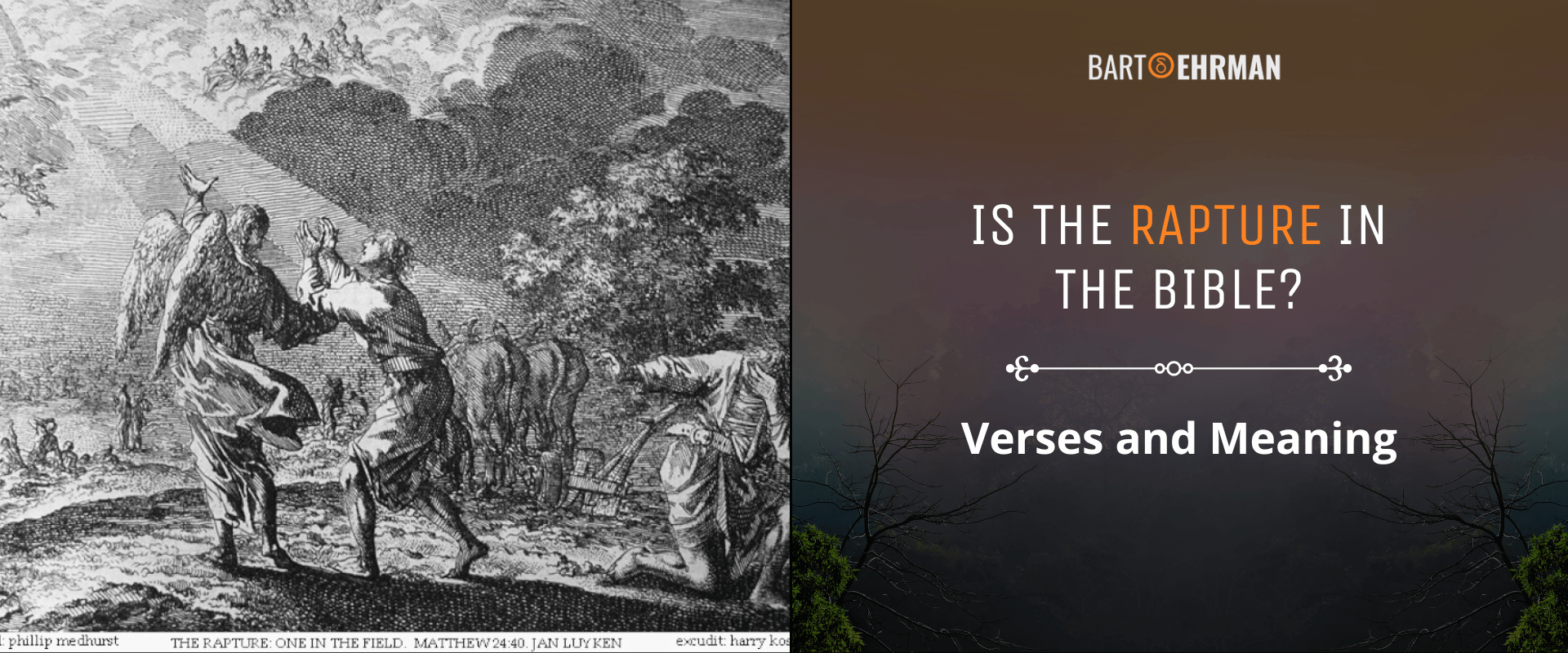
He then describes two men working in a field and two women grinding grain: in each pair, “one is taken and one is left.”
Because the passage speaks of a sudden separation at Christ’s return, Rapture advocates have often interpreted the person who is “taken” as a believer removed from the Earth, while the person left behind remains to face the coming judgment.
R. T. France, in his Commentary on Matthew, however, shows that the main subject of the passage isn’t the removal of the Church. Instead, it’s the unpredictable arrival of the Parousia and the need for constant readiness.
The comparison with Noah emphasizes that ordinary life will continue until judgment arrives suddenly and universally. The examples of people working in the field and at the mill illustrate how individuals who appear to occupy identical circumstances will ultimately meet different fates.
The author of Matthew’s Gospel doesn’t explain where the person is taken, however, or whether being taken represents rescue or punishment. The Greek verb paralambanō can sometimes mean “take to oneself,” but, as France stresses, the word by itself doesn’t determine whether the action is beneficial or destructive.
In fact, the immediate context makes the Rapture interpretation less likely. In the story of Noah, it’s the unprepared who are swept away by the flood, while Noah and his family remain alive.
France therefore considers it more probable that those who are “taken” in verses 40–41 are taken for judgment, whereas those left behind survive the crisis.
At minimum, the passage is too ambiguous to support the elaborate system developed by Darby and his later followers: it says nothing about Christians being taken to heaven, nothing about a seven-year Tribulation, and nothing about a secret return of Christ preceding a later public appearance.
Its central message is instead ethical and pastoral: because no one knows when the Son of Man will come, disciples must live in a state of continuing faithfulness rather than attempt to calculate the sequence of end-time events.

The Rapture in Popular Media and Culture
As I noted in the introduction, living in Croatia meant that the doctrine of the Rapture was never mentioned in the religious education classes I attended or in Croatian religious television programs and series.
It did, however, reach our part of the world, mainly through popular culture imported from the United States.
The most influential example is undoubtedly the “Left Behind” franchise, which began with the 1995 novel by Tim LaHaye and Jerry B. Jenkins, and eventually expanded into a long series of books, films, and related media.
Its story begins with the sudden disappearance of millions of believers, leaving cars without drivers, airplanes without pilots, and families struggling to understand what has happened. The survivors then confront the Tribulation, the rise of the Antichrist, and the final conflict between divine and demonic powers.
Through this dramatic narrative, a specific form of dispensational Rapture theology was presented not as one disputed interpretation among many, but as the expected sequence of future events.
An earlier and equally revealing example is the evangelical movie “A Thief in the Night,” released in 1972.
Ehrman, in his book Armageddon: What the Bible Really Says about the End, recalls the social and psychological effects that the movie had on many young people:
[It was] an unusually low-budget production about what would happen if you were not among those raptured and had to face the terrifying rule of the Antichrist. The movie was meant to scare the hell out of teenagers, and it was massively successful. Everyone I know who was a 1970s evangelical has stories about it, often about the horrible sense that came over them when, one day, they found themselves alone in the house and thought the rapture had just happened but they had missed it.
The movie actually follows a young woman who awakens to discover that the Rapture has occurred and that she has been left behind to face an authoritarian global regime during the Tribulation.
Shown widely in churches, youth groups, and revival meetings, the film used fear, suspense, and the possibility of sudden disappearance to encourage immediate conversion.
Works such as these demonstrate how the Rapture moved beyond theological books and prophecy conferences into mass storytelling.
For many people outside the evangelical communities in which the doctrine was formally taught (including those of us encountering it from predominantly Catholic societies) popular culture provided the first, and sometimes the only, introduction to the idea.
Conclusion
Is the Rapture in the Bible? Most critical scholars would answer that the Rapture as envisioned by John Nelson Darby and developed by his followers isn’t.
The New Testament certainly speaks of Christ’s future coming, the resurrection of the dead, the transformation of living believers, divine judgment, and the final separation of the saved from the lost.
What it doesn’t present is the distinctively dispensational sequence in which Christ secretly removes the Church from the earth before a seven-year Tribulation and then returns publicly a second time to establish an Earthly kingdom.
First Thessalonians 4 describes believers going out to meet the descending Lord; 1 Corinthians 15 concerns bodily resurrection and victory over death; and Matthew 24 warns of the suddenness of judgment and the necessity of faithful readiness.
Only when these passages are extracted from their original literary and historical contexts and reorganized within a much later theological framework do they become evidence for the modern Rapture doctrine.
That framework emerged in the 19th century, spread through evangelical networks and institutions, and acquired enormous cultural influence through works such as “A Thief in the Night” and “Left Behind.”
Is the Rapture biblical? Only in the limited sense that it combines images and concepts found in biblical texts and then reinterprets them.
To put it more bluntly, Rapture theology is better understood as a modern interpretation of the Bible than as a doctrine or belief system explicitly taught by it.
Don't Miss Bart Ehrman's New Webinar:
"Will You Be Left Behind? A History of The Rapture"
50-minute lecture by critically acclaimed Biblical Scholar & 6 NYT best-selling author, Dr. Bart Ehrman, to be turned into an online course