
Who Wrote Exodus?

Written by Joshua Schachterle, Ph.D
Author | Professor | Scholar
Author | Professor | BE Contributor
Verified! See our editorial guidelines
Verified! See our guidelines
Date written: August 1st, 2026
Disclaimer: The views and opinions expressed in this article belong to the author and do not necessarily match my own. - Dr. Bart D. Ehrman
For thousands of years, Jews and Christians have traditionally believed that Moses wrote the book of Exodus, along with the other four books of the Torah. After all, Moses is the central human figure in the story, leading the Israelites out of Egypt and establishing the covenant that would shape Israel's identity. But how can we really know who wrote Exodus?
To answer that question, in this article I’ll explain what the book is, go into the Exodus meaning, provide a summary of the content, clarify why it was traditionally attributed to Moses, and mention what evidence has led modern scholars to propose a very different origin. Who was Exodus’ author? As we’ll see, what is true about the authorship of Exodus is mostly true of the whole Torah.
What Does Exodus Mean?
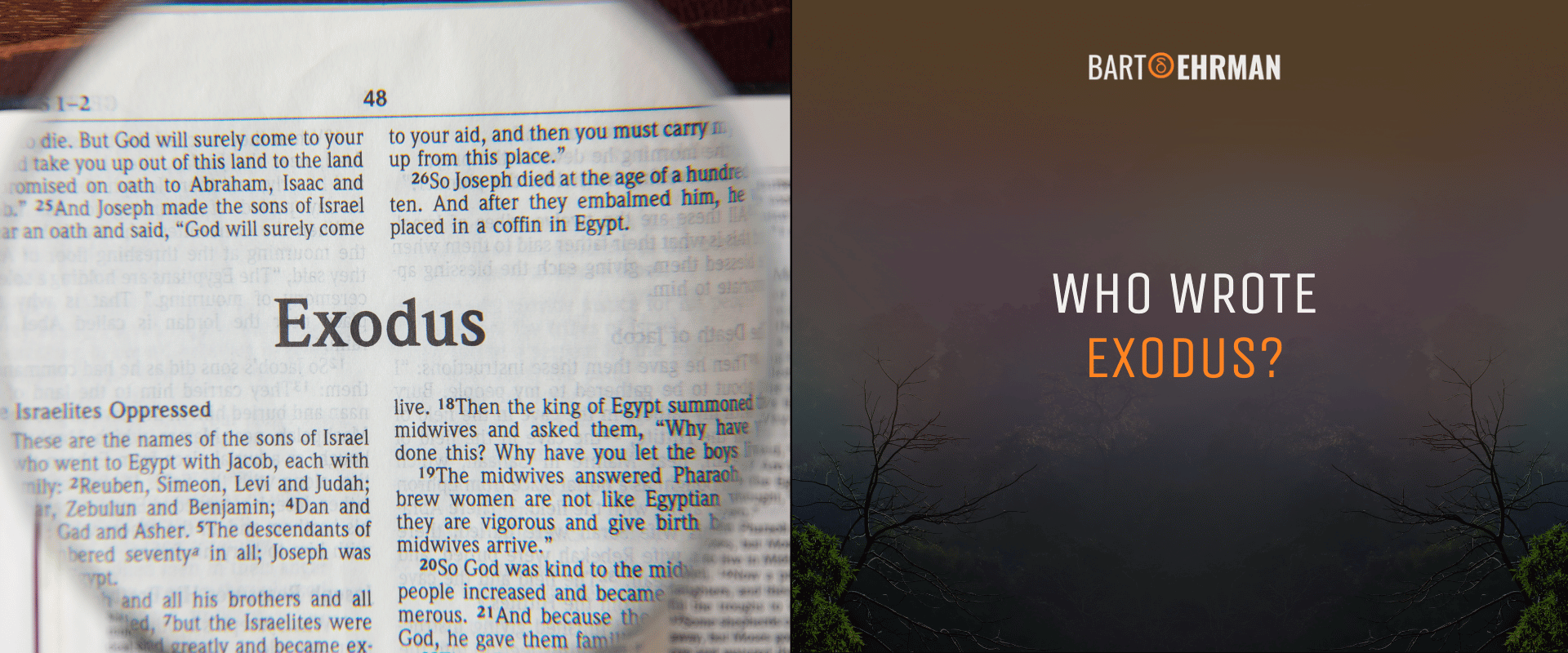
Exodus is the second book of the Hebrew Bible/Old Testament, and is additionally classified as a part of the Torah or Pentateuch (the first five books of the Bible). The word “exodus” comes from the Greek word exodos meaning "going out," since the book’s story revolves around the Israelites leaving Egypt. The Greek word exodos is also sometimes used in ancient Greek writings to mean “a military expedition, a solemn procession, or death." Interestingly, the name of the book in its original Hebrew is Shemot, which means “names” or “these are the names.” This is because, like the other four books of the Torah, it is simply named for the first word or phrase of the book.
The book of Exodus is foundational for the Jewish people and Judaism, introducing themes and characters which have resonated with Jewish people, as well as Christians, for millennia. Traditionally, the book has been attributed to Moses, although most modern scholars don’t believe this anymore (more on this later). In what style is it written? The book can be clearly divided into two principal segments: the departure from Egypt and the Law given on the mountain.
Exodus Part 1: The Departure from Egypt (Chapters 1–19)
The first book of the Bible, Genesis, ends with Jacob’s son, Joseph, having become a powerful governor in Egypt. As such, he asks Jacob and his brothers and their families to come to live the rest of their lives in Egypt. However, generations after Joseph’s death, the Israelites are made slaves by a Pharaoh in Egypt to prevent them from becoming too powerful and taking over. Eventually, a new Pharaoh, fearing their growing population, commands that all newborn Israelite boys be drowned. Nevertheless, one mother hides her baby, Moses, in a basket she sets afloat on the Nile. Pharaoh’s daughter encounters the infant Moses, rescues, and raises him in the Egyptian palace.
As an adult, Moses flees Egypt, but later returns, commanded by God—who was communicating through a burning bush—to free his people. When Pharaoh refuses to let the Israelites go, God sends 10 terrible plagues upon the Egyptians, the last and most severe being the death of all of Egypt's firstborn sons. To protect themselves during this plague, the Hebrews celebrate the first Passover, painting their doorways with lamb’s blood to allow this plague to “pass over” their houses.
With this tragedy, Pharaoh finally lets the Israelites go. Soon after, however, he changes his mind and chases them to the Red Sea. God miraculously parts the water so the Israelites can cross safely, but when the Pharaoh’s troops attempt to follow, the waters again close, destroying the Egyptian army.
Part 2: Law and Tabernacle (Chapters 20–40)
In the second part of Exodus, after wandering in search of the Promised Land God vowed to give them and struggling with hunger and fear, the Israelites reach Mount Sinai. Moses goes up to the top of the mountain to commune directly with God, who invites the Israelite into a special covenant and gives them the Ten Commandments. God also gives Moses instructions on how to build the Tabernacle, a large, portable tent where God’s presence would physically live among his people. When this tent is built, God’s glory fills it, and the book ends.
Why Do People Think It Was Moses Who Wrote Exodus?
It’s impossible to know exactly when and why early Jews and Christians began to credit the idea that Moses had written Exodus (and, indeed, the whole Torah/Pentateuch). However, scholars have made some reasoned speculations based on the evidence we do have.
If you read carefully, you’ll see that several places in the Pentateuch portray Moses writing down specific laws and events as ordered by God (see Exodus 24:4, for instance), although Exodus is probably not history in the modern sense. However, there is no verse in the entire Torah that says that Moses wrote out all five books of the Pentateuch. That conclusion may have been based on an inference that if Moses wrote down God’s laws, he must have written down the rest of the Torah as well.
In addition, other Old Testament books, such as Chronicles, written not very long after the Pentateuch, frequently use the phrase "Law of Moses" or "Book of Moses" (see 2 Chronicles 25:4, for instance). This tradition of identifying the Torah with Moses must have then been passed on into the New Testament period where Jesus (Matt 19:8, Mark 12:26) and the apostle Paul (Rom 10:5) attribute the Torah to Moses.
Lastly, some 1st-century Jewish authors, including the historian Josephus ,wrote that Moses was the author of all the events and laws recorded in the first five books of the Hebrew Bible. The philosopher Philo of Alexandria also held this view. Of course, none of these references prove that Moses wrote Exodus or anything else in the Pentateuch, but they certainly prove that this was the predominant belief for a very long time.
(Affiliate Disclaimer: We may earn commissions on products you purchase through this page at no additional cost to you. Thank you for supporting our site!)
Why Scholars Don’t Believe Moses Wrote Exodus
The first problem in the attempt to confirm Mosaic authorship of Exodus and the rest of the Torah is the absence of evidence that Moses even existed. In What Did the Biblical Writers Know and When Did They Know It?, William Devers notes that the scholarly consensus is that there is insufficient evidence to establish Moses as a historical figure. Additionally, in her commentary on Exodus, Carol Meyers writes that there are no references to Moses in any Egyptian source before the 4th century BCE, centuries after he would have lived. Moreover, no early Egyptian sources mention Moses or the events of Exodus, and there has never been any archaeological evidence found in Egypt to support the entire story of the Israelite Exodus. In other words, outside of the Hebrew Bible tradition, there is no proof Moses ever lived.
However, even if we accepted the historicity of Moses, there are several examples in the Torah that make his authorship of it doubtful at best. First, there are logical inconsistencies. For instance, Deuteronomy 34 describes his death and burial and says no prophet like him ever arose again. How could Moses have first written about his own death and what happened afterwards?
Note, also, that the entire text of Exodus, where Moses is the main character, is written in the third person, not in the first. If Moses was, indeed, the Exodus author, wouldn’t he have used “I” rather than “he” to refer to himself?
Next, the text uses names of places that did not exist during Moses' lifetime. For example, the city of Dan is named in Genesis 14:14, but this city was not captured and renamed Dan until long after Moses died, all but proving that the text was written by someone long after the life of Moses would have occurred.
Finally, the entire Pentateuch text contains competing versions of the same events, such as two different Creation accounts (Genesis 1 and Genesis 2). Most scholars have concluded that these were two competing versions of the Creation story that were sewn together by a later editor, which brings us to the earliest modern theory about how the Exodus and the Torah were composed.
Who Wrote Exodus If It Wasn’t Moses?
Interestingly, Ellen Goodfriend notes that one of the first references to the Torah as five distinct books (as opposed to one whole unit) comes from the abovementioned Philo of Alexandria (25 BCE–50 CE). This is fairly late in the Torah’s history, as most scholars agree that its final form came to be between the 5th and 3rd centuries BCE. A few decades later, we get a similar reference in Against Apion by the historian Josephus:
For we have not an innumerable multitude of books among us . . . but only twenty‑two books… and of them five belong to Moses, which contain his laws and the traditions of the origin of mankind till his death.


On top of that, there are several modern theories on the composition and compilation of the Pentateuch which apply to Exodus as well. Let’s start with the one that started it all.
The Documentary Hypothesis
This theory was first made famous by German scholar Julius Wellhausen in 1876. It argued that, instead of being the product of just one author, Genesis, Exodus, Leviticus, Numbers, and Deuteronomy were assembled from four discrete, related sources. The author (or authors) of each of these documents were given provisional names by Wellhausen:
J (Yahwist): Wellhausen said this source was written in the 10th century BCE in Judah. The J source calls God "Yahweh."
E (Elohist): Composed around the 8th century BCE in Israel. E uses the name "Elohim" for God.
D (Deuteronomist): This source is found mainly in the book of Deuteronomy, written around the 7th century BCE. D’s emphasis is on obedience to the law (that is, the Torah) and having a central temple for worship.
P (Priestly): Composed either during or after the Babylonian exile in the 6th century BCE, P focuses primarily on the correct performance of religious rituals, on genealogies, and on rules for how to behave in the Tabernacle.
While the basic idea of multiple authors of the Torah is still defended by many biblical scholars, several other revisions of Wellhausen’s conclusions have emerged since the 20th century.
NOW AVAILABLE!
Finding Moses: What Scholars Know About The Exodus & The Jewish Law
Riveting and controversial, the "FINDING MOSES" lecture series takes you on a deep dive into the stories of Moses, the exodus, and a whole lot more...
Other Scholarly Theories About Who Wrote the Torah
The Supplementary Hypothesis says that, instead of four separate documents, there was only one central text that was then expanded and updated over many years by later writers and editors. John Van Seters argues for this theory in his book The Pentateuch: A Social-Science Commentary. In other words, there were still many authors, or perhaps just many editors, of the final form of the Torah, including Exodus.
The Fragmentary Hypothesis, on the other hand, expands the number of authors of the Torah even further. It rejects the idea that extended texts like J, E, P, or D ever existed. Instead, it suggests the Pentateuch was created by gathering and weaving together an enormous assortment of much smaller, independent oral stories and fragments. Pauline Viviano espouses this theory in To Each Its Own Meaning, Revised and Expanded: An Introduction to Biblical Criticisms and Their Application.
Finally, there is the Neo-Documentary Hypothesis, a revision of the original Documentary Hypothesis. As Jason Gaines writes in The Poetic Priestly Source, this theory states that the old sources, J, E, D, and P, are still valid but can be differentiated more by plot and continuity rather than the stylistic or linguistic features used to differentiate them in the past.
How Did Followers of Judaism and Christianity Come to Believe Moses Wrote It?
While we can’t know for certain when and why Jews and Christians came to believe that it was Moses who wrote the Torah, there are clues which indicate how it might have happened.
First, the Pentateuch does say that Moses wrote down specific laws and events. For example, Exodus 24:4 says Moses wrote down “all the words of the Lord,” and Deuteronomy 31:9 mentions him writing the law. However, it must be noted that while Moses is said to write down specific things, there is no mention of him writing everything found in the Pentateuch.
Second, we find other Hebrew Bible books, such as Joshua, which was written not long after the last Torah material, referring to "the Law of Moses" or "the Book of Moses,"which seems to be used as a general cipher for this body of work. Third, we have New Testament references to Moses’ authorship. New Testament writers including Paul, and even quotes attributed to Jesus, cite passages from these books and attribute them to Moses.
Finally, the 1st-century Jewish historian Josephus and the 1st-century Jewish philosopher Philo of Alexandria both wrote that Moses was the author of all the events and laws recorded in the Torah. This data doesn’t mean that Moses wrote the material, but it does mean that the belief in Moses’ authorship was widespread.
In Struggling with God: An Introduction to the Pentateuch, Mark McEntire writes that there were three factors influencing the belief in Mosaic authorship of the Torah:
[F]irst… a number of passages in which [Moses] is said to write something, frequently at the command of God, although these passages never appear to apply to the entire five books; second… his key role in four of the five books (Genesis is the exception); and finally… the way in which his authority as lawgiver and liberator of Israel united the story and laws of the Pentateuch.
So Much for the Torah. Who Wrote Exodus?
As you may have gathered, asking who wrote Exodus is very similar to asking who wrote the Torah in general. Religious groups have long attributed them both to Moses, but there are many scholarly theories, at least since the 19th century, about who may have written the Torah. However, in this final section, I’ll look specifically at the authorship of Exodus, to the extent that we can differentiate its authorship from the rest of the Pentateuch.
In his book The Bible: A Historical and Literary Introduction, Bart Ehrman writes that three sources likely wrote the book of Exodus. The first two are J and E which comprise the first half of Exodus. However, Ehrman also notes that, in some cases in the Pentateuch, material from J and E are woven together in such a complicated manner that “it is almost impossible to discern where one source ends and the other begins.” For this reason, many scholars now call the two combined sources “JE” for simplicity’s sake.
The second part of Exodus, including receiving the Law on Sinai and creating the Tabernacle, are the product of the P, or Priestly, source. This makes sense since this source was mostly concerned with the duties and ritual activities of priests in the Israelite community.

Conclusion
Like the other five books of the Torah, the book of Exodus was traditionally believed to have been written by Moses, the great Israelite hero and prophet. However, as modern historical critical scholarship began to be the norm, this attribution was questioned.
The book is made up of two interwoven halves. First, we have the escape, where Moses acts as God’s instrument to free the Israelites from Egyptian slavery. Part two, meanwhile, is the story of the Israelites wandering in the desert, receiving God’s law, and then searching high and low for the land God promised them.
The consensus among modern scholars about who wrote Exodus is that it, like the rest of the Torah, was written by multiple authors, with the first part written by the JE source and the second by the P or priestly source. These two sources were then woven together by later editors.
NOW AVAILABLE!
Finding Moses: What Scholars Know About The Exodus & The Jewish Law
Riveting and controversial, the "FINDING MOSES" lecture series takes you on a deep dive into the stories of Moses, the exodus, and a whole lot more...