
Who Were the Corinthians?

Written by Marko Marina, Ph.D.
Author | Historian
Author | Historian | BE Contributor
Verified! See our guidelines
Verified! See our editorial guidelines
Date written: July 7th, 2026
Disclaimer: The views and opinions expressed in this article belong to the author and do not necessarily match my own. - Dr. Bart D. Ehrman
Who were the Corinthians? The question takes us back to the earliest stages of the Jesus movement, long before Christianity had become a world religion, long before it possessed settled creeds, church buildings, imperial patronage, or the institutional structures that later generations would come to associate with “the Church.”
In Paul’s day, the movement was still small, fragile, and experimental: a network of communities scattered across the eastern Mediterranean, united by the conviction that God had raised Jesus from the dead, yet still struggling to determine what that conviction meant in practice.
These early Jesus-followers didn’t all look alike, think alike, or organize their lives in identical ways. From the beginning, the Jesus movement was marked by diversity, debate, and disagreement, which sometimes resulted in church problems.
Few communities reveal that reality more vividly than the believers in Corinth. Through Paul’s letters to them, we catch a rare glimpse of an early Christian group trying to work out its identity in real time.
The Corinthians weren’t representatives of “early Christianity.” Rather, they were people living in a specific city, shaped by its social pressures, economic opportunities, religious traditions, and public values.
To understand who they were, we need to begin not with later Christian assumptions, but with the world they inhabited: the city of Corinth, Paul’s relationship with its Jesus-following community, and the historical circumstances that led him to write some of the most fascinating letters in the New Testament and resulted in him being the one who wrote Corinthians.
Corinth in the Ancient World: A Roman City with a Greek Past
In his book Einleitung in das Neue Testament (Introduction to the New Testament), Udo Schnelle notes:
(Affiliate Disclaimer: We may earn commissions on products you purchase through this page at no additional cost to you. Thank you for supporting our site!)
“In 44 B.C.E. Caesar refounded Corinth, which had been destroyed in 146 B.C.E. but had by no means been uninhabited in the meantime, as a Roman colony for veterans. In 27 B.C.E. Corinth then became the capital of the senatorial province of Achaia. Alongside a strong Roman element, the Greek and eastern component of the population must have been substantial. Philo attests a noteworthy Jewish colony in Corinth, and Acts 18:4 reports the existence of a synagogue. The city’s special location, with the two harbors of Cenchreae and Lechaeum, explains Corinth’s significance as an economic center between Asia and Rome/Greece. Corinth was regarded as a wealthy city, in which trade, financial transactions, and artisanal production flourished.” (my translation)


 pop Quiz!
What happened when christianity's two biggest apostles went head to head?
Paul openly rebuked Peter in Galatians and took swipes at the Jerusalem leaders as “super-apostles” who “added nothing” to his message. Later Christian writings from outside the Bible indicate an even deeper rift between Paul and Peter, so why does Acts paint them as best friends? Join Dr. Bart Ehrman to explore the evidence of rivalry and conflict in this free two-lesson course, "Did Peter Hate Paul?"
100% free, no credit card required or upsells... promise!
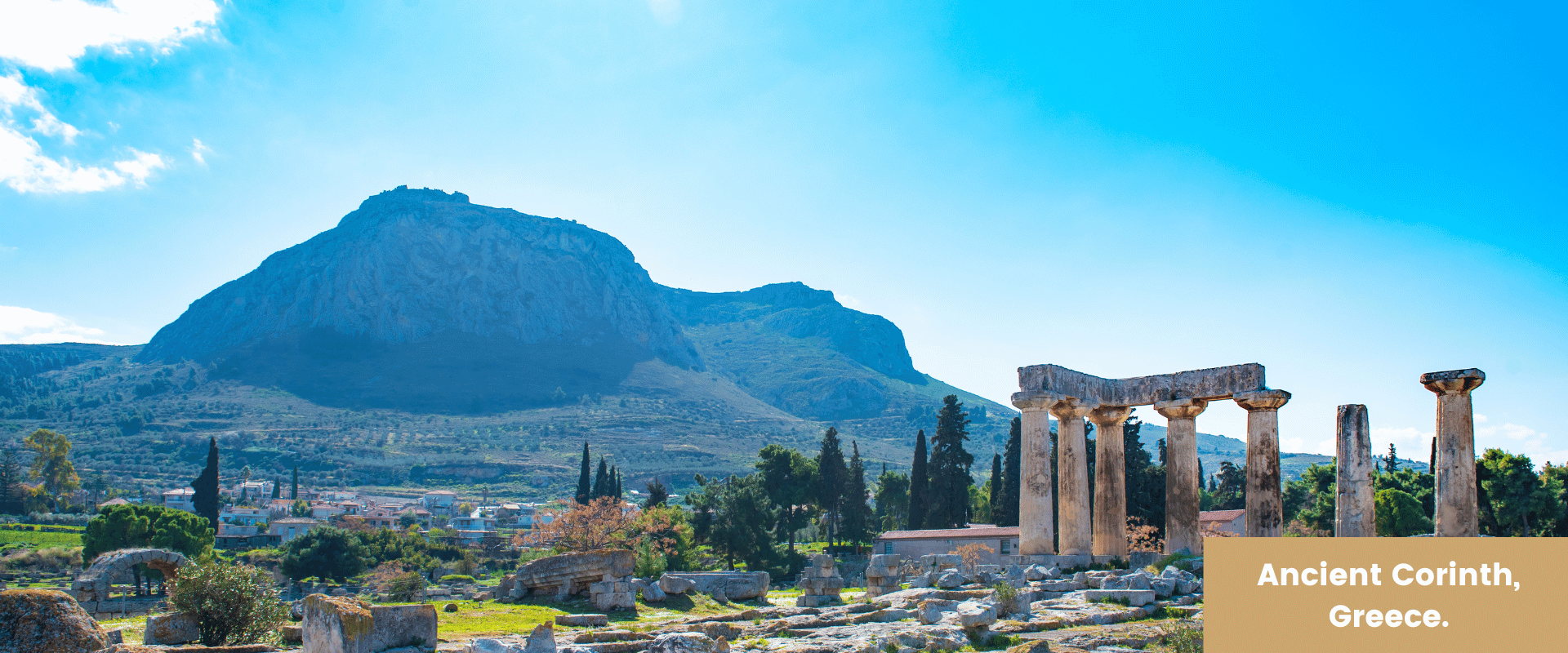
Corinth, then, wasn’t a small or insignificant town when the first followers of Jesus emerged there. Far from it. It was one of the most important cities of the eastern Mediterranean, a place where goods, people, languages, customs, and religious traditions constantly intersected. Its importance was rooted first of all in geography.
The city lay near the narrow Isthmus of Corinth, the land bridge connecting central Greece with the Peloponnese. Anyone traveling by land between these regions could hardly avoid passing near Corinth.
Even more importantly, two harbors (Cenchreae to the east and Lechaeum to the north-west) that Schnelle mentioned opened the city towards Saronic Gulf, the Aegean, Asia Minor, Gulf of Corinth, the Adriatic, and Italy!
This position made Corinth a city “between worlds.” As Joseph A. Fitzmyer notes, ancient writers were well aware of this advantage and even spoke of “bimaris Corinthus”, “Corinth on two seas.”
Its two-harbor system made it a natural commercial hub, especially because ships and cargo could avoid the dangerous voyage around the southern capes of the Peloponnese.
The famous diolkos, a paved trackway across the isthmus, allowed smaller boats or cargo to be transported overland from one gulf to the other. In practical terms, this meant that Corinth was not merely a local Greek city. It was tied into the larger economic and social networks of the Roman Mediterranean.
Yet the Corinth Paul knew was also a city with a complicated past. Ancient Corinth had been one of the great cities of Ancient Greece, famous for its wealth, pottery, naval power, and political significance.
But in 146 B.C.E., after conflict with Rome, the city was defeated, sacked, and largely destroyed by the Roman general Lucius Mummius.
As mentioned, more than a century later, Julius Caesar refounded it as a Roman colony. This is crucial for understanding the Corinthian Christians. Paul’s Corinth wasn’t simply the old Greek city continuing unchanged. It was Roman Corinth: a colonial city with Roman law, Roman institutions, Roman public architecture, and a strong Roman civic identity, even though its population remained culturally mixed.
By the middle of the 1st century C.E., Corinth had become the capital of the Roman province of Achaia and the seat of the Roman proconsul.
Its public life centered on the forum, temples, shops, administrative buildings, fountains, and the judicial platform known as the bēma. It was a city of trade and administration, but also of public status, civic honor, religious plurality, and social competition.
This is the world in which Paul’s Corinthian converts lived. They didn’t join the Jesus movement in a vacuum. They brought with them the assumptions, ambitions, tensions, and habits of a bustling Roman city.
And that helps explain why Paul’s correspondence with them became so intense, so revealing, and so historically valuable. To see that more clearly, we now need to turn from Corinth itself to the Jesus-following community that took shape within it.
Who Were the Corinthians? Exploring the Origins of Christianity in Corinth
In the book Introduction au Nouveau Testament (Introduction to the New Testament), François Vouga notes:
“Almost the entire content of 1 Corinthians is determined by direct questions from the Corinthians or by news that the apostle had received from Corinth. Paul sometimes indicates the source of his information, as in 1 Cor. 1:11. In other cases, he merely cites the statements that have been reported to him (11:18; 15:12). The first reports mentioned come from ‘Chloe’s people,’ probably traveling on business, who inform Paul about the conflicts and rivalries dividing the church. On the basis of the information contained in the letter, the following elements can be reconstructed: several cliques had formed, each claiming the authority of one of the apostles who had been directly or indirectly present in Corinth. One faction attached itself to Apollos, another seems to have attached itself to Cephas (although there is no trace of Peter having passed through Corinth), and a third remained loyal to Paul, the founder of the community.” (my translation)
While the exact depth and causes of these divisions are beyond the scope of this article, and have been meticulously studied by several well-known scholars, they lead us back to the question at the heart of our inquiry: Who were the Corinthians?
It’s tempting to read 1 Corinthians simply as a list of problems and then ask what were the Corinthians doing wrong.
But historically, the more basic question comes first: what kind of community produced these problems? What was the social structure of the earliest Christ-following group in Corinth, and why did its internal tensions take the forms they did?
This is where the work of Gerd Theissen remains important.
While I am fairly critical of Theissen’s broader methodological framework and especially of his strong division between Semitic and Hellenistic elements in reconstructing the rise of primitive Christianity, his study of the social structure of the Corinthian Christians is still one of the most well-known and respected analyses of this community.
Theissen’s key argument is that the Corinthian congregation was socially stratified. It wasn’t simply a gathering of the poor, nor was it an elite philosophical association.
Rather, it included a majority of people from lower or modest social strata alongside a smaller number of wealthier, better-connected, and more influential members.
Paul’s own language points in this direction. In 1 Corinthians 1:26, he reminds the Corinthians that “not many” among them were wise by ordinary standards, powerful, or of noble birth. The phrase is crucial. Paul does not say “none.” He says “not many.”
That implies that some members of the community did have education, influence, public status, or social prestige.
At the same time, the passage also suggests that most members didn’t belong to the upper ranks of Corinthian society. The Corinthians, then, were a mixed urban group, internally unequal and socially diverse.
Other details suggest the same. Crispus, whom Acts describes as a synagogue ruler, likely held a position of some local significance. Gaius appears to have had a house large enough to host Paul and “the whole church.”
Stephanas and his household seem to have provided important service to the community. Erastus, mentioned in Romans 16:23 as connected with the city’s financial administration, may also have belonged to the more prominent social level of Corinthian life, although the precise meaning of his office remains debated.
These figures shouldn’t make us imagine the whole congregation as wealthy. Rather, they show that some prominent members had houses, resources, mobility, and influence, while many others almost certainly did not—as it was the case in the broader Roman society at the time!
Thus, Vouga concludes:
“Sociological analyses undertaken to reconstruct the composition of Pauline Christianity in Corinth, which rely to a large extent on the data in Acts, converge in their descriptions: the church was made up of representatives from a broad social spectrum, with ordinary people – small artisans, small merchants, and slaves – forming the majority, and a minority of influential figures from the city carrying particular weight within the community.” (my translation)
This social mixture helps us understand why Paul’s letters to Corinth are so vivid. The community’s conflicts weren’t merely abstract theological disagreements. They were shaped by the everyday realities of a Roman city: status, honor, patronage, education, public speech, wealth, poverty, meals, households, and competing forms of authority.
The Corinthians were trying to live as followers of Jesus, but they were doing so within the habits and pressures of Corinthian urban life. That is why Paul had to write to them. And when did he write to them? To that question, we now turn!
Paul, Corinth, and the Chronology of the Corinthian Letters
Now that we have seen who the Corinthians were, at least from the perspective of their social background, we can ask where Paul’s letters to them fit within his wider missionary activity.
This question isn’t as simple as it may first appear. Paul didn’t leave us an autobiography, and his letters were not written to provide later historians with a neat timeline of his life. They were occasional writings, addressed to specific communities facing specific problems.
To reconstruct Paul’s movements, scholars must combine what Paul says in his own letters with the narrative found elsewhere in the Bible, in the Acts of the Apostles. Acts is indispensable, but it’s also a theological and literary narrative, not a modern historical biography. For that reason, the chronology of Paul’s life can be established only with caution.
Still, Corinth gives historians one of the most important chronological anchors in Paul’s career. According to Acts, Paul came to Corinth after traveling through Macedonia and Achaia, including Philippi, Thessalonica, Beroea, and Athens.
This took place during what is usually called his second missionary journey. In Corinth, Paul encountered Aquila and Priscilla, Jewish artisans who had come from Italy after the emperor Claudius ordered Jews to leave Rome.
Paul stayed with them and worked alongside them, while also preaching in the synagogue and eventually helping to establish the Corinthian community. Acts says that he remained in Corinth for eighteen months, teaching among them.
The key episode comes near the end of that first stay. Acts reports that Paul was brought before Gallio, the Roman proconsul of Achaia, at the judicial platform known as the bēma. This matters because Gallio is known not only from Acts but also from an inscription found at Delphi.
As Fitzmyer explains, this link between Gallio and wider Roman history makes the Corinthian episode one of the strongest chronological fixed points in Paul’s life.
Depending on how one reconstructs the evidence, Paul’s appearance before Gallio is usually placed around the early 50s C.E., with Fitzmyer favoring late spring, summer, or early autumn of 52 C.E.
This suggests that Paul’s first substantial contact with Corinth belongs roughly to the years 51–52 CE.
The letters themselves came later. After leaving Corinth, Paul eventually spent a substantial period in Ephesus, one of the great cities of Roman Asia.
From there, reports reached him about serious tensions in the Corinthian community: divisions, scandals, disputes, and resistance to Paul’s own authority. It was from Ephesus that Paul wrote what we now call 1 Corinthians, probably sometime in the mid-50s C.E., perhaps in 55 or late 56 C.E.
The letter wasn’t Paul’s first communication with the Corinthians. In 1 Corinthians 5:9, he refers to an earlier letter in which he had apparently instructed them not to keep company with sexually immoral people, a letter that has not survived.
This reminds us that the New Testament preserves only part of Paul’s correspondence with this community.
But the situation didn’t end with 1 Corinthians. Paul’s relationship with the Corinthian believers appears to have worsened, leading to what he later calls a “painful visit” and then to another severe letter written “with many tears.”
That letter too is no longer extant, unless some part of it has been preserved within what we now call 2 Corinthians, a possibility many scholars have considered.
Eventually, Titus brought Paul more encouraging news, and Paul wrote at least part of 2 Corinthians from Macedonia, probably in the autumn of the same general period, around 57 C.E.
Later still, Paul returned to Corinth and likely spent the winter of 57–58 there, during which he probably wrote his Letter to the Romans.
In other words, Corinth wasn’t a minor stop in Paul’s mission. It was one of the central places where his work, conflicts, theology, and pastoral strategy came sharply into focus.
DID PAUL AND JESUS HAVE THE SAME RELIGION?
Jesus taught a message of repentance to prepare for the Kingdom of God while Paul taught faith in Jesus. Did they agree? Should they be considered the “co-founders” of Christianity?
Appendix: What Became of the Corinthian Church?
What became of the Corinthian church? The honest historical answer is that we can trace it only in fragments.
Paul’s letters show the community in the 50s C.E., still unstable, divided, and negotiating its identity. Later evidence suggests that the church didn’t disappear.
Near the end of the 1st century, the church of Rome addressed a letter to the Corinthians, known as 1 Clement, which shows that the Corinthian community was still active but still troubled by disputes over leadership and order.
In the 2nd century, Corinth remained an important Christian center: Dionysius, bishop of Corinth, corresponded with other churches and was remembered by Eusebius as an influential ecclesiastical figure.
What we see, then, isn’t a simple story of failure or triumph. The Corinthian church survived, developed structures of leadership, and became part of wider networks of communication among early Christian communities.
In that sense, if someone asks, “Who are they today?” the answer isn’t that Paul’s Corinthians survive as a distinct, traceable ethnic or social group.
Rather, the ancient Corinthian church became part of the wider history of Christianity in Greece, while the modern city of Corinth remains a place where the memory of Paul’s mission and his letters continues to shape Christian imagination, pilgrimage, and interpretation.
Yet the later evidence also suggests continuity with the issues we see already in Paul: authority, unity, discipline, and the difficult process of turning a small urban Jesus-following group into a more stable Christian institution.
Conclusion
Who were the Corinthians? They were members of one of the earliest Jesus-following communities in the Roman Mediterranean: socially diverse, internally divided, and deeply shaped by the city in which they lived.
They weren’t later Christians with settled doctrines, church buildings, or centuries of tradition behind them.
What were the Corinthians known for? They were urban men and women trying to understand what faith in the risen Jesus meant in the concrete realities of Corinthian life: status, wealth, poverty, meals, public honor, household networks, religious plurality, and competing claims to authority.
That is why Paul’s letters to them remain so historically valuable. They reveal Christianity as a movement still being formed through argument, correction, negotiation, and communal struggle.
Finally, the Corinthians were not simply Paul’s “problem church.” They were a window into the earliest decades of the Jesus movement, when new convictions about Jesus and salvation had to be lived out in the ordinary, complicated, and often messy world of a Roman city.
DID PAUL AND JESUS HAVE THE SAME RELIGION?
Jesus taught a message of repentance to prepare for the Kingdom of God while Paul taught faith in Jesus. Did they agree? Should they be considered the “co-founders” of Christianity?