
Remember the Sabbath Day (Meaning of Keeping it Holy)

Written by Marko Marina, Ph.D.
Author | Historian
Author | Historian | BE Contributor
Verified! See our guidelines
Verified! See our editorial guidelines
Date written: April 2nd, 2026
Disclaimer: The views and opinions expressed in this article belong to the author and do not necessarily match my own. - Dr. Bart D. Ehrman
“Remember the Sabbath day, to keep it holy,” says one of the 10 Commandments in the Bible. Despite its prominence within the Decalogue, this commandment is often overlooked, or at least interpreted in ways that differ significantly from its original context.
I was reminded of this some years ago in a conversation with a couple of Seventh-day Adventists, a Christian group that continues to observe the Sabbath on Saturday.
They argued that most Christians have, in effect, abandoned one of God’s core commandments. While their position wasn’t unfamiliar to me, the discussion itself turned into a thoughtful and mutually respectful exchange about the historical relationship between Judaism, early Christianity, and the Hebrew Bible.
It raised a broader question that extends well beyond any single denomination: what did it actually mean, in its original setting, to “keep the Sabbath holy”?
In this article, we’ll approach that question from a historical perspective. Rather than asking how the Commandment should be observed today, we’ll explore how it functioned within ancient Judaism, how it was interpreted in the time of Jesus, and how what it meant to keep the Sabbath shifted as Christianity emerged as a distinct religious movement.
By tracing these developments across different historical contexts, we can better understand how a commandment that once stood at the center of religious life came to be practiced (or reinterpreted) in markedly different ways.
But before we begin, are you perhaps curious how scholars approach the origins of biblical law and figures like Moses? Check out Finding Moses: What Scholars Know About the Exodus and the Jewish Law, an 8-lecture online course by renowned scholar and bestselling author Bart D. Ehrman.
Remember the Sabbath Day to Keep It Holy: Historical Background
In his Introduction to the Hebrew Bible, John J. Collins provides a useful framework for situating the Decalogue within the broader legal and literary traditions of the Hebrew Bible:
(Affiliate Disclaimer: We may earn commissions on products you purchase through this page at no additional cost to you. Thank you for supporting our site!)
The Ten Commandments as found in Exodus 20 are usually attributed to the E source of the Pentateuch. Another series of laws in Exod 34:11–26 is called ‘the Yahwist Decalogue,’ although it is clearly not a decalogue. It is now judged to be a late redactional text. The closest parallel to Exodus 20 is found in Deut 5:6–21. Other lists of commandments that partially overlap the Decalogue are found in Lev 19:1–18 and Deut 27:15–26. The requirements of the covenant are said to be ‘ten words’ in Exod 34:28; Deut 4:13; 10:4.


This observation immediately signals that what later tradition would treat as a fixed and unified set of commandments was, in its earliest literary and historical context, embedded within a more fluid and evolving body of covenantal instruction.
Therefore, the fourth Commandment (“Remember the Sabbath day to keep it holy”) appears twice in the Old Testament, most prominently in Exodus 20 and Deuteronomy 5, even though other lists of commandments and covenantal stipulations also circulated in ancient Israel.
These parallel formulations aren’t merely repetitions. Instead, they offer distinct interpretive perspectives that illuminate how the meaning of the Sabbath was already being shaped and reframed within the biblical tradition itself.
To understand what it meant to “keep it holy,” one must therefore attend carefully to the specific literary and theological contexts in which the Commandment appears.
In the version found in Exodus, the Commandment is embedded within a broader presentation of the Decalogue that functions less as a legal code and more as a foundational statement of communal identity.
As Carol Meyers explains, the Commandments are best understood as apodictic, absolute norms that articulate the basic contours of Israel’s covenantal life.
Within this framework, the Sabbath commandment stands out for its length and complexity: it combines a positive injunction (“remember” and “keep it holy”) with a detailed prohibition of labor that extends beyond the household head to include children, servants, and even animals.
The rationale given in Exodus (God’s rest after creation) grounds the practice in a cosmic pattern, but the Commandment itself is strikingly non-cultic. It doesn’t prescribe ritual acts or sacrifices.
Rather, it organizes social time by instituting a regular cessation of work. In this sense, “holiness” is applied to a recurring unit of time, marking the Sabbath as a distinctive temporal expression of Israel’s covenant with its God.
The formulation in Deuteronomy, while clearly dependent on the earlier tradition, reinterprets the fourth Commandment in a significant way.
Here, the emphasis shifts from creation to history: Israel is to observe the Sabbath in remembrance of its former slavery in Egypt and its subsequent liberation.
As Moshe Weinfeld has argued, this doesn’t imply that the Sabbath originated with the Exodus. Instead, the memory of oppression becomes the ethical motivation for its observance. The commandment thus acquires a pronounced social dimension, underscoring the obligation to grant rest to all members of the household, especially those in subordinate positions.
At the same time, Deuteronomy prefers the language of “observing” or “keeping” the Sabbath, reflecting a concern with proper legal practice, while still maintaining its fundamentally theocentric character as “a Sabbath to the Lord your God.” The result is a nuanced synthesis in which divine command, historical memory, and social responsibility converge.
Taken together, these two formulations reveal that the meaning of the Sabbath was neither static nor monolithic within ancient Israel.
Even within the Hebrew Bible, it could be grounded in creation or in liberation, framed as an expression of divine order or as an ethical obligation toward others. This internal diversity cautions against any overly simplistic reading of the commandment and instead points to an ongoing process of interpretation in which inherited traditions were adapted to new theological and social concerns.
As Collins further observes,
The weekly day of rest would become a distinctive characteristic of Judaism and a subject of mockery among some pagans in antiquity who thought it a sign of laziness. The origin of the custom is unknown. In ancient Babylon, the Akkadian word shappatu designated the middle day of the month, the festival of the full moon. The Sabbath is associated with the festival of the new moon in Amos 8:5 and Isa 1:13. It may be that the Sabbath was originally linked to the waxing and waning of the moon, but in the Bible it is independent of the lunar calendar.
What emerges, then, is a practice that, whatever its distant origins, came to function in the biblical tradition as a regular, weekly institution; one that structured time, expressed covenantal identity, and set Israel apart within the religious landscape of the ancient world.
By the Second Temple period, the Sabbath had become one of the most visible and widely recognized markers of Jewish identity, but it wasn’t observed in a single, uniform way.
Different Jewish groups (whether associated with emerging Pharisaic traditions, priestly circles, or sectarian communities such as those reflected in the Dead Sea Scrolls) debated what precisely constituted “work” and how strictly the Commandment should be enforced.
These interpretive differences didn’t undermine the centrality of the Sabbath. Instead, they highlight the dynamic and contested nature of Jewish legal and religious life in this period. It’s precisely within this diverse and vibrant context that the debates about the Sabbath found in the Gospels (and the views attributed to Jesus) are best understood.
Honor the Sabbath: Historical Jesus and the Fourth Commandment
The Gospels portray Jesus as engaging in a number of disputes with other Jewish groups, most notably the Pharisees, and several of these revolve around the observance of the Sabbath.
One well-known episode describes Jesus’ disciples plucking heads of grain on the Sabbath, prompting criticism that they are doing what is not permitted on that day (e.g., Mark 2:23–28).
In another instance, Jesus heals a man with a withered hand in a synagogue on the Sabbath, raising the question of whether acts of healing constitute forbidden “work” (e.g, Mark 3:1–6).
These narratives present Jesus as someone who, at the very least, challenged prevailing interpretations of what it meant to “remember the sabbath day to keep it holy,” especially when issues of human need and well-being were at stake.
But do these stories mean that Jesus was fundamentally opposed to the Sabbath itself? Was he, in effect, advocating the abolition of the fourth Commandment?
At first glance, such a conclusion might seem plausible, particularly if the Gospel accounts are read as straightforward reports of direct and sustained conflict between Jesus and other Jewish authorities.
Yet this impression begins to dissolve once we approach these traditions through the lens of historical-critical scholarship.
With the rise of modern historical Jesus studies, scholars have increasingly emphasized Jesus’ Jewish identity and the importance of situating him within the diverse landscape of Second Temple Judaism.
From this perspective, it becomes difficult to identify any clear instance in the Gospel traditions where Jesus explicitly violates the Sabbath laws as articulated in the Hebrew Scriptures.
Rather, in nearly every case, the point of tension lies not in the rejection of the Commandment itself, but in differing interpretations of how it should be observed.
Jesus heals on the Sabbath, but healing doesn’t necessarily constitute “work” in a legal sense; his disciples pluck grain, but the extent to which this action violated Sabbath restrictions depends on how those restrictions were defined in the first place.
In other words, the debates reflected in the Gospels are best understood as intra-Jewish disagreements over interpretation rather than as evidence of a wholesale rejection of the law.
This line of interpretation has been articulated with particular clarity by E. P. Sanders in his influential study Jesus and Judaism.
Sanders argues that the prominence of Sabbath controversies in the Gospels likely reflects the concerns of later Christian communities (especially those including Gentiles) rather than the central focus of Jesus’ own activity.
As he notes, issues such as Sabbath observance and dietary practice would have been relatively uncontroversial within a Jewish setting but became pressing questions in the early church.
Moreover, Sanders points out that many of the Gospel conflict stories bear signs of literary shaping and may not preserve direct historical encounters in a straightforward way. For example, the idea of Pharisees actively seeking out Sabbath violations in Galilean fields appears historically implausible.
Perhaps most importantly, Sanders concludes that even if one accepts these stories at face value, they do not actually demonstrate that Jesus transgressed the Sabbath law.
In the healing accounts, no form of labor that would clearly violate biblical prohibitions is described, and in disputes about handwashing or food, the issues at stake often concern practices that weren’t universally required within Judaism.
Consequently, Sanders argues that we shouldn’t speak of Jesus as opposing or rejecting the law. Instead, he exercised a certain interpretive freedom within it, shaped by his conviction that the kingdom of God was at hand.
Seen in this light, Jesus’ engagement with the Sabbath appears less as a repudiation of the fourth Commandment than as a participation in ongoing Jewish debates about its meaning and proper application.
His statements and actions suggest a concern to align Sabbath observance with human well-being and divine intention, rather than to abolish it altogether.
This more nuanced historical perspective not only clarifies Jesus’ own position but also sets the stage for a further question: if Jesus did not reject the Sabbath, how and why did early Christians come to reinterpret (or even replace) it in the centuries that followed?
NOW AVAILABLE!
Finding Moses: What Scholars Know About The Exodus & The Jewish Law
Riveting and controversial, the "FINDING MOSES" lecture series takes you on a deep dive into the stories of Moses, the exodus, and a whole lot more...
From Remember the Sabbath to Sunday: Early Christian Reinterpretation
In his book From Sabbath to Sunday, Samuele Bacchiocchi notes:
The specific choice of Sunday as the new Christian day of worship in contradistinction to the Jewish Sabbath was suggested, however, not by anti-Judaism but by other factors. It appears that anti-Judaism caused a devaluation and repudiation of the Sabbath, thus creating the necessity to seek for a new day of worship; but we found the reasons for the specific choice of Sunday elsewhere. The diffusion of the Sun-cults, which early in the second century caused the advancement of the day of the Sun to the position of first day of the week (the position held previously by the day of Saturn), oriented especially Christian converts from paganism toward the day of the Sun.
Whether or not one accepts all the arguments and conclusions Bacchiocchi advances, this formulation at least underscores a point widely recognized in scholarship: the transition from Sabbath observance to Sunday was neither linear, simple, nor instantaneous, but unfolded through a complex interaction of theological, social, and cultural developments.
To begin with, the earliest followers of Jesus didn’t immediately abandon the Sabbath. As a movement that emerged within Judaism, early Christianity initially shared in Jewish patterns of worship, including Sabbath observance.
Even the New Testament preserves traces of this continuity, with Jesus’ followers participating in synagogue life and maintaining inherited practices.
At the same time, however, new theological emphases (above all the belief that Jesus had been raised from the dead on the “first day of the week”) gradually conferred a special significance on Sunday.
Importantly, this didn’t at first constitute a replacement of the Sabbath. Instead, it introduced an additional temporal marker alongside existing practices.
The evidence from the 1st and early 2nd centuries suggests a period of overlap and diversity rather than uniform change.
Some Christian communities, particularly those with strong Jewish roots, likely continued to observe the Sabbath, while also gathering on the first day of the week for communal meals or commemorative purposes.
Moreover, New Testament passages sometimes cited as proof of early Sunday worship (such as Acts 20:7 or 1 Corinthians 16:2) are better understood as reflecting particular circumstances rather than establishing a universal norm.
In this respect, caution is warranted: the sources indicate emerging tendencies, not yet a settled or empire-wide pattern of Sunday observance.
As Christianity spread more widely among Gentile populations, especially in urban centers like Rome, the situation began to shift more decisively.
In these contexts, the social and political costs of maintaining practices strongly associated with Judaism (particularly after the two Jewish revolts against the Roman Empire) may have encouraged some Christians to distance themselves from Sabbath observance.
At the same time, Sunday could be invested with new symbolic meaning, interpreted as the day of resurrection and, in some theological reflections, as the beginning of a “new creation.”
While Bacchiocchi places considerable weight on the influence of solar cults, most scholars (myself included) would treat this as one possible contributing factor among others rather than as a primary cause.
By the 2nd and 3rd centuries, we can observe more explicit attempts in certain Christian circles to redefine sacred time. In some regions (especially in the Latin West) the Sabbath could even be reinterpreted negatively, while Sunday increasingly functioned as the primary day for communal worship and Eucharistic celebration.
Texts such as the Epistle of Barnabas, but also authors such as Ignatius of Antioch, and Justin Martyr recast the Sabbath as either symbolic, obsolete, or specifically Jewish, thereby distancing emerging Christian identity from traditional Jewish timekeeping.
Yet even here, the process was uneven, and not all Christian groups moved in the same direction at the same pace.
The transition from Sabbath to Sunday, therefore, is best understood not as a single decisive break, but as a gradual reconfiguration of religious practice, shaped by theological reflection, communal identity, and the broader cultural environment of the Roman world.
Appendix: The Sabbath Day Commandment in Various Bible Versions
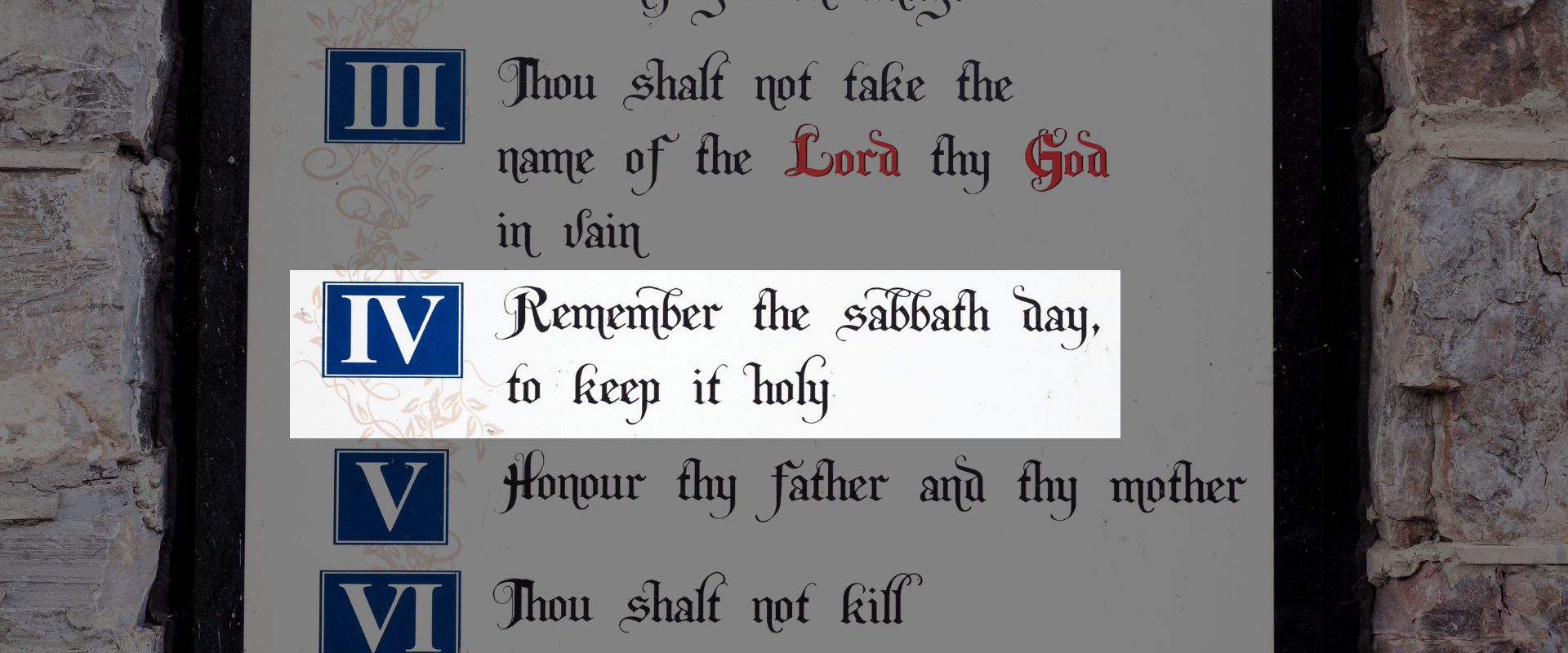
To appreciate how the fourth Commandment (“Remember the Sabbath day to keep it holy”) has been transmitted and rendered across time, it’s helpful to compare how several widely used English Bible translations phrase it.
The table below presents five common versions, illustrating both continuity and subtle variation in wording.
Translation | Exodus 20:8 |
|---|---|
KJV (King James Version) | “Remember the Sabbath day, to keep it holy.” |
NRSV (New Revised Standard Version) | “Remember the Sabbath day, and keep it holy.” |
NIV (New International Version) | “Remember the Sabbath day by keeping it holy.” |
ESV (English Standard Version) | “Remember the Sabbath day, to keep it holy.” |
NASB (New American Standard Bible) | “Remember the Sabbath day, to keep it holy.” |
Conclusion
In retrospect, my conversation with those Seventh-day Adventists was asking a question far more historically complex than it might initially appear. Were Christians mistaken to move away from the Sabbath?
From a strictly historical perspective, the answer is less about “mistakes” and more about development.
As we have seen, the command to “remember the Sabbath day to keep it holy” emerged within ancient Israel as a foundational expression of covenantal identity, was debated and reinterpreted within diverse forms of Second Temple Judaism, and was engaged by Jesus not as something to abolish but as something to be understood and applied within the broader framework of Jewish law and life.
The eventual shift toward Sunday observance, therefore, did represent a gradual and uneven transformation shaped by new theological convictions, changing social realities, and evolving communal identities.
What began as a shared Jewish practice became, over time, a point of differentiation within emerging Christianity. Seen in this light, the history of the Sabbath isn’t a story of loss or replacement alone, but of reinterpretation.
It’s a story that reminds us that even the most central religious commandments are lived, contested, and reshaped within the flow of history. Perhaps that is why I find myself so drawn to the study of religions.
NOW AVAILABLE!
Finding Moses: What Scholars Know About The Exodus & The Jewish Law
Riveting and controversial, the "FINDING MOSES" lecture series takes you on a deep dive into the stories of Moses, the exodus, and a whole lot more...