
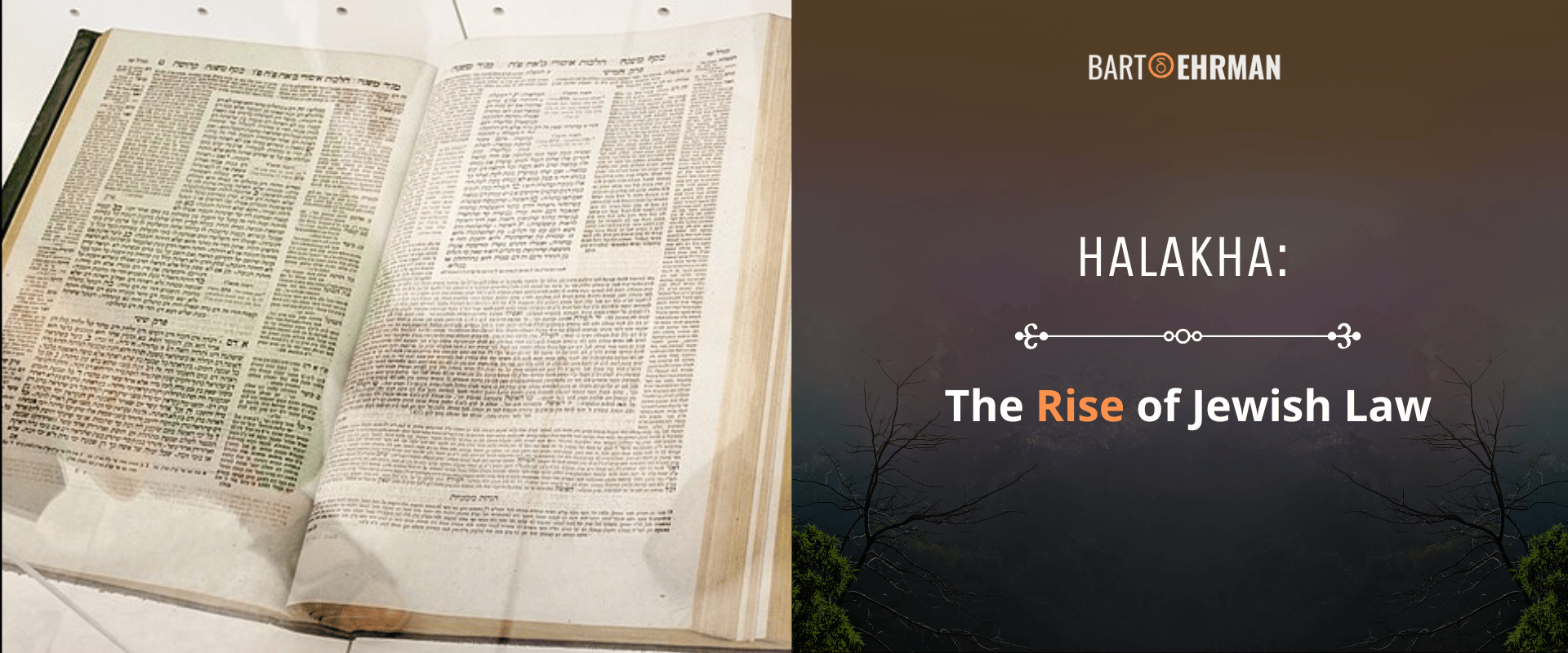
Halakha: The Rise of Jewish Law

Written by Marko Marina, Ph.D.
Author | Historian
Author | Historian | BE Contributor
Verified! See our guidelines
Verified! See our editorial guidelines
Date written: March 18th, 2026
Disclaimer: The views and opinions expressed in this article belong to the author and do not necessarily match my own. - Dr. Bart D. Ehrman
Do you know what Halakhah is? A recent conversation with my brother about religious laws (about whether religion ultimately controls people or, paradoxically, gives them structure and freedom) prompted me to think more carefully about Jewish law as a particularly revealing case.
Religious law is often imagined in stark terms: either as an oppressive system of rules or as a divinely ordained moral compass.
But historically speaking, legal systems within religious traditions are rarely so simple. They emerge, develop, and adapt in response to changing social, political, and theological realities. Few examples illustrate this better than Halakhah (also spelled Halacha and Halakha), whose historical trajectory is far more dynamic than many assume.
To understand Halakhah historically is to step into a world of debate, interpretation, and institutional transformation stretching from the Second Temple period through late antiquity.
What began as the interpretation of Israel’s sacred texts eventually became the organizing framework of post-Temple Judaism, shaping daily practice, communal identity, and religious authority.
In what follows, we’ll explore what Halakhah is, how and when Jewish law began to take on its distinctive interpretive character, how rabbinic literature such as the Mishnah and Talmud reshaped it after the destruction of the Jerusalem Temple, and how it differs from the biblical law from which it emerged.
Rather than viewing Jewish law as static or monolithic, we will examine it as a historical phenomenon, one that both responded to crises and helped redefine Judaism itself.
Before we step deeper into the world of Judaism and its laws, you might enjoy Dr. Bart D. Ehrman’s 8-lecture course, Finding Moses: What Scholars Know About The Exodus and The Jewish Law. In this engaging series, Dr. Ehrman explores what modern critical scholarship can tell us about Moses, the Exodus tradition, and the historical development of biblical law, separating later religious claims from the evidence available to historians.
Messianic Judaism: Beliefs and Practice
In his book The Halakhah: Historical and Religious Perspectives, Jacob Neusner writes:
(Affiliate Disclaimer: We may earn commissions on products you purchase through this page at no additional cost to you. Thank you for supporting our site!)
The normative law, or halakhah, of the Oral Torah defines the principal medium by which the sages set forth their message. Norms of conduct, more than norms of conviction, convey the sages’ statement. And from the closure of the Talmud of Babylonia to our own day, those who mastered the documents of the Oral Torah themselves insisted upon the priority of the halakhah, which is clearly signaled as normative, over the aggadah, which commonly is not treated as normative in the same way as is the halakhah.


But what, precisely, is Halakhah? How should we understand a term that carries such weight within Jewish religious and cultural history?
The word Halakhah derives from the Hebrew root (halakh), meaning “to walk” or “to go.” In its most literal sense, then, Halakhah refers to “the way one walks”, that is, the path of conduct that structures daily life.
In scholarly usage, the term designates the body of normative Jewish law as interpreted and elaborated within the rabbinic tradition.
While grounded in the Torah (the “Written Law”) and its 613 commandments, it developed through what later rabbis called the “Oral Torah,” a corpus of interpretive traditions that eventually found expression in the Mishnah and Talmud.
Importantly, Halakhah encompasses far more than ritual observance or Jewish rules. As Neusner observes, it regulates three broad spheres of life: the relationship between Israel and God (including agricultural obligations, sacrificial practice, and blessing), the ordering of society through civil law and institutions of justice, and the structuring of family and household life, including marriage, purity, and sacred time.
In other words, Halakhah functions as a comprehensive framework for communal existence. It governs worship and property, contracts and calendars, courts and kitchens.
To understand Halakhah historically, then, is to recognize it not simply as “religious law,” but as an all-encompassing legal culture that shaped how Jews understood covenant, community, and daily conduct.
Understanding Halakhah in this way allows us to see it not simply as “law” in the modern sense, but as a historically evolving framework that shaped Jewish communal and religious identity.
If we want to appreciate how such a system emerged and why it became so central, we must turn to the period in which legal interpretation intensified and diversified: the world of Second Temple Judaism.
The Rise of Halakhic Interpretation in Second Temple Judaism
The term Second Temple Judaism refers to the period stretching roughly from the rebuilding of the Jerusalem Temple in the late 6th century B.C.E. until its destruction by the Romans in 70 C.E.
Far from being a static or uniform era, this was a time of intense literary creativity and religious diversity.
Alongside the books that would later become part of the Hebrew Bible, Jewish authors produced apocalyptic writings, wisdom literature, sectarian rules, legal interpretations, and historical narratives.
The discovery of the Dead Sea Scrolls in the last century has only underscored how varied Jewish thought and practice were in this period. Lester L. Grabbe rightly points out that during this period, “a variety of groups and professions within Judaism were concerned with the text of the law.”
So, rather than a single, monolithic Judaism, we encounter a landscape of competing interpretations, communities, and authorities.
Within this diverse environment, the interpretation of Torah assumed increasing importance. The written commandments of the Pentateuch didn’t always provide detailed guidance for new historical circumstances (whether under Persian administration, Hellenistic influence, or Roman rule).
As a result, Jewish scholars, priests, and teachers engaged in sustained efforts to interpret, expand, and apply biblical law to everyday life.
Questions concerning Sabbath observance, dietary regulations, ritual purity, marriage, inheritance, and temple practice required clarification. The result was not yet the fully articulated Halakhah of later rabbinic Judaism, but the emergence of structured legal reasoning that sought to translate scriptural norms into lived reality.
Different groups developed distinct approaches to this task. The Pharisees, Sadducees, and the community associated with Qumran, for instance, disagreed sharply over matters such as calendar calculation, purity laws, and temple legitimacy.
The sectarian documents from Qumran contain detailed legal rulings that diverge from other Jewish interpretations, demonstrating that multiple halakhic systems coexisted in the late Second Temple period.
These disagreements weren’t marginal. Rather, they concerned the correct way to observe core commandments and thus how to embody Jewish communal identity.
But all of these groups nevertheless considered themselves Jewish. As Elliot N. Dorff and Arthur Rosett note in their book A Living Tree: The Roots and Growth of Jewish Law:
There were distinct groups, and there undoubtedly was rivalry and recrimination between them; but, except for the Samaritans, all were considered Jews. Thus Josephus describes the Pharisees, Sadducees, and Essenes as simply three Jewish parties, none of which held a monopoly on what it meant to be Jewish.
Since no one held a monopoly, it was precisely the Jewish law that, in many cases, functioned as a boundary marker, distinguishing one group’s understanding of covenantal faithfulness from another’s.
It's also important to note that this growing legal discourse wasn’t limited to the Temple cult. While sacrifice remained central to Jerusalem worship, many aspects of Jewish life unfolded outside the Temple precincts: in homes, villages, and synagogues.
Observance of Sabbath, dietary restrictions, circumcision, and purity practices shaped daily conduct across the land and in the Diaspora. As Mendell Lewittes notes, in later rabbinic reflection the normative dimension of Jewish tradition came to be expressed primarily through Halakhah, which gradually emerged as an articulated standard of conduct rather than some abstract doctrine.
At the same time, legal interpretation among Jewish elite was inseparable from questions of authority. Who had the right to determine the correct reading of Torah? Was it the priestly aristocracy, learned scribes, charismatic teachers, or particular sectarian leaders?
The proliferation of legal debate suggests that no single institution exercised uncontested control. Instead, Halakhah in this period developed through argument, exegesis, and communal practice.
By the 1st century C.E., Jewish society was deeply invested in interpretive traditions that extended beyond the biblical text itself.
When the Temple was destroyed in 70 C.E., these interpretive habits would prove decisive. It’s to that post-Temple transformation (and to the rise of rabbinic Judaism) that we now turn.
NOW AVAILABLE!
Finding Moses: What Scholars Know About The Exodus & The Jewish Law
Riveting and controversial, the "FINDING MOSES" lecture series takes you on a deep dive into the stories of Moses, the exodus, and a whole lot more...
The Rabbinic Transformation: Mishnah and Talmud
The destruction of the Jerusalem Temple in 70 C.E. marked a decisive turning point in the history of Jewish law. The Temple had functioned both as a cultic center and a focal point of legal authority.
With its loss, sacrificial worship ceased, priestly leadership was destabilized, and Jewish communities were forced to reorganize their religious life under radically altered conditions. In this context, groups associated with the Pharisaic tradition gradually assumed a more prominent role.
Their emphasis on the interpretation of Torah (already visible in the late Second Temple period) proved adaptable to a Judaism no longer anchored in a single sacred site. Legal study, debate, and the application of commandments to everyday life increasingly became the primary modes through which communal continuity was maintained.
One of the most significant developments in this reorganization was the redaction of the Mishnah around the early 3rd century C.E., traditionally associated with Judah ha-Nasi.
The Mishnah did not present itself as a new revelation but as a systematic compilation of earlier traditions, many of which had circulated orally. It organized legal material into thematic divisions covering agriculture, festivals, marriage, civil damages, sacrificial matters, and purity laws.
Even laws that could no longer be practiced in the absence of the Temple were preserved and discussed, reflecting a commitment to maintaining the full scope of Torah-based norms. The Mishnah thus represents an effort to stabilize and transmit halakhic discourse in a period marked by dispersion and political subordination.
Over the following centuries, the Mishnah became the foundation for further interpretive expansion in both Roman Palestine and Sasanian (Persian) Babylonia. The resulting corpora (the Jerusalem Talmud and the Babylonian Talmud) should not be understood as legal codes in the modern sense.
Rather, they preserve layered discussions in which earlier traditions are analyzed, questioned, and reconciled. As Patrick Glenn, in his book The Legal Traditions of the World, notes, the Talmud is characterized by a distinctive argumentative form that records multiple positions rather than imposing a single, final voice.
Its structure reflects an understanding of law as an ongoing discursive process rather than a closed system. This multi-voiced quality allowed halakhic reasoning to remain dynamic while still grounded in authoritative texts.
By the late antique period, rabbinic Judaism had developed a durable framework in which legal interpretation became the central medium of religious expression. Authority increasingly resided in the mastery of textual tradition and disciplined methods of exegesis.
Halakhah, shaped through the Mishnah and Talmud, emerged as the organizing principle of Jewish communal life in the diaspora.
To understand how this legal system functioned in practice (and how it adapted to changing historical circumstances) we must now consider a couple of frequently asked questions about Halakhah. Furthermore, we’ll take a brief look at another term that is quite important within the Jewish tradition!
FAQ
Did Halakhah function with or without sacrifice?
Originally, Halakhah functioned in close connection with the Temple cult, since many biblical commandments presupposed sacrificial offerings, priestly service, and pilgrimage to Jerusalem. As it turns out, large portions of early Jewish law regulated agricultural tithes, purity, and ritual obligations tied directly to sacrificial worship.
After the destruction of the Temple in 70 C.E., however, Halakhah didn’t disappear. Instead, it adapted to a non-sacrificial context. Rabbinic authorities preserved the legal memory of the Temple in the Mishnah and Talmud, while elevating practices such as prayer, Torah study, and acts of charity as central modes of religious life.
How does Halakhah differ from biblical law?
Biblical law refers to the commandments as preserved in the Torah, embedded within narrative, covenantal, and cultic contexts.
Halakhah, by contrast, represents the interpretive and applicative tradition that developed around those commandments, translating often brief or ambiguous scriptural injunctions into detailed norms governing daily life.
To put it bluntly, Halakhah doesn’t replace biblical law or represent some different legal system but extends and systematizes the biblical law within changing social, religious and historical circumstances.
What are the Noahide laws?
In their book The Path of the Righteous Gentile, Chaim Clorfene and Yakov Rogalsky note:
All the religions of the world, other than Judaism, approach the idea of unity with the precept, ‘Believe as we believe, and the world will be one.’ This approach has never worked. Judaism approaches unity from an entirely different perspective. It teaches that there are two paths, not just one. One path is yours. The other one is mine. You travel yours and I will travel mine, and herein will be found true unity: the one God is found on both paths because the one God gave us both. The Noahide laws define the path that God gave to the non-Jewish peoples of the world.
So, what exactly are the Noahide laws? In rabbinic literature, the Noahide laws refer to seven universal commandments believed to have been given to humanity through Noah after the flood.
They include prohibitions against idolatry, blasphemy, murder, sexual immorality, theft, and cruelty to animals, as well as the obligation to establish courts of justice.
From a historical-critical perspective, the formulation of these laws reflects a rabbinic effort to articulate a minimal ethical “monotheism” applicable to non-Jews while distinguishing it from the more extensive set of commandments binding upon Israel.
Conclusion
If we step back and look at the larger picture, Halakhah emerges as a centuries-long process of interpretation, debate, and institutional consolidation.
What began as the interpretation of biblical commandments in the diverse environment of Second Temple Judaism gradually developed into a highly structured legal tradition in the rabbinic period.
The destruction of the Temple didn’t mark the end of Jewish law; rather. Instead, it accelerated its transformation. Through the Mishnah and Talmud, legal reasoning became the central medium through which Jewish communities preserved continuity, negotiated change, and articulated authority in the absence of a sacrificial cult and political sovereignty.
NOW AVAILABLE!
Finding Moses: What Scholars Know About The Exodus & The Jewish Law
Riveting and controversial, the "FINDING MOSES" lecture series takes you on a deep dive into the stories of Moses, the exodus, and a whole lot more...