
Book of Enoch: Summary, Who Wrote It, When Written

Written by Marko Marina, Ph.D.
Author | Historian
Author | Historian | BE Contributor
Verified! See our guidelines
Verified! See our editorial guidelines
Date written: March 8th, 2026
Disclaimer: The views and opinions expressed in this article belong to the author and do not necessarily match my own. - Dr. Bart D. Ehrman
Usually, I don’t like when TV shows around the world talk about the “mysteries of the Bible” or the supposedly secret and hidden elements of the Judeo-Christian tradition.
More often than not, the result is something far more dramatic than documentary, designed to provoke curiosity rather than to inform. Ancient texts are presented as if they contain coded revelations, suppressed doctrines, or explosive theological secrets.
But when it comes to the Book of Enoch (1 Enoch), we might make an exception. Not because it confirms sensational claims, but because it truly is an unusual and fascinating work: one that was once widely read in antiquity, quoted in early Christian writings, and yet excluded from most biblical canons.
The Book of Enoch expands brief and cryptic passages from Genesis into elaborate narratives about fallen angels, cosmic journeys, heavenly judgment, and the ultimate fate of the righteous and the wicked.
It presents a richly imagined supernatural world populated by rebellious “Watchers,” giant offspring, and a mysterious “Son of Man” figure who presides over final judgment.
Small wonder that modern audiences encountering it for the first time often ask, sometimes with genuine surprise, what is the Book of Enoch about, and why have so many people never heard of it?
In this article, we’ll set aside speculation and approach the text from a historical and scholarly perspective.
We’ll begin with a clear summary of its contents, then situate it within the broader landscape of Second Temple Judaism. From there, we’ll explore what scholars say about who wrote it, when it was composed, and whether it became a part of most Jewish and Christian biblical canons.
However, before we embark on our journey through Second Temple literature and the world of ancient Jewish texts, you might enjoy exploring how scholars approach the Hebrew Bible more broadly.
In his 8-lecture online course, Bart D. Ehrman examines what historians can (and cannot) say about the Exodus, Moses, and the origins of Jewish law. Finding Moses: What Scholars Know About The Exodus and The Jewish Law offers a clear, accessible introduction to the historical-critical methods scholars use to investigate some of the most foundational narratives of the Bible. If you’re interested in how modern scholarship studies ancient Scripture, this course provides an excellent starting point.
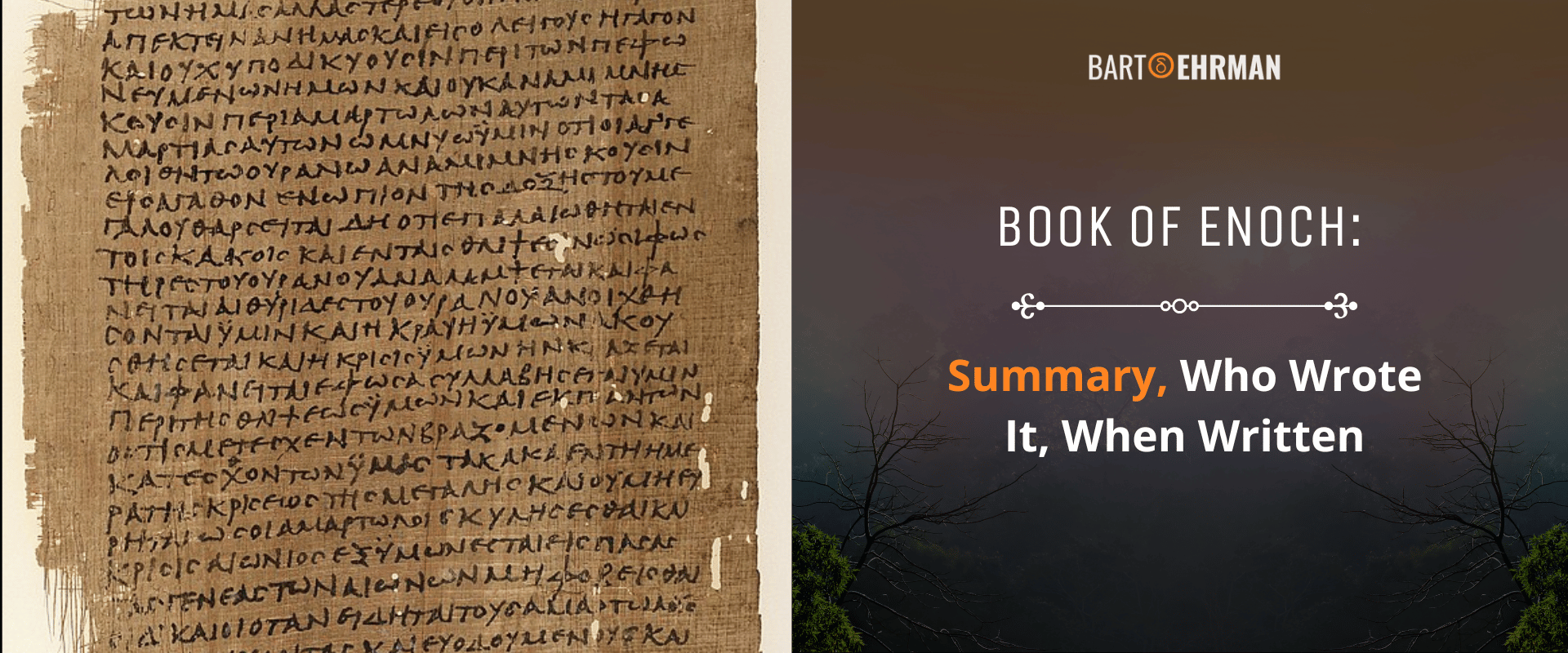
Book of Enoch: Summary
In her book, The Older Testament, Margaret Barker notes:
(Affiliate Disclaimer: We may earn commissions on products you purchase through this page at no additional cost to you. Thank you for supporting our site!)
To those brought up in the ways of the Old Testament, 1 Enoch is bizarre and surreal. Parts of it seem familiar, but the context is wrong, and everywhere there are alien forms. Drawn naturally to what is familiar, we have taken the Old Testament as our norm, and attempted to expound 1 Enoch on this basis. The results have not been satisfactory, for although individual elements have been isolated and identified, the overall pattern is still unknown. Some even imply that there is no pattern at all – that 1 Enoch is just a collection of apocryphal traditions, following the style of Daniel.


In any case, the content of 1 Enoch and the stories one can find there are as mysterious and challenging as anything in the religious landscape of the ancient world.
The Book of Enoch isn’t a single, unified narrative but a collection of several writings composed over time and later brought together.
These writings share certain themes (e.g., divine judgment, heavenly revelation, angelic rebellion, and the vindication of the righteous) but they differ in style and emphasis. Taken together, they present a sweeping vision of cosmic history, from the primeval past before the flood to the final judgment at the end of days.
The opening section, commonly known as the Book of the Watchers (chapters 1–36), expands upon the brief and cryptic account in Genesis 6:1–4.
It describes how a group of angels, called the Watchers, descended to earth, took human wives, and fathered giant offspring. In addition to this transgression, certain angels (especially Asael) are said to have taught humanity forbidden knowledge, including metalworking, weapon-making, cosmetics, and other arts.
The resulting corruption fills the earth with violence. Enoch, portrayed as a righteous figure who “walked with God,” is commissioned to announce divine judgment upon the fallen angels and their offspring. He is also taken on a series of heavenly journeys in which he sees places of punishment, cosmic storehouses, and the divine throne.
Another major portion of the Book of Enoch, often called the Similitudes or Parables (chapters 37–71), centers on visions of final judgment and introduces a prominent heavenly figure referred to as the “Son of Man.”
This figure is depicted as chosen, hidden with God, and destined to judge kings and the wicked, while vindicating the righteous.
Other sections shift in tone and content. The Astronomical Book (chapters 72–82) presents detailed revelations about the movements of the sun, moon, and stars, offering a structured description of the cosmos and its calendrical order.
The Book of Dreams (chapters 83–90) includes symbolic visions, most notably an extended allegory (often called the Animal Apocalypse) that retells Israel’s history in the form of animals representing different peoples and leaders.
Finally, the Epistle of Enoch (chapters 91–108) gathers exhortations, warnings, and apocalyptic expectations, including a schematic division of history into successive “weeks” leading toward ultimate judgment and renewal.
Such themes (e.g., angelic rebellion, heavenly journeys, cosmic order, symbolic history, and final judgment) give the Book of Enoch its distinctive character.
Having outlined its contents in broad strokes, we can now turn to the broader historical and religious context within which this remarkable work was composed.
The Book of Enoch as a Product of the Second Temple Judaism
The Book of Enoch emerged within the period commonly known as Second Temple Judaism, a span of roughly five centuries from the rebuilding of the Jerusalem temple in the late 6th century B.C.E. until its destruction by the Romans in 70 C.E.
Far from being a static or uniform era, this period was marked by political upheaval, imperial domination, internal Jewish debates, and significant literary creativity.
One important expression of this literary creativity was the flourishing of apocalyptic and revelatory writings, which sought to interpret history and cosmic reality through visionary disclosure.
As Simon C. Mimouni explains in his book Le judaïsme ancien du VIe siècle avant notre ère au IIIe siècle de notre ère (Ancient Judaism from the 6th century BCE to the 3rd century CE):
“Between the second century BCE and the first century CE, Judeans composed a considerable number of apocalypses or revelations that more broadly belong to what may be described as mystical literature. An apocalypse, or revelation, is a work in which the author – presented as a great ancestor – recounts how he was admitted into the heavens in order to receive visions that recall the origins and development of the world and disclose the end of time. These writings are in fact compilations gathered together and circulated under the name of an ancestral figure such as Adam, Enoch, Abraham, or Moses, or under that of a prophetic figure such as Daniel. Although this type of literature contains relatively little in the way of precise historical information, its contribution remains invaluable for understanding certain prophetic or messianic ideologies.” (my translation)
The intellectual and religious world reflected in 1 Enoch belongs squarely within this dynamic socio-cultural setting.
As James VanderKam notes in his discussion of how scholars have attempted to “map” Second Temple Judaism, modern reconstructions of the period must proceed with caution. The sources are fragmentary, often difficult to date with precision, and frequently pseudonymous, attributing new revelations to revered figures of the distant past.
The Book of Enoch itself is a prime example of this phenomenon, presenting its revelations as mediated by the antediluvian patriarch Enoch. Yet such literary strategies were not unusual in this era. Alongside legal interpretation centered on the Torah, there also flourished apocalyptic visions, wisdom traditions, rewritten biblical narratives, and sectarian compositions.
Rather than representing a marginal aberration, Enochic literature reflects one of the vibrant currents within this broader and multifaceted Jewish landscape.
Within this context, themes found in the Book of Enoch aren’t isolated curiosities but part of wider Second Temple concerns about divine justice, the problem of evil, and the structure of the cosmos.
At the same time, scholars continue to debate how precisely Enochic groups fit into the spectrum of Jewish communities of the time.
For readers interested in exploring this rich historical and religious environment in greater depth, we have separate articles (here, and here) devoted specifically to Second Temple Judaism and its many movements and texts.
NOW AVAILABLE!
Finding Moses: What Scholars Know About The Exodus & The Jewish Law
Riveting and controversial, the "FINDING MOSES" lecture series takes you on a deep dive into the stories of Moses, the exodus, and a whole lot more...
Who Wrote the Book of Enoch and When Was it Written?
One of the first questions historians pose when dealing with ancient texts is, “Who wrote it and when?”
In the case of 1 Enoch, these two questions are tightly intertwined. Unlike many biblical books whose authorship is debated but traditionally attributed to identifiable figures, the Book of Enoch presents itself as the work of the antediluvian patriarch Enoch, the great-grandfather of Noah mentioned briefly in Genesis 5.
Did You Know?
When 1 Enoch Almost Made It Into the Bible
When you open a Bible today, you find a fixed collection of books bound together under a single title. It can feel as if that list had always been settled and universally agreed upon. But that wasn’t the case. In the earliest centuries of Christianity, debates about which books counted as Scripture were lively, and sometimes heated. Influential Christian thinkers did not always agree on where the boundaries of the Bible should be.
One striking example is Tertullian (late second–early 3rd century C.E.). In his work On the Apparel of Women, he openly defended the authority of 1 Enoch, even acknowledging that some rejected it because it was not part of the Jewish canon.
Tertullian argued that this isn’t a sufficient reason to dismiss it and even suggested that Enoch’s teachings could have been preserved through Noah after the flood. While his view didn’t ultimately prevail in the formation of the Western Christian canon, his defense shows that the status of the Book of Enoch was once a serious subject of debate among early Christian leaders.
Modern scholarship, however, is virtually unanimous in concluding that the work wasn’t written by the ancient Enoch.
Rather, it belongs to the category of pseudepigrapha, writings composed under the name of a revered figure from the distant past in order to claim authority for the revelations they contain.
Closely related to this is the recognition that 1 Enoch isn’t a single composition but a composite work assembled over time. As Michael S. Heiser observes in A Companion to the Book of Enoch:
First Enoch as we know it today is actually a composite literary work with parts dated to different periods... This determination is based on several considerations: (a) internal evidence (e.g., historical reference points in 1 Enoch); (b) paleography (scribal handwriting style); and (c) grammatical-linguistic features.
These methods (historical analysis, manuscript study, and linguistic examination) have allowed scholars to distinguish multiple stages of composition. As James VanderKam, in his book Enoch: A Man for All Generations, has emphasized, even the major sections traditionally treated as unified, such as the Book of the Watchers, show signs of internal layering and editorial development.
In other words, not only is the Book of Enoch composite as a whole, but some of its earliest components appear to have undergone stages of growth and expansion.
When was the Book of Enoch written? Well, most scholars agree that the earliest Enochic booklets emerged during the Hellenistic period. The Book of the Watchers (chapters 1–36) is widely regarded as one of the oldest sections.
As Archie Wright notes:
A scholarly consensus for the date of the Book of Watchers places the extant Aramaic form sometime in the third century BCE based on the paleography of the Qumran fragments; some suggest pushing the date farther back into an earlier Hellenistic period or perhaps the Persian period.
The Astronomical Book (chapters 72–82) is likewise considered very early; paleographic analysis of its Qumran manuscripts indicates that it must have been composed no later than the third century BCE, and possibly earlier.
Other sections appear later. The Book of Dreams (chapters 83–90), especially the so-called Animal Apocalypse, is often dated to the mid-2nd century B.C.E., likely in connection with events surrounding the Maccabean crisis.
The Parables or Similitudes (chapters 37–71) remain more debated, with many scholars placing them in the late 1st century B.C.E. or early 1st century C.E., though precise dating continues to be discussed.
Taken together, these findings indicate that the Book of Enoch developed over a span of at least two centuries, from the early Hellenistic period into the late Second Temple era.
Rather than the product of a single visionary author, it represents a growing literary tradition in which successive writers and editors expanded, reshaped, and preserved earlier materials under the authoritative name of Enoch.
Is the Book of Enoch in the Bible?
Is the Book of Enoch in the Bible? Well, that depends on which Bible we refer to. But, to be honest, in most canons — including those that are, by sheer number, the most widely used today (Catholic and Protestant) — the answer is no.
The Book of Enoch doesn’t appear in the Jewish Tanakh. It is also not in the Old Testament of the Roman Catholic Church, nor in Protestant Bibles. Its canonical status followed a different trajectory from that of the books that eventually formed the Hebrew Bible and the Christian Old Testament.
From a historical perspective, this outcome reflects the complex and gradual process by which Jewish and Christian communities defined authoritative Scripture.
By the late Second Temple period and especially in the centuries following the destruction of the Jerusalem Temple in 70 C.E., Jewish tradition consolidated a collection of texts that would become the Hebrew Bible.
Although 1 Enoch was widely read in certain Jewish circles (as evidenced by the discovery of multiple Aramaic fragments at Qumran) it wasn’t included among the books that later achieved canonical status in rabbinic Judaism.
Early Christians, for their part, were familiar with the work. For instance, the Epistle of Jude (verses 14–15) explicitly quotes a passage from 1 Enoch. Moreover, some Church Fathers also regarded it highly.
Nevertheless, as Christian canons gradually took shape, 1 Enoch was excluded from the lists that became normative in both Western (Latin) and Eastern (Greek) traditions.
There is, however, one important exception. The Book of Enoch is included in the canon of the Ethiopian Orthodox Tewahedo Church, where it has been preserved in its fullest form in the Geʿez language.
Its survival in this tradition is historically significant since the complete text of 1 Enoch was unknown in Europe until the modern period, when manuscripts were brought from Ethiopia in the 18th century.
Thus, while the Book of Enoch isn’t part of most Jewish and Christian Bibles, it remains a canonical and authoritative text within Ethiopian Christianity, and an indispensable source for historians seeking to understand the diversity of ancient Judaism and early Christianity.

Conclusion
If television loves to speak about “mysteries of the Bible,” the Book of Enoch shows that the real intrigue of ancient religious texts doesn’t lie in secret codes or suppressed conspiracies, but in history itself.
Its angelic rebellions, heavenly journeys, and visions of final judgment are, indeed, strange and, at times, unsettling. Yet when examined carefully, they aren’t hidden fragments of forbidden doctrine but windows into the vibrant and diverse world of Second Temple Judaism.
Finally, the Book of Enoch reminds us that what later became “the Bible” emerged from a much broader landscape of ideas, debates, and literary creativity.
NOW AVAILABLE!
Finding Moses: What Scholars Know About The Exodus & The Jewish Law
Riveting and controversial, the "FINDING MOSES" lecture series takes you on a deep dive into the stories of Moses, the exodus, and a whole lot more...