
Who Destroyed the Second Temple?

Written by Joshua Schachterle, Ph.D
Author | Professor | Scholar
Author | Professor | BE Contributor
Verified! See our editorial guidelines
Verified! See our guidelines
Date written: March 8th, 2026
Disclaimer: The views and opinions expressed in this article belong to the author and do not necessarily match my own. - Dr. Bart D. Ehrman
The destruction of the Second Temple in Jerusalem marked a decisive turning point in the history of Judaism, early Christianity, and the Roman Empire. Yet despite the event’s significance and the apparent clarity of its outcome, a fundamental historical question remains: who destroyed the Temple in Jerusalem, and with what intention?
The question of who destroyed the Second Temple is not a matter of assigning blame alone. It bears directly on how we understand Roman imperial strategy, the ideological dimensions of the revolt, and the transformation of Jewish and Christian religious identities in its aftermath. To revisit this question, therefore, is to revisit the origins of rabbinic Judaism, the development of early Christian self-understanding, and the enduring legacy of Rome’s most consequential eastern war.
Background: The First Jewish Revolt
In 63 BCE, the Roman Republic conquered Judea, which had been independent under the Hasmonean Dynasty. Rome ruled Judea using a series of client kings who acted on Rome’s behalf. These included Herod the Great and Herod Antipas, major figures in the NT Gospels. However, conflicts abounded during the years of Rome’s rule.
For instance, in 6 CE, Quirinius, the governor of the Roman province of Syria which would later include Judea, took a census in the region. The purpose of this census was to document the names of any owners of land that could be taxed. In other words, Rome wanted to make sure it was taxing everyone possible in Judea, putting that wealth into its own coffers.
This enraged many Judeans, principally a violent political group later known as the Zealots. In The Zealots: Investigation into the Jewish Freedom Movement, Martin Hengel writes that the Zealots were so-named because they had a total devotion to, or “zeal,” for the Torah. Their ideology included the belief that Jews should have no king but God. The Roman census, a strategy of control, was the last straw for them, another insult to the idea that anyone but God should be ruling Judea.
(Affiliate Disclaimer: We may earn commissions on products you purchase through this page at no additional cost to you. Thank you for supporting our site!)
A revolutionary leader named Judas of Galilee thus led a violent uprising against Rome in 6 CE, encouraging faithful Jews not to pay taxes to Rome and to join him in liberating Judea from Rome. The violent movement was quickly put down by Roman forces, but the Zealots continued to operate within Judea — this would not be the last Jewish uprising against Roman rule.
In The Ruling Class of Judaea: The Origins of the Jewish Revolt against Rome, A.D. 66–70, Martin Goodman writes that during Pontius Pilate’s governorship from 26–36 CE, several other events fueled anti-Roman and Jewish nationalist sentiment in Judea. These included Roman military emblems being brought into the holy city of Jerusalem and the Roman use of Temple funds to pay for the construction of an aqueduct.
In addition, in From the Maccabees to the Mishnah, Shaye Cohen writes that many Roman officials were known to be corrupt, ruthless, and/or incompetent. Even the Roman historian Tacitus blames Jewish revolt on Roman misgovernance (see Histories 5.1–13). By the mid 60s CE, the Judeans had been pushed too far for too long, and a revolt seemed all but inevitable.
Outbreak of the Roman-Jewish War
According to Josephus, the war, which finally erupted in 66 CE, was ultimately the fault of the Roman governor Gessius Florus. In his book For the Freedom of Zion: The Great Revolt of Jews against Romans, 66–74 CE, Guy MacLean Rogers summarizes the main events leading up to the beginning of the war.
In 66 CE, Jews in the Judean city of Caesarea tried to purchase some land adjacent to their synagogue. The owner was Greek and refused to sell them the land, putting up his own non-religious buildings there instead (probably some kind of workshops). Some Jews, concerned that these workshops might defile the synagogue, attempted to prevent their construction. Florus the governor, however, intervened on the side of the Greek landowner, allowing the buildings to be built.
Knowing the infamous corruption of Florus, wealthy local Jews bribed Florus to stop construction. Florus accepted the bribe, but then did nothing on the Jews’ behalf. Finally, on the Sabbath day, a Greek man, apparently not the owner of the contested land, purposely defiled the synagogue by making a burnt sacrifice of birds in its doorway. This last action, coming as it did after numerous injustices, started a violent clash between the Greek and Jewish communities of Caesarea. Even Roman forces in the region could not stop the fighting. Some leaders of the Jewish community there came to Florus to make an official complaint about the desecration of the synagogue, but Florus arrested them.
Meanwhile, Florus went to Jerusalem, entered the Temple, and took money from its treasury “for government purposes,” refusing to explain any further. At this final outrage, the citizens of Jerusalem erupted in protests, which evidently included ridiculing Florus as if he were a poor beggar. This enraged the governor who went to the Jewish high council, the Sanhedrin, and demanded the names of the offenders who had mocked him. When the Sanhedrin refused to identify them, Florus ordered troops to attack one of the main marketplaces in Jerusalem, killing more than 3,000 Jews in the process. Other, similar massacres would soon follow.
With the violence and chaos initiated by Florus, many more Jews in Jerusalem were slaughtered, while Jewish guerilla groups, including the Zealots, initiated conflicts with Roman forces in Jerusalem and many different cities and regions, even beyond Judea. In addition, a Temple official named Eleazar ben Hanania made the executive decision to stop all sacrifices on behalf of Rome, an important religious duty imposed on the Jews after the Roman takeover. While this may not seem so significant by modern standards, it was a highly-charged gesture in 1st-century Judea.
Eventually, the Roman Emperor Nero sent his general, Vespasian, to take charge of ending the revolt. Vespasian began by defeating rebel groups all across Galilee, then began to do the same in Judea. However, by the time he and his troops arrived at Jerusalem, internecine fighting between Jewish rebel groups had actually become a three-way civil war according to Josephus, who claims to have fought in this war.
NOW AVAILABLE!
Finding Moses: What Scholars Know About The Exodus & The Jewish Law
Riveting and controversial, the "FINDING MOSES" lecture series takes you on a deep dive into the stories of Moses, the exodus, and a whole lot more...
Who Destroyed the Second Temple?
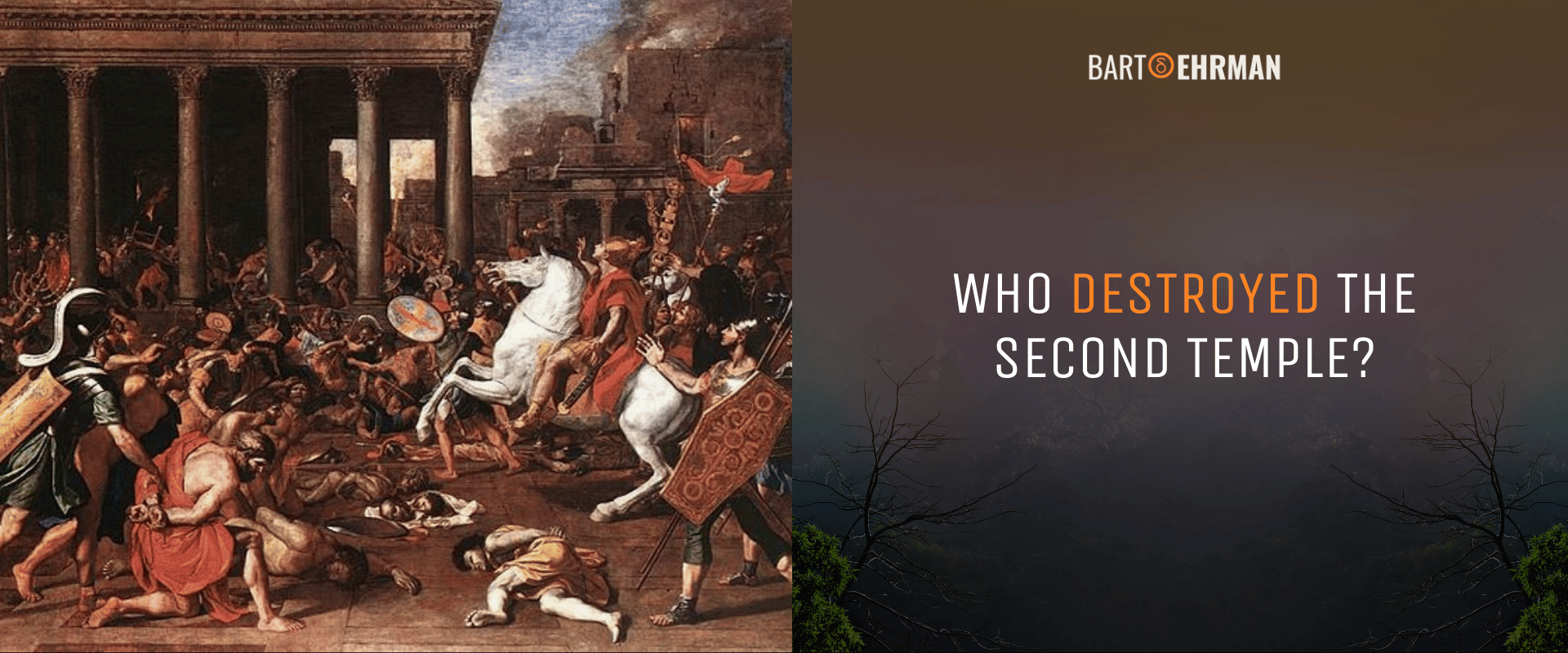
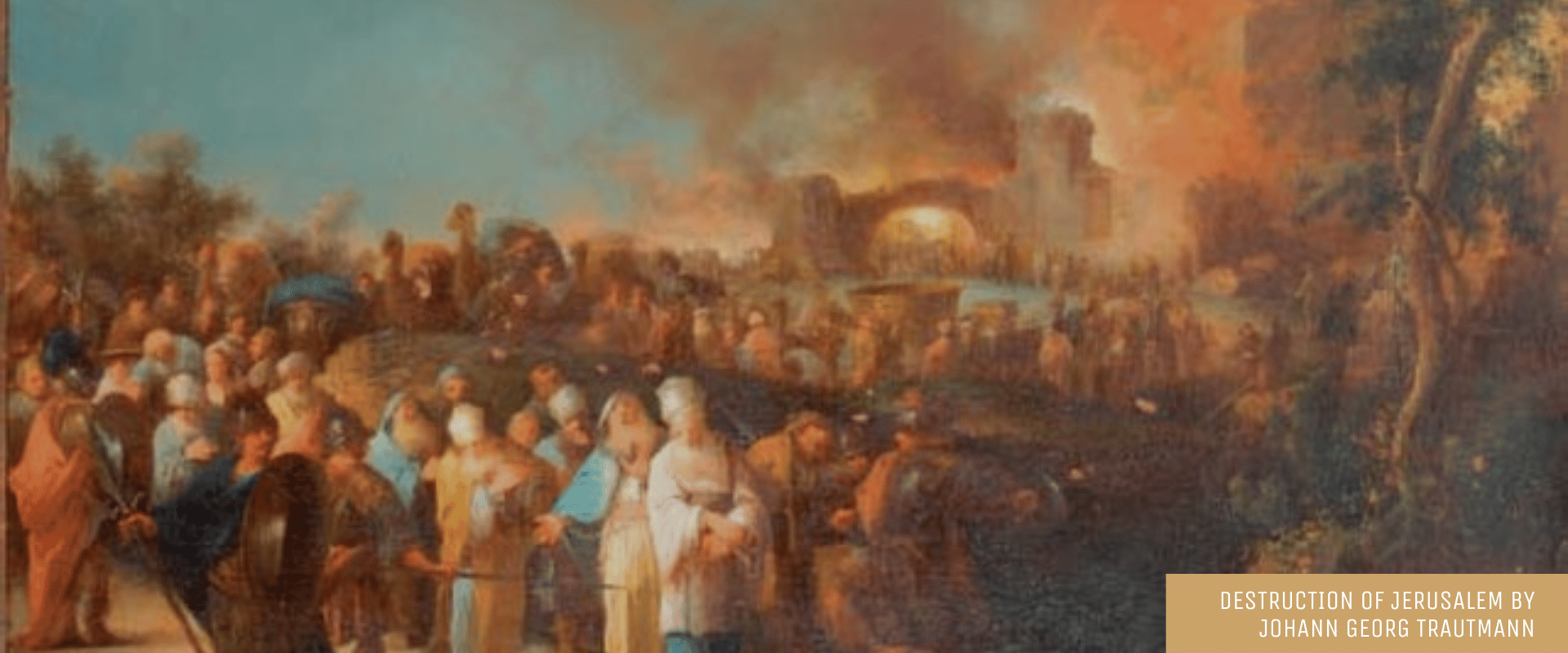
By this time, Nero had died and Vespasian had replaced him as emperor. Seeing no end in sight to the Jewish war, Vespasian sent his son Titus to end it definitively. In 70 CE, Titus’ 70,000 troops were able to lay siege to the city for almost five months, preventing any food from coming in and any Jerusalemites from leaving. Those who attempted to escape were crucified outside the city walls. Many of those who stayed simply starved to death. With the city weakening, Roman forces outside the city walls continued their assaults, eventually gaining entry and focusing attacks on the Temple.
Titus knew that with the Temple taken or destroyed, the morale of the Jewish fighters would be crushed. He thus began to attack the massive Temple complex from different sides. According to Josephus, during a battle near the entrance of the Temple’s outer court, a Roman soldier threw a burning piece of wood into one of the Temple’s chambers, starting a fire.
Josephus, who was basically sponsored by the Roman emperor while he was writing, claims that Titus ordered his troops to put the fire out. However, the troops either disregarded him or weren’t able to hear him in the chaos, and the fire continued to spread. Josephus describes some of the Roman soldiers encouraging the burning of the Temple, even adding to the fire and looting the Temple’s treasury. Eventually, the fire completely razed the Second Temple to the ground.
We have to remember that King Herod the Great had made massive additions to the Second Temple. By the time it was destroyed, it was a huge complex covering 450 acres. The size of the inferno that burned this structure down must have been terrifyingly immense.
When was the Second Temple destroyed? Since the months-long siege of Jerusalem occurred in 70 CE, historians generally believe the Temple was destroyed that same year. However, many have doubted that the fire happened the haphazard way Josephus describes. They also doubt that Josephus was objective in his view, indebted as he was to Rome when he wrote his history. For this reason, there are other ancient versions of this story.
For example, in The Sacred History, 4th-century Christian historian Sulpicius Severus writes that Titus deliberately destroyed the Temple as part of his overall strategy:
Titus is said, after calling a council, to have first deliberated whether he should destroy the temple, a structure of such extraordinary work. For it seemed good to some that a sacred edifice, distinguished above all human achievements, ought not to be destroyed… But on the opposite side, others and Titus himself thought that the temple ought specially to be overthrown, in order that the religion of the Jews and of the Christians might more thoroughly be subverted; for that these religions, although contrary to each other, had nevertheless proceeded from the same authors; that the Christians had sprung up from among the Jews; and that, if the root were extirpated, the offshoot would speedily perish (Sacred History, 2.30).


Many modern historians agree that the intentional demolishing of the most sacred structure in Judea would likely have been a strategic goal for the Romans. In The Jewish Revolt against Rome: Interdisciplinary Perspectives, historian Steve Mason writes that this was a typical Roman strategy of conquest. Rome had similarly destroyed Temples in Carthage and Corinth, and there is absolutely no evidence of any regrets about destroying the Jerusalem Temple on Titus’ part.
Remember also that the Jewish revolt was started by those who believed the Jews should be ruled only by God. In other words, Jewish religion was central to the ideology of the rebellion, as Doron Mendels writes in The Rise and Fall of Jewish Nationalism: Jewish and Christian Ethnicity in Ancient Palestine. Destroying the focal point of Jewish religion was a way to destroy Jewish resistance.
Aftermath of the Destruction of the Temple
In Mark 13:1–2, we are told that when Jesus and his disciples visited Jerusalem, the disciples were suitably impressed by Herod’s massive Temple:
As he came out of the temple, one of his disciples said to him, “Look, Teacher, what large stones and what large buildings!” Then Jesus asked him, “Do you see these great buildings? Not one stone will be left here upon another; all will be thrown down.”
This begins what is known to biblical scholars as “The Little Apocalypse,” a prophetic discourse by Jesus on the siege of Jerusalem and the destruction of the Temple. Did Jesus, who died around 30 CE, really predict the events of 70 CE? The references to the Temple’s destruction and the suffering that seems to refer to the besieging of Jerusalem makes most biblical scholars believe that Mark, our oldest Gospel, was written during or just after this historical event. Bart Ehrman agrees with that assessment, even if Jesus actually did predict these events:
Someone may respond by saying that in these passages Jesus is predicting the destruction of Jerusalem, not looking back on it. Fair enough! But when is a Christian author likely to record a prediction of Jesus in order to show that he predicted something accurately? Obviously, in order to show that Jesus knew what he was talking about, an author would want to write about these predictions only after they had been fulfilled. Otherwise the reader would be left hanging, not knowing if Jesus was a true prophet or not.
We can thus date the Gospel of Mark to no earlier than 70 CE. Lawrence Wills, writing in the Jewish Annotated New Testament, says that although the author of Mark was clearly aware of the events happening in Jerusalem, he was definitely not writing in Jerusalem — he was not an eyewitness to the events he describes.
While the earliest Christians clearly valued the Temple, going to services regularly as seen in Acts 3:1, they were no longer making sacrifices in the Temple, as they viewed Jesus’ death as sacrificial. The destruction of the Temple and Jerusalem certainly affected them, but not to the extent that it affected practitioners of Judaism.
Since the Jerusalem Temple had been the center of Judaic practice for all Jews, the place where God’s presence dwelled and the only place where sacrifices to God could be made, Jews, in many ways, had to rethink their religion after the razing of the Temple. The result would eventually be rabbinic Judaism, in which textual study rather than sacrifice was the most crucial element.
Of course, Jews already had the Torah and the rest of the Hebrew Bible and valued it deeply. However, without the Temple, interpretation of these texts, as well as later writings known as the Talmud and the Mishnah, would become their principal way to relate to God. This is still the case today, as rabbinical schools train future rabbis in intensive study of the Torah, the Talmud, and the Mishnah in order to understand and interpret them properly for their congregations.
Conclusion
The destruction of the second Temple in Jerusalem began with what seemed to be a small-scale property dispute. Jews in the town of Caesarea in the Roman province of Judea were angered when a Greek person built non-religious buildings adjacent to their synagogue. However, through gross mismanagement of the situation by the governor Gessius Florus, the problems multiplied and violence ensued. When that same Roman governor robbed the Temple treasury, apparently for his own personal gain, this violence developed into an anti-Roman revolt.
Who destroyed the Second Temple? Eventually, Jerusalem was put under siege by the Roman general Titus in 70 CE. After four months of starving the citizens and crucifying those who tried to run away, Titus’ troops were able to enter the city and then, either purposely or through negligence, destroy the magnificent Temple that served as the Jewish center of worship and sacrifice. Whether Titus did this intentionally or whether it simply developed from a failure of his soldiers to follow orders, there is no doubt about who destroyed the Temple in Jerusalem: it was Rome.
While this would affect many in the region and would send countless surviving Jews into exile, one of the biggest effects was that Jewish religion was forced to reinscribe its boundaries. With no Temple in which the presence of God and the sacrifices could be accessed, devout Jews changed their focus to textual interpretation, a change that has lasted for more than 2,000 years.
NOW AVAILABLE!
Finding Moses: What Scholars Know About The Exodus & The Jewish Law
Riveting and controversial, the "FINDING MOSES" lecture series takes you on a deep dive into the stories of Moses, the exodus, and a whole lot more...