
Antiochus IV Epiphanes: His Reign in History vs the Book of Daniel

Written by Joshua Schachterle, Ph.D
Author | Professor | Scholar
Author | Professor | BE Contributor
Verified! See our editorial guidelines
Verified! See our guidelines
Date written: December 17th, 2025
Disclaimer: The views and opinions expressed in this article belong to the author and do not necessarily match my own. - Dr. Bart D. Ehrman
Among rulers of Judea during the Hellenistic period, Antiochus IV Epiphanes has endured longest, both in historical memory and religious tradition. He was a complex monarch shaped by shifting Mediterranean power dynamics, Roman influence, and the internal fractures of his own kingdom.
In this article, I’ll explain the life and reign of Antiochus IV Epiphanes from both angles: the historical realities recorded by Greek and Roman historians, and the theological significance attributed to him by ancient Jewish authors writing in the wake of persecution.
By the way, if you’re interested in learning more about Jewish history, check out the course on Bart Ehrman’s website called The Rise and Fall of Biblical Israel, featuring scholar Joel Baden.
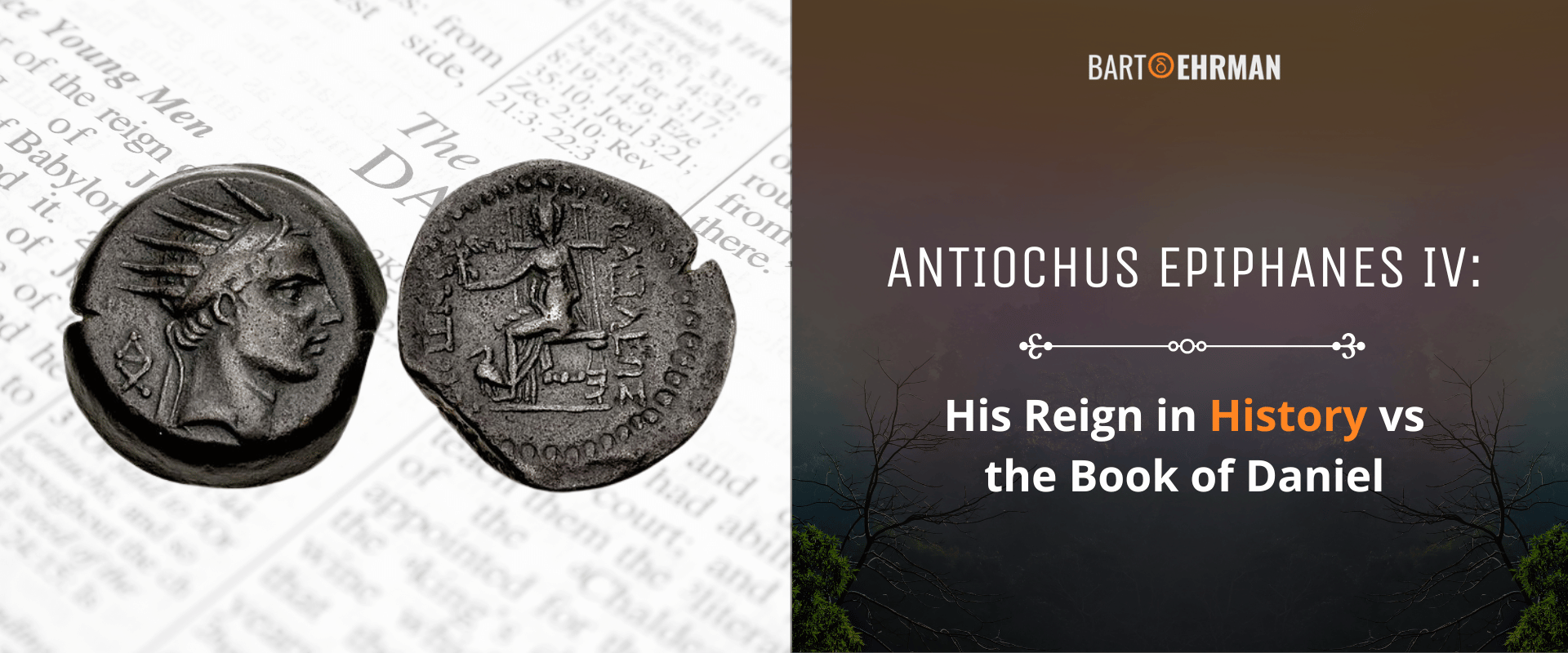
Name and Early Life
When the Macedonian king Alexander the Great (356-323 BCE) conquered the Persian Empire and an immense territory extending from Greece to Egypt, the Middle East, and parts of Central Asia and India, Greek language and culture became dominant in those territories. However, despite Alexander’s enormous military successes, he died at the relatively young age of 32, leaving a massive power vacuum.
On his deathbed, Alexander is said to have appointed a general named Perdiccas as a regent or administrator (not a king) over the empire. However, when Perdiccas was assassinated, there began a power struggle between three Greek factions known collectively as the Diadochi: the Ptolemies, ruled initially by Ptolemy I Soter and controlling Egypt, the Seleucids, ruled initially by Seleucus I Nicator and controlling Syria, and the Antigonids, ruled initially by Antigonus I Monophthalmus and controlling mainland Greece, Macedonia, and the surrounding Islands. The land of Judea was part of the territory of the Seleucid dynasty.
By the way, this is a good place to mention the naming conventions of the Hellenistic empires that divided up Alexander the Great’s territories. To understand Antiochus IV Epiphanes, we need to understand the origins of his name.
The names of Greek rulers contained three parts. First the name: in the case of this article’s subject, Antiochus. Second, a number, identifying the ruler as either the first ruler of that name or a son and successor of that ruler. In our case, the Seleucid king was named Antiochus IV because he was the son of King Antiochus III. Third, a title, chosen by the king for himself. In our case, the title was Epiphanes, a Greek word meaning “manifest” and meant to signify that Antiochus was the manifestation of a god.
His name, therefore, was Antiochus IV Epiphanes (pronunciation: an-TIE-oh-cuss the fourth e-PIFF-a-knees). He would not have been called Antiochus Epiphanies without the number, since Epiphanes was not a last name but the title taken by King Antiochus IV, son of King Antiochus III.
Beginning in 320 BCE, there was a succession of six Seleucid kings before the rule of Antiochus IV Epiphanes began. Born in 215 BCE in Antioch, Antiochus’ original name was Mithridates, a reference to the Persian god Mithras. By the time of his birth, the Seleucid empire of his forebears was well-established in Syria and surrounding territories. In Judaea and Mediterranean Politics, 219 to 161 B.C.E., Dov Gera writes that Mithridates’ name was changed to Antiochus either after the death of his older brother — also named Antiochus — or just before he ascended the throne.
(Affiliate Disclaimer: We may earn commissions on products you purchase through this page at no additional cost to you. Thank you for supporting our site!)
The ancient Greek historian Polybius wrote in his Histories that, in 188 BCE, the forces of Antiochus’ father, King Antiochus III the Great, were defeated by Roman forces. The Romans then forced Antiochus IV, as the potential successor to the Seleucid throne, to live in Rome as a political hostage for 10 years. According to Polybius, though, this had the unintended effect of making Antiochus admire the culture and power of Rome. This would, in turn, influence Antiochus’ reign, as he would always try to avoid any conflict with Rome.
After 10 years in Rome, Antiochus IV was allowed to leave, while his brother Demetrius took his place as a hostage in Rome. Meanwhile, Antiochus’ brother, Seleucus IV Philopator, had become Antiochus III’s successor on the throne. Antiochus IV himself went to live in Athens, where eventually he learned of the assassination of his brother by a government minister named Heliodorus in 175 BCE.
Gathering help in the form of the forces of the king of Pergamum, Antiochus IV traveled from Athens to Syria, intent on removing Heliodorus from the throne. Antiochus III’s legitimate heir was Demetrius, now a hostage in Rome, so Antiochus took the throne himself.
Antiochus IV Epiphanes’ Reign
Despite his later reputation as a tyrant, Antiochus was initially known as a king of uncommon generosity. In his book Judas Maccabaeus: The Jewish Struggle Against the Seleucids, Bezalel Bar-Kochva writes that Antiochus randomly gave money to common people in the Antioch streets, donated money to the Temple of Zeus in Athens, and hosted luxurious feasts for the local nobility. However, Polybius writes that his strange, albeit munificent behavior made some enemies secretly change his title to “Epimanes,” meaning “madman.”
Meanwhile, in 170 BCE, the neighboring Ptolemies in Egypt were secretly planning to wage war on the Seleucids, believing that Antiochus’ unexpected seizure of the throne had left them weak and divided. However, Antiochus had been warned and was able to attack them instead, soon conquering all of the Ptolemies’ Egyptian territory except Alexandria. He allowed the Ptolemaic king to continue ruling Egyptian territories as his client king once he went back to Antioch.
In 168 BCE, Antiochus began another attack on Egypt. However, Polybius writes that, before he arrived in Alexandria, he was confronted by a single, aging Roman ambassador who conveyed a command from the Roman Senate that Antiochus withdraw his armies from Egypt or consider himself at war with Rome. Antiochus said he would discuss it with his council, but the Roman envoy drew a line in the sand around Antiochus, saying "Before you leave this circle, give me a reply that I can take back to the Roman Senate." Unwilling to fight with Rome as always, Antiochus withdrew.
Polybius and others saw this as a humiliating defeat for Antiochus. However, in The Syrian Wars, John Grainger writes that the king may also have been somewhat relieved that he had a reason not to start a siege of Alexandria, an undertaking which would have likely have drained his royal coffers. Instead, he returned to Antioch with treasure from all the places in Egypt he had defeated.
NOW AVAILABLE!
Finding Moses: What Scholars Know About The Exodus & The Jewish Law
Riveting and controversial, the "FINDING MOSES" lecture series takes you on a deep dive into the stories of Moses, the exodus, and a whole lot more...
Antiochus IV Epiphanes and The Maccabean Revolt
Despite the encounter with Rome, this series of military successes in Egypt seemed to indicate that King Antiochus IV Epiphanes couldn’t lose. However, he would be unexpectedly challenged by a group of Jews known as the Maccabees, the result of a conflict he himself started.
The six Seleucid rulers who preceded Antiochus IV had respected Jewish culture and religion, allowing them to practice as they saw fit. This changed with Antiochus. It may have started with a Seleucid named Jason, whom Antiochus appointed High Priest. The position of High Priest was a religious position that also carried substantial political power but was supposed to be reserved for members of a certain Jewish family.
According to the deuterocanonical book 1 Maccabees, Jason had bribed his way into this position, only to have another man, Menelaus, outbribe him for the position in 171 BCE. Devout Jews, by the way, rejected both candidates as unfit for duty in the most sacred space in Judea. In 168 BCE, while Antiochus was busy on his military campaign in Egypt, 2 Maccabees 5:5-7 says that Jason decided to take revenge on Jerusalem for the loss of his position:
When a false rumor arose that Antiochus was dead, Jason took no fewer than a thousand men and suddenly made an assault on the city. When the troops on the wall had been forced back and at last the city was being taken, Menelaus took refuge in the citadel. But Jason kept relentlessly slaughtering his compatriots, not realizing that success at the cost of one’s kindred is the greatest misfortune but imagining that he was setting up trophies of victory over enemies and not over compatriots. He did not, however, gain control of the government; in the end, he got only disgrace from his conspiracy and fled again into the country of the Ammonites.


Remember, though, that Antiochus was still alive and still suffering from the humiliation of his defeat by the Romans. According to 1st-century historian Josephus in his book The Jewish War,
Antiochus returned to Jerusalem. Infuriated by the Jews' rejection of Menelaus, his chosen candidate for High Priest, he attacked Jerusalem, reinstating Menelaus as High Priest and killing a great number of Jews. He also decided, according to 1 Maccabees 1:41-50, that he had to take total control of Judea:
Then the king wrote to his whole kingdom that all should be one people and that all should give up their particular customs. All the nations accepted the command of the king. Many even from Israel gladly adopted his religion; they sacrificed to idols and profaned the Sabbath. And the king sent letters by messengers to Jerusalem and the towns of Judah… to forbid burnt offerings and sacrifices and drink offerings in the sanctuary, to profane Sabbaths and festivals, to defile the sanctuary and the holy ones, to build altars and sacred precincts and shrines for idols, to sacrifice pigs and other unclean animals, and to leave their sons uncircumcised. They were to make themselves abominable by everything unclean and profane so that they would forget the law and change all the ordinances. He added, “And whoever does not obey the command of the king shall die.”
More specifically, the king converted the Jerusalem Temple to a temple dedicated to Zeus. Anyone who knows the worship customs of ancient Judaism would know that for devout Jews, this would be the last straw. In Judaism and Hellenism: Studies in their Encounter in Palestine during the Early Hellenistic Period, Martin Hengel writes that this is what triggered the Maccabean Revolt.
In the books of 1 and 2 Maccabees, the Maccabean Revolt is depicted as resistance to cultural and religious oppression by a foreign invader. While this certainly might be the case, some modern scholars see the conflict differently.
Years of Seleucid control had introduced Greek culture and language into Judea, prompting many elite Jews to adopt Greek customs for themselves. This eventually led to a major conflict between those Hellenized Jews and the more conservative Jews like the Maccabees who saw this as a betrayal of Jewish religion and identity. According to Joseph Schultz in Judaism and the Gentile Faiths: Comparative Studies in Religion, it is possible that Antiochus was merely attempting to intervene in the impending civil war between these two groups rather than intending to abolish Jewish culture gratuitously.
Whatever the case, the Maccabean Revolt was remarkably successful, eventually allowing the Maccabean army to take over Jerusalem and establish themselves as the ruling dynasty known as the Hasmoneans, although they were still technically under a loose Seleucid control.
In terms of religious references to Antiochus IV Epiphanes, scholars believe that the book of Daniel was written largely as a history and response to the crisis the king created. For example, Pamela Milne, in her introduction to Daniel in the HarperCollins Study Bible, writes that chapter 11 of Daniel
Obviously refers to Antiochus IV Epiphanes, the Seleucid ruler from Syria, [making] it clear that the book took its final form during Antiochus’s persecution of the Jews, which began with the desecration of the temple in 167 BCE.
Antiochus IV Epiphanes in Daniel is never referred to by name but rather as “the King of the North.” Daniel 11:21 calls him
a contemptible person on whom royal majesty had not been conferred; he shall come in suddenly and seize the kingdom through intrigue.
Later Years and Death
While he was dealing with the Maccabean Revolt, Antiochus’ eastern territory was attacked by the Parthians, who were taking advantage of the trouble he was having in Judea. Instead of abandoning Judean territory to hang on to his larger eastern lands, however, Antiochus left a general named Lysias in charge of the battle in Judea and went to attack the Parthians.
He was largely unsuccessful in taking back Seleucid lands from the Parthians, but he then took his military campaign to Armenia which he reconquered, capturing the Armenian king Artaxias in the process. However, on his way back to Antioch, he died of unknown causes, likely somewhere in Persia (although 1 Macc 6:16 claims he died in Babylon) in 164 BCE.
The books of 1 and 2 Maccabees attribute his death to divine retribution for his desecration of the Jerusalem Temple. This is the description of his death from 2 Maccabees 9:5-9:
But the all-seeing Lord, the God of Israel, struck him with an incurable and invisible blow. As soon as he stopped speaking he was seized with a pain in his bowels, for which there was no relief, and with sharp internal tortures—and that very justly, for he had tortured the bowels of others with many and strange inflictions. Yet he did not in any way stop his insolence, but was even more filled with arrogance, breathing fire in his rage against the Jews, and giving orders to drive even faster. And so it came about that he fell out of his chariot as it was rushing along, and the fall was so hard as to torture every limb of his body. Thus he who only a little while before had thought in his superhuman arrogance that he could command the waves of the sea, and had imagined that he could weigh the high mountains in a balance, was brought down to earth and carried in a litter, making the power of God manifest to all. And so the ungodly man's body swarmed with worms, and while he was still living in anguish and pain, his flesh rotted away, and because of the stench the whole army felt revulsion at his decay.
However unlikely this is from a historical perspective, it clearly demonstrates Jewish antipathy toward the first Seleucid king who had tried to deprive the Jews of the consolation of their divine rituals and culture.
Conclusion
Antiochus IV Epiphanes was the most prominent Seleucid ruler in that dynasty’s storied history. However, the reasons for this are bound up with infamy, based as they are on depictions of him as a ruthless tyrant.
Born to the eighth king of the Seleucid Empire, Antiochus seemed destined for greatness until his father’s forces were defeated by Rome. The young Antiochus was taken as a hostage to Rome, where he remained for 10 years. Instead of rebelling against his Roman overlords, however, Antiochus learned to admire their power.
Returning to Antioch after the slaying of his brother the king, Antiochus merely took the throne for himself, becoming the next king of the Seleucid dynasty. However, by installing two successive Seleucid High Priests in Jerusalem, he angered devout Jews who rebelled against him. In response, he purposely desecrated the Temple and outlawed Jewish religious and cultural practices, sparking the Maccabean Revolt.
In the end, he lost the total control over Judea his family had long maintained, eventually dying in a foreign city after a military campaign. Whatever his accomplishments, he will forever be viewed as the villain in the triumphant story of the Maccabean Revolt.
NOW AVAILABLE!
Finding Moses: What Scholars Know About The Exodus & The Jewish Law
Riveting and controversial, the "FINDING MOSES" lecture series takes you on a deep dive into the stories of Moses, the exodus, and a whole lot more...