
Megiddo in the Bible: Location, Significance, & Bible Verse

Written by Marko Marina, Ph.D.
Author | Historian
Author | Historian | BE Contributor
Verified! See our guidelines
Verified! See our editorial guidelines
Date written: December 2nd, 2025
Disclaimer: The views and opinions expressed in this article belong to the author and do not necessarily match my own. - Dr. Bart D. Ehrman
I don’t think any of my students believe they know anything about the ancient site known as Megiddo or understand the significance of Megiddo in the Bible. At least, that’s what they tell me, usually with a look of mild panic, as if I am about to quiz them on Bronze Age geography.
But the moment I casually slip the word Armageddon into the conversation, their eyes light up. Suddenly everyone remembers something: a dramatic movie scene, a news headline predicting the end of the world, or even a song lyric.
It seems that while “Megiddo” draws blank stares, “Armageddon” evokes a whole catalogue of cultural associations, ranging from the apocalyptic to the Hollywood spectacular.
Of course, the irony is that Armageddon derives its very name from Megiddo. And once that connection is made, the site begins to feel far less remote or obscure. Yet, biblical references to Megiddo aren’t merely background details for end-times speculation.
Instead, it’s a real place, deeply embedded in the history, memory, and imagination of ancient Israel. Its layers (both archaeological and literary) tell us something about how ancient peoples understood power, conflict, and the meaning of decisive moments.
In this article, we’ll explore what Megiddo actually is, why it mattered in the ancient world, and how it came to play such a prominent role in both the Old Testament and the Book of Revelation.
Before we get to those texts, however, we must first understand the site itself, its name, its location, and its long history as a crossroads of cultures and armies.
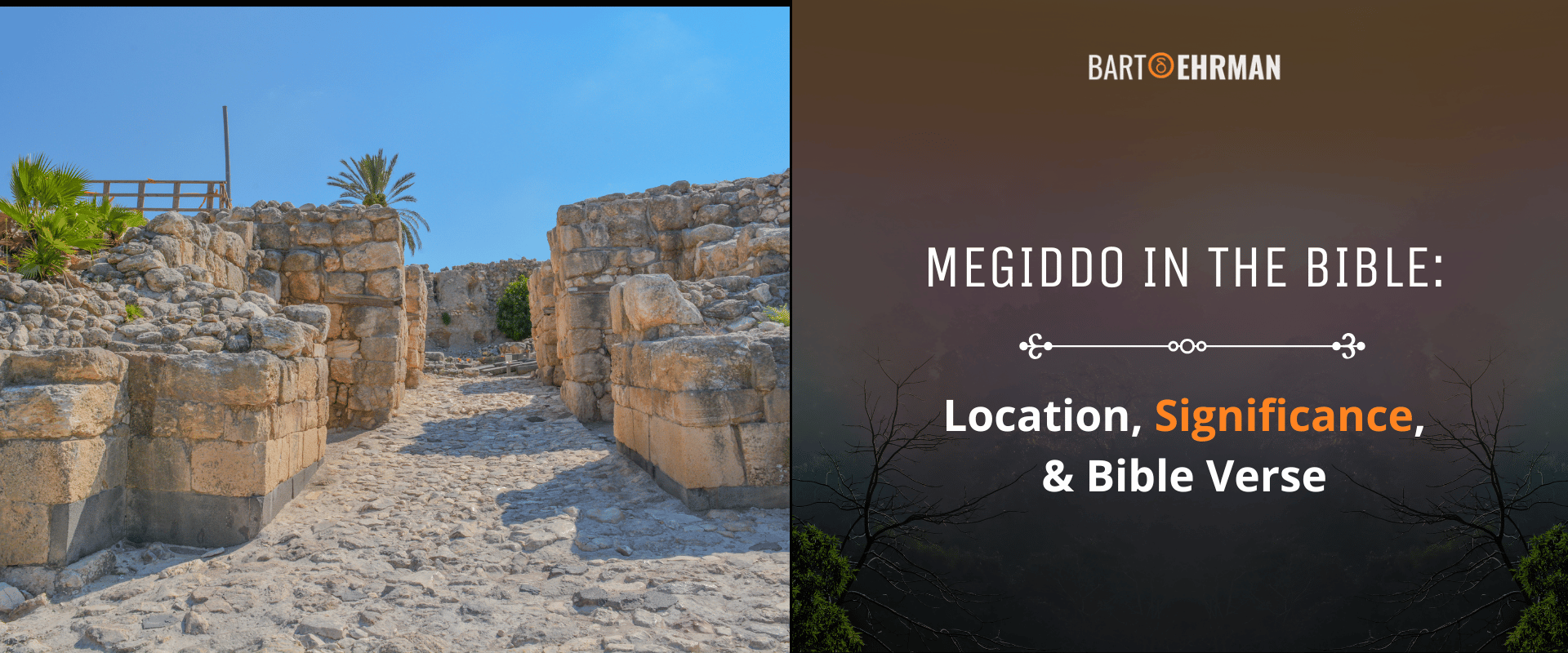
What Is Megiddo? Overview, Geography, Pronunciation, Meaning
The name Megiddo (Hebrew מְגִדּוֹ / Megiddō) is usually pronounced meh-GID-oh or meh-GID-do.
The precise etymology isn’t entirely certain, though scholars often connect it with roots meaning “assembly,” “place of troops,” (see below) or possibly “cut/cleft.” Regardless of the exact derivation, the name itself reveals what the site eventually came to represent: a place where people (especially armies) gathered at moments of decisive conflict.
This ambiguity of meaning mirrors Megiddo’s role in the biblical imagination, where a concrete geographical location gradually became the symbol of critical turning points in Israel’s story.
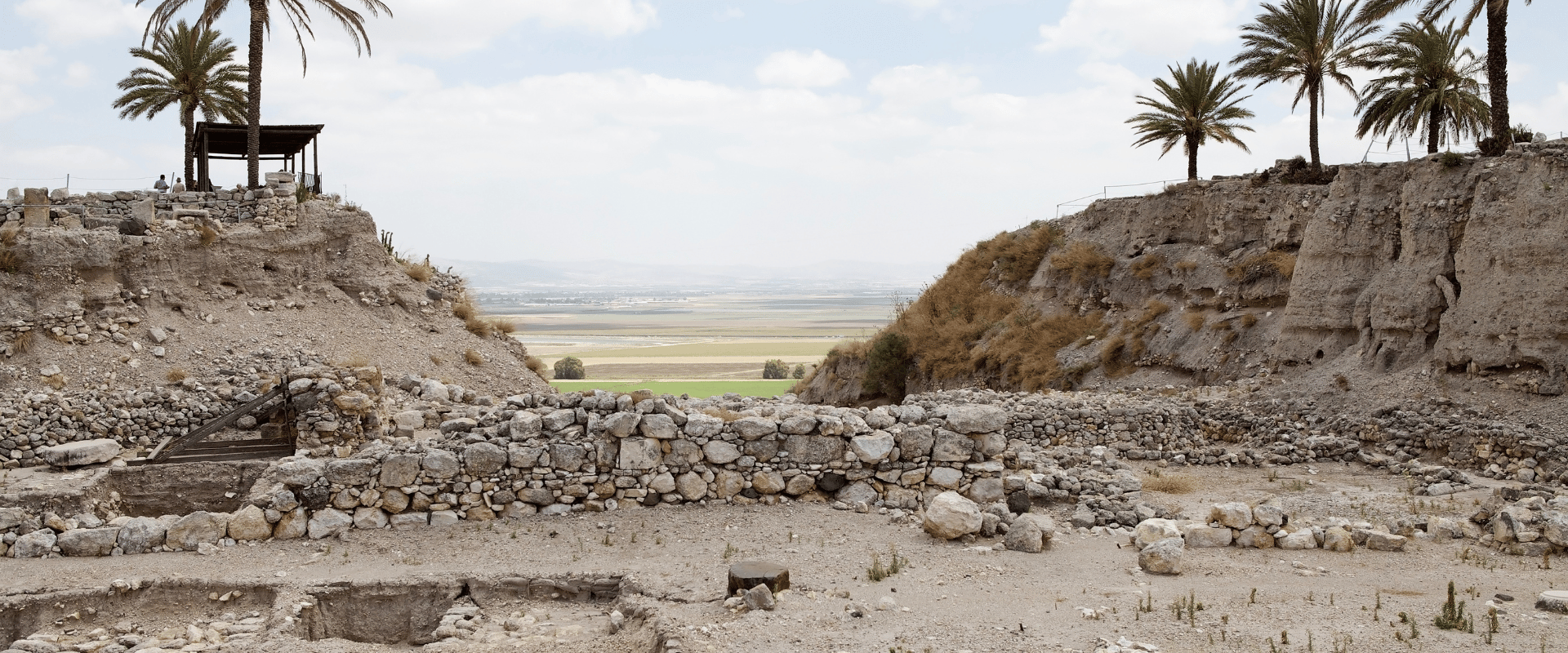
In strictly geographical terms, Megiddo refers to the ancient city located at Tell el-Mutesellim, a large mound positioned at the northeastern foot of the Carmel Ridge in northern Israel. It overlooks the southwestern edge of the Plain of Esdraelon (also known as the Jezreel Valley), one of the major natural corridors that link the Mediterranean coastal plain with the Jordan Valley, Galilee, and the regions beyond.
This landscape isn’t merely scenic! Rather, it’s strategically structured. As Graham I. Davies notes in his study Megiddo (Cities of the Biblical World), the site sits adjacent to the Wadi Ara pass which was (historically) one of the most important routes through the Carmel Ridge, used even by travelers following the coastal road north when marshlands around Mount Carmel made the shoreline impassable.
(Affiliate Disclaimer: We may earn commissions on products you purchase through this page at no additional cost to you. Thank you for supporting our site!)
This convergence of accessible routes helps explain why Megiddo became such an important center in antiquity.
The mound itself rises above fertile terrain shaped by both the plain and the ridge. To the east spreads the Jezreel Valley, composed of alluvial soil with ample rainfall, making it one of the richest agricultural areas in the region.
To the west and south lie the low limestone hills of the Carmel and Manasseh highlands, where terra rossa soil supported vineyards and olive groves in ancient times. Springs dot the area around the site, providing necessary water resources despite occasional seasonal marshiness.
This combination (fertile valleys, cultivable uplands, and steady water sources) created an environment favorable for long-term settlement and agricultural development.
Equally important is Megiddo’s position at a junction of major ancient roads. Routes ran along the edge of the Jezreel Valley toward Beth-shean and the Jordan, across the Carmel Ridge toward the coastal plain, and northward toward Galilee and Syria.
Such a location placed Megiddo at the crossroads of trade, migration, and military movement. A city situated here could both draw wealth from passing caravans and influence (sometimes even control) the movement of armies.
But let’s be honest. If Megiddo (and especially its later transformation into the term “Armageddon”) never appeared in the Bible, most readers today would probably never have heard of this site, no matter how impressive its geography may be.
The truth is, Megiddo’s fame owes far more to the biblical narrative than to its topography, and it’s precisely that biblical story we now turn to, starting with the Old Testament.
Megiddo in the Bible: Old Testament
In our exploration of Megiddo in the Bible, we begin with the Old Testament. We won’t analyze every appearance of Megiddo but will instead focus on the most significant ones, the passages that truly shaped Israel’s memory of this place.
However, don’t worry! We did prepare something for you at the end of this section. I know… We are awesome! So, let’s get started.
Megiddo in the Book of Judges (5:19)
The first major mention of Megiddo in the Old Testament appears in the Book of Judges, within the famous Song of Deborah, one of the oldest poetic texts in the Hebrew Bible. There we read that “the kings came and fought… at Taanach, by the waters of Megiddo” (Judg 5:19).
In this early victory hymn, Megiddo functions not as a city but as a landscape of battle, a geographical setting where the fate of Israel turns on divine intervention.
As Robert G. Boling notes in his Commentary on Judges, the phrase “waters of Megiddo” isn’t a casual topographical detail but an intentional poetic anticipation of the storm and swelling of the Kishon River that ultimately overwhelms Sisera’s chariot forces.
The reference evokes the flood-prone terrain of the Megiddo-Taanach corridor and sets the stage for a battle won not by military superiority but by a dramatic natural event interpreted as an act of God.
The poem also hints at the symbolic power Megiddo would later acquire in Israel’s imagination. The likely meaning of the name Megiddo (something like “place of troops” or “garrison”) fits seamlessly with the poem’s portrayal of multiple kings assembling for war near its streams.
Archaeologically, this period saw a gap or minimal occupation at the mound itself, which means the poet’s focus on the valley, waters, and battlefield rather than the city is entirely appropriate.
The Song’s imagery of stars fighting “from heaven,” understood in ancient Canaanite terms as celestial agents bringing storms, reinforces the sense that Megiddo is a place where earthly armies confront powers beyond their control.
In this earliest biblical appearance, therefore, Megiddo becomes associated not merely with a military encounter but with a decisive, divinely shaped victory. It’s a theme that will reappear in later prophetic and apocalyptic uses of the site.
Megiddo in the 2 Kings (23:29-30) and 2 Chronicles
The second appearance of Megiddo in the Bible that we have chosen comes from 2 Kings 23:29-30. Here the narrative is surprisingly brief. Pharaoh Necho of Egypt is traveling north “to the king of Assyria” at the Euphrates, and Josiah “went to meet him.”
The text doesn’t describe troop deployments or a drawn-out battle. Rather, it simply states that Necho killed Josiah “at Megiddo, as soon as he saw him,” and that Josiah’s servants brought his body back to Jerusalem for burial.
In contrast to the vivid poetry of the Song of Deborah, this is bare, almost annalistic reporting. Yet even in this compressed form, the choice of Megiddo is significant: it lies on the main military corridor between Egypt and the northern empires, which explains why a Judean king and an Egyptian pharaoh would encounter one another there at this crucial moment in the late seventh century B.C.E.
Behind this short notice lies a major geopolitical turning point. Assyria, long the dominant imperial power, was collapsing under Babylonian pressure; Egypt sought to rescue its former enemy-turned-ally and preserve a weakened Assyria as a buffer state.
Necho’s march through the region was part of that strategy, and Josiah’s decision to confront him at Megiddo may have been an attempt to block Egyptian aid and shape the new balance of power, or simply a refusal to allow a foreign army to cross his territory.
The Hebrew, however, only tells us that Necho was going to the king of Assyria. So, it never explains Josiah’s motives and never explicitly mentions a “battle,” despite the dramatic consequences.
Modern discussion therefore stresses both what the text says and what it carefully leaves unsaid: Megiddo is the stage on which Judah’s last strong king is abruptly removed, with no narrative rationale offered.
This silence creates a serious theological tension inside the book itself. In the previous chapter, the prophet Huldah had promised Josiah that he would be “gathered to [his] grave in peace” and spared the sight of the coming disaster (2 Kgs 22:20).
Instead, he dies violently on foreign soil, and Judah’s slide toward destruction accelerates in the years that follow. The Book of 2 Kings offers no explanation, no hint of hidden sin or failure that might justify this outcome.
Michael Coogan, in his Commentary, captures the problem succinctly:
There can be little doubt that the sudden and tragic death of Josiah was considered a calamity by his contemporaries. Later tradition recorded that 'the prophet Jeremiah composed a song of lament for his funeral, which remains to this day.' The Deuteronomistic historian must have been hard put to account for the death of the hero of his narration, a righteous king, the greatest since David. The astonishing fact is that 2 Kgs 23 offers no explanation for the events at Megiddo. The historian could not reconcile Josiah’s death with his world view of just retribution; nor could his death be accommodated to Huldah’s promise that 'you will be gathered to your grave in peace' (22:20).


The result is that Megiddo becomes not only a geographic crossroads but also a narrative crossroads where the Deuteronomistic historian’s usual logic of reward and punishment seems to break down. That very difficulty helps explain why later biblical tradition returns to Josiah’s death there and tries to make deeper sense of it.
Did You Know?
End-Times Forecasts: Mostly Cloudy, Zero Accuracy.
Did you know that Armageddon once played a starring role in several failed end-times predictions? Early leaders of the Jehovah’s Witnesses taught that Armageddon would arrive in 1914, then 1918, and later 1925, each time revising expectations when nothing happened.
At one point, publications even suggested that biblical figures such as Abraham, Isaac, and Jacob would return from the dead to rule from a mansion in California called Beth-Sarim. After Armageddon again failed to materialize, the predictions were quietly reinterpreted as referring to “spiritual” events rather than literal global destruction.
It’s a good reminder that when it comes to predicting the end of the world, humanity’s track record is, well, perfectly consistent: 100% enthusiasm, 0% accuracy.
The later account in 2 Chronicles 35:20-24 retells Josiah’s final encounter with Pharaoh Necho in a markedly different way. Chronicles situates the episode immediately after Josiah’s meticulous celebration of Passover and emphasizes his piety and zeal.
Furthermore, it expands the narrative by emphasizing both the geopolitical stakes and the theological meaning of Josiah’s death. Here Pharaoh Neco is explicitly marching to fight at Carchemish on the Euphrates, and the Chronicler has, as Jacob Meyers notes, “correctly transmitted the course of events,” since Carchemish was indeed “the main military base of the Egyptians during the period of control over Syria-Palestine.”
In this account, Josiah’s opposition to Neco fits a larger international picture: Egypt was hurrying north to reinforce its garrison and assist the Assyrians in their attempt to retake Harran, while Judah, possibly sympathetic to the Babylonians, tried to impede the march.
The Chronicler also frames Neco’s warning in explicitly theological terms, stating that his words “issued from the mouth of God,” even though, as Meyers notes, the pharaoh “certainly did not recognize Yahweh.”
Josiah’s refusal to heed this divinely sanctioned message becomes the interpretive key to his fate. When the archers strike him at Megiddo, the Chronicler sees not an inexplicable calamity but the tragic consequence of ignoring a divine warning conveyed through an unlikely intermediary.
What follows in Chronicles underscores just how deeply Josiah’s death reverberated through Judah. We are told that “all Judah and Jerusalem held mourning rites for Josiah,” and that Jeremiah himself composed a lamentation, a tradition reinforced by the note that male and female singers continued to chant dirges “to this day” (2 Chr 35:24-25).
Meyers highlights this national outpouring of grief, emphasizing that Josiah’s death “evoked profound sorrow throughout the nation and was the occasion for an extended period of mourning.”
Although the specific lament attributed to Jeremiah no longer survives, the Chronicler’s insistence on its existence (and on the ritual remembrance of Josiah’s fall) demonstrates how Megiddo became not only the site of the king’s downfall but also a liturgical and memorial locus, a place where Judah annually revisited the pain of losing its most admired monarch.
Megiddo in the Bible: Zechariah 12:11
The last appearance of Megiddo in the Old Testament that we have chosen comes from a prophetic book: Zechariah 12:11.
The verse speaks of “the mourning in Jerusalem as great as the mourning of Hadad-rimmon in the plain of Megiddo.” Unlike the narrative accounts in Judges and Kings, Zechariah’s reference is retrospective, evoking a well-known historical tragedy rather than describing a new event.
Most modern scholars, as illustrated by Carol L. Meyers and Eric M. Meyers, agree that the text alludes to the death of King Josiah, whose fall at Megiddo became, as we noted, a profound moment of national grief (2 Chr 35:20-25).
The phrase “Hadad-rimmon” is widely interpreted as either a nearby town in the Megiddo region or a cultic site associated with mourning rituals, possibly involving the storm-god Hadad.
In either case, the prophet uses Megiddo as a symbolic point of comparison, assuming his audience knew the story of Josiah’s death and the deep lamentation that followed it. Thus, Zechariah’s reference isn’t geographical for its own sake” Instead, it’s a literary device that pulls forward the emotional weight of a remembered catastrophe.
What is most striking in Zechariah’s use of Megiddo is how it transforms from a battlefield into a metaphor for collective sorrow. Here Megiddo isn’t a strategic pass or a political crossroads but a memory-locus for devastating loss.
In the larger context of Zechariah 12, the prophet envisions a future day when Jerusalem will be delivered yet will also experience intense mourning as part of a process of national purification and restoration.
By invoking Megiddo, the text situates this future grief within Israel’s remembered past, linking eschatological hope with historical trauma. Megiddo thus becomes a bridge between memory and prophecy. Its name evokes a sorrow so iconic that it can serve as an analog for the emotional upheaval accompanying God’s decisive intervention in the future.
And now that we’ve moved from poetry to history to prophecy, there’s only one thing left to do: follow Megiddo where it famously goes next: into the Book of Revelation. So buckle up! If Megiddo’s earlier appearances were dramatic, its grand entrance in the New Testament is the biblical equivalent of a blockbuster sequel. Here comes “Armageddon!”
Megiddo in the Bible: Table (Old Testament Verses)
But wait a minute! We did promise something earlier and we aren’t in the business of breaking our promises. If you’ve made it this far, you deserve a reward.
So before we march onward to the New Testament (with all the apocalyptic fireworks that implies), here’s a complete overview of every place where Megiddo appears in the Old Testament. Think of it as your Megiddo survival guide, minus the chariots, of course!
Biblical Reference | Verse | Context Summary |
|---|---|---|
Joshua 12:21 | “The king of Taanach, one; the king of Megiddo, one.” | Listed among the Canaanite kings defeated in the land. |
Joshua 17:11 | “...and the inhabitants of Megiddo and its villages; the third is Naphath.” | Megiddo lies within territory associated with Manasseh’s allotments. |
Judges 1:27 | “Manasseh did not drive out the inhabitants of Beth-shean and its villages… or Megiddo and its villages…” | It notes incomplete conquest and continued Canaanite presence. |
Judges 5:19 | “The kings came, they fought; then fought the kings of Canaan, at Taanach, by the waters of Megiddo; they got no spoils of silver.” | Poetic reference in the Song of Deborah describing a key battle near Megiddo. |
1 Kings 4:12 | “Baana son of Ahilud, in Taanach, Megiddo, and all Beth-shean, which is beside Zarethan below Jezreel…” | Megiddo is listed within Solomon’s administrative districts. |
2 Kings 9:27 | “...And they shot him in the chariot at the ascent of Gur, which is by Ibleam. He fled to Megiddo and died there.” | King Ahaziah dies at Megiddo while fleeing from Jehu. |
2 Kings 23:29 | “...King Josiah went to meet him, and when Pharaoh Neco met him at Megiddo, he killed him.” | Josiah is killed at Megiddo in a brief but tragic encounter. |
2 Kings 23:30 | “His servants carried him dead in a chariot from Megiddo, brought him to Jerusalem...” | Josiah’s body is transported from Megiddo back to Jerusalem to be buried. |
1 Chronicles 7:29 | “Along with the territory of the Manassites… Megiddo and its villages…” | Parallel list of Manassite towns, including Megiddo. |
2 Chronicles 35:22 | “He did not listen to the words of Neco from the mouth of God, but joined battle with him in the plain of Megiddo.” | The Chronicler’s expanded account of Josiah’s death at Megiddo. |
Zechariah 12:11 | “On that day the mourning in Jerusalem will be as great as the mourning for Hadad-rimmon in the plain of Megiddo.” | Megiddo is invoked as a symbol of profound national mourning. |
Megiddo in the Bible: New Testament
Megiddo appears in the New Testament only once, in the (in)famous Book of Revelation. While Church tradition held for centuries that the book was written by the apostle John, modern scholarship has rejected that notion.
As Ludovic Nobel notes in his Introduction au Nouveau Testament (Introduction to the New Testament):
“The theological and stylistic differences rule out the possibility that the author is the same as the one who composed the Fourth Gospel. Likewise, nothing allows us to identify him with the ‘Elder’ mentioned in 2 and 3 John. We must, in all probability, conclude that the author of the Apocalypse was a member of the Johannine community who, in order to lend greater authority to his work, wrote under the patronage of John, the son of Zebedee, thereby placing his composition within the long tradition of pseudepigraphy. Probably written around the year 95, under the reign of the emperor Domitian (91-96), this work belongs to the apocalyptic literary genre.” (my translation)
By the way, if questions about who actually wrote the New Testament books spark your curiosity, Bart has a free online course you might enjoy: Did Matthew, Mark, Luke, and John Actually Write Matthew, Mark, Luke, and John? It’s a great, accessible overview of how scholars approach issues of authorship.
With this background in mind, we can now turn to the single New Testament passage where Megiddo appears and examine what the author meant by the enigmatic term “Armageddon.”
Megiddo appears in the New Testament only once, under its more famous apocalyptic guise, in Revelation 16:16. The reference occurs in the context of the sixth bowl of God’s wrath, where demonic spirits emerge from the dragon, the beast, and the false prophet to gather “the kings of the whole world” for “the great day of God the Almighty” (Rev 16:13-14).
The narrator then adds a brief but programmatic note: “And they assembled them at the place that in Hebrew is called Harmagedon” (16:16).
Interpreters have long connected Harmagedon with Har-Megiddo, “the mountain of Megiddo,” and this remains the most widespread proposal. The association makes historical sense: Megiddo, as we have seen, was a well-known battlefield in Israel’s memory, linked with decisive and often disastrous conflicts.
Yet the phrase raises an obvious difficulty: there is no “Mount Megiddo.” The site of Megiddo is a mound in a valley, not a towering peak.
Robert Mounce, in his Commentary on Revelation, notes both the strength and the limits of this identification.
On the one hand, Megiddo’s strategic location and long military history make it a natural symbol for a climactic battle; on the other hand, the linguistic form “mountain of Megiddo” and the lack of a real mountain by that name suggest that geography isn’t the author’s primary concern.
For Mounce, the term is best understood symbolically. As he notes, “wherever it takes place, Armageddon is symbolic of the final overthrow of all the forces of evil by the might and power of God.”
Klaus Berger’s Commentary on Revelation helps make sense of why the author of Revelation might speak of a “mountain” at all.
He situated Harmagedon within a much broader apocalyptic tradition of the final battle, in which God gathers the nations (or at least their kings) to a specific location for judgment. Texts such as Ezekiel 38-39, Zechariah 14, and Psalm 2 all envision a final confrontation in which the nations assemble against God or his people and are then decisively defeated.
In many of these traditions the setting is a mountain or a valley flanked by mountains, and Revelation itself has a pronounced “mountain theology” (the Lamb on Mount Zion in Rev 14:1, for example).
Berger therefore argues that the “har” in Har-magedon isn’t accidental. According to his views, the seer deliberately places the final gathering on a “mountain” because mountains are theologically freighted sites of theophany, judgment, and salvation in Jewish apocalyptic imagination.
On this reading, the name may derive from a different expression. As Berger explains:
“Baroque exegesis (as in the Critici sacri, 1701) interprets Har-Magedon as the ‘mountain of assembly.’ This is probably correct. For it is the nations who assemble there, and – unlike in 14:1-7 – this is not a gathering for salvation. Similarly, D. Aune holds that the underlying form is har-moʿed, ‘mountain of assembly’ (see on 14:1). The Hebrew ע was often rendered by the Greek γ. Moreover, in Isaiah 14:13, the mountain functions as a place of assembly for those destined for destruction. According to Isaiah 14:13, the godless king of Babylon declares: ‘I will ascend to heaven; above the stars of God I will set my throne; I will sit on the mountain of the gods, in the far north.’ … Within the framework of contemporary mountain symbolism, and because of Isaiah 14:13, a mountain is the place where the decisive reversal of fortune occurs, and indeed to the detriment of the king of Babylon. He knows that Harmagedon is a site of battle. This function the place/name retains. In this way, something like a typology is created.” (my translation)
What emerges from these discussions is that Armageddon is less a coordinate on a map than a condensed theological symbol. Revelation 16 doesn’t describe troop movements around a particular hill in northern Israel. Instead, it describes how “the kings of the whole world” are deceived by demonic spirits and drawn into a final, futile rebellion against God.
The emphasis falls on demonic deception and divine sovereignty, not on military strategy. The gathering at Armageddon is the last act of resistance in a cosmic drama.
In other words, the powers of the earth, under the spell of the dragon and the beast, assemble in apparent strength, only to be confronted and overthrown by God and the Lamb in the scenes that follow (especially Revelation 19).
In that sense, the “battle of Armageddon” isn’t so much a prolonged combat as the moment when the opposition to God reaches its apparent peak and is instantly shown to be powerless.
FAQ: Megiddo in the Bible
Before we conclude our exploration of Megiddo and its place in the Bible, we should briefly answer a couple of the most common questions readers tend to ask.
Where is Megiddo in the present day? Where is it in relation to Gaza?
Megiddo is located in northern Israel, at Tell el-Mutesellim, overlooking the Jezreel Valley near modern Kibbutz Megiddo. It lies roughly 30 km southeast of Haifa. In relation to Gaza, Megiddo is approximately 150 km (about 95 miles) to the north, in a completely different region of the country.
Can you visit Megiddo?
Yes. Megiddo is a major archaeological park and a UNESCO World Heritage Site, open to visitors year-round. The site includes ancient gates, stables, palaces, and a remarkable Iron Age water system carved into the rock.
It’s a very popular site, mostly because of its connection to the Book of Revelation. As Eric H. Cline, in his book Digging Up Armageddon, explains:
There have actually been numerous Armageddons at the ancient site of Megiddo already, as one civilization, group, or political entity gave way to another over the millennia – one world ending and another beginning – from the Canaanites to the Israelites, and then the Neo-Assyrians, Neo-Babylonians, Persians, Greeks, and Romans, followed in turn by the Muslims, crusaders, Mongols, Mamlukes, Ottomans, and, most recently, World War I and the 1948 Israeli War of Independence. However, it is the New Testament’s Armageddon that is the most famous and which is responsible for attracting the tourists.
Are there ruins at Megiddo?
Absolutely! Excavations at Megiddo have identified over 20 layers of settlement, ranging from the Early Bronze Age to the Persian period. Visitors today can see monumental structures from the Canaanite and Israelite eras, including city walls, cultic areas, and administrative complexes.
Conclusion
As we have seen, Megiddo in the Bible is far more than a dot on an ancient map. It’s a landscape where poetry, history, and prophecy converge; where Israel’s victories were sung; where a beloved king met his tragic end, and where the prophetic imagination transformed past sorrow into a symbol of future hope.
And by the time we reach the New Testament, Megiddo is no longer simply a tell in the Jezreel Valley but a theological signpost pointing toward the climactic moment when evil gathers itself for one last, futile stand.
Few places in the biblical world manage to carry so much narrative weight while remaining so compact: twenty settlement layers stacked neatly in a mound roughly the size of a football stadium.
At the same time, Megiddo’s journey from an ancient Canaanite city to the famous “Armageddon” of popular culture serves as a reminder that biblical places can take on a life of their own. If nothing else, it proves that a site doesn’t need a mountain to become monumental.