
Jerusalem in the Bible: Location, History, and Verses

Written by Joshua Schachterle, Ph.D
Author | Professor | Scholar
Author | Professor | BE Contributor
Verified! See our editorial guidelines
Verified! See our guidelines
Date written: November 20th, 2025
Disclaimer: The views and opinions expressed in this article belong to the author and do not necessarily match my own. - Dr. Bart D. Ehrman
Few cities in the world carry the historical depth, religious weight, and enduring symbolism of Jerusalem. Over the centuries, it has been conquered, rebuilt, sanctified, and fought over by many empires and several faith traditions. Its spiritual pull, however, has never waned.
In this article I’ll explore the complex history of Jerusalem in the Bible and beyond, including its ancient origins, its rise under Israelite kings, its destruction and rebirth, and its enduring presence throughout the Hebrew Bible and New Testament. By tracing both archaeological evidence and biblical narratives, we gain a deeper understanding of how this “city of peace” became a focal point of Jewish, Christian, and, later, Islamic tradition.
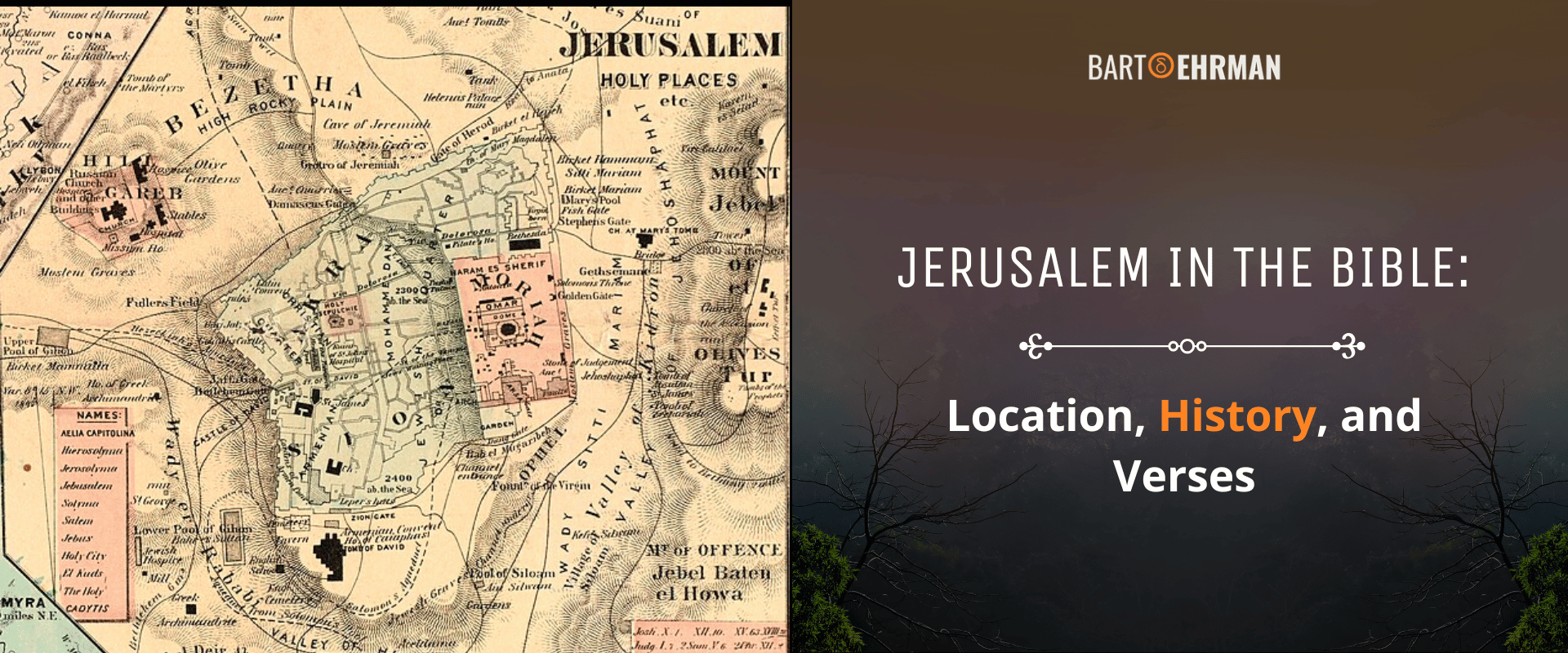
How Old is Jerusalem, and Where is Jerusalem Located?
Jerusalem’s history goes back 5,000 years to approximately 3,000 BCE. In the Zondervan Atlas of the Bible, Carl Rasmussen notes that the earliest settlement in the area was made near the Gihon Spring, a natural source of water located in the Kidron Valley just outside what would become the walls of Old Jerusalem. By Old Jerusalem, I mean the city built later under Israelite kings, but before the Babylonian exile (more on this later).
(Affiliate Disclaimer: We may earn commissions on products you purchase through this page at no additional cost to you. Thank you for supporting our site!)
Rasmussen also writes that the original Canaanite city, then called Urusalimum, is first mentioned by Egyptian texts between the years 2000 and 1550 BCE. In the Historical Atlas of Jerusalem, Meir Ben-Dov writes that the name Jerusalem originally meant “foundation or city of the god Shalem.” Shalem was a Canaanite deity and the patron god of the city before the foundations of biblical Judaism. However, Rasmussen also notes that, although this was undoubtedly the original meaning of the name, the word Shalem is also closely associated with the Hebrew word for peace, shalom. Thus, the name has long been understood to mean “city of peace.”
Archeologists have found very few ruins of buildings from the earliest settlements of Jerusalem, but they have uncovered portions of a thick wall which would have surrounded the city to protect it from invaders. The wall, according to Rasmussen, was built around the year 1800 BCE and remained in use until 586 BCE. This oldest form of the city was comparatively small, covering only about 15 acres.
We also know from the Amarna Letters, a set of 12th-century BCE clay tablets sent as letters between Ancient Egypt and other people groups, that during the 12th century BCE, Jerusalem was a vassal of Ancient Egypt. This meant that Egypt expected loyalty, including Jerusalem’s help in military conquests, and that Egypt offered them protection in turn. By the way, this has nothing to do with the enslavement of the Israelites by Egypt in the Bible, which most scholars agree probably did not happen.
However, the city’s significance increased by leaps and bounds during the Israelite period (1000 BCE to 586 BCE). Most believe that this began with the kingship of David, specifically when David conquered Jerusalem around the year 1010 BCE and made it the capital of the united kingdom of Israel. This would remain the status of Jerusalem throughout the Israelite period. However, here’s where we run into a bit of a historical quandary.
History of Jerusalem
As a historian, I have to point out that there is really only one clear piece of evidence to prove that King David even existed. It is the Tel Dan Stele from around 850 BCE. The inscription on the Stele, written by a non-Israelite king, boasts of conquering two kings, Omri of Israel and an unnamed Judean king “from the house of David.” While this makes it likely that a king named David did exist, it doesn’t give us any other real information about him. If you’re interested in this topic, I recommend reading The Bible Unearthed: Archaeology's New Vision of Ancient Israel and the Origin of Its Sacred Texts by Israel Finkelstein and Neil Asher Silberman, two leading scholars on the history of ancient Israel.
Having said that, I’ll explain the city’s history with references to stories associated with Jerusalem in the Bible from here on in. I’m comfortable taking this approach since Rutgers professor of biblical studies, Hebrew language, and ancient Judaism, Gary Rendsburg, writes that he believes that the account of David’s reign in the books of Samuel and Kings are “essentially historical” (see The Hebrew Bible: New Insights and Scholarship). The traditional dates of David’s reign in Judea are thus said to be from 1010 to 970 BCE.
David’s son Solomon, the next king of Israel, built the First Temple in Jerusalem around the year 962 BCE. Solomon died around 930 BCE and, soon after, the northern kingdom of Israel and the southern kingdom of Judah split, with Jerusalem remaining the capital of Judah under the rule of King David’s grandson Rehoboam. From here on, Jerusalem’s history will be plagued with invasions. Very rarely will Jerusalem be a “city of peace.”
In 925 BCE, the Egyptian pharaoh Sheshonk I invaded most of the land of Canaan, pillaging Jerusalem in the process. This Sheshonk may be the Shishek mentioned in 1 Kings 14:25-26 and 2 Chronicles 12:1-10.
In 850 BCE, Jerusalem was again sacked by a combination army made up of Philistines and Arabs, according to 2 Chronicles 21:16-17. In 830 BCE, during the reign of Jehoash of Judah, King Hazael of the kingdom of Aram Damascus conquered most of the land of Canaan. According to 2 Kings 12:18, King Jehoash, fearing the destruction of his kingdom, offered Hazael all the treasures of Judah, which didn’t stop Hazael from sacking Jerusalem as well.
In 712 BCE, the Neo-Assyrians laid siege to Jerusalem, followed in 670 BCE by the Judahite king Manasseh being captured and brought as a prisoner to the Neo-Assyrian king Sennacherib as Judah became part of the Neo-Assyrian Empire. In 627 BCE, the Neo-Assyrians were conquered by the Neo-Babylonian Empire, which made Jerusalem its vassal.
The Neo-Babylonians would lay siege to Jerusalem twice in response to Israelite rebellions. The first siege occurred from 599-597 BCE, and the Judahite king Jehoiachin was taken into captivity in Babylon. The second occurred from 587-586 BCE. This time, however, the city was razed, including the First Temple, and the wealthiest leading citizens of Jerusalem were taken into captivity in Babylon, an event that would prove to be the impetus for the composition of much of the Hebrew Bible.
In 539 BCE, the Persians defeated the Neo-Babylonians and took over their lands and peoples. The Persian king, Cyrus the Great, allowed the Israelite captives to return to Jerusalem and rebuild the Temple, although many chose not to return, having been in Babylon for almost 50 years. The Second Temple was built in 516 BCE under the Persian king Darius the Great. Thus began a short-lived period of autonomy in Judah.
However, in 332 BCE, Macedonian king Alexander the Great came stomping into Jerusalem as its newest conqueror. Alexander died, however, in 323 BCE, leaving a power vacuum and causing infighting among Alexander’s generals vying for Alexander’s lands and power. This led to the creation of different Greek dynasties in the region of Israel. The first of these generals was Ptolemy I Soter, founder of the Ptolemaic dynasty who first controlled the land of Egypt. However, in 301 BCE, after a series of battles between competing Greek generals, Seleucus I Nicator, ended up with control of Judah. This was the beginning of the Seleucid Empire.
In 200 BCE, the army of the Seleucid Empire, under their king Antiochus III the Great, officially conquered and took control of Jerusalem from the Ptolemies. The king’s son, Antiochus IV Epiphanes, then succeeded his father as king. Antiochus attempted to exterminate the Jewish religion by outlawing the Sabbath and circumcision and setting up an altar to Zeus in the Second Temple, a grave instance of blasphemy.
This eventually prompted a full-scale Jewish revolt in 167 BCE known as the Maccabean Revolt since Judas Maccabeus led it. This led to an initial Seleucid defeat, but eventually, the Maccabees were defeated by the Seleucids who maintained control of Jerusalem. However, descendants of the Maccabees, known as the Hasmoneans, were allowed to rule as client kings under the Seleucids.
Meanwhile, the Roman Republic was rapidly expanding its territory and moving toward Jerusalem. In 63 BCE, the Roman general Pompey conquered Jerusalem, effectively making it Roman territory. Their practice was to allow locals to run the day-to-day operations under a loose Roman supervision, so the Hasmoneans continued to rule. However, in 45 BCE, a local aristocrat named Antipater the Idumean was made procurator of Judea by the Roman dictator Julius Caesar. When Antipater was killed, his sons, Herod and Phasael took over his duties, although a Hasmonean king still retained control.
However, in 40 BCE another Hasmonean king staged a coup, taking the throne of Jerusalem and prompting Phasael to commit suicide and Herod to flee to the Romans for help. While Herod was in Rome, the Roman Senate declared him “King of the Jews.” Thus emboldened, Herod returned to Jerusalem with a large army and, in 37 BCE, defeated the Hasmonean usurper, taking the throne of Jerusalem for himself. However, for the rest of his reign he remained a client king of Rome. He would rule until his death in 4 BCE.
Herod was best known for his massive building projects. He greatly expanded the Second Temple complex, and built palaces and fortresses all over the region of Judea. Herod’s expanded Temple became the defining feature of Jerusalem, remaining so as the 1st century CE began around the time of the birth of Jesus (sometime between 6 and 4 BCE, according to scholars).
Jesus’ ministry, taking place almost exclusively in the region of Galilee, happened sometime between 25 and 30 CE. However, near the end of his life in 30 CE, he traveled to Jerusalem for the Passover celebration. While there, he was arrested by the Romans and crucified under the Roman procurator Pontius Pilate. Thereafter, the church founded in his name would be based in Jerusalem.
Finally, from 66-73 CE, there was a major Jewish revolt against the Romans. Titus, a general and the son of the Roman emperor Vespasian, was sent to Jerusalem to quell it in 70 CE. His long siege of the city would ultimately result in Jerusalem’s destruction and, most notably, in the total demolition of the Second Temple.
Below is a table of those significant events in Jerusalem’s history for easier reading.
Year | Event |
|---|---|
2000 BCE | First mention of the city in Egyptian texts. |
12th century BCE | Amarna Letters suggest Jerusalem is a vassal of Egypt. |
1010 BCE | King David conquers the city and makes it his capital. |
962 BCE | King Solomon builds the First Temple. |
925 BCE | Egypt sacks Jerusalem. |
850 BCE | Jerusalem sacked by Philistine and Arabian armies. |
830 BCE | King Hazael of Aram Damascus conquers Canaan, gaining tribute from Jerusalem. |
712 BCE | Neo-Assyrian siege of Jerusalem. |
627 BCE | Neo-Babylonians replace Neo-Assyrian Empire. |
599-597 BCE | First Babylonian siege of Jerusalem. |
587-586 BCE | Second Babylonian siege of Jerusalem. First Temple destroyed, people taken into captivity. |
539 BCE | Persian Empire conquers Babylonians. Israelite captives allowed to return and rebuild. |
516 BCE | Second Temple built. |
332 BCE | Alexander the Great conquers Jerusalem. |
323 BCE | Alexander the Great dies, setting off battles for control among his generals. |
312 BCE | Ptolemaic dynasty takes over Jerusalem. |
200 BCE | Seleucid Empire takes over Jerusalem. |
175 BCE | Antiochus IV Epiphanes takes over, trying to eliminate Judaism. |
167 BCE | Start of Maccabean revolt. |
160 BCE | End of Maccabean revolt. |
63 CE | Pompey conquers Jerusalem for Rome. |
40-37 CE | With Roman help, Herod the Great conquers Jerusalem and becomes client king. |
6-4 BCE | Birth of Jesus. |
28-30 CE | Ministry of Jesus. |
30 CE | Jesus crucified. |
66-73 CE | Jewish revolt against Rome. |
70 CE | Rome destroys Jerusalem including the Second Temple. |
Jerusalem in the Hebrew Bible
What does the Bible say about Jerusalem? The first mention of Jerusalem in the Bible is from Genesis 14:18, where it is called Salem, and is the city of King Melchizedek, who gives Abraham a blessing. The first time it is called Jerusalem is in Joshua 10:1, where it is the city of a Canaanite king whom Joshua is planning to conquer.
As I mentioned above, King David made Jerusalem his capital, making it the most sacred city in Judaism to this day. In fact, the name Jerusalem appears 669 times in the Old Testament. In Contested Holiness: Jewish, Muslim, and Christian Perspectives on the Temple Mount in Jerusalem, Gonen Rivka notes that, as the holiest city in Judaism, Jerusalem has long been the place toward which Jews turn and face during prayer throughout the world.
The Jerusalem temples were the places used for all religious rituals required by God, including burnt offerings, and special prayers and rites to be performed only by the High Priest. While one could pray to God in a local synagogue elsewhere, the required sacrifices could only be made in the Jerusalem temple. Since the temples were there, Jerusalem was literally believed to be the dwelling place of God. As Solomon says to God after building the First Temple,
The Lord has said that he would dwell in thick darkness.
I have built you an exalted house,
a place for you to dwell forever.


Jerusalem was also the place where the storied Davidic dynasty began and thus it continued to be a symbol of Israelite unity.
When the Second Temple was still standing, Jerusalem was the major pilgrimage site for Jews, especially on high holidays. After its destruction, the Romans banned Jews from living in Jerusalem. This, along with the destruction of the all-important Second Temple, forced Jewish religious authorities to move their base to another city known as Yavneh. The destruction of the Temple thus caused the beginning of what we call Rabbinic Judaism, which focused on the significance of texts rather than sacrifices.
By the way, if you’re interested in Jerusalem in the Hebrew Bible, check out Bart Ehrman’s Hebrew Bible course featuring Joel Baden.
Jerusalem in the New Testament
Jerusalem is understood as the birthplace of Christianity. Jesus was crucified there and his church formed, grew, and developed in Jerusalem before expanding to other lands. In Luke 2:22, the infant Jesus was brought to the Jerusalem temple soon after his birth. Shortly before his death, Jesus created a scene in Jerusalem by “cleansing the temple,” driving out the money changers in dramatic fashion (Matt 21:12-16, Mark 11:15-17, Luke 19:45-46, and John 2:14-16).
After Jesus’ resurrection in Jerusalem, the striking events of Pentecost also occurred in Jerusalem (Acts 2). The Jerusalem church continued to be the hub around which all the other distant churches revolved. Paul visited Jerusalem to meet Peter and the original apostles and get their approval for his own mission to the Gentiles (Galatians 2:1-10). In fact, the Jerusalem council (Acts 15), in which the original apostles and Paul participated, was a major turning point for Christianity, prompting significant decisions about what would be required of Gentile converts to the faith.
Another indication of Jerusalem’s importance in the New Testament is the way it’s used as a symbol. In the book of Revelation, for instance, God’s heavenly kingdom to come is called the New Jerusalem (Rev 21:2), ostensibly replacing the Old Jerusalem, which had been all but destroyed by the Romans who represented Revelation’s villains.
Of course, on top of all of these references, Christians continued to revere Jerusalem for its historical and spiritual significance to Judaism, without which Christianity could not have existed.
Conclusion
Jerusalem’s significance to three major world religions—Judaism, Christianity, and, later on, Islam— is so staggering that it can’t possibly be overstated. It’s interesting, then, to note its humble beginnings as a small tribal settlement near a spring in southern Israel.
In fact, Jerusalem’s history is fraught with blood and conflict, not only the initial conquest by David to establish his dynasty there and make it his capital, but also centuries of conquests by surrounding peoples including the Babylonians who took many of Jerusalem’s citizens into exile.
Despite this, much of Jerusalem’s importance lies in the spiritual realm, which partially explains the many references to Jerusalem in the Bible. Solomon built the First Temple there, a place where God was said to dwell. After its destruction by the Babylonians, a Second Temple was built in Jerusalem, later made even grander by King Herod. On top of this, Christianity’s most formative events—the crucifixion, the resurrection, Pentecost—all occurred in Jerusalem, making the city an indispensable part of Christian history, as well.