
Babylon in the Bible: Israel’s Great Enemy to the North

Written by Joshua Schachterle, Ph.D
Author | Professor | Scholar
Author | Professor | BE Contributor
Verified! See our editorial guidelines
Verified! See our guidelines
Date written: November 20th, 2025
Disclaimer: The views and opinions expressed in this article belong to the author and do not necessarily match my own. - Dr. Bart D. Ehrman
Few names carry as much weight—or as much menace—as Babylon in the Bible. To ancient Israel, Babylon was not merely a distant city on the plains of Mesopotamia; it was the very embodiment of oppression, arrogance, and godless power.
This article explores Babylon’s journey from historical kingdom to biblical villain. Long after the city itself fell to dust, its name lived on—transformed in Jewish and Christian imagination into a lasting symbol of worldly corruption and divine judgment.
What’s in a Name?
Let’s start with a little etymology: Where does the name “Babylon” come from, and what does it mean? The word we write as Babylon in English is taken directly from the Latin rendering of the Greek form Babylōn (In Greek, it’s written Βαβυλὼν). That Greek form, in turn, was derived from the native language of the Babylonians, a semitic language called Akkadian, which called the city Bābilim. Bab in Akkadian meant gate and ilim meant god or gods. The name thus meant “the gate of the gods.” This meaning was derived from an even older reference to Babylon in the Sumerian language. The Sumerian form was Kan dig̃irak, also meaning “gate of the gods.”
Interestingly, the Hebrew rendering of Babylon in the Bible is Babel, a word you might remember from the story of the Tower of Babel in Genesis 11:1-9. In that story, the author, making a play on words, mixes the word Babel with the Hebrew word bā·lal which means “confused.” This is an apt name since the story is about God confusing the ambitious humans building the tower by changing their languages.
Location and History: the Old Babylonian Empire
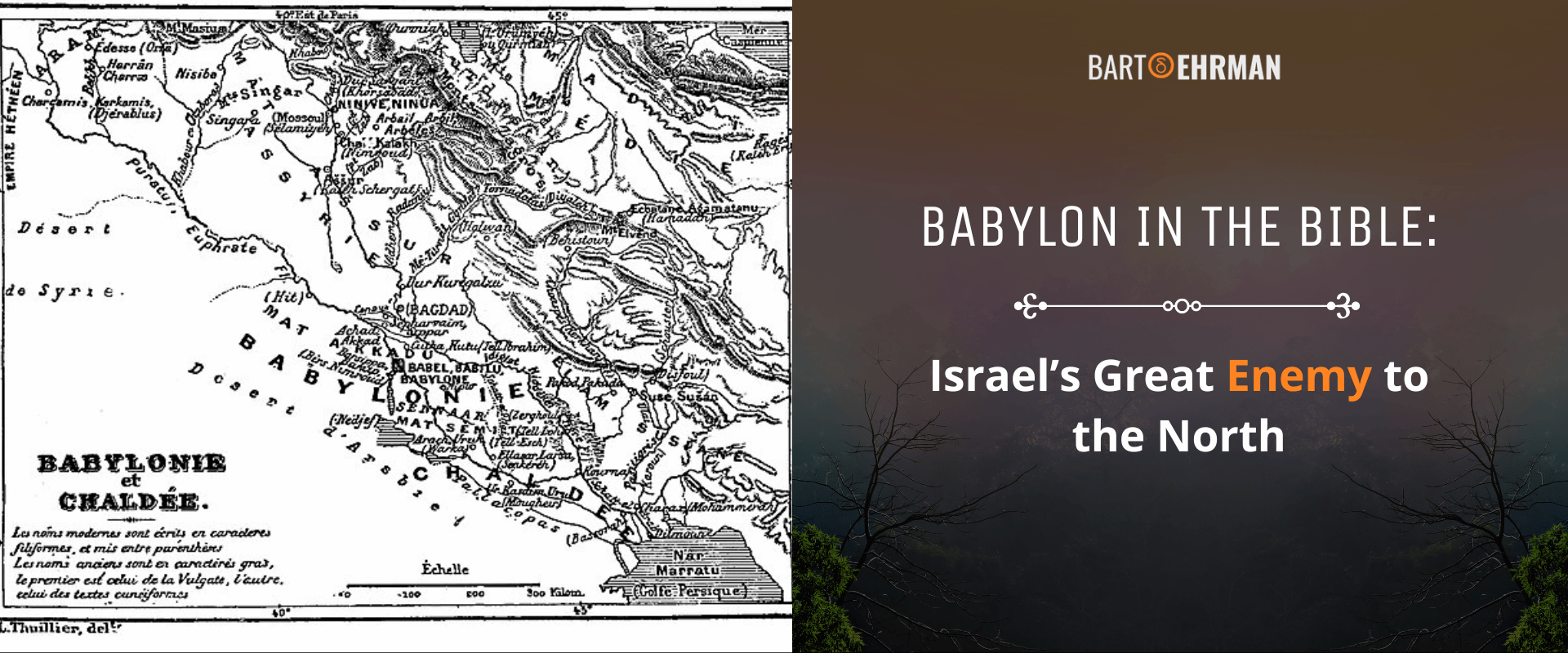
The city of Babylon was located in modern-day Iraq, about 50 miles from modern-day Baghdad, in fact. It was the political and social center of not one but two major empires: the Old Babylonian Empire from the 19th to the 16th centuries BCE, and the Neo-Babylonian Empire from the 7th to the 6th centuries BCE.
In A History of Babylon, 2200 BC - AD 75, Paul-Alain Beaulieu writes that the earliest mention of the city comes from a clay tablet from sometime between the years of 2217-2193 BCE. On this tablet, Babylon is referred to as a small town that is nevertheless a religious center for the Akkadian Empire. For this reason, the tablet mentions that the Akkadian king at the time, Shar-Kali-Sharri, built two temples there. The next reference, some three centuries later, mentions Babylon as part of another empire, the Amorites.
(Affiliate Disclaimer: We may earn commissions on products you purchase through this page at no additional cost to you. Thank you for supporting our site!)
The Amorite King Sumu-la-El, who reigned from 1880-1845 BCE, was likely the first king of what we now call the Old Babylonian Empire. Records from his reign note that his armies had great victories, conquering surrounding lands and making Babylon from a mere town into a city-state. In other words, it became much more than just a city.
From 1792 to 1750 BCE, the Babylonian city-state was ruled by the Amorite king Hammurabi. This king is most famous for consolidating Babylonian laws into the Code of Hammurabi, the clearest and best-preserved list of laws from ancient Mesopotamia. However, although he conquered and incorporated a lot of surrounding territory, which would become known collectively as Babylonia, Hammurabi’s empire evidently didn’t last long. After Hammurabi’s death, the empire quickly broke into local dynasties, ending the Old Babylonian Empire.
The Neo-Babylonian Empire
For the next 850 years, Babylon was conquered and incorporated by a number of other empires, including the Arameans, the Chaldeans, and the Assyrians. In 689 BCE, citizens of Babylon staged a revolt against the Assyrian king Sennacherib. The result was the complete destruction of Babylon by the Assyrians. Future Assyrian kings would rebuild the city for their own use.
Eventually, however, a Babylonian king named Nabopolassar (reigned from 626-609 BCE) was able to throw off the yoke of the Assyrian Empire. In With Arrow, Sword, and Spear: A History of Warfare in the Ancient World, Alfred Bradford writes that this conquest signaled the end of the Assyrian Empire and the rise in its place of the Neo-Babylonian Empire.
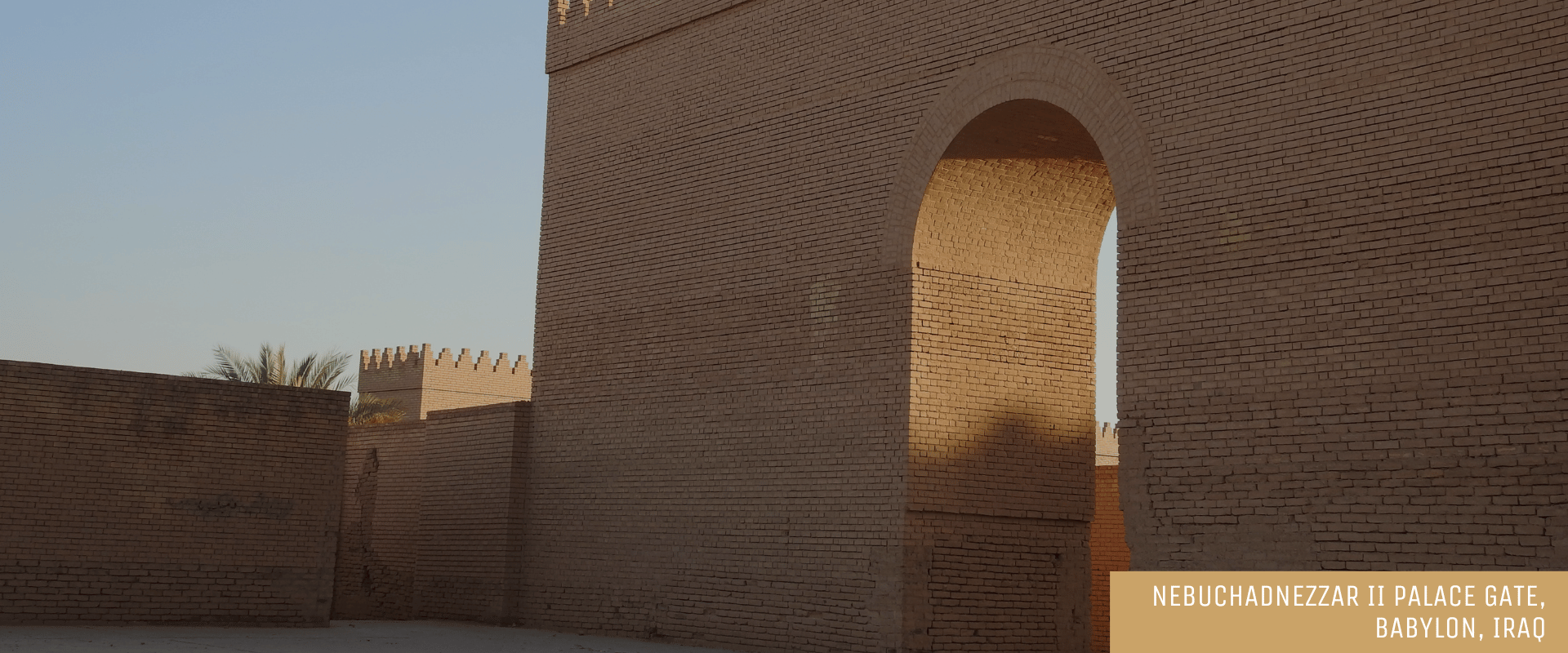
Now that Babylon was finally free of outside control, it once again expanded. While this began with Nabopolassar, it increased massively under his son and successor Nebuchadnezzar II, according to the book Babylonians by H.W.F. Saggs. This included the rebuilding of the Etemenanki ziggurat, a rectangular 300-foot-tall tower dedicated to the Babylonians’ chief god, Marduk. Nebuchadnezzar also initiated another impressive construction project, the 50-foot-high Ishtar Gate, an ornate structure leading to the inner walls of the city of Babylon. Finally, Nebuchadnezzar also ordered the construction of the famous Hanging Gardens of Babylon, which was touted as one of the Seven Wonders of the Ancient World.
Like all kings, especially those who ruled over powerful ancient empires, Nebuchadnezzar built these massive structures to monumentalize his rule by leaving his mark on the landscape. However, it turns out that his worldwide fame would be ensured not by his impressive buildings but by his depiction in the Hebrew Bible, where he is portrayed as the cruel, anti-Yahweh king who destroys Jerusalem and carries many of its inhabitants off to exile in Babylon.
Nebuchadnezzar II died in 561 BCE, and Babylon was subsequently conquered in 539 BCE by the Persian Empire.
Babylon in the Bible
Given Nebuchadnezzar’s role as a villain, it’s not surprising that Babylon shows up a lot in the Hebrew Bible. Let’s look at some of those references.
Remember that the Hebrew word for Babylon was Babel. In fact, the story of the Tower of Babel, in which God foils a human plot to make a tower to reach heaven, is set in “the land of Shinar,” another name for the region that would become Babylonia. This is not surprising since scholars have surmised that the final editing and compilation of the Pentateuch, the first five books of the Bible, were written during Israel’s Babylonian exile.
Meanwhile, in 2 Kings 20:12, King Hezekiah of Judah became ill and Baladan, the king of Babylon, sent him gifts. This was before the days of Nebuchadnezzar, however, a time when Babylon was not nearly as powerful as it would become. Intriguingly, this incident is also referred to in Isaiah 39:5-6, which was written after Babylon had invaded and destroyed Jerusalem in. In this version of the story, the prophet speaks to King Hezekiah:
Isaiah said to Hezekiah, “Hear the word of the Lord of hosts: Days are coming when all that is in your house and that which your ancestors have stored up until this day shall be carried to Babylon; nothing shall be left, says the Lord.”


While this prophecy would obviously come true, Isaiah 13:19-20 also predicts Babylon’s later downfall:
And Babylon, the glory of kingdoms,
the splendor and pride of the Chaldeans,
will be like Sodom and Gomorrah
when God overthrew them.
It will never be inhabited
or lived in for all generations;
Other prophetic books, such as Jeremiah and Ezekiel, also contain many references to the Babylonian captivity and to Babylon’s eventual destruction. However, nowhere is the story of the Babylonian exile written about more poignantly than in the book of Daniel.
Daniel is said to be a Hebrew prophet taken into exile in Babylon by Nebuchadnezzar. Due to his prophetic abilities, though, Nebuchadnezzar ends up favoring Daniel, along with some of his companions.
However, while the book of Daniel claims to be written during the exile, scholars have long known that it was written much later. In the introduction to Daniel in the HarperCollins Study Bible, Pamela Milne writes that, although the book claims to be written in the 6th century BCE during the Babylonian captivity, there are strong indications of a later date of composition projected back onto the story:
The fact that chapter 11 obviously refers to Antiochus IV Epiphanes, the Seleucid ruler from Syria, makes it clear that the book took its final form during Antiochus’s persecution of the Jews, which began with the desecration of the temple in 167 BCE.
As a result of the trauma of the exile, along with all the scriptural references to Babylon’s wickedness, Jewish traditions understandably continued to associate Babylon with any sort of opulent oppressor, including Rome later on. This brings us to New Testament references to Babylon.
The lion’s share of NT references to Babylon in the NT come from the book of Revelation, where it is used as a symbol for Rome. We see this perhaps most clearly in Revelation 17:1-6, with its depiction of the Whore of Babylon:
Then one of the seven angels who had the seven bowls came and said to me, “Come, I will show you the judgment of the great whore who is seated on many waters, with whom the kings of the earth have engaged in sexual immorality and with the wine of whose prostitution the inhabitants of the earth have become drunk.” So he carried me away in the spirit into a wilderness, and I saw a woman sitting on a scarlet beast that was full of blasphemous names, and it had seven heads and ten horns. The woman was clothed in purple and scarlet and adorned with gold and jewels and pearls, holding in her hand a golden cup full of abominations and the impurities of her prostitution, and on her forehead was written a name, a mystery: “Babylon the great, mother of whores and of earth’s abominations.” And I saw that the woman was drunk with the blood of the saints and the blood of the witnesses to Jesus.
The author, John of Patmos, has no idea of the significance of what he’s seeing at the time. However, the angel explains it to him. As Bart Ehrman notes
the seven heads of the beast are actually seven mountains on which the woman is seated (17:9). Anyone living in the ancient world would by now have no trouble figuring out who she is. For those not who do not understand the clue, the angel provides the final answer “The woman you saw is the great city that rules over the kings of the earth” (17:18).
The Whore of Babylon is Rome, and the vision is stating symbolically that Rome is evil and in league with Satan (20:2). But why call Rome Babylon? Well, the first Jerusalem temple was destroyed by the ruler of the Babylonian Empire, Nebuchadnezzar. But by the time John is writing at the very end of the 1st century CE, the second temple has also been destroyed by Rome. Hence, Rome is equal to Babylon and therefore equally wicked, to say nothing of how they are persecuting Christians, according to John.
While these symbols may not be clear to your average 21st-century reader of Revelation, readers of John’s time would likely have understood the symbolism right away.
Conclusion
Babylon was one of a succession of impressive Near East empires in the years in which much of the Hebrew Bible was written. They rose and fell like all empires, but the second iteration of their rule remains immortal, thanks to all the references to Babylon in the Bible as a villain in the story of Israel.
Babylon was initially a small town. While it wasn’t a political center, it was a center for religious activity. Perhaps this is the reason that the city grew and grew, becoming the political and cultural base for a mighty empire as well.
Actually there were two Babylonian empires. The first, dubbed the Old Babylonian empire, was relatively short-lived, ruled first by Amorite King Sumu-la-El and then by the famous lawgiver Hammurabi, who built it into an impressive regime. However, after Hammurabi’s death, the empire quickly declined and broke into different kingdoms.
However, eight-and-a-half centuries later, a king named Nebuchadnezzar took the slowly-growing empire his father was building and made it into a powerhouse, including impressive buildings and the Hanging Gardens of Babylon. This was only done, though, through conquering territory and people, including the Israelites who were taken into captivity in the 6th century BCE.
This is why the Israelites who wrote and compiled the Hebrew Bible had nothing good to say about Babylon or Nebuchadnezzar. And even the author of Revelation, centuries later, took those evil associations with Babylon and applied them to Israel’s current “Babylon,” Rome.
By the way, if you’re interested in scholarship on the Hebrew Bible, check out Bart Ehrman’s course with Hebrew Bible scholar Joel Baden here.