
Gospel of Philip: Author, Date, & Exclusion from Bible
Written by Joshua Schachterle, Ph.D
Author | Professor | Scholar
Author | Professor | BE Contributor
Verified! See our editorial guidelines
Verified! See our guidelines
Date written: October 10th, 2025
Disclaimer: The views and opinions expressed in this article belong to the author and do not necessarily match my own. - Dr. Bart D. Ehrman
When most people think of the Gospels, they think of the four familiar accounts of Jesus’ life and teachings found in the New Testament. But in the early centuries of Christianity, there were many more writings that claimed to tell the story of Jesus, explore his teachings, or offer deeper spiritual insight. One of the most intriguing of these is the Gospel of Philip—a mysterious, symbol-rich text ultimately excluded from the Christian biblical canon.
So who wrote this gospel, when was it written and why can’t we find the Gospel of Philip in the Bible today? To answer these questions, we need to dive into the theological battles, lost traditions, and alternative Christianities that shaped the early Church—and ultimately, defined orthodoxy by what it chose to leave out.

Gospel of Philip Overview
You may already know that in addition to the four Gospels in the Bible—Matthew, Mark, Luke, and John—there were many other gospels that didn’t make the New Testament cut. Some of these, such as the Gospel of Thomas, have become widely known. Others, however, are more obscure, including the Gospel of Philip.
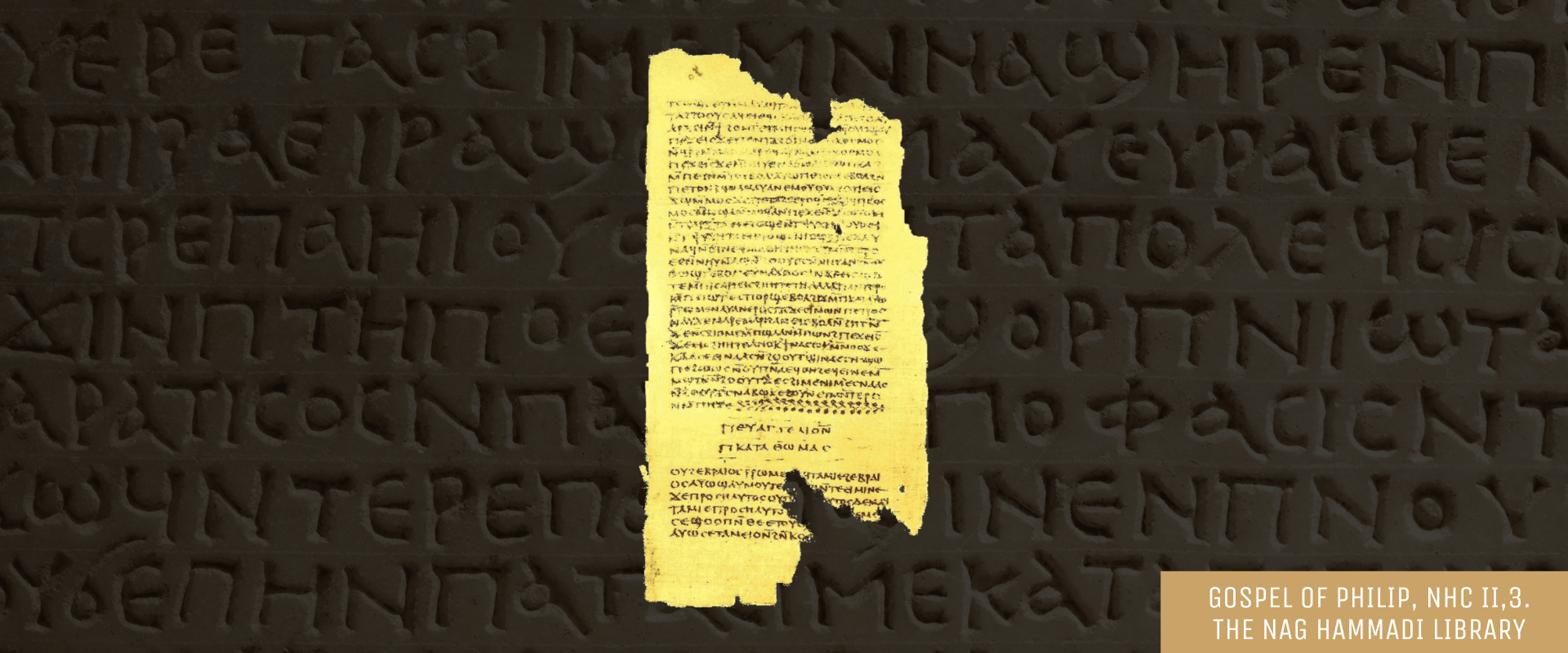
The one extant manuscript of this gospel was found, along with many other early Christian texts, near a town called Nag Hammadi in Egypt in 1945. Other Christian authors had written about some of these texts, while others were all but unknown until being found at Nag Hammadi. The Gospel of Philip was discovered bound together in the same codex, an early book form, with the Gospel of Thomas. This may imply that the two texts were meant to be viewed as one whole unit, although there is no scholarly consensus about this.
The text of the Gospel of Philip, like many of those found at Nag Hammadi, can be broadly put under the category of Gnosticism. However, as I pointed out in this earlier article, many scholars continue to find the word Gnosticism far too vague to precisely describe all the ancient Christian factions usually lumped together under that classification. In this case, for example, most scholars, including Bart Ehrman, specifically place the Gospel of Philip under the category of Valentinian Gnosticism (more on that later).
In Lost Christianities: The Battles for Scripture and the Faiths We Never Knew, Ehrman agrees with most scholars who argue that the Gospel of Philip was written in the 3rd century. The manuscript was in Coptic, the last phase of the Egyptian language before Arabic became the principal language of Egypt. Although the text’s title appears at the end of the manuscript, it does not claim to be written by Philip. In fact, Ehrman notes that the only connection to Philip in the text is that he is the only one of the original 12 apostles mentioned by name.
(Affiliate Disclaimer: We may earn commissions on products you purchase through this page at no additional cost to you. Thank you for supporting our site!)
So if the Gospel of Philip was a Valentinian Gnostic text, what exactly was Valentinian Gnosticism?

Who Was Valentinus?
Valentinian Gnosticism was named for its founder, a man named Valentinus (100-175 CE). Valentinus was an Egyptian who was classically educated in Alexandria, one of the great cities of learning in the ancient world. While not born to a Christian family, he converted to Christianity and became a teacher. This is important: he and his followers didn’t call themselves “Gnostics,” but Christians. Valentinus eventually moved to Rome to continue his career as a Christian teacher.
Unfortunately, much of what we know about Valentinus and his followers comes from people who hated him. Christian authors who specialized in vilifying heretics wrote about him and his movement. This means we have to take their descriptions of his teachings with a grain of salt, as their whole purpose was to make Valentinus look bad.
In her Introduction to Gnosticism: Ancient Voices, Christian Worlds, Nicola Denzey Lewis notes that Valentinus must have been an impressive philosopher and charismatic leader as he was almost elected the bishop of Rome (otherwise known as the Pope)! However, after staying in Rome for about 20 years, Valentinus either died there or returned to Alexandria briefly before his death.
What Did the Valentinians Believe?
While we do have some Valentinian texts, such as the Gospel of Philip, they are often hard to understand and, for the most part, don’t contain any sort of systematized beliefs. Most of what we can say about their beliefs comes from the writings of 2nd-century heresy hunter Irenaeus of Lyons, who singled them out for his most pointed vitriol. On the one hand, this means we have to be wary of taking Irenaeus’ opinions as incontrovertible facts. On the other, it’s all we’ve got in terms of explaining a general set of Valentinian beliefs.
Lewis points out that one of the main things that angered Irenaeus about the Valentinians is that they so closely resembled Irenaeus’ own group, which scholars call proto-orthodox Christians. This is why, in Irenaeus’ book Against Heresies, he calls Valentinian teachers “wolves in sheep’s clothing.” However, whatever similarities existed, Irenaeus made a point of emphasizing the differences.
In terms of cosmology, he says the Valentinians believed that, in the beginning, there was something called the Pleroma, Greek for “fullness,” at the center of which was a divine being known as the Father. Eventually, 30 beings called Aeons emanated from the Father. These Aeons were composed of 15 pairs of male/female counterparts. Among the Aeons was Sophia, or Wisdom. However, because Sophia had strong passions and curiosity, she fell away from the Pleroma and human beings.
Meanwhile, the flawed god of the Old Testament, whom the Valentinians called the Demiurge, then created the world we know. This notion, that an imperfect or even evil god had created the material world, was a common feature of Gnostic thought.
Human beings, who were both spiritual and physical, were the highest creation of the Demiurge. In her book The Gnostic Gospels, Elaine Pagels writes that, for many Gnostic sects, the aim of salvation was to free human beings from the material world. This could be done through obtaining special, mystical knowledge (Greek: gnosis).
This is a (very) basic summary of Valentinian beliefs, but it’s enough for us to begin to explore the Gospel of Philip. By the way, if you’re still unsure about why you won’t find the Gospel of Philip in the Bible, remember that proto-orthodox Christians such as Irenaeus labeled the authors and readers of this and other so-called Gnostic texts as heretical. The proto-orthodox won the war to define the soul of Christianity, so later Christians rejected the Gospel of Philip out of hand.
What’s in the Gospel of Philip?
As I mentioned, the Gospel of Philip has an unnamed author, so all we can say for sure about him is that he lived sometime in the 3rd century and was a Valentinian Gnostic. Beyond this, we can only peruse the contents of the Gospel for clues.
Like the Gospel of Thomas, the Gospel of Philip has no overarching narrative, a fact which differentiates it sharply from the canonical Gospels. Instead, it’s a collection of sayings, parables, dialogues, and biblical interpretations focused primarily on the book of Genesis.
One early translator of the Gospel of Philip into English, Wesley Isenberg, noted that while the text includes seventeen sayings attributed to Jesus, nine are nearly identical to sayings in the canonical Gospels. Some are difficult to translate, as they contain gaps in the text (due to the age of the manuscript) which translators have to fill in as best they can through speculation. Unlike the canonical Gospels, there is only one manuscript to work with. Here are a couple of examples:
"Whoever doesn't eat my flesh and drink my blood doesn't have life in them." (Gospel of Philip, Resurrection, 57).


While John 6:53 is almost identical to this saying, the Gospel of Philip goes on to explain the phrase in a way that differentiates it from the meaning of John’s version:
What's his flesh? It's the Word, and his blood is the Holy Spirit. Whoever has received these have food, drink, and clothing.
There is also this phrase ascribed to Jesus:
Enter your closet, shut the door behind you, and pray to your Father who's hidden.
Again, this is almost identical to a phrase Jesus utters in Matthew 6:6. However, while in Matthew the phrase is meant to discourage pride, the explanation of the phrase in the Gospel of Philip gives a very different interpretation, explaining what Jesus meant by “hidden”:
that is, the one who's within all of them. But the one who's within all of them is the fullness (Pleroma). Beyond that, there's nothing else within. This is what's called "that which is above them."
More common in the Gospel of Philip are enigmatic phrases which, while they were surely understood by Valentinian Christians according to their beliefs, can be difficult for modern minds to interpret:
The Lord said, "Blessed is the one who exists before existing, because they who exist did exist, and will exist."
Those who say that the Lord died first and then rose up are in error – for He rose up first and then died.
Those who say they will die first and then rise are in error. If they do not first receive the resurrection while they live, when they die they will receive nothing.
Jesus came to crucify the world.
Knowing the cosmology and mythology of the Valentinians, we can perhaps guess at the meaning behind some of these phrases. However, imagine reading them without any such prior knowledge. In fact, such difficult sayings probably reflect the Valentinian notion of the special knowledge or gnosis one needs to be saved from the material world.
In addition, one of the main emphases of this gospel is three of the sacraments, special church rituals which are key to Christian identity. These three are baptism, unction— the anointing of a sick or dying person with oil— and marriage. These are still important sacraments in the Catholic and Orthodox churches, but there is so much symbolism in the Gospel of Philip that scholars are not certain whether these refer to the literal meanings of these sacraments or larger, symbolic rituals lost to us now.
There may also be reference to another kind of ritual or initiation found in this phrase in the gospel:
The Lord did everything in a mystery, a baptism and a chrism [or anointing] and a eucharist and a redemption and a bridal chamber.
Since this bridal chamber comes after a list of other sacraments (“a baptism and a chrism [and a eucharist”), it could have been some other kind of sacrament or ritual. Unfortunately, there is no explicit tie in this phrase to any other Christian sacraments we know of, so scholars are still undecided about its meaning.
The gospel also focuses on the role of Mary Magdalene during Jesus’ life. Take a look at this reference to her and her closeness to Jesus from the Gospel of Philip.
There were three who always walked with the Lord: Mary, his mother, and her sister, and Magdalene, the one who was called his companion. His sister and his mother and his companion were each a Mary.
In their book The Gospels of Mary: The Secret Tradition of Mary Magdalene, the Companion of Jesus, Marvin Meyer and Esther De Boer note that the word translated as “companion” in this passage is a Coptic word of Greek origin: koinōnos. This word can have a range of meanings. In general, it means that the people involved have a kind of relationship, anything having an activity in common, to even owning a business together.
However, in the Bible, the word sometimes also refers to a spouse, a fact which has fueled endless speculation about a romantic relationship between Jesus and Mary Magdalene. Also, like the Gospel of Mary Magdalene, the Gospel of Philip gives Mary a key role in understanding the deeper meaning of the teachings of Jesus.
A further passage about Mary from the Gospel of Philip is even more provocative, especially since it has gaps in all the wrong places:
As for Wisdom who is called "the barren," she is the mother [of the] angels. And the companion of the [...] Mary Magdalene. [... loved] her more than [all] the disciples [and used to] kiss her [often] on her [...]. The rest of [the disciples...] They said to him, "Why do you love her more than all of us?"
Regardless of what part of Mary’s body Jesus kissed, the point of the passage is actually that Mary Magdalene was worthier than the 12 disciples to receive Jesus’ wisdom. Most scholars think that a romantic relationship, while not impossible, is less likely as an interpretation.
Conclusion
The Gospel of Philip was an extracanonical gospel written in the 3rd century CE. Its content identifies it as a key text for the popular and successful early Christian sect known as Valentinian Gnosticism (although, again, its followers simply called themselves Christians).
This sect was founded by an erudite and charismatic Egyptian Christian leader called Valentinus, who apparently taught a complicated system of mythological cosmology, defining the god of the Old Testament as highly flawed and inferior to the New Testament God of Jesus Christ. In addition, while human beings were both spiritual and material, Valentinians believed that by following their teachings, one could liberate oneself from the defective material world in order to reunite with a divine wholeness.
While the Gospel of Philip does refer to Jesus and includes some passages found in the canonical Gospels, even those quotations are explained in unusual ways, implying that Jesus was merely hinting at the secret knowledge gained by the spiritual elect in the Valentinian system. While the meaning of some of its terms and phrases are lost to us, the Gospel of Philip is a fascinating example of the diversity of Christian thought in the 2nd and 3rd centuries.