
The Sermon on the Mount: Understanding Jesus’ Most Famous Preaching

Written by Joshua Schachterle, Ph.D
Author | Professor | Scholar
Author | Professor | BE Contributor
Verified! See our editorial guidelines
Verified! See our guidelines
Date written: October 14th, 2026
Disclaimer: The views and opinions expressed in this article belong to the author and do not necessarily match my own. - Dr. Bart D. Ehrman
The Sermon on the Mount, found in the Gospel of Matthew, contains some of the most familiar teachings attributed to Jesus. For centuries, Christians have regarded these teachings as a foundational expression of what it means to live according to the will of God.
What is the Sermon on the Mount? This article examines that question, along with how Matthew structures it, and what its major teachings mean within the Gospel. We will also compare Matthew’s Sermon on the Mount with Luke’s Sermon on the Plain to see how the two Gospel writers present similar traditions with different emphases. In doing so, we can better understand both the historical questions surrounding the Sermon and its enduring significance within the Christian tradition.
If you're interested in the Gospels, check out our course The Gospels Contradict: Now What? , taught by Dr. James Barker.
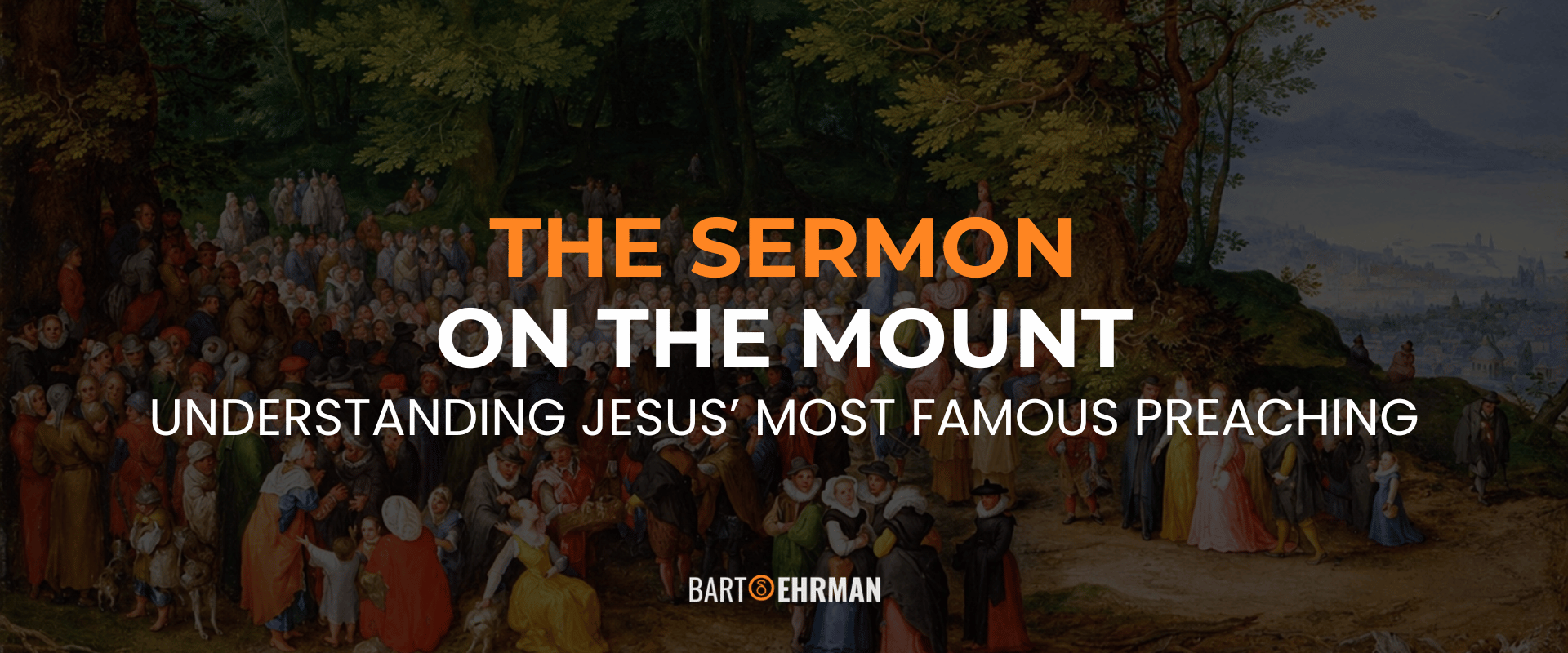
What Is the Sermon on the Mount?
Where is the Sermon on the Mount in the Bible? This spoken discourse or speech is delivered by Jesus in chapters 5, 6, and 7 of the Gospel of Matthew. The title of the speech is not in the original biblical passage itself but was created by the famous 4th-century bishop and theologian Augustine of Hippo in a commentary called On the Lord's Sermon on the Mount (Latin: De sermone Domini in monte). In fact, in that work, Augustine claimed that the Sermon’s moral and ethical teachings provided "a perfect standard of the Christian life." Carl G. Vaught also notes that with “the possible exception of John 3:16, no biblical text is more widely known or widely quoted than the Sermon on the Mount.”
Before we get to the contents of the Sermon on the Mount, let’s address whether it depicts an actual speech given by Jesus. While many Christians have long viewed the actual event as historical, most critical scholars do not regard Matthew 5–7 as a verbatim transcript of a single speech delivered by Jesus on one occasion. Rather, Matthew appears to have brought together and arranged teachings attributed to Jesus into a sustained literary discourse. Bart Ehrman, for instance, notes that since Matthew is believed to have been written 55–60 years after the life of Jesus, it is unlikely that he was able to fully reconstruct such a long speech:
(Affiliate Disclaimer: We may earn commissions on products you purchase through this page at no additional cost to you. Thank you for supporting our site!)
Matthew was not from Israel, he did not know Jesus, he is writing in a different language from Jesus, basing his account on what he has heard and read from others. And so my question is: how could Matthew possibly know what was in the lengthy sermon that Jesus gave 55-60 years earlier in a different part of the world speaking a different language? There was no audio recording, and there were no stenographers.


Furthermore, Ehrman notes that “Even if Matthew HAD been there… how would he remember exactly what Jesus said? Not just in general but in specifics — saying by saying by saying, word for word?” Given the limitations of human memory, this seems unlikely.
Where did Jesus give the Sermon on the Mount? Its setting is important for the author for a specific reason:
When Jesus saw the crowds, he went up the mountain, and after he sat down, his disciples came to him. And he began to speak and taught them
This setting matters because for Matthew, Jesus is the new Moses giving a new law, or at least a new interpretation of the Mosaic Law. In his book Scripting Jesus: The Gospels in Rewrite, L. Michael White notes that in Matthew, Jesus “resembles Moses, in both the birth narrative and his teachings on Torah, especially in the Sermon on the Mount.” White also writes that for Jesus in the Sermon on the Mount, “the key is observance of Torah as the ground of righteousness.”
It is likely, then, that Matthew deliberately placed the scene of this long speech on a mountain, depicting a scene analogous to Moses receiving the law from God on Mount Sinai. This is why, in Matthew 5:17–18, Jesus is quoted as saying
Do not think that I have come to abolish the Law or the Prophets; I have come not to abolish but to fulfill. For truly I tell you, until heaven and earth pass away, not one letter, not one stroke of a letter, will pass from the law until all is accomplished.
Ehrman notes that while the setting and description of an actual lengthy discourse given by Jesus is likely a literary invention, that doesn’t necessarily mean that Jesus did not deliver these teachings during his ministry:
It is obviously quite possible (probable, I’d say) that Jesus may well have spoken at times to groups. And he certainly may have delivered many of the sayings we find in the Sermon on the Mount today, probably on numerous occasions. But the collection of the sayings into a single Sermon is almost certainly Matthew’s own construction.
Where was the Sermon on the Mount? Despite the scholarly consensus arguing that the speech containing all these teachings was likely fictional, Christians have long theorized about its location. In The Holy Land: An Oxford Archaeological Guide, for instance, Jerome Murphy-O'Connor writes that a hill known as the Mount of the Beatitudes which faces the Sea of Galilee is the leading candidate among those who take the entire story as a literal occurrence.

Components and Contents of the Sermon on the Mount
The Sermon is structured into several different categories of teaching. It can be divided into an introductory portion which includes The Beatitudes (5:1–16), Salt and Light (5:13–16), a main body consisting of Fulfillment of the Law (5:17–20), The Antitheses (5:21–48), Secret Disciplines (or Personal Piety) (6:1–18), Earthly Possessions and Trust (6:19–34), and Relationships/Ethics (7:1–12). Finally, the concluding section includes the Two Ways (7:13–23) and the Two Builders (7:24–27). Here, we’ll go through each of these components in more detail.
Beatitudes
The Beatitudes are eight or nine benedictions which start off the Sermon on the Mount. The number changes depending on how you count them. In verses 3–10, eight beatitudes use the 3rd person; in other words, they address “they”: “Blessed are the meek, for they will inherit the earth,” “Blessed are the merciful, for they will receive mercy.” Then in verses 11 and 12, the shift focuses to the 2nd person, “you.”
Blessed are you when people revile you and persecute you and utter all kinds of evil against you falsely on my account. Rejoice and be glad, for your reward is great in heaven, for in the same way they persecuted the prophets who were before you.
Because of this grammatical change, most scholars argue that this is a separate blessing from the beatitudes, while others count it as a 9th Beatitude.
The word “beatitudes,” by the way, comes from the Latin version known as the Vulgate. In the original Greek, the word that begins each beatitude is makarioi, meaning “blessed” or “happy.” That word was later translated into the Latin word beātī, meaning “blessed” or “fortunate.”
Each blessing includes two parts: the condition (“Blessed are the meek”) and the result of inhabiting that condition (“for they will inherit the earth”). In the Jewish Annotated New Testament, Aaron Gale writes that the phrase “blessed are” or “happy are” occurs 68 times in the Septuagint, the Greek version of the Hebrew Bible:
Happy are those who live in your house,
ever singing your praise (Psalm 84:4).
Moreover, Gale notes that “Blessed are the meek” is a near-quotation from Ps 37:11, which says
But the meek shall inherit the land
and delight themselves in abundant prosperity.
In other words, the teachings from the Beatitudes draw upon scriptural precedents.
Salt and Light
In the next section, Jesus compares his disciples to salt:
You are the salt of the earth, but if salt has lost its taste, how can its saltiness be restored? It is no longer good for anything but is thrown out and trampled underfoot.
While there have been many interpretations of this metaphor, the general sense is that the work of Jesus’ disciples benefits the world. Salt had a variety of important uses in antiquity, and interpreters have proposed several explanations for Jesus' metaphor. The passage most clearly emphasizes the disciples' distinctive usefulness and public witness.
Jesus next compares his followers to light:
You are the light of the world. A city built on a hill cannot be hid. People do not light a lamp and put it under the bushel basket; rather, they put it on the lampstand, and it gives light to all in the house.
The image presents Jesus' followers as a visible source of illumination whose conduct should lead others to glorify God.
Fulfillment of the Law
In this section, Jesus emphasizes the importance of the Jewish Law, claiming not to do away with it or replace it but to accomplish its aims. This serves as an introduction to the next section, the Antitheses, in which Jesus reinterprets the law more rigorously than do the religious authorities of his day. He thus says
For I tell you, unless your righteousness exceeds that of the scribes and Pharisees, you will never enter the kingdom of heaven (Matt 5:20).
The Antitheses
An antithesis is a rhetorical contrast of two ideas, generally putting the two opposing ideas side by side to make a point. A famous example is Neil Armstrong’s quotation when he landed on the moon: “That's one small step for a man, one giant leap for mankind."
The Antitheses are the longest part of the Sermon on the Mount. Each saying in the Antitheses begins by noting a traditional requirement of the Torah, and then contrasts it with Jesus’ more demanding interpretation. The first example sets the tone for the entire section:
“You have heard that it was said to those of ancient times, ‘You shall not murder,’ and ‘whoever murders shall be liable to judgment.’ But I say to you that if you are angry with a brother or sister, you will be liable to judgment, and if you insult a brother or sister, you will be liable to the council, and if you say, ‘You fool,’ you will be liable to the hell of fire” (Matt 5:21–22).
In his commentary on Matthew, John Nolland notes that the claim that Jesus came "not to abolish but to fulfil" supports his teaching aims "to enable God's people to live out the Law more effectively.” The section also establishes Matthew's distinctive understanding of how Jesus' followers should embody the righteousness demanded by the Torah. It also indicates to other Jewish sects that Christians truly obey the Torah correctly.
Secret Disciplines
In this section, Jesus focuses on three core religious duties, as well as the requirement of not performing those duties merely to bring oneself glory. These three include:
1. Almsgiving, which Jesus says should be done secretly in order to avoid calling attention to oneself.
2. Prayer, which Jesus emphasizes should be done quietly in private instead of loud, performative prayers in order to appear pious to others. Here, Jesus also gives the example of the Lord’s Prayer as a model for correct prayer practice.
3. Fasting, during which Jesus instructs listeners not to appear to suffer but instead to wash their faces and act normally so that only God sees what you are doing.
Earthly Possessions and Trust
The main body of the Sermon ends with Jesus speaking about material belongings and relying on God to sustain you. Jesus first says not to store up belongings or “treasures” on earth since they will not last. Instead, Jesus says to “store up treasures in heaven” (Matt 6:19-21)—usually interpreted as virtues or having a spiritual focus—whose value is eternal. He also says to maintain this focus, since “if your eye is healthy, your whole body will be full of light.”
He then extends this idea to the accumulation of money, which he says can too easily become one’s master instead of God: You cannot serve both God and wealth. Jesus also tells people that if they focus primarily on spiritual values—the Kingdom of God and its righteousness—all their other material needs will be met as well.
Relationships/Ethics
Jesus then goes on to tell people not to judge others, so that they will not be judged similarly by God, warns against giving what is holy to those who will abuse or reject it (7:6), then encourages persistent prayer (7:7–11), culminating in the Golden Rule (7:12):
In everything do to others as you would have them do to you, for this is the Law and the Prophets.
Concluding Section
This section includes the Two Ways discourse, including warnings about the narrow gate, false prophets, and a call to genuine obedience over hypocrisy. The final parable, known as the Two Builders, urges listeners to put all of Jesus’ words into practice like a man building his house on a solid rock foundation.
Sermon on the Mount vs. Sermon on the Plain
Those familiar with the Synoptic Problem will recognize that while both Matthew and Luke likely used Mark’s Gospel as a source, there is also material shared by Matthew and Luke which is not found in Mark, possibly indicating that Matthew and Luke used another shared source. The Sermon on the Mount in Matthew, therefore, has a parallel in the Sermon on the Plain found in Luke, although there are differences.
First, while Matthew puts Jesus's teachings into groups of similar material and places them narratively in one long discourse, similar material is scattered throughout the entire book of Luke. Moreover, in the Sermon on the Plain (Luke 6:17–49), even some of the nearly-identical material is changed. For instance, “Blessed are the poor in spirit” in Matthew 5:3 is simply “Blessed are you who are poor” in Luke 6:20. Luke's wording fits a broader Lukan emphasis on poverty, wealth, social reversal, and the treatment of economically vulnerable people.
However, unlike Matthew, Luke also includes a set of corresponding “Woes” in opposition to his beatitudes. In opposition to “Blessed are you who are poor,” he later writes “But woe to you who are rich, for you have received your consolation.” Like the Sermon on the Mount, the Sermon on the Plain appears to be less a historical event and more a literary compilation of Jesus’ most important teachings with different emphases. While the Sermon on the Mount shows Jesus as a new Moses, Luke's Sermon on the Plain places particular emphasis on poverty, wealth, reversal, mercy, and the treatment of one's enemies, giving Jesus a strongly prophetic voice.
Conclusion
What is the Sermon on the Mount? It stands as one of the most influential and recognizable collections of Jesus’ teachings in the New Testament. Whether or not it represents a single, extended speech delivered on one occasion, its importance does not depend entirely on the historical reconstruction of the event. The evidence suggests that Matthew carefully arranged teachings attributed to Jesus into a unified discourse, presenting Jesus as a new Moses who authoritatively interprets the Law and defines what it means to live according to God’s will.
Comparisons with Luke’s Sermon on the Plain also demonstrate how the Gospel writers shaped Jesus’ teachings to address particular theological concerns. Matthew emphasizes Jesus as a teacher who fulfills and authoritatively interprets the Torah, while Luke places greater emphasis on poverty, wealth, and justice. In both cases, however, the teachings ultimately point toward a radical transformation of how people understand righteousness and their relationships with God and one another.
For Christians, the Sermon on the Mount therefore remains more than an ancient collection of sayings. Why is the Sermon on the Mount so important? It is a foundational expression of Christian ethics and discipleship, challenging believers to move beyond outward religious observance toward a life in which their actions, motives, relationships, and priorities reflect the values of the Kingdom of God. Whether viewed primarily as a historical record of Jesus’ preaching or as Matthew’s carefully constructed literary presentation of his teachings, the Sermon on the Mount remains central to understanding how the Gospel of Matthew portrays Jesus and what it means to follow him.