
The Two Versions of 10 Commandments: Deuteronomy vs Exodus

Written by Joshua Schachterle, Ph.D
Author | Professor | Scholar
Author | Professor | BE Contributor
Verified! See our editorial guidelines
Verified! See our guidelines
Date written: March 27th, 2026
Disclaimer: The views and opinions expressed in this article belong to the author and do not necessarily match my own. - Dr. Bart D. Ehrman
The Ten Commandments are among the most famous passages in the Bible and have shaped religious thought, ethics, and law for thousands of years. Traditionally understood as divine instructions given by God, these commandments form a central part of the Hebrew Bible and have played a foundational role in several religious traditions. Yet the biblical text itself reveals a more complex picture than many people realize.
What many don’t realize is that there are two versions of the Ten Commandments and that they are worded slightly differently in each version. By examining these different versions—particularly those found in Exodus and Deuteronomy—we can better understand not only what the Ten Commandments say, but also how they developed over time and why they have been interpreted in different ways across centuries of religious history.
What Are the Ten Commandments?
The Ten Commandments are a set of moral and religious instructions from the Hebrew Bible. In the original Hebrew they are called ʿĂśéreṯ had-Dibbərôṯ, which simply means “the ten words (or sentences).” In the Greek version of the Hebrew Bible known as the Septuagint, they are called dekálogos, again “ten words,” from which we get our English word, the Decalogue, another name for the Ten Commandments.
According to the Hebrew Bible account, God gave the commandments to Moses—first orally and then in written form—who then gave them to the Israelites.
When God finished speaking with Moses on Mount Sinai, he gave him the two tablets of the covenant, tablets of stone, written with the finger of God (Exodus 31:18).


The Ten Commandments are an important part of the Torah for Jews (along with more than 600 other commandments). However, they are also foundational for Christians and Muslims, although interpretations may vary slightly within the three traditions.
In this article, however, we’ll look at two versions of the Ten Commandments, the first from Exodus 20 and the second from Deuteronomy 5, and analyze their differences. Take a look at the comparison chart below, borrowed from “The Decalogue or Ten Commandments: Similarities and Differences in Religious Traditions” by Felix Just.
Exodus 20:1-17 (NRSV) | Jewish | Orth. | Prot. | Luth. | Cath. | Deuteronomy 5:6-21 (NRSV) |
|---|---|---|---|---|---|---|
1 Then God spoke all these words: | 1 | 1 | 0 | 1 | 1 |
|
2 I am the LORD your God, who brought you out of the land of Egypt, out of the house of slavery; | 1 | 1 | 0 | 1 | 1 | |
3 you shall have no other gods before me. | 2 | 1 | 1 | 1 | 1 | |
4 You shall not make for yourself an idol, whether in the form of anything that is in heaven above, or that is on the earth beneath, or that is in the water under the earth. | 2 | 2 | 2 | 1 | 1 | |
7 You shall not make wrongful use of the name of the LORD your God, | 3 | 3 | 3 | 2 | 2 | 11 You shall not make wrongful use of the name of the LORD your God, |
8 Remember the sabbath day, and keep it holy. | 4 | 4 | 4 | 3 | 3 | 12 Observe the sabbath day and keep it holy, as the LORD your God commanded you. |
12 Honor your father and your mother, | 5 | 5 | 5 | 4 | 4 | 16 Honor your father and your mother, as the LORD your God commanded you, |
13 You shall not murder. | 6 | 6 | 6 | 5 | 5 | 17 You shall not murder. |
14 You shall not commit adultery. | 7 | 7 | 7 | 6 | 6 | 18 Neither shall you commit adultery. |
15 You shall not steal. | 8 | 8 | 8 | 7 | 7 | 19 Neither shall you steal. |
16 You shall not bear false witness against your neighbor. | 9 | 9 | 9 | 8 | 8 | 20 Neither shall you bear false witness against your neighbor. |
17a You shall not covet your neighbor's house; | 10 | 10 | 10 | 9 | 9 | 21a Neither shall you covet your neighbor's wife. |
The first thing you’ll notice is that the two versions are nearly identical. The main differences occur in only two of the Commandments. However, before we look at those differences, we need to understand that different religious traditions enumerate the commandments differently. Look specifically at the middle columns, telling us how Jewish, Orthodox Christians, the majority of Protestants, Lutherans specifically, and Catholics enumerate the commandments differently.
Adherents of Judaism traditionally view the prologue—“I am the LORD your God”—as the first Commandment, followed by “You shall have no other gods before me” as the second. Protestants, on the other hand, see the Jews’ second Commandment as the first. Why are these numbered differently in different traditions, resulting in two versions of the Ten Commandments? It all comes down to how the manuscript evidence presents the passage. As Felix Just notes, the Ten Commandments
come from the Hebrew Bible, but it is not so obvious to determine exactly what they are or how to count them. These commandments are recorded in two different biblical chapters (Exodus 20:1–17 & Deuteronomy 5:6–21), yet each text is slightly different, and neither passage explicitly numbers the commandments one through ten.
The line breaks that we see between Commandments in our modern Bibles, as well as chapters and verses, were not there in ancient manuscripts but were a later innovation. The original versions were simply included in blocks of text. Early interpreters thus had to decide which lines constituted commandments and which were merely prologues or explanations of the Commandments. For this reason, I won’t refer to the first or second Commandments in this article. Instead, I’ll just quote each Commandment itself, leaving out the numbers.
NOW AVAILABLE!
Finding Moses: What Scholars Know About The Exodus & The Jewish Law
Riveting and controversial, the "FINDING MOSES" lecture series takes you on a deep dive into the stories of Moses, the exodus, and a whole lot more...
How and Why Are the Two Lists Different?
When it comes to any biblical text, including the Ten Commandments, interpretations vary. In fact, in The Decalogue through the Centuries: From the Hebrew Scriptures to Benedict XVI, Daniel Block writes that the Commandments were written as broad and general, which permitted varied interpretations. In other words, the author(s) of the Commandments supplied guiding norms that could be relevant across changing situations and conditions.
It’s also important to note, as Michael Coogan does, that the fact that the Exodus Ten Commandments and Deuteronomy Ten Commandments are (slightly) different shows that the text of the Ten Commandments remained somewhat fluid and changeable at the time they were written. As we’ll see, the dissimilarities indicate that the two versions had a different focus.
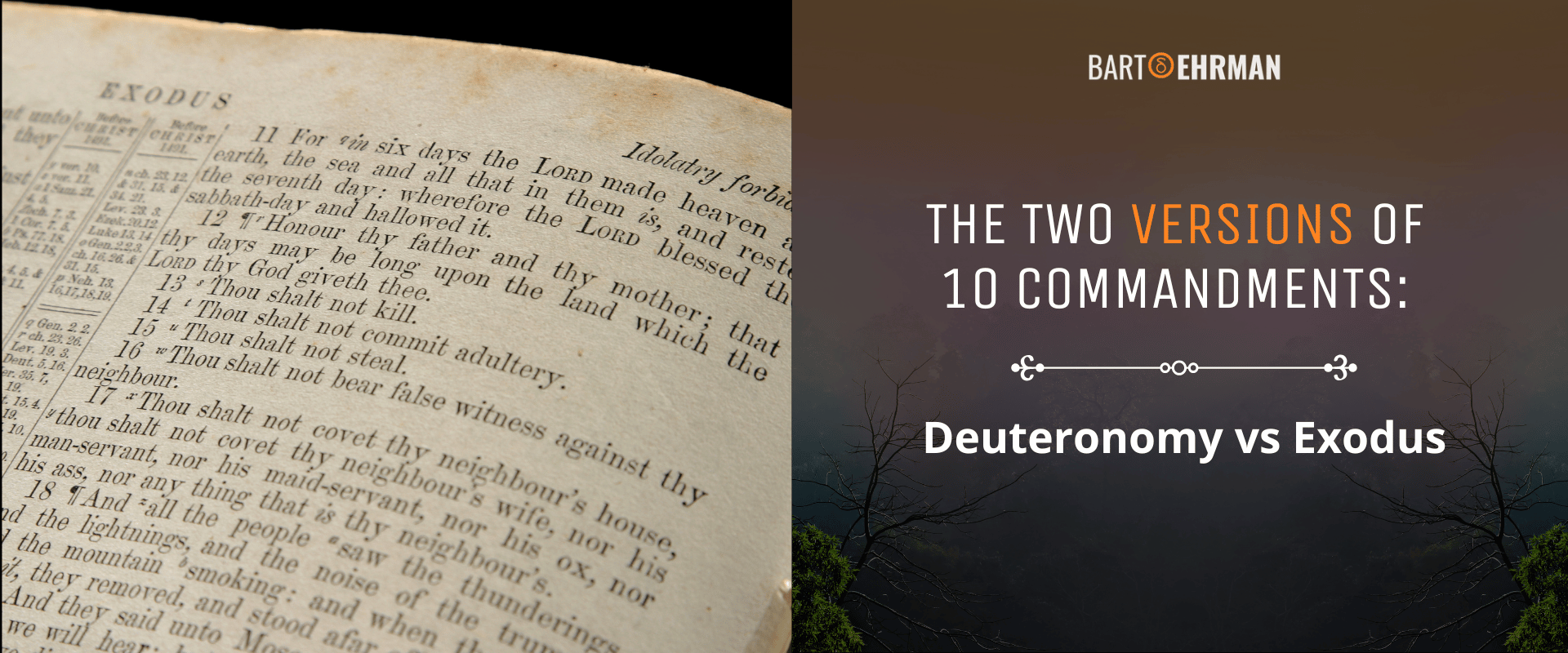
First, in the Commandment about the Sabbath, there is a major distinction between the explanations for why it is necessary to “remember” or “observe” the Sabbath, which in this case means to refrain from all work on that day. In the Exodus version (Exodus 20:11) we see this:
(Affiliate Disclaimer: We may earn commissions on products you purchase through this page at no additional cost to you. Thank you for supporting our site!)
For in six days the Lord made heaven and earth, the sea, and all that is in them, but rested the seventh day; therefore the Lord blessed the Sabbath day and consecrated it.
In this Ten Commandments Exodus passage, the reason given for resting on the Sabbath is to commemorate the completion of God’s creation by making the next day holy. However, in Deuteronomy 5:15, we see a different rationale for not working on the Sabbath:
Remember that you were a slave in the land of Egypt, and the Lord your God brought you out from there with a mighty hand and an outstretched arm; therefore the Lord your God commanded you to keep the Sabbath day.
In that Ten Commandments Deuteronomy excerpt, the Sabbath is a day for the Israelites to honor God for liberating them from Egypt. What do those differing rationales tell us?
In his Introduction to the Hebrew Bible, John J. Collins writes that the two versions were written by two different sources. The Exodus version is generally believed to have been written by the E or Elohist source in the 9th century BCE, while the Deuteronomy version was written later by the D or Deuteronomist source in the 7th century BCE (if you’re not familiar with these sources, this article on Genesis explains them). This means that the D source likely used the E source version as a basis, much like the Gospels of Matthew and Luke used Mark as a source. However, the two sources were from different regions and thus had a somewhat different emphasis.
We can see the different emphasis in the two versions of the Sabbath commandment. While both prohibit working on the Sabbath, the Exodus version is grounded in a theology of creation, acknowledging that their God is the Lord of the universe. The Deuteronomy version, on the other hand, is based on the notion of liberation. God is the great liberator of the Israelites and, by implication, loyalty to him will keep them free.
The other difference in commandment wording occurs in the final commandment, which prohibits coveting. In Exodus, the list of possessions not to be coveted begins with “your neighbor’s wife,” while in Deuteronomy, it begins with “your neighbor’s house.” Was this an intentional reordering of priorities between the two or just a scribal accident or mistake?
While there’s no way to be entirely sure, scholars have speculated about this. Since we know that the Exodus list was written earlier than that of Deuteronomy, it seems at least plausible that this change was made on purpose. Shawna Dolansky points out that the point of both prohibitions on coveting
is that doing so could lead to actions forbidden in the previous four commandments, thereby undermining the fabric of human community. Coveting people or property that do not belong to you might instigate activities like adultery, murder, theft and even bearing false witness.
If this is the case, it might be that the author of the Exodus Decalogue believed wanting another’s house was more likely to lead to unlawful activity, while the Deuteronomist believed that wanting another’s wife would do so. This is, again, speculation, but is a possible interpretation of this difference.

More Than Two Versions of the Ten Commandments? The Case of Exodus 34:11–26
While the two versions of the Ten Commandments in Exodus 20 and Deuteronomy 5 are remarkably similar overall, there is a third version which is quite different from them. The first two, the ones with which most of us are familiar, are often called the Ethical Decalogues, but the third is generally known as the Ritual Decalogue.
There is a specific narrative context for the Ritual Decalogue in Exodus. When Moses descends from Mount Sinai in Exodus 32 with the two stone tablets containing the Decalogue, he sees his people worshipping a golden calf instead of God. This infuriates him, causing him to smash the tablets in anger. God then tells Moses to carve out two more stone tablets and writes out the Commandments again. But wait! This time, they are almost entirely different.
The Exodus 34 version is, in large part, a set of cultic instructions for how to make sacrifices and keep holy festivals. Why would these be so different in emphasis from the Ethical Decalogue?
Well, the Ethical Decalogue is linked to the E source, as I stated above. The Ritual Decalogue, on the other hand, is linked to the J or Yahwist source, and emphasizes cultic responsibilities in order to maintain the covenant with God. Since the golden calf incident broke the covenant between God and the Israelites, scholars believe that J wrote the Ritual Decalogue to re-sanctify the people and renew that covenant.
Conclusion
The Ten Commandments have been influential for millennia. While biblical texts claim that their mandates came directly from God, there are three versions of them which seem to have different emphases.
The first version, in Exodus 20, is a list of ethical imperatives meant to preserve the fabric of Israelite society and their covenant with God by preventing conflicts. The version in Deuteronomy has this same emphasis. The main difference, owing to their different sources, is that in Exodus, God as creator is highlighted while in Deuteronomy, God as liberator is the focus.
Then there’s version number 3. The version in Exodus 34 takes the emphasis (mostly) away from ethics and focuses on the importance of the correct performance of rituals. This shows, among other things, that a third source wrote this version.
All of this goes to show the patchwork form that characterized the creation of these two biblical books and how different traditions in ancient Israel focused on different interpretations of the Israelites’ relationship with God.
By the way, if you’re interested in learning more about the Hebrew Bible, check out Bart Ehrman’s course In the Beginning: History, Legend, and Myth in Genesis.
NOW AVAILABLE!
Finding Moses: What Scholars Know About The Exodus & The Jewish Law
Riveting and controversial, the "FINDING MOSES" lecture series takes you on a deep dive into the stories of Moses, the exodus, and a whole lot more...