
The Role of Women in Paul’s Letters

Written by Marko Marina, Ph.D.
Author | Historian
Author | Historian | BE Contributor
Verified! See our guidelines
Verified! See our editorial guidelines
Date written: July 11th, 2026
Disclaimer: The views and opinions expressed in this article belong to the author and do not necessarily match my own. - Dr. Bart D. Ehrman
What is the role of women in Paul’s letters? For some readers, the question isn’t merely historical. It touches directly on some of the most contested debates in modern Christianity: who may teach, preach, lead, preside, or hold formal ecclesiastical authority?
Recent surveys show why the issue continues to matter. According to Pew Research Center, many Catholics in the United States and Latin America say the Catholic Church should allow women to become priests.
Another Pew survey published in 2025 showed that 59 percent of U.S. Catholics said women should be ordained as priests.
Of course, asking what the apostle Paul would say about modern ordination debates is inevitably anachronistic if handled too quickly. Paul didn’t live in a world of Catholic priests, Protestant preachers, denominational policies, or modern debates about gender equality.
Still, the fact that Paul’s letters continue to be invoked in these discussions shows how important the question remains, not only for one Christian tradition, but for Christianity more broadly.
For that reason, the historical question is worth asking carefully: what do the letters attributed to Paul actually say about women? The answer isn’t as simple as either Paul’s defenders or critics sometimes assume.
The Pauline letters in the Bible were written in specific ancient settings, to particular communities, and in response to concrete social, theological, and pastoral problems.
They also do not all stand on the same footing historically, since scholars commonly distinguish between letters widely regarded as authentically Pauline and other letters whose authorship remains highly disputed.
This article will therefore approach the question in two stages. First, we’ll look at the role of women in Paul’s undisputed letters.
Then we’ll turn to the disputed letters, especially the Pastoral Epistles, where the discussion becomes particularly important for later Christian views of women, authority, and church order.
But before we begin exploring the role of women in Paul’s letters, it’s worth stepping back to ask an even larger question: how closely did Paul’s message actually align with the teachings of Jesus?
In his 8-lecture course Paul and Jesus: The Great Divide, Bart D. Ehrman tackles one of the most important and controversial issues in the study of Christian origins: whether Paul should be seen as a faithful interpreter of Jesus, a co-founder of Christianity, or the figure who transformed the Jewish religion of Jesus into the Christian religion about Jesus. It’s a course well worth checking out!

Women in Paul’s Undisputed Letters
In her book In Memory of Her: A Feminist Theological Reconstruction of Christian Origins, Elisabeth Schüssler Fiorenza notes:
(Affiliate Disclaimer: We may earn commissions on products you purchase through this page at no additional cost to you. Thank you for supporting our site!)
When we read the occasional Pauline references to women in their own setting, we recognize that the Pauline and the post-Pauline literature know of women not merely as rich patronesses of the Christian missionary movement but as prominent leaders and missionaries who – in their own right – toiled for the gospel. These women were engaged in missionary and church leadership activity both before Paul and independently of Paul. Without question they were equal and sometimes even superior to Paul in their work for the gospel. As Jewish Christian missionaries, these women might have belonged to the Christian communities in Galilee, Jerusalem, or Antioch which stand at the very beginnings of the Christian missionary movement.


For some readers, this thesis may come as a surprise. Modern discussions of Paul and women often begin with the most restrictive passages attributed to him, and these texts have shaped Christian debates for centuries.
Yet a closer historical analysis quickly shows that the role of women in Paul’s letters, especially in the undisputed letters, is more complex and more significant than such debates sometimes allow.
The earliest Pauline communities weren’t organized around preaching that occurred in church buildings, later clerical offices, or settled parish structures. They were small urban assemblies that often met in houses, depended on networks of travel and hospitality, and were sustained by patrons, coworkers, and local leaders.
In such settings, women could exercise forms of authority that do not map neatly onto later ecclesiastical categories.
The most important evidence comes from Romans 16, where Paul greets a striking number of women associated with his missionary network.
Phoebe is introduced as a “diakonos” of the church at Cenchreae and as a “prostatis” of many, including Paul himself. The precise meaning of these terms remains debated, but neither should be minimized simply because Phoebe is a woman.
In Paul’s letters, “diakonos” can refer to someone engaged in significant ministerial or missionary service, while “prostatis” likely suggests some form of patronage, protection, or leadership.
Phoebe may also have carried Paul’s letter to Rome, which would have made her not merely a courier in the mechanical sense, but potentially the first person to present, explain, and defend the letter before its Roman recipients..
Paul also greets Prisca and Aquila, “my coworkers in Christ Jesus,” adding that they risked their necks for his life and that not only he, but “all the churches of the Gentiles” give thanks for them.
Here, the order of the names is significant. In several early Christian texts, Prisca or Priscilla is named before Aquila, which may suggest her prominence within the missionary pair.
More importantly, Paul doesn’t describe her as Aquila’s assistant or as a merely domestic supporter of his ministry. She and Aquila are coworkers, hosts of a house church, and figures whose service has significance beyond one local congregation.
In a movement whose assemblies gathered in homes, the household wasn’t simply “private space.” It was one of the primary institutional settings in which Christian worship, teaching, fellowship, and mission took place.
Romans 16 also names Mary, Tryphaena, Tryphosa, and Persis as women who “worked” or “labored” in the Lord.
Fiorenza rightly draws attention to the significance of this language. Paul uses the language of labor not only for manual work but also for missionary and communal service. These women are remembered as active participants in the work of the gospel.
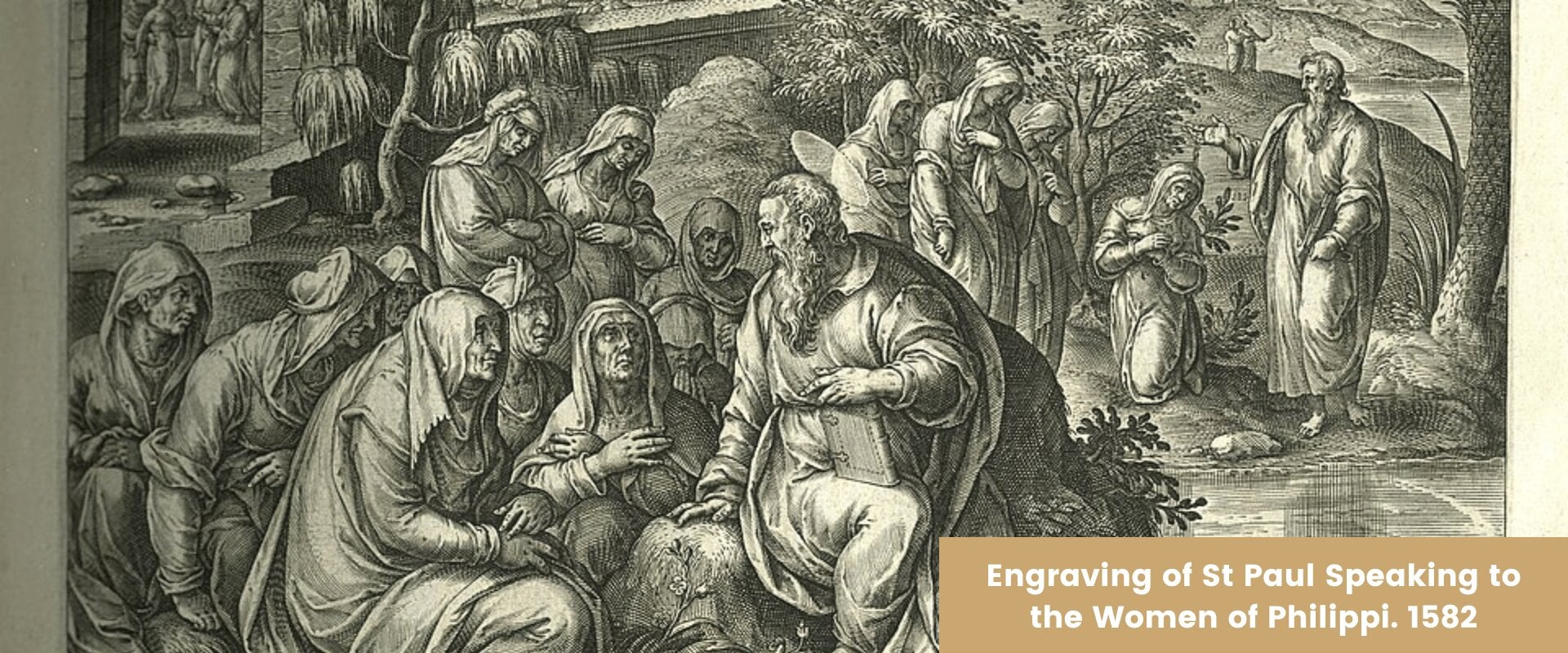
Similarly, in Philippians 4:2–3, Paul refers to Euodia and Syntyche as women who “struggled beside” him in the gospel, together with Clement and his other coworkers.
The passage is often remembered because Paul urges the two women to agree, but that shouldn’t obscure what the text presupposes: according to Paul, they had been important collaborators in the mission, and their relationship mattered enough to affect the life of the Philippian community.
 pop Quiz!
What happened when christianity's two biggest apostles went head to head?
Paul openly rebuked Peter in Galatians and took swipes at the Jerusalem leaders as “super-apostles” who “added nothing” to his message. Later Christian writings from outside the Bible indicate an even deeper rift between Paul and Peter, so why does Acts paint them as best friends? Join Dr. Bart Ehrman to explore the evidence of rivalry and conflict in this free two-lesson course, "Did Peter Hate Paul?"
100% free, no credit card required or upsells... promise!
Women in Paul’s Letters: The Case of Junia and Galatians 3:28
The most debated example is Junia in Romans 16:7. Paul greets Andronicus and Junia as his relatives or fellow Jews, his fellow prisoners, and people who were “prominent among the apostles,” or possibly “well known to the apostles,” depending on how the Greek phrase is interpreted.
The older tendency to masculinize Junia into “Junias” has largely fallen out of favor, since Junia, as explained in Eldon J. Epp’s excellent study, is well attested as a woman’s name, whereas the supposed male form is much more problematic.
The remaining debate concerns whether Paul means that Junia was herself outstanding among the apostles or highly regarded by them.
In the book, Tell Her Story: How Women Led, Taught, and Ministered in the Early Church, Nijay K. Gupta notes:
One of the earliest patristic writers, Origen (184–253), likewise acknowledged that Junia and Andronicus were apostoloi (apostles), and he went one step further, theorizing what this meant in light of Paul’s reference to their preceding him in the faith... So I hope by now it seems clear that, with the support of patristic evidence, we can comfortably conclude that Paul was commending Andronicus and Junia as apostles, respected ministry leaders who were distinguished and remarkable among the apostoloi.
But either way, the verse places her within the sphere of early Christian missionary authority. If she is counted among the apostles (which I believe was the case!), she becomes one of the clearest examples of a woman holding a title of remarkable prestige in the earliest Christian movement.
If she is “well known to the apostles,” she still appears as a figure of recognized importance in the apostolic network before or alongside Paul.
This evidence should be read alongside Galatians 3:28, one of Paul’s most famous statements: “There is no longer Jew or Greek, there is no longer slave or free, there is no longer male and female; for all of you are one in Christ Jesus.”
This isn’t a modern manifesto for social equality, and it should not be forced into categories Paul himself did not possess.
Craig Keener makes this point well in his Commentary on Galatians:
A declaration such as ‘neither slave nor free’ would have sounded like nonsense to a slave society such as the Roman empire where such divisions lay on the surface. Differences between male and female were even more pronounced, not only in roles but also, conspicuously, in apparel. As no one suggests that Paul explicitly advocated a unisex clothing style, it seems clear that Paul was not seeking to eradicate all gender differences in his world...Today scholars continue to debate whether Gal 3:28 has, or at least whether Paul intended it to have, implications for Christian life beyond salvation. Paul’s primary concerns lie elsewhere; this age is passing (1 Cor 7:31), so such matters are temporary anyway.” Keener’s caution is important. Galatians 3:28 does not mean that Paul imagined the immediate disappearance of all social structures. Yet it does show that Paul’s theology of baptism placed men and women, slaves and free persons, Jews and Gentiles on the same fundamental footing “in Christ.”
Taken together, the undisputed letters suggest that women were deeply embedded in Paul’s missionary world.
They hosted churches, supported communities, traveled or worked in missionary partnerships, labored in the gospel, and, in some cases, bore titles associated with ministry and apostolic authority.
This doesn’t mean that Paul held a fully consistent or modern view of gender equality. Nor does it mean that every Pauline community practiced the same social arrangements. It does mean, however, that any account of the role of women in Paul’s letters must begin with the fact that women weren’t marginal to the Pauline mission.
They were among its patrons, coworkers, and leaders. The question becomes more complicated when we turn from these forms of missionary activity to the question of women’s speech and behavior in the worship assembly, especially in the difficult evidence from 1 Corinthians.
Should Women Remain Silent in the Church? Paul and 1 Corinthians 16
Discussion of the role of women in Paul’s letters cannot skip one of the most debated passages in the entire Pauline corpus: 1 Corinthians 14:34–35.
There, readers encounter the command that “women should be silent in the churches,” that “they are not permitted to speak,” and that they should ask questions at home, since “it is shameful for a woman to speak in church.”
Read in isolation, this text appears to impose a sweeping restriction on women’s speech in Christian assemblies. Yet precisely because it appears so sweeping, it creates a serious historical and literary problem.
Earlier in the same letter, Paul seems to assume that women do pray and prophesy in the assembly, even if he is concerned with how they do so. The difficulty, then, isn’t simply that modern readers dislike the passage. The difficulty is that the passage doesn’t sit easily within 1 Corinthians itself.
As Joseph A. Fitzmyer explains, several features make these verses especially problematic. First and foremost, they interrupt Paul’s larger discussion of prophecy, tongues, and orderly worship, to which he returns immediately afterward.
The appeal to “the law” is also unusual in this form, especially since there is no clear biblical command prohibiting women from speaking in worship assemblies.
In addition, some Western manuscripts place these verses after 1 Corinthians 14:40 rather than in their present location, suggesting that the passage may have circulated as a movable textual unit.
Scholarly Insights
Did Later Scribes Rewrite Paul on Women? A Recent Argument.
In a recent article Richard G. Fellows argued that 1 Corinthians may preserve evidence of early scribal attempts to reduce the prominence of women in Paul’s churches.
His argument focuses especially on two passages: 1 Corinthians 14:34–35, where women are commanded to be silent in the assemblies, and 1 Corinthians 16:19, where most manuscripts name “Aquila and Prisca,” even though Paul elsewhere names Prisca before Aquila.
The textual issue is important because, in some Western manuscripts, the command for women’s silence appears not after 1 Corinthians 14:33, where it stands in most modern Bibles, but after 14:40. Fellows argues that such large transpositions in New Testament manuscripts usually occur when scribes are inserting material that was absent from an earlier copy, correcting an omission, or incorporating a marginal note into the main text.
Since 1 Corinthians 14:34–35 also interrupts Paul’s argument and conflicts with the assumption elsewhere in 1 Corinthians that women pray and prophesy, Fellows concludes that the passage is best explained as an early interpolation.
He then suggests that the unusual order of “Aquila and Prisca” in 1 Corinthians 16:19 may reflect a similar tendency, since “Prisca and Aquila” would have made a woman appear as the more prominent host of a house church.
Whether or not every detail of this reconstruction convinces all scholars, the larger implication is significant: some textual traditions may preserve traces of later discomfort with women’s authority, meaning that certain passages used to restrict women in Paul’s name may tell much more about later scribes and editors than about Paul himself.
For these reasons, many scholars, including Bart D. Ehrman, have argued that 1 Corinthians 14:34–35 is a post-Pauline interpolation, perhaps inserted by a later scribe or editor whose assumptions about women’s silence stood closer to the world of the Pastoral Epistles than to the missionary situation reflected in Paul’s undisputed letters.
This interpretation cannot be proven with absolute certainty, since the verses appear somewhere in all surviving Greek manuscripts of 1 Corinthians.
Still, the interpolation theory has real explanatory power. It accounts for the tension with 1 Corinthians 11, the disruption in the flow of the argument, the unusual appeal to “the law,” and the similarity between this passage and later restrictions, such as 1 Timothy 2:11–12.
At minimum, therefore, 1 Corinthians 14:34–35 shouldn’t be treated as a simple or uncontested summary of Paul’s view of women. Far from it!
With that caution in mind, we can now turn to the disputed Pauline letters, where questions about women, authority, household order, and ecclesiastical stability become even more explicit.
Women in the Disputed Pauline Letters: Pastoral Epistles
As soon as we move to the disputed letters of Paul and the role of women in the early Church, one document proves to be particularly important: 1 Timothy.
This letter is usually classified as one of the so-called Pastoral Epistles, together with 2 Timothy and Titus.
But here, we immediately face a historical problem. If 1 Timothy was written by Paul, then it would belong to the middle of the 1st century, before Paul’s death—usually placed sometime in the 60s C.E.
Yet many scholars think that 1 Timothy was probably written later, toward the end of the 1st century or perhaps the beginning of the 2nd.
Yann Redalié, in the book Introduction au Nouveau Testament (Introduction to the New Testament) notes:
The full range of arguments exchanged in the debate over the author and the recipients has therefore led scholars to regard the Pastoral Epistles as pseudepigraphic writings, probably composed around the turn of the first century CE in Asia Minor – perhaps near Ephesus – by a leader of Pauline communities.
So, Paul never wrote 1 Timothy? Most scholars would say so! For instance, in his book Forgery and Counterforgery, Bart D. Ehrman argues that 1 Timothy and Titus are especially concerned with two related issues: controlling false teaching and establishing proper church leadership.
The world presupposed by these letters looks different from the more charismatic, missionary, and house-church environment reflected in Paul’s undisputed letters. In 1 Corinthians, for example, the community is marked by prophecy, spiritual gifts, disputes, and a certain degree of disorder.
In 1 Timothy and Titus, by contrast, we encounter a more settled concern with overseers, deacons, elders, qualifications for office, approved teaching, and the silencing of dangerous voices.
On this reading, the author isn’t simply preserving Paul’s earlier missionary practice. He is using Paul’s authority to shape a later stage of Christian communal life, one in which hierarchy, doctrinal control, and respectable household conduct have become central concerns.
This context is crucial for understanding 1 Timothy 2:11–15, the most influential restrictive passage about women in the Pauline tradition.
In that passage, the author instructs women to learn quietly and submissively, prohibits a woman from teaching or exercising authority over a man, appeals to the creation of Adam before Eve and to Eve’s deception, and then concludes with the difficult statement that a woman will be “saved” through childbearing if “they” continue in faith, love, holiness, and self-control.
Whatever one makes of the details, the passage clearly represents a more restrictive posture than the one we find in the undisputed letters, where women such as Phoebe, Prisca, Junia, Euodia, and Syntyche appear as coworkers, patrons, missionaries, and leaders.
At the same time, the passage shouldn’t be treated simplistically. Cynthia Long Westfall has shown how many interpretive decisions are already being made before one even begins to explain the text.
Is 1 Timothy read as Paul’s own letter, as a later writing in Paul’s name, as a general church order, or as an occasional response to a specific crisis? Is the setting assumed to be a worship assembly, a household context, or a broader attempt to correct false teaching?
Even if we set aside Westfall’s own highly problematic assumption that Paul wrote 1 Timothy, several of her exegetical observations remain important.
The letter itself opens by identifying false teaching as a major problem, and later passages refer to myths, genealogies, ascetic teachings against marriage, the spread of problematic instruction, and the vulnerability of some women to deceptive teachers.
This makes it possible that the restrictions in 1 Timothy 2 aren’t merely abstract rules about gender, but part of a larger attempt to control teaching, household behavior, and the transmission of doctrine.
One especially important detail is the Greek verb often translated “to have authority” in 1 Timothy 2:12.
The word is “authentein,” and it occurs only here in the New Testament. Its meaning is debated. Some interpreters understand it neutrally as exercising authority; others argue that it has a more negative sense, such as domineering, controlling, or acting coercively.
Westfall strongly emphasizes this point: the verb shouldn’t automatically be equated with ordinary pastoral care, benevolent leadership, or the responsible exercise of ministry. That doesn’t make the passage easy, nor does it remove its restrictive force.
But it does mean that one of the most consequential texts in later Christian debates about women’s authority rests partly on a rare and contested word.
DID PAUL AND JESUS HAVE THE SAME RELIGION?
Jesus taught a message of repentance to prepare for the Kingdom of God while Paul taught faith in Jesus. Did they agree? Should they be considered the “co-founders” of Christianity?
Adam and Eve and the Meaning of Authority
The appeal to Adam and Eve also needs careful handling. The author of 1 Timothy grounds his instruction in the Genesis story: Adam was formed first, and Eve is said to have been deceived. So, this prohibition is directly tied to a particular story from the book of Genesis.
Traditional readings have often taken this appeal to creation as proof that the prohibition is universal and permanent.
John Chrysostom, for example, read the passage precisely in this way: “If it be asked, what has this to do with women of the present day? It shows that the male sex enjoyed higher honor. Man was first formed; and elsewhere he shows their superiority.”
Yet the matter isn’t so simple. Ancient Jewish and Christian writers could appeal to Genesis in a variety of ways, including to address specific moral, social, or communal problems.
In 1 Timothy, the reference to Eve’s deception may connect with the letter’s concern about false teaching and the deception of certain women.
The strange statement about childbirth may, likewise, point to anxieties about marriage, sexuality, asceticism, and childbearing in the author’s social world.
In other words, the passage isn’t only about “women in general.” It also reflects the author’s effort to define proper teaching, proper households, and proper church order in a community he regarded as threatened by disorder and false doctrine.
Seen historically, then, 1 Timothy marks a significant development in the Pauline tradition. If the majority scholarly view is correct, a later author writing in Paul’s name sought to regulate the role of women in Paul's letters by placing sharper limits on women’s teaching and authority than we find in the undisputed correspondence.
But that wasn’t the voice of the apostle Paul who knew, respected and even admired the work and the role of women in the early Church!
The Pastoral Epistles therefore give us valuable evidence for a later stage of early Christianity, when communities were becoming more institutionally organized, more concerned with public respectability, and more anxious about who had the right to teach.
Conclusion
The role of women in Paul’s letters and traditions cannot be reduced to a single slogan, whether liberating or restrictive.
In the undisputed letters, women appear at the heart of Paul’s missionary world: they host churches, support communities, labor in the gospel, function as coworkers, and, in some cases, stand within the sphere of apostolic and ministerial authority.
At the same time, later texts written in Paul’s name, especially 1 Timothy, reflect a more restrictive and institutionalized moment in early Christianity, when questions of teaching, authority, household order, and public respectability became increasingly urgent.
The difference matters historically. It means that when modern readers ask what Paul “really” thought about women, they must distinguish between Paul’s own letters, later Pauline tradition, and even possible scribal changes in the transmission of the text.
Once that distinction is made, the picture becomes clearer: women weren’t marginal figures in the earliest Pauline communities, but active participants in the mission, leadership, and growth of the early Christian movement.
DID PAUL AND JESUS HAVE THE SAME RELIGION?
Jesus taught a message of repentance to prepare for the Kingdom of God while Paul taught faith in Jesus. Did they agree? Should they be considered the “co-founders” of Christianity?