
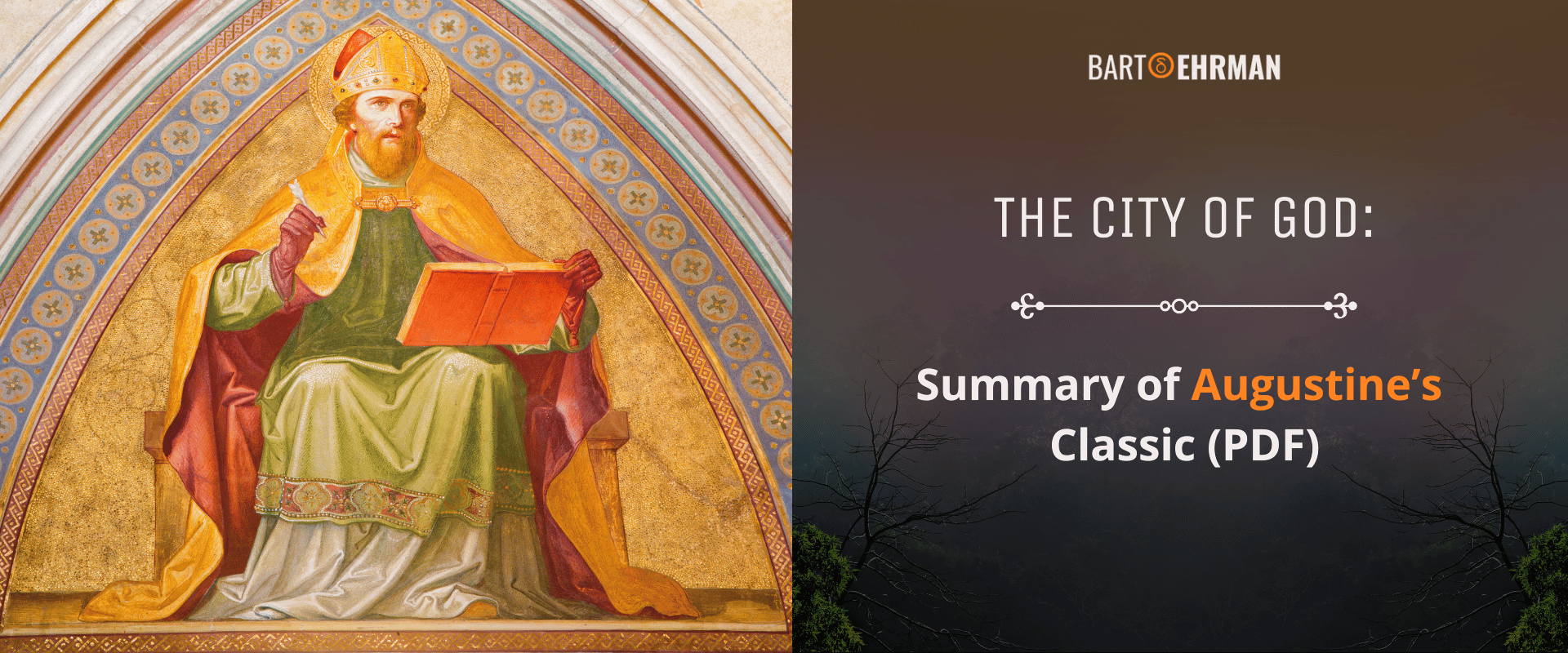
The City of God: Summary of Augustine’s Classic (PDF)
Written by Joshua Schachterle, Ph.D
Author | Professor | Scholar
Author | Professor | BE Contributor
Verified! See our editorial guidelines
Verified! See our guidelines
Date written: August 7th, 2025
Disclaimer: The views and opinions expressed in this article belong to the author and do not necessarily match my own. - Dr. Bart D. Ehrman
Few books in the history of Christianity have had the enduring impact of the City of God by Augustine. Written in the aftermath of one of the most shocking events of late antiquity, Augustine’s massive theological and philosophical work was both a defense of the Christian faith and a sweeping reimagining of history itself. In this deeply influential text, Augustine sought to answer a pressing question of his time: if Christianity was supposed to save civilization, why was the Roman Empire crumbling?
In this article I’ll give you a comprehensive summary of City of God, exploring both its historical background and its two major sections: the critique of the Earthly City and the theological vision of the City of God. We’ll also trace the book’s profound influence on centuries of Christian thought, from late antique and medieval theologians to Protestant reformers.
The Author, Dating, and Purpose of Augustine’s City of God (PDF)
City of God (for a free pdf of the English translation, go here) was originally written in Latin and titled De civitate Dei contra paganos (“The City of God Against the Pagans”). The author was Augustine of Hippo, one of the most influential thinkers the Catholic Church has ever produced. While my colleague Marko wrote a more comprehensive article about him here, I’ll summarize his life briefly before we dive into City of God.
Augustine was born in 354 CE in a city called Thagaste (present-day Souk Ahras, Algeria) in Roman North Africa to a Christian mother and a pagan father. It’s clear from Augustine’s own book The Confessions, that while his family was not wealthy, they had ambitions for their son and, thus, ensured that he had a good education in order to improve his position in society. In his late teens, Augustine was sent to complete his education in the much larger North African city of Carthage. While there, he writes that he enjoyed all the carnal delights available to a teenage boy at the time (as he tells us in Confessions 2.3.7).
(Affiliate Disclaimer: We may earn commissions on products you purchase through this page at no additional cost to you. Thank you for supporting our site!)
However, during this time in Carthage, he also became interested in philosophy and, despite his mother’s devout Christianity, he converted to Manichaeism, a popular religion of the time founded in the 3rd century CE by a prophet named Mani. After finishing his education, he became a grammar teacher, teaching in several major cities including Carthage, Rome, and Milan.
After living as a teacher and a devotee of Manichaeism for years, Augustine converted to Christianity at the age of 31 after a dramatic experience, which he relates in Book 8 of The Confessions. In 391, he was ordained a priest in the North African city of Hippo Regius, where he would live the rest of his life. In 395, he became the city’s bishop. Despite his vast administrative and pastoral duties during this time, he managed to write a huge number of works on Christian life and theology. He died in Hippo Regius in the year 430 CE.
The impetus for the City of God, a massive tome of more than 400,000 words (my physical copy of the English translation is over 1,000 pages!) was the sack of Rome in 410 CE by a Germanic tribe called the Visigoths and their king Alaric. Up to this point, Rome had seemed all but invincible and had not been invaded for close to 800 years. While this was not the definitive end of the Roman Empire, many Romans felt it was a sign of impending doom. Augustine completed City of God in chunks, completing the final work by 427 CE.
As a Roman citizen in a Roman North African city, Augustine of Hippo might have been concerned about the sack of Rome too, but in City of God, he was more focused on addressing pagan accusations that Rome had fallen because of the Christians. In fact, many pagans believed that Christians’ refusal to appease the Roman gods by sacrifice had caused the protection and generosity of the gods to lapse. There had been similar accusations against Christians for a long time in the Roman Empire, including by Tertullian. This 2nd and 3rd-century North African Christian author, wrote in his Apology that “If the Tiber rises as high as the city walls, if the Nile does not send its waters up over the fields, if the heavens give no rain, if there is an earthquake, if there is famine or pestilence, straightway the cry [from pagans] is, ‘Away with the Christians to the lion!’”
Nevertheless, Augustine was anxious to argue that Christianity was ultimately responsible for the long-term success of the Roman Empire. In addition, he argued that history could be divided into two cities, the Earthly City, which he sometimes called the City of Man, and the heavenly city or the City of God. In City of God, he argued that the entirety of human history was a conflict between these two cities, a conflict ultimately between God and the Devil. The sack of Rome, then, should not concern Christians since, ultimately, the Earthly City would fall and the City of God would prevail.
Having given a brief overview of Augustine and his magnum opus, let’s look at a basic summary of City of God. The book is divided into two parts: Part 1 includes books 1-10, and Part 2 encompasses books 11-22.
join bart ehrman's new conference!
New Insights into the Hebrew Bible
March 20-22 | 13 Bible Scholars | Early-Bird Pricing
Inaugural conference will focus on the book of Genesis
City of God Summary
Part 1, books 1-10, addresses the Earthly City, specifically criticizing Roman religion and philosophy.
Books 1-5 deal with Roman religion.
First of all, Augustine berates pagans who blame Christians for the sack of Rome while noting that good and bad things happen to all people, Christians included. He then argues that every misfortune Rome has ever experienced is actually God’s punishment for centuries of Roman worship of pagan gods. In addition, Augustine reminds his critics that pagan gods didn’t save Rome from numerous attacks in the past, specifically the sack of Rome by Gallic tribes, which occurred in 387 BCE. He, therefore, argues that the real explanation of Rome’s long-lasting power is because of the protection of the God of Christianity. Furthermore, he argues against the typically Roman notion of an inevitable fate, claiming instead that humans have been granted free will by God. Finally, he argues that the success of Rome, even before Christianity, can only be attributed to those few Romans who behaved virtuously despite being pagans, rather than the interventions of pagan gods.
Books 6-10 deal with Roman philosophy.
Augustine here argues against the notion that pagans worship their gods to attain eternal life. Instead, he insists that they worship these gods selfishly merely to gain good things in this life.
In fact, he maintains that specific Roman gods, such as Jupiter and Saturn, have never granted eternal life to their devotees, even in mythical stories. Next, Augustine argues against the theology of some followers of the eminent Greek philosopher Plato. He specifically refutes the notion of a Platonic philosopher named Apuleius who argued that demons are intermediaries between human beings and God. Challenging this, Augustine asserts that demons are entirely malevolent and only Christ can truly mediate between humans and God. Finally, Augustine writes that no sacrifice to pagan gods can lead to purity of the soul, but only worship directed toward the Christian God.
Part 2, books 11-22, addresses the City of God and the nature of its connection to the Earthly City.
Books 11-14 discusses the foundations of the two cities.
Augustine first describes the beginning of the division between good and evil using the Genesis story, and demonstrates how this prefigured the two cities. He then describes why there are both good and bad angels, and how the first human beings were created by God. Next he explains that Adam and Eve’s sin ushered death into the world for the first time. God had not created death initially when he made the world. This leads to Augustine’s famous (or infamous) doctrine of Original Sin — that the sin and guilt of the first humans is eternally passed down through procreation to every human being.
Books 15-18 talks about the history of the two cities, earthly and heavenly, including theological principles of creation.
To begin with, Augustine here explores history through the lens of the Bible narrative, beginning with the time between Cain and Abel and the Great Flood. Continuing this theme, he next discusses the history of the earthly city from Noah to Abraham. It also discusses the heavenly city as the connection between human beings and God from the time of Abraham up to the kings of Israel. Finally, he writes about the history of the time between the prophet Samuel, King David, and Christ, tying this history conceptually to the City of God, as well as interpreting Hebrew Bible prophecies as referring to Jesus. He argues that although Jews had received numerous prophecies in the Hebrew Bible predicting the advent of Jesus as Messiah, they rejected him and have, therefore, been scattered throughout the world as punishment.
Books 19-22 discuss how the two cities will receive the rewards or punishments they have earned.
Augustine writes that the earthly city will come to end, while the heavenly city will endure forever. He discusses this further using eschatological passages in the Hebrew Bible and the New Testament, arguing that the earthly city, which he also calls the Devil’s city, will ultimately be destroyed. Finally, he writes that those who are saved will have an eternal reward after the bodily resurrection.
The Legacy of City of God
While Augustine himself died soon after completing the City of God, the book and its ideas have had a long and fruitful life in the thinking and writing of others, including ancient, medieval, and modern authors. Here are just a few.
Gregory of Tours, a 6th-century Roman historian and bishop in what is now modern-day France, wrote an extensive History of the Franks. While the book does not directly quote Augustine’s book, we know that City of God was popular during that time in European Christendom. Moreover, Gregory seems to have been influenced by Augustine’s idea of history as the story of God’s salvation and begins his history of the Frankish people from the Genesis creation story. He thus sees the story of the Franks as a continuation of the biblical story of the rise of Christianity.
Isidore of Seville, a 6th and 7th-century theologian and archbishop, based much of the framework of his magnum opus Etymologies (sometimes also called Origines) on City of God. Etymologies was basically a massive encyclopedia. Like Augustine, Isidore presented all of history as a conflict between the Devil and God, even using Augustine’s concept of the earthly city (motivated by self-love) and the City of God (motivated by love of God).
Twelfth-century bishop and philosopher John of Salisbury was heavily influenced by City of God, especially in his work on political theory called Policratus where he referred to it numerous times. Beyond simply drawing on the notion of the two competing cities, John wrote, like Augustine, that the purpose of government was to maintain peace and order so that citizens could be free to pursue spiritual matters. He also agreed with Augustine that earthly rulers received their legitimate authority only from God.
Massively influential thirteenth-century monk and philosopher Thomas Aquinas was deeply influenced by Augustine, although he used many of the ideas in City of God as jumping-off points to develop his own ideas. While he acknowledged the heavenly city, he focused more on correct governance of the earthly city. He proposed, therefore, the concept of natural law, a law ultimately derived from the divine law but accessible in a limited way to humans through reason or rationality. In this sense, he echoed Augustine’s notion of the ultimate authority of God as necessary for earthly authority.
Finally, Protestant reformer Martin Luther — a former Augustinian monk — took Augustine’s idea of the two cities and ran with it. He called his theology based on City of God “the two kingdoms doctrine.” It proposed that God's rule was divided into two domains. The first was the spiritual kingdom, with God ruling through the authority of the Bible and the Church, while the second was the earthly kingdom, with God ruling through legal and political authority. Another Protestant reformer, John Calvin, wrote a similar idea based on Augustine’s tome.
Conclusion
The City of God by Augustine was a response to an empire-wide crisis. After the sack of Rome in 410, many believed the Empire was coming to end. Many non-Christians blamed Christians and the Christianization of the empire for this downfall. Augustine wrote his massive tome to refute that claim.
As the well-educated bishop of a Roman North African city, Augustine was well aware of Rome’s religious past and the scope of its religious practices. He himself was a Manichaean for several years, only converting to Christianity in his 30s. However, his God was a God who intervened in history, not merely governing the heavens but deeply involved in earthly events, as well. He thus divided the world into the Earthly City and the City of God, a heavenly city toward which all Christians were striving.
The book, finished not long before the eminent theologian’s death, was highly influential for centuries, guiding ancient, medieval, and modern authors to theorize for themselves about the role of God and conflicts with the Devil in the events of history. In fact, many Christians today are deeply influenced by this notion, whether they’ve read the book or not.
join bart ehrman's new conference!
New Insights into the Hebrew Bible
March 20-22 | 13 Bible Scholars | Early-Bird Pricing
Inaugural conference will focus on the book of Genesis