
Seraphim Angel: What is a Seraphim in the Bible? (Verses)

Written by Marko Marina, Ph.D.
Author | Historian
Author | Historian | BE Contributor
Verified! See our guidelines
Verified! See our editorial guidelines
Date written: August 26th, 2025
Disclaimer: The views and opinions expressed in this article belong to the author and do not necessarily match my own. - Dr. Bart D. Ehrman
I must admit — when I hear the phrase “Seraphim angel,” the first thing that comes to mind isn’t the Old Testament. Honestly, any mention of angelic beings tends to trigger flashbacks to Dan Brown’s infamous novel Angels and Demons.
I don’t know exactly why that is. Maybe it’s because Brown’s world of shadowy conspiracies, secret symbols, and ancient orders has become so deeply embedded in our pop culture consciousness that it ends up coloring how we think about anything remotely connected to the celestial realm.
Angels, demons, heavenly hierarchies. They all get bundled into the same swirling mix of fiction, folklore, and fascination.
But here’s the twist: the real story of the Seraphim angel is far more compelling than any modern thriller.
The biblical portrayal of these enigmatic beings is rich, strange, and utterly captivating. It has little to do with flaming swords or cryptic codes in Renaissance paintings. Instead, what we find in the ancient texts is something far more mysterious and theologically charged, rooted in a worldview vastly different from our own.
In this article, we’ll dive deep into the ancient origins and meanings of the Seraphim angel.
We’ll explore the etymology of the term, trace where the Seraphim in the Bible appear, and consider what role they play in those texts.
From there, we’ll tackle some of the most frequently asked questions about them: How they relate to other angelic beings, whether they’re “good” or “bad,” and how they compare to cherubim and archangels. Spoiler alert: not everything is as simple as it seems!
So if you’ve ever wondered who or what the Seraphim angel really is (from a historical and biblical perspective!) you’re in the right place. Let’s leave the thrillers on the shelf for a moment and step into the strange, symbolic, and often overlooked world of biblical angelology.
However, before we explore the world of Seraphim angels, you might be interested in another foundational topic in the Bible: the Book of Genesis.
In his course “In the Beginning: History, Legend, or Myth in Genesis?,” Dr. Bart Ehrman explores some of the most iconic stories from the Book of Genesis and asks the hard historical questions: Did these stories originate in Israel, or were they borrowed from surrounding cultures? Are figures like Abraham, Isaac, and Jacob based on real people, or are they legendary constructions?
In just six thought-provoking lectures, Dr. Ehrman leads a fascinating scholarly investigation into the origins, meanings, and enduring significance of Genesis
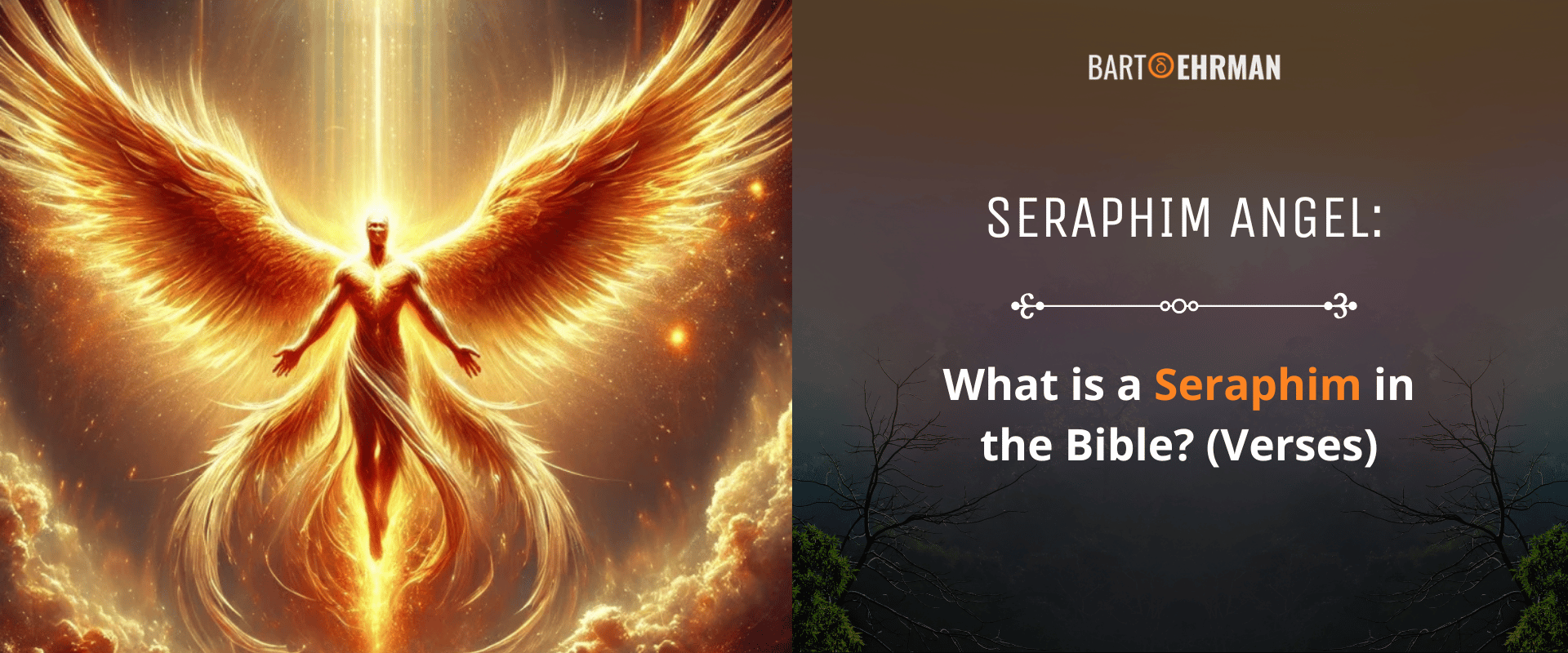
What Is a Seraphim Angel? A Look at the Etymology and the Origins
When it comes to understanding the Seraphim angel, everything begins with language. The term seraphim is the plural form of the Hebrew root śārāf which means “to burn.” In its simplest sense, a seraph is a “burning one” — a term that conjures images of fire, heat, and divine intensity.
Interestingly, this same Hebrew root also appears in other biblical contexts to refer to venomous serpents, especially those whose bite produces a burning sensation (cf. Numbers 21:6). This overlapping imagery of fire and serpents is more than just poetic.
As Sarah Bartlett notes in her book A Brief History of Angels and Demons:
(Affiliate Disclaimer: We may earn commissions on products you purchase through this page at no additional cost to you. Thank you for supporting our site!)
The Hebrew word for ‘to burn’, 'seraph', was the name given to another serpent, one that had wing-like cartilage along its rippling edges, which enabled it to rise up from the sand and bite the odd passing horse, or maybe the odd passing Christian.


It’s a vivid, if somewhat whimsical, description, but it captures the lingering power of the word and the eerie ambiguity of the beings it describes.
Of course, no religious image (however arresting) emerges in a cultural vacuum. This is especially true of the biblical world, where centuries of interaction with neighboring civilizations constantly shaped beliefs.
As is the case with concepts like heaven and hell, the Seraphim angel cannot be fully understood apart from the broader context of the ancient Near East.
Religious motifs, symbols, and mythologies often traveled across cultural boundaries, becoming adapted and reimagined over time. And when it comes to the Seraphim, one of the most striking influences seems to have come not from Mesopotamia or Canaan, but Egypt.
Among the ancient cultures that influenced early Israelite thought, Egypt stands out as particularly significant, not only because of Israel’s foundational memory of enslavement there, but also due to Egypt’s powerful religious symbols that left an enduring mark.
One of the most striking images in Egyptian iconography is the uraeus serpent: a rearing, flame-spitting cobra often depicted on the crowns of pharaohs as a sign of divine authority and protective power.
This imagery resonates deeply with the biblical depiction of the Seraphim. As T. N. D. Mettinger explains:
While some scholars have hinted that the seven thunders of Baal and his lightning bolts or their iconography might provide illuminating parallels, there is now an emerging consensus that the Egyptian uraeus serpent is the original source of the seraphim motif.
In both cases, we find fiery, winged beings associated with divine presence, guardianship, and overwhelming majesty.
This Egyptian background helps explain why the Seraphim angel, as depicted in biblical texts, is so closely associated with fire, holiness, and divine proximity. It also suggests that Israelite theology wasn’t constructed in isolation but drew upon (and at times transformed) powerful religious imagery from its cultural neighbors.
Understanding these cultural origins sets the stage for the question that matters most to biblical readers: where exactly do these fiery beings show up in the Bible, and what role do they play? Let’s take a closer look!
Where Do Seraphim Appear in the Bible? Function and Meaning
There are different types of angels in the Bible, and although their representations in popular culture are often more Renaissance than Revelation (feathered wings, glowing halos, and soft choral music) they remain a powerful part of the religious imagination.
Jewish, Christian, and Islamic traditions all feature complex hierarchies of heavenly beings, some tasked with delivering divine messages, others with carrying out judgment or praise. Among the most enigmatic of these are the Seraphim angels, beings who appear only fleetingly in the biblical text, but whose presence is charged with awe and transcendence.
The one clear and central appearance of Seraphim angels occurs in the Book of Isaiah, chapter 6. The text has fascinated scholars, mystics, and theologians for centuries. The scene unfolds in the year of King Uzziah’s death, when the prophet Isaiah experiences a dramatic vision of the heavenly realm:
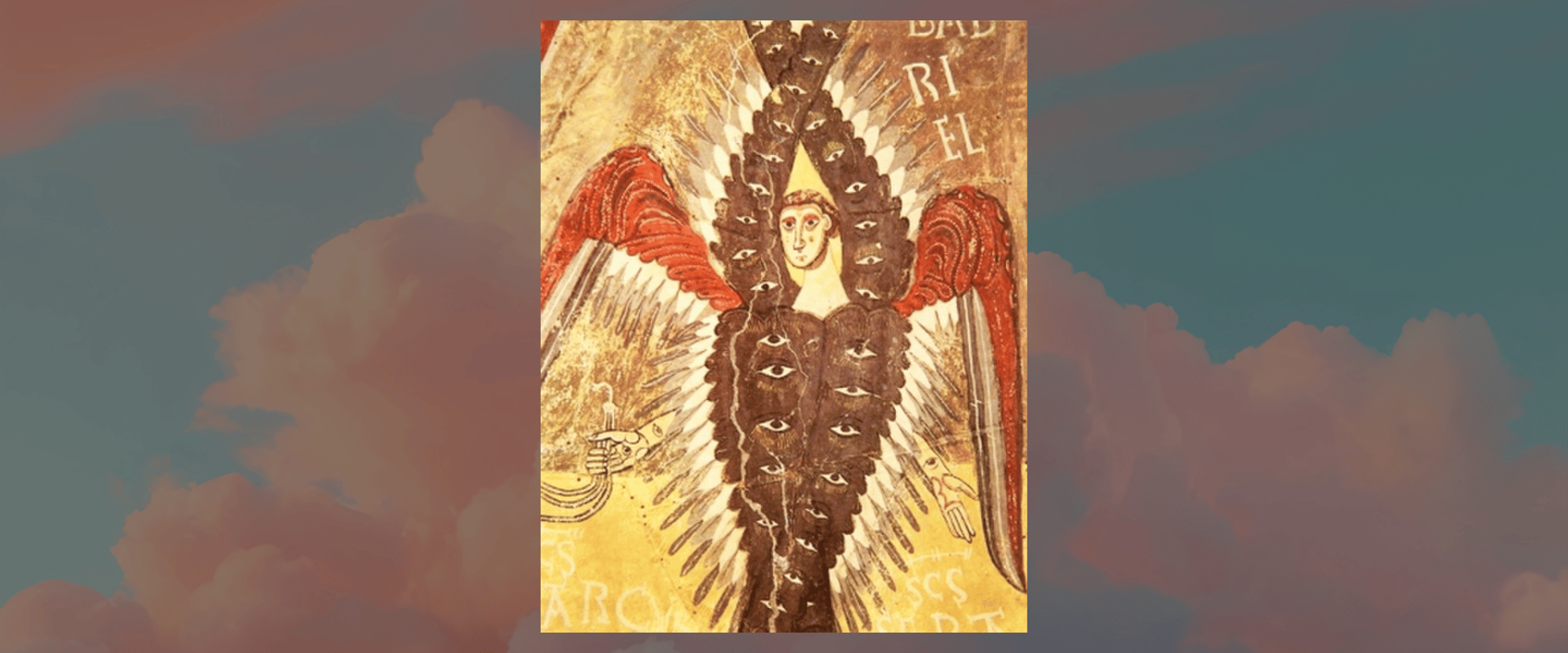
In the year that King Uzziah died, I saw the Lord sitting on a throne, high and lofty; and the hem of his robe filled the temple. Seraphs were in attendance above him; each had six wings: with two they covered their faces, and with two they covered their feet, and with two they flew. And one called to another and said: ‘Holy, holy, holy is the Lord of hosts; the whole earth is full of his glory’.
The historical context of this vision is critical. King Uzziah’s reign, though long and prosperous, ended in crisis and uncertainty. He had been struck with leprosy and isolated from public life (2 Chronicles 26:21).
In the vacuum of royal stability, Isaiah’s vision places the prophet not in the court of Judah, but in the very throne room of God. The vision functions as a moment of commissioning, but also as a theological statement: while earthly kings may fall, the divine King remains exalted and enthroned.
Furthermore, the description is loaded with imagery. A Seraphim angel has six wings, but it doesn’t use them all for flight. With two wings, it covers its face (unable or unworthy to gaze directly upon the divine presence) and with two more, it covers its feet, a gesture often associated with reverence or concealment of vulnerability.
As A. S. Herbert observes in his Commentary on Isaiah:
The total effect is to convey the sense of awe in the presence of the majesty of God, before whom even such 'unearthly' beings veil themselves. This is further expressed in the continuous antiphonal cry of adoration.
That cry (“Holy, holy, holy is the Lord of hosts”) has echoed for millennia in liturgies and hymns. But in Isaiah’s text, it’s more than praise: it’s the sound of divine holiness shaking the very foundations of the temple.
This trembling is not incidental. Joseph Blenkinsopp, in his Commentary explains:
The tectonic phenomena induced by the seraphic acclamation belong to the standard description of theophanies (cf. the Sinai theophany, Exod 19:18) and perhaps provide some idea of how the earthquake during Uzziah’s reign would have been understood.
In other words, Isaiah’s vision blends the historical and the symbolic: the trauma of a recent earthquake becomes the sensory template for a divine encounter. And in that moment, Isaiah is overwhelmed, not by curiosity or elation, but by dread.
“Woe is me! I am lost, for I am a man of unclean lips,” he cries (Isaiah 6:5). He recognizes that his impurity, especially in speech, renders him unfit to join the praise of the Seraphim. Blenkinsopp continues, “Isaiah’s reaction is also understandable in the present context… as he laments that his unclean lips make it impossible for him to participate in the seraphic liturgy.”
Yet the Seraphim aren’t merely otherworldly spectators. One of them takes a burning coal from the altar and touches Isaiah’s mouth, declaring his guilt removed and sin blotted out. The fiery coal (fitting for a being whose very name means “burning one”) serves a liturgical and transformative function.
It’s a moment of purification, enabling Isaiah to speak on God’s behalf. The Seraphim, then, are more than decorative symbols of majesty. They act as mediators of holiness, guarding the space between the human and the divine.
Before turning to the conclusion, we should address a handful of the most frequently asked questions about Seraphim angels in the Bible, questions that continue to intrigue readers, both ancient and modern.
FAQ: Questions About Seraphim Angels
We aren’t at the finishing line yet. Before our conclusion, let’s take a brief look at a couple of questions people often ask about both angels in general and Seraphim angels in particular.
What Is the Difference Between an Angel and a Seraphim?
In the Bible, the term “angel” (from the Hebrew mal’akh, meaning messenger) refers broadly to a being who serves as a divine intermediary, delivering messages, executing judgment, or offering guidance.
St. Augustine famously wrote:
Angels are spirits, but it is not because they are spirits that they are angels. They become angels when they are sent. For the name angel refers to their office, not their nature. You ask the name of this nature, it is spirit; you ask its office, it is that of an angel, which is a messenger.
Seraphim, on the other hand, are a specific category of heavenly beings mentioned only once in the Hebrew Bible (Isaiah 6), and they aren’t depicted there explicitly as messengers but as attendants to God’s throne who proclaim divine holiness.
While later Jewish and Christian traditions placed the Seraphim within hierarchical systems of angels this development reflects post-biblical theological interpretation, adaptation, and conceptual expansion.
Specifically, the Seraphim angel known from Isaiah 6 became an important part of liturgy. As Ellen Muehlberger, in her book “Angels in Late Ancient Christianity,” notes:
Practitioners in the religious traditions that claimed Isaiah as their own saw these words as a way to join with the angels in the worship of the Lord: a prayer beginning with “Holy, Holy, Holy” became a regular part of the liturgy in both ancient Jewish and ancient Christian groups.
So, we should think of “angel” as a broad category within the divine realm of Judeo-Christian world and Seraphim as a particular type of angel!
Are Seraphim Good or Bad?
In the biblical tradition, Seraphim are firmly associated with the divine realm and portrayed as beings who serve in the immediate presence of God. Their role in Isaiah 6 is one of worship and purification, not opposition or rebellion.
While their fiery appearance and overwhelming presence might evoke fear or awe, there is no indication in the biblical text that Seraphim are malevolent or adversarial.
Cyril of Jerusalem famously employed the image of the Seraphim angel as a teaching device. He encouraged young Christian initiates to use the power of visualization, urging them to imagine these heavenly beings present among them as they participated in sacred rituals.
In his famous work “Mystagogical Catechesis,” Cyril wrote:
Let us bring to mind heaven and earth and sea, sun and moon, stars, every rational and irrational creature, seen and unseen, angels, archangels, powers, dominions, principalities, authorities, thrones, the many-faced cherubim, saying forcefully the words of David, ‘Extol the Lord with me.’ Let us bring to mind also the seraphim, who Isaiah contemplated in the Holy Spirit standing encircling the throne of God, with two wings covering their faces, two their feet, and two for flying, saying ‘Holy, holy, holy Lord Sabaoth.’ It is for this reason that we say this doxology, transmitted to us by the seraphim, and through this hymning we become fellows in the army above the world.
Are Seraphim Stronger Than Archangels?
The Bible doesn’t offer a ranked list comparing the strength or status of different heavenly beings, so any such hierarchy is the result of later theological interpretation rather than scriptural data.
In the biblical text, archangels (a term used explicitly only in 1 Thessalonians 4:16 and Jude 1:9) function as high-ranking messengers or leaders among angels. The Seraphim angel, as already noted, is depicted in Isaiah 6 as a being stationed in close proximity to God that engages in perpetual worship and acts of purification.
Who Are the “Four Seraphim Angels”?
The Bible doesn’t refer to “four seraphim angels.” This phrase likely reflects a blending of different biblical and post-biblical traditions.
In the Book of Revelation (chapters 4 and 6), four living creatures are described as surrounding God’s throne, each with multiple wings and distinct faces, attributes that resemble, but aren’t identical to, the Seraphim in Isaiah 6.
It seems some later interpreters have conflated these visionary beings with the Seraphim, especially due to their shared setting in the divine throne room and their roles in heavenly worship.
How Are Seraphim Different From Cherubim?
Though both Seraphim and Cherubim are portrayed as heavenly beings associated with God’s presence, the Bible presents them as distinct in both form and function.
Unlike Seraphim, Cherubim angels appear in multiple texts, most notably guarding the entrance to Eden (Genesis 3:24) and as part of the divine chariot in Ezekiel’s visions (Ezekiel 1 and 10).
They are often depicted with composite features (e.g., human, animal, and bird-like elements) and serve as guardians of sacred space.
Conclusion
Even after all of this, I must admit I’m not sure Dan Brown will stop being my first association when I hear the word “angels.” Pop culture has a way of imprinting itself on the imagination.
But the Seraphim angel, as we've seen, has roots that go far deeper than modern thrillers, reaching into the ancient world of Hebrew prophecy, Egyptian symbolism, and rich biblical imagery that continues to provoke awe and curiosity.
Mysterious, fiery, and exalted, the Seraphim appear only briefly in the pages of Scripture, but their impact is lasting. Whether as divine attendants, symbols of purification, or echoes of ancient Near Eastern tradition, they invite us to rethink what we imagine when we talk about “angels.”
And if nothing else, they remind us that the biblical world is often far stranger, and far more interesting than we expect!
join bart ehrman's new conference!
New Insights into the Hebrew Bible
March 20-22 | 13 Bible Scholars | Early-Bird Pricing
Inaugural conference will focus on the book of Genesis