
Pontius Pilate vs Herod Antipas: Different Roles in Jesus’ Death

Written by Joshua Schachterle, Ph.D
Author | Professor | Scholar
Author | Professor | BE Contributor
Verified! See our editorial guidelines
Verified! See our guidelines
Date written: November 13th, 2025
Disclaimer: The views and opinions expressed in this article belong to the author and do not necessarily match my own. - Dr. Bart D. Ehrman
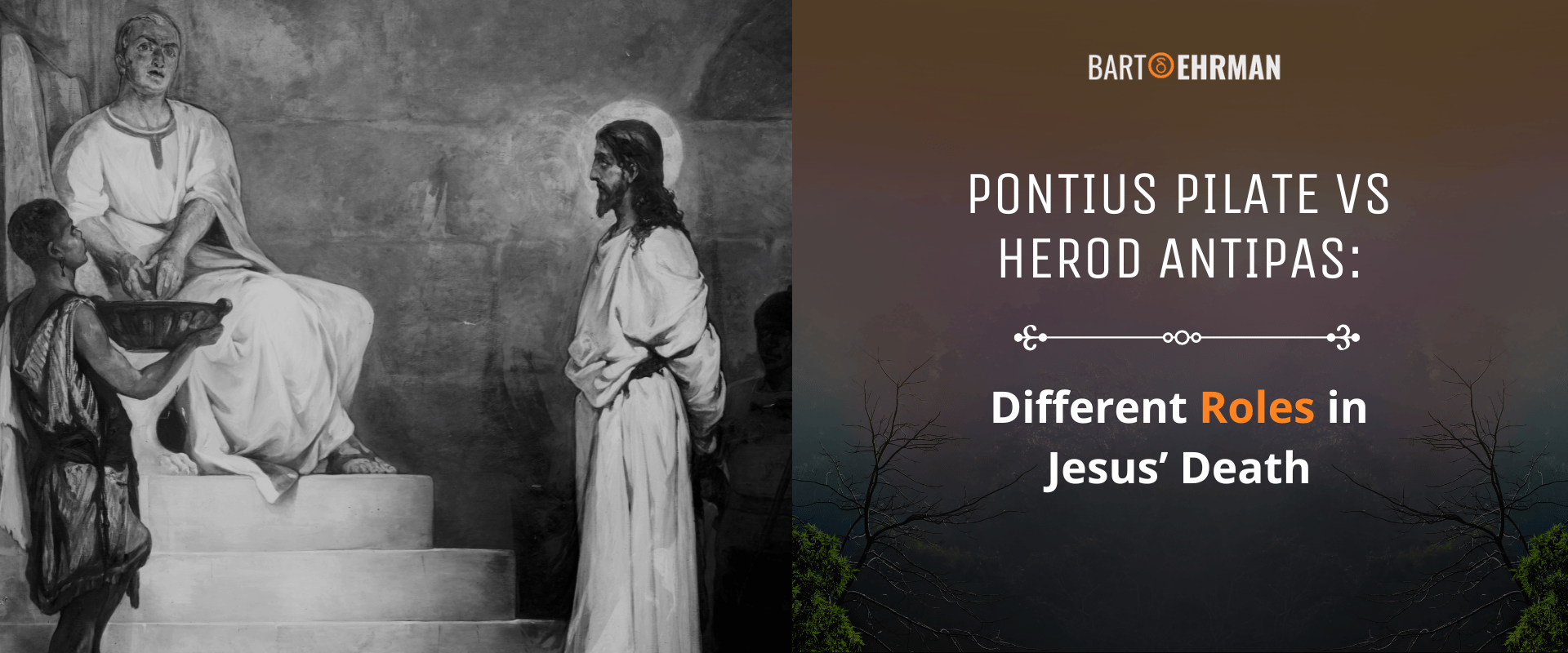
When it comes to the trial and crucifixion of Jesus, two names often stand out—Pontius Pilate and Herod. Both were rulers under Roman authority and both make appearances in the Gospel accounts of Jesus’ final hours. Yet the roles they play are very different.
In this article, we’ll examine those roles as told in the Gospels. By looking at who these historical figures really were—Pontius Pilate vs. Herod, if you will—we’ll understand not only what happened to Jesus but also how early Christians were trying to make sense of their world—a world caught between Jewish tradition and Roman power.
By the way, if you’re interested in learning more about the historical Jesus, check out the courses in Bart Ehrman’s The Historical Jesus Mastery Pack.
All These Herods!
Let’s start by talking about the historical Herod, or rather Herods. It turns out that the Bible mentions no less than six kings named Herod. Before we look into which one (or ones) were contemporaries of Jesus, here’s a list of them, along with the Jewish territories over which they reigned:
Herod the Great - 37-4 BCE, reigned over Judea.
Herod Antipas - 4 BCE-39 CE, reigned over Galilee and Perea.
Herod Philip - 4 BCE-34 CE, reigned over Iturea, Trachonitis, Gaulanitis, Trachonitis, Paneas, Batanea, and Auranitis.
Herod Archelaus - 4 BCE-6 CE, reigned over Idumaea, Judea and Samaria.
Herod Agrippa I - 37-44 CE, reigned over Judea and Samaria.
Herod Agrippa II – c. 50s CE-93 CE, reigned over Chalcis, Batanaea, Trachonitis, Abilene, Ituraea, Gaulanitis, and Auranitis.
Although these rulers all came from the same family, they all ruled territories in Judea as client kings of the Roman Empire.
The first Herod from the Bible is known to history as Herod the Great. This isn’t because he was a great guy, but because he accomplished a lot, specifically in the realm of building. For example, it was he who expanded the Second Temple complex in Jerusalem that would be destroyed by Roman forces in 70 CE. The Temple was massive and impressive, covering 450 acres and visible for miles around.
Oddly enough, though, Herod was not even technically Jewish. He was born to a father who was an Edomite (from the region of Edom, now part of southern Jordan and southern Israel) and an Arabian mother from the Jordanian city of Petra. However, Herod’s father’s ancestors had been forcibly converted to Judaism in the distant past. For this reason, Herod was raised as a (very privileged) Jew.
We know something about Herod’s life before he became king from the book Antiquities of the Jews (14.8.5) written by 1st-century Jewish historian Josephus. Because Rome already controlled Palestine and his father had good relations with Julius Caesar, in 47 CE, a young Herod was made governor of Galilee, the region from which Jesus and his disciples came. By 37 CE, just 10 years later, Herod had been appointed King of Judea by Rome. In other words, he ruled the Jewish people, but only on behalf of Rome. His reign ended with his death in 4 BCE.
(Affiliate Disclaimer: We may earn commissions on products you purchase through this page at no additional cost to you. Thank you for supporting our site!)
Now, according to Jesus Remembered: Christianity in the Making by James D.G. Dunn, the vast majority of scholars believe that Jesus was born between 6 and 4 BCE. This means that, while Herod the Great was probably king of Judea around the time of Jesus’ birth, Herod never witnessed most of the life and death of Jesus. However, Herod the Great is the Herod referred to in the story known as the Massacre of the Innocents, as told only in Matthew 2:16-18. It’s a great story, but one that the author likely invented because it’s told nowhere else.
Herod had four sons, three of whom are mentioned in the Bible: Archelaus (Matt 2:22), Herod Antipas (Matt 14:1-12, Mark 6:14-28), and Philip (Luke 3:1, Matt 14:3). There was a fourth son, Aristobulus, whom Herod had assassinated because he believed Aristobulus’ popularity made him a threat to his own reign.
After Herod the Great’s death, Josephus says that his last will and testament divided his territories up among his remaining three sons (Antiquities, 7.12.317-319). This is why his sons’ reigns overlapped in time—they each ruled parts of Judea simultaneously. Herod Antipas, the next significant Herod mentioned in the Gospels, became ruler of the regions of Galilee and Peraea.
For this reason, outside of the references to Herod the Great in Matthew’s birth story of Jesus, all the important stories about Herod in the Gospels refer to Herod Antipas. This includes the beheading of John the Baptist and Antipas’ brief involvement in Jesus’ trial. But before we get to that, let’s proceed with the Pontius Pilate vs. Herod Antipas discussion by examining the life of the other ruler involved in Jesus’ execution.
Who Was Pontius Pilate?
As I noted in my previous article on Pilate, we have almost no information on Pilate’s early life. In a 2009 article, classical scholar J.G.F. Powell writes that wealthy Roman men were normally given three names: the praenomen, or first name, the nomen, the last name in our time, and the cognomen, used only by wealthy Romans to refer to each other.
So while his praenomen isn’t given in the Gospels or anywhere else, his nomen was Pontius and his cognomen was Pilate (Latin: Pilatus). While scholars have speculated on the possible significance of those names, all we can know for sure is that he came from a fairly wealthy family.
In fact, in Pontius Pilate in History and Interpretation, Helen Bond writes that, while Pilate was certainly not from the top level of Roman society, he would certainly never been allowed to become the governor of a Roman territory had he not been wealthy and, therefore, educated.
According to Josephus, Pilate was governor of Judea for 10 years, while Bond estimates that this probably occurred between the years 26 and 36 CE, which certainly included the years when Jesus was crucified (30-33 CE).
Josephus also notes that Pilate was infamous in Judea for being an absolutely brutal, merciless governor who had no respect for the people he governed and was willing to slaughter them at the slightest hint of rebellion. In his book On the Embassy to Gaius, 1st-century Jewish philosopher Philo of Alexandria wrote that Pilate was renowned for his
corruption, and his acts of insolence, and his rapine, and his habit of insulting people, and his cruelty, and his continual murders of people untried and uncondemned, and his never-ending, and gratuitous, and most grievous inhumanity.


Clearly, Pilate was not a nice guy. However, the Gospels, which admittedly were written decades after Jesus’ crucifixion, seem to portray Pilate as a far more likeable character than other sources. Let’s look at those portrayals, along with those of Herod Antipas.
join bart ehrman's new conference!
New Insights into the Hebrew Bible
March 20-22 | 13 Bible Scholars | Early-Bird Pricing
Inaugural conference will focus on the book of Genesis
What Did Pontius Pilate Do to Jesus?
Pilate is mentioned in all four Gospels, as well as many other sources, many of which acknowledge that Jesus was crucified under his governorship. Second-century Roman historian Tacitus, for example, writes that Jesus was executed “in the reign of Tiberius by the procurator Pontius Pilate.” Since Herod Antipas is mentioned much less in relation to the crucifixion, let’s start with Pilate.
In Mark, our earliest Gospel, the Jewish priests bring Jesus to Pilate for questioning. Pilate asks Jesus if he is king of the Jews. This implies that the charge brought against Jesus was a form of sedition against Rome. Jesus merely says “You say so” (15:2). Other than this, Jesus is silent during this episode in Mark.
But then Pilate offers to release one Jewish prisoner since it is the time of Passover. Although Mark says this was a common tradition at the time, scholars have long noted that there is no evidence for this at all. Given the brutal reputation of Pilate, scholars including Bart Ehrman find the idea of such a merciful act unlikely at best. Nevertheless, in Mark 15:14, after the crowd has shouted that Jesus should be executed, a mild, compassionate Pilate asks the crowd
“Why, what evil has he done?” But they shouted all the more, “Crucify him!” So Pilate, wishing to satisfy the crowd, released Barabbas for them, and after flogging Jesus he handed him over to be crucified.
This is consistent with Pilate’s depictions in the other three Gospels as well (Matt 27:11-26, Luke 23:1-25, John 18:28-40). Pilate seems to want to release Jesus but, because of the angry crowd, feels obligated to execute him instead. Having seen in sources such as Philo of Alexandria how heartless he could be, often beating and killing anyone who got in his way, this kinder, gentler Pilate seems, at best, implausible. So why did the Gospel writers show him in such a sympathetic light?
There are two possible answers to this question. First, when the Gospels were written near the end of the 1st century, Christianity was, at least some of the time, illegal. By refusing to participate in Roman religious rites, which were supposed to garner favor with the gods, Christians were often seen as actively working against the well-being of the empire. The Gospel writers may, therefore, have figured that it was a good idea to make the Roman procurator look almost innocent of Jesus’ death, thus not antagonizing any Roman higher-ups.
The second answer might be found in the portrayal, especially of Matthew, of “the Jews.”
Then the people as a whole answered, “His blood be on us and on our children!” So he released Barabbas for them, and after flogging Jesus he handed him over to be crucified.
This passage has been used for millennia to justify Christian antisemitism. However, since we know that the author of Matthew was almost certainly a Jew himself, as was Jesus and all of his original disciples, it is not reasonable to believe that Matthew’s author intended to put the blame of Jesus’ death on all Jews.
Instead, the author of Matthew, whose group of Christian Jews had probably been kicked out of the synagogue for adhering to a faith most Jews wouldn’t accept, was angry at the Jewish religious leaders. By making Pilate look less guilty, most of the guilt for Jesus’ execution fell on the Jewish priesthood.
But what about Herod Antipas? So far we haven’t seen him in the story of the crucifixion at all. In looking into the roles of Pontius Pilate vs. Herod, where does Herod come in?
What Did Herod Antipas Do to Jesus?
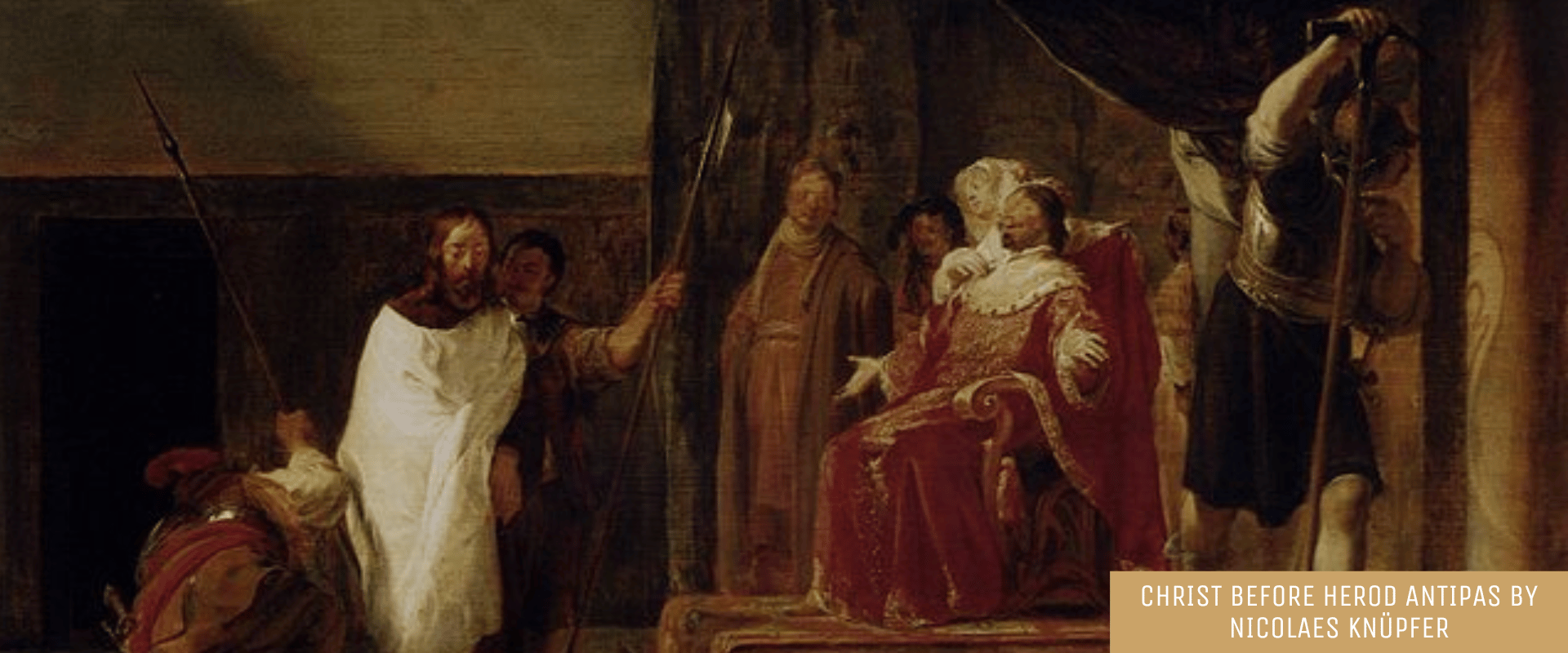
Part of the reason it’s easy to miss Herod Antipas’ part in the crucifixion is that it’s only found in one of the four Gospels, specifically in Luke 23:6-12. In Luke’s version, Pilate once again notes that Jesus has done nothing wrong. This time, however, he wants to pass the buck, giving authority for the trial and sentencing of Jesus to someone else.
For this reason, Pilate asks if Jesus is from Galilee. When he is told that he is, he orders that Jesus be sent to him to be sentenced because Herod Antipas is the ruler over that region. But before going any further, what kind of ruler was Herod Antipas?
First of all, the Gospels of Matthew and Mark acknowledge that it was Herod Antipas who arrested and executed John the Baptist. The Gospels say that the reason was that John called Herod out publicly for marrying his brother’s wife. However, Josephus writes that Herod killed John because he was a very popular preacher and had a large following. Herod felt that this might turn to some kind of mass rebellion against him and so killed him preemptively. Either way, no one thought of Herod Antipas as a nice guy. He could be just as brutal as Pilate.
To continue with the story from Luke 23, when Jesus arrives at Herod’s court, Herod is delighted to see him and asks him to perform miracles because he has only heard about Jesus’ miracles from others. Jesus not only refuses to oblige but even refuses to speak, while the chief priests, who have once again come along, continue loudly accusing Jesus. Apparently bored with this, we are told that
Even Herod with his soldiers treated [Jesus] with contempt and mocked him; then he put an elegant robe on him and sent him back to Pilate. That same day Herod and Pilate became friends with each other; before this they had been enemies.
That’s all there is to Herod’s part in the trial and execution of Jesus. In fact, because Luke is the only Gospel containing this story and since there is no evidence that Pilate or any Roman ruler ever deferred to a regional king for the sentencing of criminals, most scholars believe this part of the story never happened.
In The Unauthorized Version: Truth and Fiction in the Bible, Robin Lane Fox argues that the story of Herod’s involvement may have its origins in the words of Psalm 2, in which "the kings of the earth" are described as challenging the anointed one of God. Fox believes these words were included in Luke’s story to show that multiple sources of authority failed to find any valid reason to condemn Jesus.
Conclusion: Pontius Pilate vs. Herod
There are quite a few rulers named Herod in the Bible, all belonging to the same dynastic family. However, only two of these are said to have been involved in any way with Jesus. Herod the Great, the patriarch of the family, was an impressive builder, but a cruel king. His death and Jesus’ birth roughly coincided. Although most scholars doubt the historicity of the Massacre of the Innocents in Matthew, there is no doubt that the author of that story was referring to Herod the Great.
His son, Herod Antipas, was the ruler who ruled over Galilee, Jesus’ home turf, after his father’s death. Herod was an impressively violent ruler himself. He executed John the Baptist, for example, either for publicly denouncing his lack of morality or simply to prevent any possible mass rebellion.
However, in the Gospel stories of Jesus’ trial and crucifixion, it is Pontius Pilate, the Roman governor of Judea, who played the starring role as the ruling authority. Historical references to Pilate paint him as cruel and entirely indifferent to the traditions and people over whom he presided.
Nevertheless, all four Gospels portray him as sympathetic to Jesus, almost begging the crowd to let Jesus go and insisting that Jesus was innocent. While this was likely done by the authors to make Christianity more palatable to Romans, it is historically unlikely.
Herod Antipas, on the other hand, has a tiny, walk-on role in the story of Jesus’ trial, but only in the Gospel of Luke. In this version, Pilate doesn’t want to condemn Jesus himself and so sends him to Herod, because Jesus was from his territory. Herod, however, simply mocks Jesus and sends him back. If Herod was really involved at all, it seems odd that the other Gospels would not have mentioned it. Most scholars believe that the story merely had narrative value, reinforcing that no ruling authority could find a legitimate reason to crucify Jesus.
join bart ehrman's new conference!
New Insights into the Hebrew Bible
March 20-22 | 13 Bible Scholars | Early-Bird Pricing
Inaugural conference will focus on the book of Genesis