
Messianic Judaism: How It Differs from Judaism and Christianity

Written by Marko Marina, Ph.D.
Author | Historian
Author | Historian | BE Contributor
Verified! See our guidelines
Verified! See our editorial guidelines
Date written: March 15th, 2026
Disclaimer: The views and opinions expressed in this article belong to the author and do not necessarily match my own. - Dr. Bart D. Ehrman
Every time I hear the phrase Messianic Judaism, I am reminded of something historians of religion learn very early on: no religion is ever just “one thing.”
From the outside, it is tempting to speak of “Judaism” or “Christianity” as if each were internally uniform, stable systems with clearly defined boundaries and universally shared beliefs. But anyone who has spent time studying religious history knows that inherited diversity isn’t the exception; it is the norm.
Traditions develop, fragment, adapt, and reinterpret themselves across time and place. What looks simple from a distance often turns out, on closer inspection, to be far more complex.
The term “Messianic Judaism” immediately raises questions precisely because it unsettles familiar categories.
Is it a form of Judaism? A variety of Christianity? A bridge between the two? Or something else altogether?
The very label suggests continuity with Jewish identity while the “messianic” meaning affirms belief in Jesus as Messiah. It’s a combination that has generated both theological controversy and sociological debate.
For scholars, this isn’t merely a matter of doctrinal disagreement but of classification. Namely, how do we define religious communities, and who gets to decide where one tradition ends and another begins?
In what follows, I will approach Messianic Judaism from a historical and analytical perspective.
We’ll first clarify what the movement is and how its core beliefs compare with those of Rabbinic Judaism and mainstream Christianity.
We’ll then examine its modern historical development, briefly consider ancient Jewish-Christian groups, such as the Ebionites, for context, and conclude with a note on terminology because, in discussions like this, words matter.
If questions about Jewish identity, Scripture, and historical origins interest you, you might also enjoy Dr. Bart D. Ehrman’s 8-lecture online course, Finding Moses: What Scholars Know About the Exodus and the Jewish Law. In this course, Ehrman explores what critical scholarship can (and cannot) say about the Exodus tradition and the formation of the Mosaic Law. It’s a clear, accessible guide to the historical foundations that continue to shape Jewish and Christian thought today.
Messianic Judaism: Beliefs and Practice
“The number of messianic congregations in the U.S. approaches 300,” writes Peter Hocken, adding that “there are over 50 in Israel, together with remarkable growth in several states of the former Soviet Union. The latter is partly a fruit of the Hear O’ Israel festivals led by Jonathan Bernis, who has emerged as a major messianic Jewish evangelist.”
Observations like this raise important questions, not only about the appeal of Messianic Judaism itself, but about the broader vitality of charismatic and identity-driven religious movements in the modern world.
Growth statistics, however, tell us little unless we understand what the movement actually affirms. What, then, is Messianic Judaism? What are its core beliefs, and how should scholars classify it? Are they simply Jews who believe in Jesus?
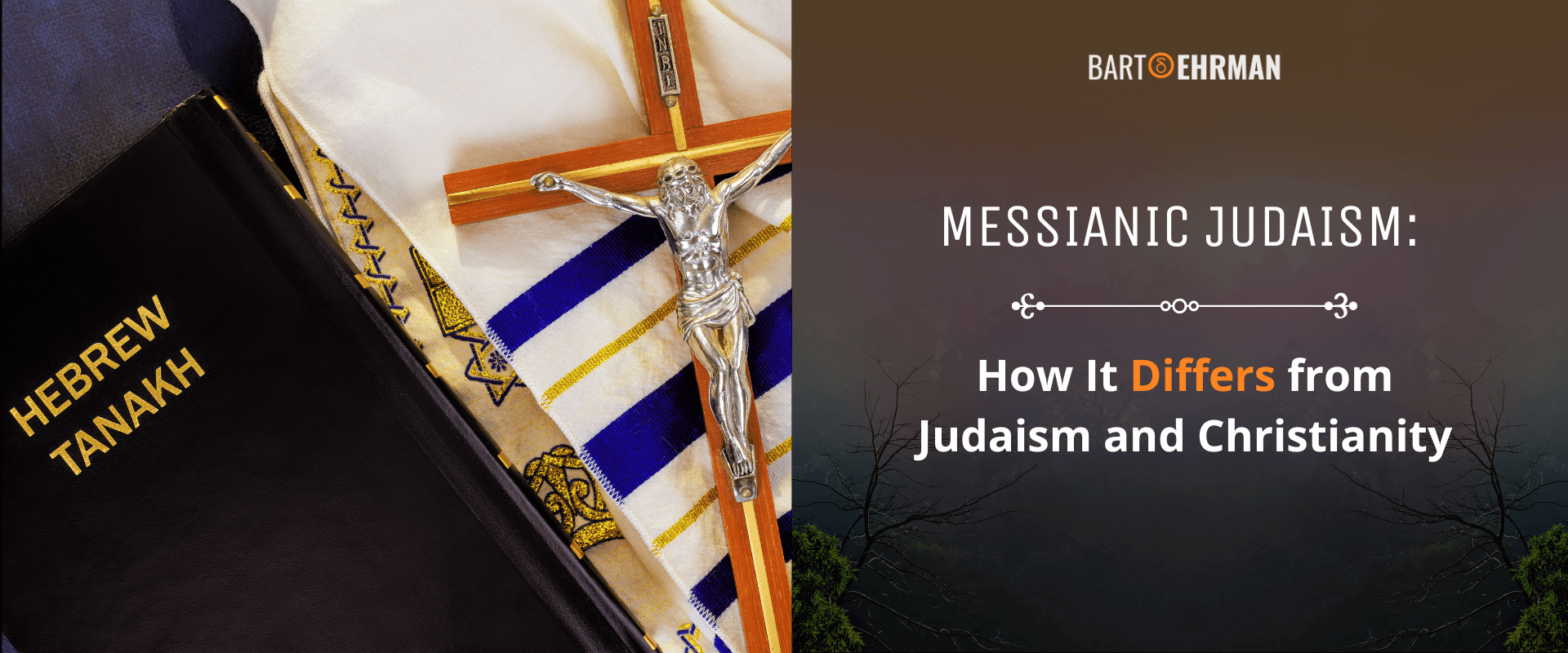
At its most basic level, Messianic Judaism is a modern religious movement composed of individuals (some ethnically Jewish, others not) who affirm that Jesus (often referred to by the Hebrew name Yeshua) is the Jewish Messiah.
Members typically accept the authority of both the Hebrew Bible and the New Testament and interpret the former through a Christological lens.
Many congregations affirm theological doctrines common within evangelical Protestantism, including belief in the Trinity, the virgin birth, the bodily resurrection of Jesus, his future second coming, and the infallibility of Scripture.
Furthermore, salvation is understood to come through faith in Yeshua as Lord and Messiah. In this respect, the theological framework of many Messianic congregations closely resembles conservative evangelical Christianity.
At the same time, Messianic Judaism places significant emphasis on Jewish identity and continuity.
Adherents often maintain that belief in Jesus doesn’t require abandoning Jewish ethnic or covenantal distinctiveness.
As Esther Foreman notes, the movement sees itself as an indigenous expression within the broader “Body of Messiah,” one that remains in solidarity with gentile Christians while preserving Jewish symbolism, festivals, and elements of Torah observance.
In practice, this may include celebrating Shabbat, observing Passover and other biblical festivals, incorporating Hebrew liturgy, and using traditional ritual objects, such as the tallit or tefillin.
Dan Cohn-Sherbok, in his book Messianic Judaism: A Critical Anthology, explains:
(Affiliate Disclaimer: We may earn commissions on products you purchase through this page at no additional cost to you. Thank you for supporting our site!)
For [many] Messianic Jews, Shabbat is of paramount importance. Following Yeshua’s teaching in Mark 2:27: The Sabbath was made for man and not man for the Sabbath’, Messianic Jews believe that the Sabbath is not meant to be understood as a day of legalistic conformity. Rather, it should be a day of rest, worship and renewal. This should be so for all peoples, but for Israel, the seventh day has particular significance: it is a sign of the covenant between God and his chosen people.


Yet the extent of Jewish practice varies widely from congregation to congregation. Some communities are strongly shaped by charismatic worship styles and evangelical preaching; others adopt forms more closely modeled on synagogue structures. The movement itself is therefore far from homogeneous.
This combination (evangelical Christology alongside Jewish ritual and identity) creates the distinctive (and very interesting!) profile of Messianic Judaism and explains why its classification remains debated.
Scholarly Insights
What is Messianic Christianity?
What is Messianic Christianity? The expression Messianic Christianity isn’t a standard scholarly category in the study of religion. It’s sometimes used informally to describe Christian groups (typically evangelical or charismatic) that emphasize the Jewish background of Jesus, celebrate certain Jewish festivals, or incorporate Hebrew terminology into worship.
Unlike Messianic Judaism, however, these communities do not claim a distinct Jewish communal identity nor present themselves as a continuation of Jewish covenantal life. In academic scholarship, such groups are generally classified within broader forms of evangelical or restorationist Christianity rather than as a separate religious movement.
The distinction matters! To put it more bluntly, Messianic Judaism frames itself as a Jewish movement affirming Jesus as Messiah, whereas what is occasionally called “Messianic Christianity” remains structurally and institutionally Christian.
In the next section, we’ll examine more closely how Messianic Judaism differs from Rabbinic Judaism on the one hand, and from mainstream Christianity on the other.
Messianic Judaism in Comparison to Rabbinic Judaism and Christianity
You know what? Instead of offering a long, densely analytical comparison that risks becoming tedious, let’s take a clearer route.
Below is a simple (but carefully constructed) table highlighting key differences between Messianic Judaism, Rabbinic Judaism, and mainstream Christianity.
It’s not exhaustive, and each of these traditions contains internal diversity. Still, it should provide a reliable framework for understanding how they diverge along major theological and practical lines. (And yes, future articles could certainly explore different streams within Judaism and Christianity in more depth.)
Category | Messianic Judaism | Rabbinic Judaism | Mainstream Christianity |
|---|---|---|---|
Jesus (Yeshua) | Affirmed as the Jewish Messiah; often understood as divine and part of the Trinity. | Not accepted as Messiah; regarded as a historical Jewish figure at most | Affirmed as Messiah, Son of God, and divine (Trinitarian theology in most major branches) |
View of God | Typically Trinitarian, though expressed in Jewish terminology | Strict monotheism | Trinitarian in Catholic, Orthodox, and most Protestant traditions |
Scripture | Hebrew Bible (Tanakh) and New Testament | Hebrew Bible (Tanakh) | Old Testament and New Testament |
Torah Observance | Varies; some observe dietary laws, Sabbath, and festivals; others less so | Halakhic observance (adherence to Jewish religious law) central; commandments interpreted through rabbinic law | Generally not bound by Mosaic Law |
Religious Identity | Emphasizes Jewish identity and affirming faith in Jesus | Jewish identity defined by halakhic criteria | Identity based on faith in Christ; not ethnically defined |
Worship Style | Often blends synagogue elements (Hebrew prayers, Jewish symbols) with charismatic worship | Synagogue-based liturgy; Hebrew prayers; rabbinic structure | Church-based liturgy; varies from highly liturgical to charismatic |
View from (other) Jewish communities | Generally regarded as outside Judaism due to belief in Jesus’ divinity | Self-understood as normative Judaism | Viewed as a historical Jewish sect that went beyond the norm and became a different religion |
A few clarifications are essential. First, neither “Rabbinic Judaism” nor “Christianity” is internally uniform. Instead, both encompass multiple denominations and theological nuances. Second, Messianic Judaism itself is diverse, especially regarding Torah observance and worship style.
Third, the most decisive theological dividing line concerns the identity and status of Jesus. Belief in his messiahship (and particularly in his divinity) remains the central boundary marker separating Messianic Judaism from Rabbinic Judaism.
With these distinctions in view, we can now turn to the historical development of Messianic Judaism and explore how this modern movement emerged and took institutional shape.
NOW AVAILABLE!
Finding Moses: What Scholars Know About The Exodus & The Jewish Law
Riveting and controversial, the "FINDING MOSES" lecture series takes you on a deep dive into the stories of Moses, the exodus, and a whole lot more...
Messianic Judaism: A Brief History of the Movement(s)
The origins of any religious community are rarely reducible to a single founding moment. Rather, they emerge through gradual development within specific historical, cultural, and theological environments.
Messianic Judaism is no exception. Although the movement often presents itself as a continuation of the earliest Jewish followers of Jesus, its modern institutional form took shape through a much later and more complex process.
To understand that development, we must begin in the missionary movements of 19th-century Protestant Christianity.
In the early 1800s, organizations such as the London Society for Promoting Christianity Amongst the Jews actively sought the conversion of Jewish communities.
Out of this missionary context arose what became known as the Hebrew Christian movement, a community of Jews who accepted Jesus as Messiah while remaining conscious of their Jewish heritage.
Associations such as the Hebrew-Christian Alliance were formed to foster fellowship among these converts.
Yet their theological framework was unmistakably evangelical: justification by faith alone, Trinitarian doctrine, the authority of the New Testament, and a strong emphasis on evangelizing other Jews.
As Cohn-Sherbok notes, early 20th-century efforts to institutionalize Hebrew Christianity in the United States through the Hebrew Christian Alliance of America (founded in 1915) reflected both a desire for Jewish self-expression and a firm commitment to mainstream Protestant theology.
Debates over whether Jewish believers should retain ritual observances such as Sabbath and circumcision surfaced repeatedly, but resolutions generally affirmed an evangelical platform rather than a binding return to Torah observance.
At the same time, alternative models were emerging. In Eastern Europe, figures such as Joseph Rabinowitz sought to construct congregational forms that blended Jewish liturgical elements with the explicit confession of Jesus as Messiah.
His movement, “Israelites of the New Covenant,” incorporated Sabbath worship, Hebrew prayers, and even circumcision, while simultaneously affirming doctrines such as Christ’s atoning death and resurrection.
This effort illustrates a recurring tension within Jewish-Christian history: how to balance continuity with Jewish communal life against integration into the broader Gentile-dominated Church.
Throughout the late 19th and early 20th centuries, Jewish believers navigated this tension, sometimes welcomed by Protestant churches, other times criticized for attempting to maintain a distinct corporate identity.
The transition to what is now called “Messianic Judaism” occurred gradually during the mid-20th century, particularly in North America.
By the 1960s and 1970s, a generational shift led many within the Hebrew Christian movement to reject that older label in favor of “Messianic Jew,” signaling a renewed emphasis on Jewish self-identification rather than simple assimilation into Christian denominations.
Independent congregations emerged, Jewish festivals were more visibly integrated into worship, and the movement adopted a more self-consciously Jewish vocabulary while retaining evangelical theology.
In this sense, modern Messianic Judaism evolved from earlier missionary and Hebrew Christian frameworks, reshaped by changing cultural conditions, theological debates, and questions of identity in the modern religious landscape.
Ebionite Christianity: An Ancient Comparison
Although sometimes compared to modern Messianic Judaism (and despite the fact that some members of Messianic Judaism claim their movement reaches back to the earliest followers of Jesus) the Ebionites were a distinct ancient Jewish-Christian religious movement.
Any historical comparison must therefore be handled carefully. The Ebionites didn’t represent a modern evangelical reinterpretation of Jewish identity, but rather a form of Jewish Christianity that developed within the complex and fluid landscape of the early Christian world.
But who were they? What were their beliefs? Because there are certain surface-level overlaps, it’s worth briefly examining this often overlooked yet historically significant group.
In Le christianisme des origines à Constantin (Christianity. From its Origins to Constantine), Simon Claude Mimouni and Pierre Maraval offer a concise and careful description:
“Ebionite Judeo-Christianity is a religious movement documented indirectly from the second to the fifth century, and perhaps even into the seventh. It appears to have been an interstitial movement of Christians of Judean origin that emerged either in the first or the second century and disappeared at a date difficult to determine with certainty. It is attested primarily in certain regions of the Eastern Roman Empire, but also in Rome. In comparison with the Nazoreans, the Ebionites were regarded by ancient Christian heresiologists as ‘heterodox,’ essentially because they recognized only the messiahship of Jesus while rejecting the divinity of Christ; that is to say (...) they confessed solely his human nature and not also his divine nature. Moreover, like all ‘heterodox’ Judeo-Christians, they were characterized by a definite and even vehement anti-Pauline stance.” (my translation)
This description highlights the crucial differences. Unlike most contemporary Messianic Jewish congregations (which typically affirm Trinitarian theology) the Ebionites rejected the divinity of Jesus and upheld a strictly “human Christology.”
They also maintained a strong adherence to Jewish (Mosaic) law and displayed explicit hostility toward Paul, whom they viewed as distorting the authentic message of Jesus. The Ebionites were part of a remarkably diverse early Christian world in which multiple interpretations of Jesus’ identity competed for legitimacy.
Over the course of several centuries, one theological trajectory (what later became known as “orthodox” Christianity) gradually consolidated authority and marginalized alternative forms, including Ebionite Christianity.
For that reason alone, the Ebionites deserve sustained attention in their own right, and perhaps a separate article in the future!

Appendix: Crucial Terminology
Before we conclude our exploration of Messianic Judaism, it’s wise to pause briefly and clarify some of the most commonly used (and often confused) terms related to this topic.
The term “Messianic Jew” generally refers to a member of the modern Messianic Jewish movement who affirms that Jesus (Yeshua) is the Jewish Messiah while maintaining some form of Jewish identity and, in many cases, Jewish ritual practice.
It’s a self-designation that emerged prominently in the latter half of the 20th century, replacing the earlier label “Hebrew Christian” in many circles.
The expression “Christian Jews” is more ambiguous. Historically, it can refer to Jews that lived within the early Christian world of the Roman Empire and followed Jesus while remaining within the broader framework of Jewish communal life.
In other contexts, it may simply describe Jews who converted to Christianity and became part of mainstream Christian denominations. The term therefore requires careful contextualization.
Finally, the phrase “Jews who believe in Jesus” is often used descriptively, especially in Israeli settings. It functions as a sociological label rather than a formal institutional title, and it may be preferred by individuals who wish to emphasize belief in Jesus without fully adopting the organizational structures associated with Messianic Judaism.
Conclusion
“Anyone who has truly practiced a religion,” wrote the French sociologist Émile Durkheim, “knows very well that it is the set of regularly repeated actions that make up the cult that stimulates the feelings of joy, inner peace, serenity, and enthusiasm that, for the faithful, stand as experiential proof of their beliefs.”
Durkheim’s observation reminds us that religions aren’t sustained by doctrines alone. They endure through shared practices, collective rituals, and lived identities that give meaning to belief and bind communities together.
In this light, Messianic Judaism can be understood both as a theological position and a lived religious formation, one that combines evangelical faith in Jesus with forms of Jewish ritual and identity.
Its history reflects ongoing negotiations over belonging, continuity, and classification within the broader landscapes of Judaism and Christianity. Whether viewed as a distinct religious movement or as a particular stream within modern Christianity, Messianic Judaism illustrates once again that religious boundaries are rarely as fixed as they appear.
NOW AVAILABLE!
Finding Moses: What Scholars Know About The Exodus & The Jewish Law
Riveting and controversial, the "FINDING MOSES" lecture series takes you on a deep dive into the stories of Moses, the exodus, and a whole lot more...